Friday, April 24th 2026

Intel Foundry Improves Yields Across Intel 4, Intel 3, and 18A Nodes

Intel posted strong Q1 2026 earnings results, indicating improvements across multiple verticals, from Intel Products to Intel Foundry divisions. Both groups experienced operational enhancements, but Intel Foundry achieved a significant milestone: yield improvement across all major foundry nodes currently in high-volume manufacturing. This includes Intel 4, Intel 3, and 18A nodes, which power the majority of Intel's product portfolio. In the latest Q1 2026 earnings call, Intel CFO David Zinsner noted that the company continues to improve yields on its older nodes, such as Intel 4 and Intel 3, while refining the yield of the current top-performing 18A node to reduce waste and increase the number of functional chips, even in larger dies.
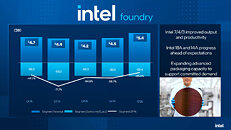
David Zinsner, Intel CFOIntel Foundry operating loss in Q1 was $2.4 billion, improved $72 million quarter-over-quarter as better yields across Intel 4, Intel 3, and 18A drove higher gross margins. This was mostly offset by increased operating expenses associated with an intentional step-up in Intel 14A investments to support both internal and external customer evaluations. As a reminder, Intel Foundry carries the bulk of the cost associated with the early ramp of Intel 18A, and we expect Intel Foundry's operating loss to improve through the year as 18A continues to ramp into volume and yields improve further. Within the quarter, Intel Foundry delivered output above our expectations, drove steady improvements in yields, and met key 14A milestones.
Intel's foundry revival is finally going according to plan, and yield improvements are just one part of this process. Intel has secured Elon Musk's Tesla as the first major customer for its 14A node, although details are still lacking. Other areas for improvement include updating the process design kits (PDKs) for the 18A and 14A nodes, which the company is actively working on. For instance, the 14A node is currently at the 0.5 PDK stage, and customers will finalize volume, design, and other requirements when the PDK 0.9 is released. Therefore, Intel still has time for refinement and is collaborating with customers, incorporating their feedback into the node's design.
Source: Intel Earnings Call
Add your own comment

18 Comments on Intel Foundry Improves Yields Across Intel 4, Intel 3, and 18A Nodes

#1
Tek-Check
Intel folks will need to explain to the public all those super expensive High-NA EUV litography purchases.

We know that TSMC will not be using High-NA EUV litography for a few extra years. They said even A13 node won't need it in 2029.
Posted on Reply
#2
AleksandarK
News Editor
Tek-CheckIntel folks will need to explain to the public all those super expensive High-NA EUV litography purchases.

We know that TSMC will not be using High-NA EUV litography for a few extra years. They said even A13 node won't need it in 2029.
That explanation comes with 14A, you will see Tesla using 14A, but I suspect even more announcements soon. Someone much smarter than me thought of risks of buying HighNA or keep using LowNA. And at that game, I suspect Intel made a right choice.

I can't wait to see what comes out of it :)
Posted on Reply
#3
Dragokar
AleksandarKThat explanation comes with 14A, you will see Tesla using 14A, but I suspect even more announcements soon. Someone much smarter than me thought of risks of buying HighNA or keep using LowNA. And at that game, I suspect Intel made a right choice.

I can't wait to see what comes out of it :)
Teslas fab and manufacturing plans are kinda.........well lets call it spacey.
Posted on Reply
#4
kondamin
Tek-CheckIntel folks will need to explain to the public all those super expensive High-NA EUV litography purchases.

We know that TSMC will not be using High-NA EUV litography for a few extra years. They said even A13 node won't need it in 2029.
Intel made that gamble when they tried 10nm, got stuck and lost the lead.

I hope intel and Samsung both get a couple of good nodes
Posted on Reply
#5
bonehead123
Sooooo, I guess their chip prices will be dropping soon, huh ?

yea right, hahaha :)
Posted on Reply
#6
Tek-Check
AleksandarKThat explanation comes with 14A, you will see Tesla using 14A, but I suspect even more announcements soon. Someone much smarter than me thought of risks of buying HighNA or keep using LowNA. And at that game, I suspect Intel made a right choice.:)
We have no idea if and how well this would work with 14A. Plus, their capacity of high-NA EUV scanners is really small. I will believe it when I seen it.

Too many times in the past Intel was deceiving the public with their empty claims about performance and delayed timelines for 10 nm and then 18A performance, cancellation of 20A, lackluster N4 on Meteor Lake, the whole empty narrative "5 nodes in 4 years", etc. Way too many shenanigans to even recall at the moment. I have no trust whatsoever, being acutely aware of the past.

It's not an accident that Nova Lake will not use 18A process on the compute tile. Intel doesn't have a confidence in their own latest node against silicon produced on N2 at TMSC. How telling is that.
Posted on Reply
#7
Vayra86
AleksandarKThat explanation comes with 14A, you will see Tesla using 14A, but I suspect even more announcements soon. Someone much smarter than me thought of risks of buying HighNA or keep using LowNA. And at that game, I suspect Intel made a right choice.

I can't wait to see what comes out of it :)
Yeah, Tesla of all of them; truly a company to trust. Wasn't Nvidia going to 'do' Tesla before? :D

I think its a very real possibility this High-NA push isn't done on the merits of the technology but rather the supposed leadership position and a whole clique of powerful dudes invested in it, around Intel. The fact is, the company with the much stronger track record is postponing it because it can extract more value (higher margins) out of similarly competitive chips baked on Low-NA.

Read between the lines here and Intel is not only on the more risky venture than TSMC, its also on the more costly one.
Posted on Reply
#8
tsurugi
Tek-CheckIt's not an accident that Nova Lake will not use 18A process on the compute tile. Intel doesn't have a confidence in their own latest node against silicon produced on N2 at TMSC. How telling is that.
18a is a 3nm node, while n2 is next gen, there is no problem with using the most advanced node n2p. 18a is healthy, Gelsinger's plan is successful, and 14a uses high-na to reduce difficulty, risk, and cost. The pdk of 14a is more mature than 18a, and its performance/density is similar to a14.
Vayra86I think its a very real possibility this High-NA push isn't done on the merits of the technology
high-na can do single pattern, so the technical advantage is obvious.
Posted on Reply
#9
Tek-Check
tsurugi18a is a 3nm node, while n2 is next gen, there is no problem with using the most advanced node n2p. 18a is healthy
Nova Lake is going to be yet another generation that cannot use the most advanced node on Intel, as Intel does not have one.
18A is healthy, indeed, whatever that means. Yes, it can launch in low power mobility devices and on e cores on Xeons. It cannot serve HPC.
tsurugiGelsinger's plan is successful
Overall or only some parts of it? I thought he was sacked, no? What was he sacked for?
tsurugi14a uses high-na to reduce difficulty, risk, and cost. The pdk of 14a is more mature than 18a, and its performance/density is similar to a14.
Reduce difficulty, risk and cost? Would you, kindly, share any evidence of this?
Posted on Reply
#10
Vayra86
tsurugihigh-na can do single pattern, so the technical advantage is obvious.
if you can get equal results with older scanners multi patterning thats going to benefit you in the long run;

- more volume (more machinery can do it)
- high NA can be refined in the meantime (one does not exclude the other)
- you use old machinery better to extract value

There are just a few of these high NA scanners out there. There is no way they cost less. They cost more; and in return can reduce production time IF you have enough of them. If you dont you are just pioneering shit at lower volume than the competition and this eats into margins big time. (Yield advantages work on volume production)
Posted on Reply
#11
tsurugi
Tek-CheckNova Lake is going to be yet another generation that cannot use the most advanced node on Intel, as Intel does not have one.
18A is healthy, indeed, whatever that means. Yes, it can launch in low power mobility devices and on e cores on Xeons. It cannot serve HPC.

Overall or only some parts of it? I thought he was sacked, no? What was he sacked for?

Reduce difficulty, risk and cost? Would you, kindly, share any evidence of this?
HPC means DC and AI. DT is secondary and not what HPC seeks, even though it seems important to DIYers. tsmc n3x reaches 5.0ghz, while 18a reaches 5.1ghz.

All Nova Lake have 18a-p node, and in modern SoC design, uncore and core are equally important. The use of 18a-p tile in Nova Lake has increased the share of intel node in its own products.

Gelsinger was fired because his long-term manufacturing investments in intel, which pushed for advanced node production in the US, were necessary given today's AI industry and domestic demand, subsequently driving the stock price to an all-time high.
Vayra86if you can get equal results with older scanners multi patterning thats going to benefit you in the long run;

- more volume (more machinery can do it)
- high NA can be refined in the meantime (one does not exclude the other)
- you use old machinery better to extract value

There are just a few of these high NA scanners out there. There is no way they cost less. They cost more; and in return can reduce production time IF you have enough of them. If you dont you are just pioneering shit at lower volume than the competition and this eats into margins big time. (Yield advantages work on volume production)
I thought we were discussing high-na here. If we are discussing tsmc's economies of scale and low-na depreciation costs, tsmc certainly has an advantage. tsmc also has many other advantages, which is why tsmc chose low-na, but this is unrelated to the technical advantages of high-na. Intel places more value on the advantages of high-na.

tsmc node demand is high, so low-na may have an advantage in mass production, while for intel node, using advanced technology helps reduce costs rather than increase them. Similar to the reasons why Samsung first used gaa and euv.
High-na costs can also be reduced, semianalysis has an article introducing the DSA that intel 14a expects to use.
Posted on Reply
#12
Tek-Check
tsurugiGelsinger was fired because his long-term manufacturing investments in intel, which pushed for advanced node production in the US, were necessary given today's AI industry and domestic demand, subsequently driving the stock price to an all-time high.
You seem to present an alternative history of the world than the one that public is aware of. During his tenure several expansion plans and fabs were cancelled, grounds were prepared for firing over 45,000 employees and the amount of debt and foundry losses skyrocketed, to the point that the government had to intervene and rescue tham by taking 10% of their shares. You certainly have a lot to read to find out what was going on.
Posted on Reply
#13
tsurugi
Tek-Checkou seem to present an alternative history of the world than the one that public
Tek-Checkthe government had to intervene and rescue
First look at what history you described looks like.
This act provides funds to support the domestic production of semiconductors
The act establishes and provides funding for the Creating Helpful Incentives to Produce Semiconductors (CHIPS) for America Defense Fund to carry out the National Network for Microelectronics Research and Development.

The intel shares held by the government come from CHIPS, according to the description, CHIPS is a plan to boost domestic semiconductor manufacturing.
If you think your subjective views can represent the views of the entire world, then you do indeed live in a different universe from me.
Considering that intel didn't have a good foundry node as a foundation to begin with, and everything started from scratch, investment inherently means short-term losses. Do you know that the investment cycle for semiconductor manufacturing is naturally very long. Gelsinger did what intel was always reluctant to do but had to do, bringing intel back to the correct IDM path and entering the foundry market to compete with TSMC and Samsung. The world today is in a massive shortage of advanced logic, and Gelsinger predicted this and took action.
Any financial problems do not need to be solved by changing the CEO, Gelsinger can solve them himself. In fact, replacing him with a new CEO did not change Gelsinger's direction, and what he is doing is not much different from what Gelsinger planned to do, which is enough to show the stupidity of changing the CEO. One obvious change is that during the interim CEO's tenure, intel postponed the Ohio fab construction, thereby losing the opportunity to bring in more revenue in a world with a shortage of advanced logic.
Posted on Reply
#14
Vayra86
tsurugiI thought we were discussing high-na here. If we are discussing tsmc's economies of scale and low-na depreciation costs, tsmc certainly has an advantage. tsmc also has many other advantages, which is why tsmc chose low-na, but this is unrelated to the technical advantages of high-na. Intel places more value on the advantages of high-na.

tsmc node demand is high, so low-na may have an advantage in mass production, while for intel node, using advanced technology helps reduce costs rather than increase them. Similar to the reasons why Samsung first used gaa and euv.
High-na costs can also be reduced, semianalysis has an article introducing the DSA that intel 14a expects to use.
I'll repeat myself. High-NA does not live in a vacuum and its not really true it enables a new class of chip yet. We think it might, but honestly, there is nothing Intel makes that TSMC can't match, even with multipatterning low NA. So technical advantages, what? Its the same story as what happened with the transition from DUV to EUV. You can get far with multipatterning, but there is a point where its going to get too complex. Going by TSMC though we clearly ain't there yet; and Intel is diversifying itself from them by chasing something newer instead of chasing maximum volume.

The bottom line is very simple: how many chips can you push out of your fabs per time unit, and are they chips that people want to buy.
Posted on Reply
#15
tsurugi
Vayra86I'll repeat myself. High-NA does not live in a vacuum and its not really true it enables a new class of chip yet. We think it might, but honestly, there is nothing Intel makes that TSMC can't match, even with multipatterning low NA. So technical advantages, what? Its the same story as what happened with the transition from DUV to EUV. You can get far with multipatterning, but there is a point where its going to get too complex. Going by TSMC though we clearly ain't there yet; and Intel is diversifying itself from them by chasing something newer instead of chasing maximum volume.

The bottom line is very simple: how many chips can you push out of your fabs per time unit, and are they chips that people want to buy.
Intel is not tsmc. intel was the latest to obtain euv, while tsmc leads in euv.
18a uses two advanced technologies that n3 does not have, gaa and bspd, to reach a level equivalent to n3.
The premise is that intel has pointed out that 14a can be made without high-na. Intel has never ruled out the low-na option. Using high-na in this situation implies that it is a better method.
Your reasoning is that because tsmc does not do high-na, intel's choice of high-na is a failure, and the topic never seems to leave tsmc. However, how tsmc acts has nothing to do with intel's technology selection.
For intel to compete with tsmc, using more advanced technology than tsmc is the only way. You do not oppose intel using gaa and bspd, is there a fundamental difference between that and using different lithography equipment? If intel uses low-na for 14a, can intel achieve the same level of performance and density as tsmc at a similar cost? We know Samsung cannot do it, right?
Posted on Reply
#16
Tek-Check
tsurugiThe intel shares held by the government come from CHIPS,
CHIPS Act helped all silicon manufactures, not just Intel. Original Act didn't contain the provision of public ownership of Intel shares. This came later, with the current administration, as a result of deepening problems within Intel, the problems that led to firing more than 45,000 employees and cancellation of numerous fabs, not only Ohio. This is all publicly available information. Read it...
tsurugiThe world today is in a massive shortage of advanced logic,
The only reason for this is artificially hyped silicon need for advanced data centres, growing number of which are being delayed and directly cancelled due to environmental impact, lack of electrical provision, pollution of local rivers, etc. More of advanced silicon is gathering dust in warehouses and cannot be put online, while aging. More than 73% of advanced silicon comes from TSMC anyway, including almost 100% of CoWoS for most advanced AI GPUs. Intel has little to offer here at the moment. If they had, Nvidia and others would be baking those advanced GPUs in Intel Foundry. Theu are not.
tsurugiDo you know that the investment cycle for semiconductor manufacturing is naturally very long.
Indeed. For how long are you willing to tolerate losses on books? One year? Two years? Three years? Five years? Ten years? Look at Foundry losses. How many years it has been? Are you able to tell?
tsurugi18a uses two advanced technologies that n3 does not have, gaa and bspd, to reach a level equivalent to n3.
Yes, but N3 was commercialised for high volume production in 2023. 18A is reaching high volume only now, in 2026. That's three years delay.
tsurugiThe premise is that intel has pointed out that 14a can be made without high-na
Even if they wanted 14A on High NA, they might not have enough scanners for it by that time. Nothing wrong with using low NA EUV.
Posted on Reply
#17
tsurugi
Tek-CheckCHIPS Act
This is still an extension of CHIPS, and over-interpreting the government's claims won't help you. Who would have thought that the only advanced logic in the US, which insists on semiconductor manufacturing in an environment where AI demand for silicon is expanding greatly, would receive industrial support from the government?
All the problems you listed are normal reactions of intel to changes in the financial environment; as financial pressure increases, it cannot to do the plans originally made during the COVID expansion. And contrary to what you think, there is a plus 50% probability that Gelsinger was pushed out because he disagreed with the LBT massive layoff plan.
If you see the key point, you won't be misled by these plan cancellations and layoffs. As a technology company, intel's recovery of technical capabilities and reaching a node comparable to tsmc n3/a14 with 18a/14a is the fundamental change.
Tek-Checkhyped
Hype what, which industry doesn't need AI now, as AI develops, we are growing at high speed in all fields, new materials, new control technologies, more efficient work, we are truly entering the era of robotics, agents, biotechnology, and new energy. The media's narrative bubble doesn't help you.
Intel's emib-t, foveros and foveros direct are all the most advanced packaging technologies, intel clearly stated the importance of packaging technology in foundry financials, therefore your point is invalid. Intel is an emerging foundry, and a lack of trust and cooperation experience is also one of the reasons they chose tsmc.
Tek-CheckThat's three years delay.
18a is a good foundation and prepares the way for the 18a-pt
3 years, can you still say the same when 14a arrives.
Tek-Checkhow long are you willing to tolerate losses on books
This is the choice, and making a choice requires courage.
Tek-CheckNothing wrong with using low NA EUV.
It depends on the quantity of 5200B arriving.
Posted on Reply
#18
Tek-Check
tsurugiWho would have thought that the only advanced logic in the US, which insists on semiconductor manufacturing in an environment where AI demand for silicon is expanding greatly, would receive industrial support from the government?
Who would have thought that strategic sectors receive support... Who would have thought...
Posted on Reply
Add your own comment
Nov 12th, 2026 04:42 CST change timezone

New Forum Posts

Popular Reviews

TPU on YouTube

Controversial News Posts