Friday, May 1st 2026

Noctua Explains Why chromax.black Fan Releases Take So Long
Austrian fan maker Noctua has published a technical blog explaining why it sometimes takes a long time for the company to release the dark-edition chromax.black fans after the initial beige and brown design is out. The company compares the level of engineering required for a new color code to painting a Formula 1 car, rather than a simple color change like you would typically do with a wooden fence. Noctua is known for its scientific testing, rigorous performance evaluations, highly detailed lab experiments, and more, which make its fans worthwhile. This has created a massive fan base within the enthusiast community over the years, who now eagerly await each new product release. When it comes to manufacturing, the company applies that same rigor everywhere, and a simple color change is not taken lightly. For example, Noctua produces its fans using injection molding, where plastic is melted and forced into a steel mold. However, when a new pigment is used, the entire calculation can be disrupted.
Noctua designs its fans with high precision to maximize airflow performance. This means that blade impellers have a tip clearance before hitting the fan frame of only a few tenths of a millimeter, about 0.5 mm for 120 mm fans and about 0.7 mm for 140 mm fans. Introducing any third-party pigment into this process could disrupt the structure of this fan tip clearance and potentially interfere with Noctua's Sterrox liquid-crystal polymer (LCP) material used in its fans. Specifically, color pigments have particles that directly affect how the injection mold behaves, as they carry their own particle imperfections. This negatively impacts the hundreds of thousands of performance tests that Noctua conducts in the lab and significantly delays the chromax.black product launch.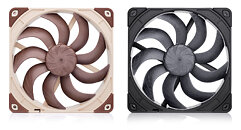

 For example, Noctua is now preparing to launch the chromax.black version of its NF-A12x25 G2 fan about 10 months after the initial version. However, readers may recall that it took Noctua three years after the first-generation NF-A12x25 launch, as the company was dealing with the challenges of pandemic-induced material shortages and logistical nightmares. These days, the situation is much better, but the engineering challenges remain.
Source:
Noctua
Noctua designs its fans with high precision to maximize airflow performance. This means that blade impellers have a tip clearance before hitting the fan frame of only a few tenths of a millimeter, about 0.5 mm for 120 mm fans and about 0.7 mm for 140 mm fans. Introducing any third-party pigment into this process could disrupt the structure of this fan tip clearance and potentially interfere with Noctua's Sterrox liquid-crystal polymer (LCP) material used in its fans. Specifically, color pigments have particles that directly affect how the injection mold behaves, as they carry their own particle imperfections. This negatively impacts the hundreds of thousands of performance tests that Noctua conducts in the lab and significantly delays the chromax.black product launch.


73 Comments on Noctua Explains Why chromax.black Fan Releases Take So Long
I reckon Noctua is one of the rare exceptions where the glazing is somewhat justified, it's simply a cut above.
Also AIOs drastically reduce airflow in your case, meaning that with a high end 300-500w GPU everything will be warmer in there vs an aircooler. Used to have a 3090 with an AIO for the CPU, the experience was horrible, changed to an aircooler and it felt like magic.They value their customers greatly. Considering they actively (they literally begged me to not buy a new cooler but wait for brackets) encourage you to keep your cooler for over a decade, they are in the business of selling you once. With that into account 180$ for a cooler that's long going to outlive your pc, your house and probably yourself as well isn't such a bad deal.
Also yes, there is a difference, especially for shorter bursts of loads. If you can't saturate AiO coolant in several minutes, that means fans don't really need to ramp up at all. It also means CPU will clock higher and do so for longer. Just because "it works" doesn't mean it "works well". CPU's today are not like they were in the past where they just ran at fixed clock unless they were thermal throttling, even if that was just 1°C under the throttling threshold. Today's CPU's will clock significantly lower the closer they get towards throttling point. And when I dump a lot of money into something performing at its peak, I like to extract all the performance from it.
Below is my 13900k on a single tower air cooler at 85C. This is the score on stock performance, no amount of cooling will make it run any faster. That's it. You can spend 10.000$ on cooling and the score will be the same. CPUs don't clock "significantly lower" the closer they are to throttling. Intel chips don't clock lower at all actually until they hit 100C.
When using an Intel CPU, lower temperatures make a significant difference. For Ryzen, however, there’s a limit to PBO—beyond which you won’t see meaningful improvements (diminishing returns set in).
In PC cooling, the most effective way to manage heat is to expel hot air from the case as efficiently as possible.
A cooler is not a battery or a buffer storage, we wouldn't care how or if it holds energy.
pcmasterrace/comments/1iog4qf/noctuas_customer_support_is_unreal_i_requested_an many examples of this
AIOs on the other hand - assuming they haven't failed - become almost unusable after between 4 to 6 years (of course it depends on runtimes, if you only use your PC 2 hours a day well that's different). Either due to the pump not keeping up anymore or liquid evaporation. I've had changed 3 AIOs between 2009 and 2019 - I've kept my aircooler from 2019 till today and I don't see it being changed ever again. So overall, it ends up being cheaper.
@theonlyrobert
as soon as you go away from the overpriced stuff and say take the redux series, they are "crap".
and a truly "german way of looking at things" good company, wouldnt sell crap, only to have fans at a lower price point.
Noctua is decent, but 2-3 better than those costing 2-3x less like Arctic.
why isnt there a <5% fan off like the other brands offer, or why didnt they care to ask the "community" for input on their next fans like Blacknoise did (more than a decade ago)?
no Noctua (consumer) has 10y warranty like some Arctics, or even one of the best (fan) blade materials/coatings like the eloops (virtually dust free after 2yof use).
if "you" want me to believe i get the "best", give me all those things combined in "your" fan, otherwise im more willing to spend 40$ per Blacknosie fan, then 20-30$ on a Noctuas.
@ymdhis
im gonna give you the benefit of "not knowing":
the only stuff that leaks are those cheap/crappy sealed Asetek based units.
as soon as you go with brands doing their own stuff like Ek or Alphacool, its not an issue.
and downtime isnt relevant on a non-work machine. those that are worried, can buy a cheapo air cooler as backup, no matter if they use LC or air.
im using LC for +15y, with my recent loop being an upgraded AIO, and not a single time did anything leaked/blew up/or failed (inc pumps),
all while in use for +5y.
there is a reason why many things on this planet are liquid cooled, and its not because air cooling is cheaper/easier and "lasts" longer.
@EatingDirt
1. air will never be as quiet at the same temp, unless you are using igpu.
2. air will always dump the cpu heat inside the case, heating up EVERYTHING needlessly, affecting gpu boost clocks, and life expectancy of all parts inside.
3. i can have much lower fan profiles/longer delays before ramping up vs "pure" air cooling.
i have now build +5 machines identical to that of a good friend, and under gaming load mine were/are always quieter,
while getting lower temps, even if his case fans go to max.
so no, unless you have noisy case flow, it will never be able to get to LC temps/noise, or i wouldnt be under water.
@JustBenching
i assume all you AIOs were sealed, and im willing to bet (+99% sure) based on Asetek, as others (EK/Alphacool) doing their own (pump) desing, dont have those issues.
ignoring for the cost of one air cooler, i can buy two Arctic LF, and will definitely have +10y of use, while still being cooler/quieter and cheaper.
and in +25y of using arctic products, never had an issue to receive "updated" mounting/parts, to make things work with newer hw, and usually only paying for shipping,
the Eisbaer i bought in 2019 is now "converted" to a loop to incl the gpu, and while im using a D5 clone, the stock pump is still working (in a different Eisbaer a friend messed up,
and a few others (friends as well as customers) are still using theirs, all at minimum now 5-6y old.
but the emphasis on "sludge".
thats not a (normal) part failure, like age/use..
after i saw all the coolants on display (microcenter stores), all growing mold spores while still below BB date, decide to use distilled water (never de-ionized) and biocide.
recently XSPC, as i wanted non-clear coolant, and even their opaque coolant didnt leave any residue after 2y, except for some light staining on the tubing that went away after a cleaning cycle and a few flushes.
Prior to my existing Noctua cooler, I had a cheaper cooler, which was highly recommended by reviewers and multiple communities, its cooling performance was what was expected. However as is often the case with lower quality manufacturers the fans became noisy after a while, so I replaced the fan, problem was there was no real fan replacements, it had some kind of propriety mounting system, and it was either a new replacement cooler, or doing what I did which was a frankenstein solution, kind of forcing another fan on to the mount.
At some point it was replaced by my current Noctua cooler, this was several years ago, and then when I upgraded my platform to Z690, I filled in the form, and they shipped me the mounting kit, a letter included thanking me for being a customer, and the box it arrived in was premium, not just bits lumped in to a bag.
Given cheaper fans fail, and you typically need to replace the entire thing once the socket becomes incompatible, then the premium of Noctua isnt so much a premium, and when the quality is clear and proven, I dont mind paying more for it.
i also understood later why people were selling in masses the nh-d15. any arctic liquid Freezer II 360 or 420 is far better.
the offset bracket which i bought for am5 are a hoax. i did not saw any differences or a single more MHz when compiling my stuff in gnu gentoo linux. nothing with B550 and ryzen 5800x and nothing with the x670 and ryzen 7600x. i did test that several times offset position and repaste the thermal paste vs the other position.
my exhaust fan is for testing purposes. Could be better as the previous 140mm Arctic P14.I swapped the p14 with the p14 pro recentlyyou need certain rpm ranges but arctic wins when your main focus is value and noise and you accept 80% fan performance vs the best fans on the market.
--
arctic gives 6 years warranty what i saw for the liquid freezer II series for europe, the market i am interested in. After 6 years you need to refill or replace certain parts anyway from an aio. No system is really 100 tight and never looses any coolant. thanks to teh poster above to remind me to check how hold the arctic liquid freezer II is on the ryzen 5800x on the x570 motherboard i build ages ago.
In my current system, I have 5 Noctua fans; I bought them second-hand simply because I know the quality is good and they’ll last a long time, and the performance/noise ratio is close to the best for this RPM. And I use them only for airflow inside the case, simply because I don’t want to spend money on a top-tier AIO or air cooler—they’re absurdly expensive, and all the heat will end up inside the case anyway.