Friday, September 25th 2026

DLSS 5 Boosts RTX 5090 Connector Power Spikes to 647 W, Pushing Past 90°C

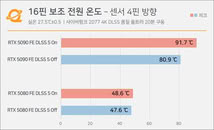
NVIDIA's DLSS 5 has been controversial ever since its announcement and eventual launch. Perhaps more concerning than the visual changes is its effect on the user's hardware. As reported by Videocardz, Korean outlet QuasarZone ran its own thermal tests on the RTX 5090's power connector with DLSS 5 enabled, to see if the technology really has a hand in recent reports of melting 12V-2x6 connectors. Testing an RTX 5090 Founders Edition in Cyberpunk 2077 at 4K with DLSS Quality and the Ultra preset over 20 minutes, the 12V-2x6 connector reached 91.7°C on the sense-pin side with DLSS 5 on, up from 80.9°C without it. The latch side climbed from 77.1°C to 83.4°C. An RTX 5080 FE tested the same way stayed far cooler, reaching just 48.6°C and 52.2°C at those two points with DLSS 5 enabled.

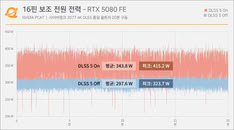
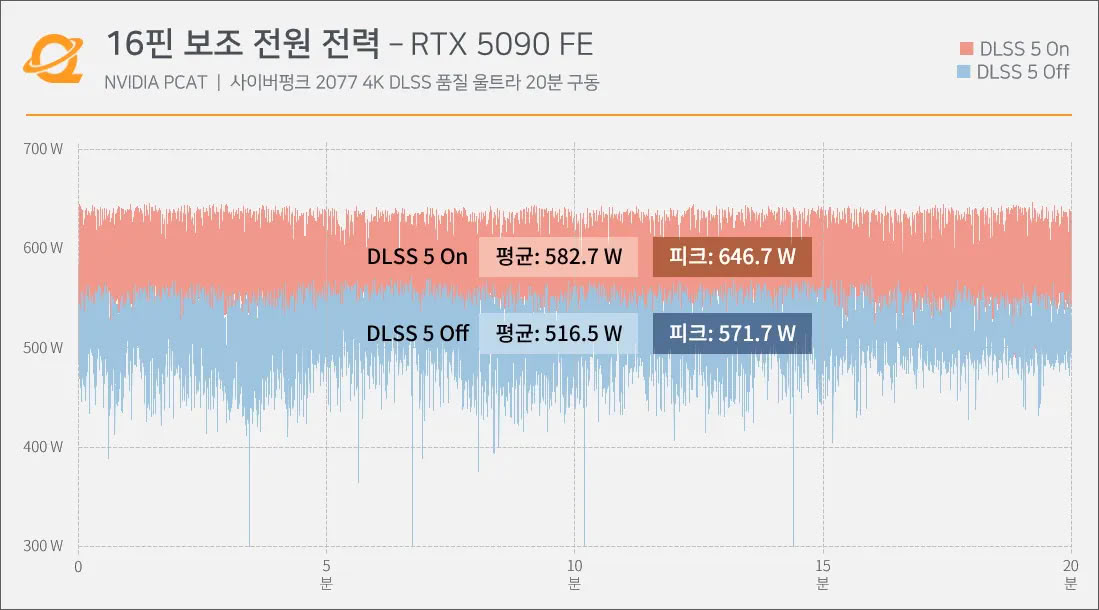
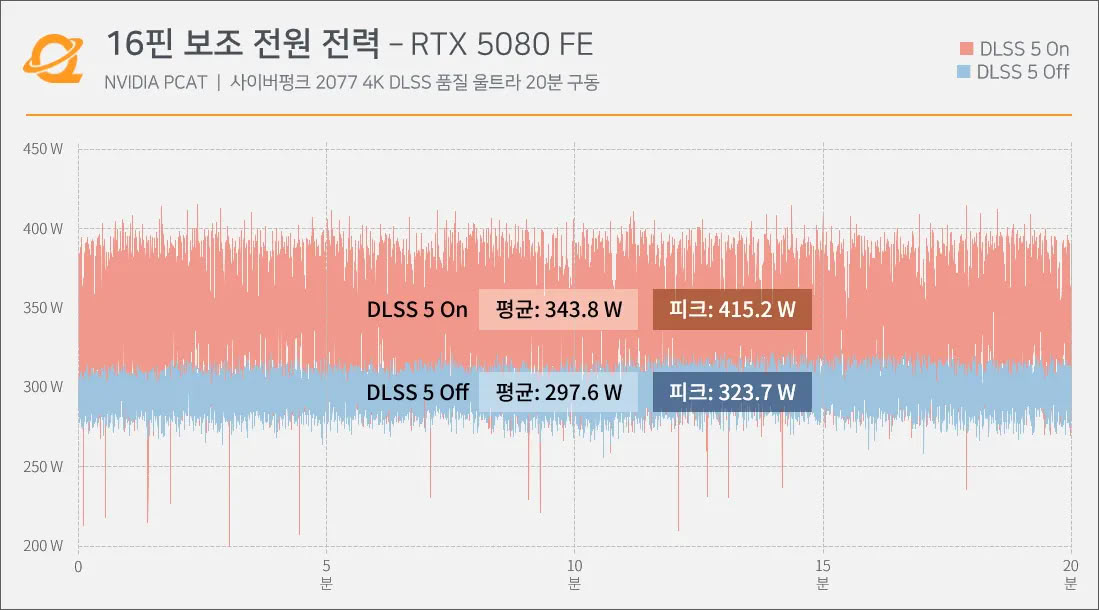
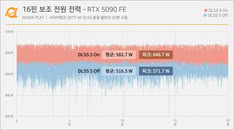
The increased heat aligned with a real jump in power draw. HWiNFO logged the RTX 5090's average power draw rising from 509.2 W to 575.1 W with DLSS 5 on, right at its 575 W limit. The RTX 5080 went from 298.2 W to 350.3 W, close to its own 360 W ceiling. External PCAT readings, which also catch short spikes, showed higher figures still: total board power rose from 527.3 W average and 582.5 W peak to 593.9 W average and 658.0 W peak. On the 16-pin 12V-2x6 connector alone, the RTX 5090 pulled 582.7 W on average and briefly spiked as high as 646.7 W. Of course, transient power spikes over 600 W are normal, and are not necessarily to blame for any melting connector issues. The increased power draw, however, lines up with Tom's Hardware's early DLSS 5 testing, which showed a noticeable jump in power draw with DLSS 5 enabled.

Despite the fresh data, this doesn't confirm that DLSS 5 is directly responsible for connectors melting, or GPU failures, for that matter. However, it's entirely possible that DLSS 5 may be propagating the issue and exposing limits that would otherwise stay hidden. The 12V-2x6 implementation has had occasional melting issues since the RTX 4090 days, and the cables could simply be being pushed past their limit under higher sustained loads. There's one reported case of a 5090 connector melting after a DLSS 5 test, and another one of an RTX 5080 reportedly "dying" after testing DLSS 5. A 10°C+ jump tied to one software feature is hard to brush off, not to mention the increased power draw, but it's probably worth waiting for more independent tests before drawing firm conclusions.
Sources: Quasar Zone, via Videocardz
Add your own comment

55 Comments on DLSS 5 Boosts RTX 5090 Connector Power Spikes to 647 W, Pushing Past 90°C

#1
Chomiq

Can't wait for DLSS6.
Posted on Reply
#2
SnoutBaron
Is there a reason why we keep doing this clickbait nonsense of saying it's explicitly DLSS 5 doing anything at all. It has nothing to do with DLSS 5. It has to do with people finally finding something that actually maxes their card.
Posted on Reply
#3
Chrispy_
As much as I enjoy dumping on Nvidia for the stupid connector, this is clickbait.

Transient spikes to over 600W are nothing new. The card's average power draw is still under the rated 600W, so this is just news sensationalism at its worst and adds valid ammunition to those idiots trying to defend the 12VHPWR cables.
Posted on Reply
#4
_JP_
The fantastic thing for me is that if you try to run the damn card as a graphics processor, without the added "excuses" for performance, such as RTX and DLSS/Reflex, that not only does not happen, you can actually tell what a poor offer for the cost the 5090 really is over the previous generations and as product by itself versus its lineup.
Posted on Reply
#5
Hecate91
DLSS5 Flame Generation.

Regardless if cards with this connector having power spikes is new or not, this is just yet another reason why the connector needs to be recalled.
Posted on Reply
#6
Tomgang
Yikes. I may have to be careful with dlss5 on my rtx 4090. If that card will support it. I think i should be careful at least until we know more about this.

I have so far not had melting issues with my card. But i also on purpose runs my card well below the 450 watt threshold with first of all undervolting the card. Why not both save the card and on the electric bill. Secondly i use the power limit slider to throttle the card down more when possible. I dont need 120 fps+ all the time. It can go down to 150 watt so why not save on power and protect your hardware in one go.
Hecate91DLSS5 Flame Generation.

Regardless if cards with this connector having power spikes is new or not, this is just yet another reason why the connector needs to be recalled.
I agree. That connector is a menace. Sure it does look nicer than 3 or 4 8 pins kabels sticking out. But at least 8 pins did not melt.

I think i'll prefer some 8 pins cables sticking out despite it dosent look as neat, but at least its safer.
Posted on Reply
#7
JustBenching
And since the cable melts at 150c+, this is perfectly fine?
Posted on Reply
#8
dgianstefani
TPU Proofreader
SnoutBaronIs there a reason why we keep doing this clickbait nonsense of saying it's explicitly DLSS 5 doing anything at all. It has nothing to do with DLSS 5. It has to do with people finally finding something that actually maxes their card.
Well, in this case DLSS 5 maxes the card, but you're correct it's generally related to maxing the card and not a specific feature.
JustBenchingAnd since the cable melts at 150c+, this is perfectly fine?
It would seem to be, as this and other stress testing rarely exhibits actual melting despite often being designed to induce exactly that. But of course pushing things that are close to limits further towards the limit can always introduce new risk, when other factors are involved. I'd wager most people's cooling setups aren't really aligned with the concept of a 600 W GPU.
Chrispy_As much as I enjoy dumping on Nvidia for the stupid connector, this is clickbait.

Transient spikes to over 600W are nothing new. The card's average power draw is still under the rated 600W, so this is just news sensationalism at its worst and adds valid ammunition to those idiots trying to defend the 12VHPWR cables.
It's not intentional clickbait, but I've refined the terminology to make it clear that power excursions (which every GPU have, and which are accounted for in PSU/GPU spec) are what's happening, not sustained draw, amongst some other revisions to enhance clarity regarding specific technical terms such as board power and die power etc.
Posted on Reply
#9
JustBenching
TomgangYikes. I may have to be careful with dlss5 on my rtx 4090. If that card will support it. I think i should be careful at least until we know more about this.

I have so far not had melting issues with my card. But i also on purpose runs my card well below the 450 watt threshold with first of all undervolting the card. Why not both save the card and on the electric bill. Secondly i use the power limit slider to throttle the card down more when possible. I dont need 120 fps+ all the time. It can go down to 150 watt so why not save on power and protect your hardware in one go.


I agree. That connector is a menace. Sure it does look nicer than 3 or 4 8 pins kabels sticking out. But at least 8 pins did not melt.

I think i'll prefer some 8 pins cables sticking out despite it dosent look as neat, but at least its safer.
You shouldn't worry. Tested my 4090s 4 year old 12vh connector, with the card completely maxed out and overclocked to the moon the cable was at 60c on a 28c ambient room. Unless your cable is already problematic there is nothing to worry about, dlss5 or not

So this article is pretty much :we pushed the 5090 to its absolute max, cable didn't give a dime, no worries all is good!
dgianstefaniWell, in this case DLSS 5 maxes the card, but you're correct it's generally related to maxing the card and not a specific feature.


It would seem to be, as this and other stress testing rarely exhibits actual melting despite often being designed to induce exactly that. But of course pushing things that are close to limits further towards the limit can always introduce new risk, when other factors are involved. I'd wager most people's cooling setups aren't really aligned with the concept of a 600 W GPU.
Igorslab made a really nice test about that specifically, most cases on the market couldn't handle a 450w card at all, the ambient temp inside the case started climbing rapidly. Back then it was only the fractal torrent that passed the test.
Posted on Reply
#10
dgianstefani
TPU Proofreader
JustBenchingIgorslab made a really nice test about that specifically, most cases on the market couldn't handle a 450w card at all, the ambient temp inside the case started climbing rapidly. Back then it was only the fractal torrent that passed the test.
Interesting, I didn't know about that.
Posted on Reply
#11
Dr. Dro
Well duh, DLSS 5 increases GPU load which in turn increases power draw which in turn increases cable temperature

Sustained high load is what causes the meltdowns, like my card which melted on an hours long Metro Exodus session.
Posted on Reply
#12
Hecate91
JustBenchingUnless your cable is already problematic there is nothing to worry about, dlss5 or not
So how exactly is someone supposed to know if their cable is problematic?
JustBenchingSo this article is pretty much :we pushed the 5090 to its absolute max, cable didn't give a dime, no worries all is good!
Until it's not, and the fact with this article is an official feature shouldn't be melting cards.
JustBenchingmost cases on the market couldn't handle a 450w card at all
Cases not being able to handle more than a 450W card is further proof these aren't gaming cards.
TomgangI agree. That connector is a menace. Sure it does look nicer than 3 or 4 8 pins kabels sticking out. But at least 8 pins did not melt.

I think i'll prefer some 8 pins cables sticking out despite it dosent look as neat, but at least its safer.
It looks nicer but that's it, with the 12v2x6 spec Nvidia got rid of load balancing and shunt resistors which can weaken connector pins from unevenly loaded pins and heat cycles.
I'd rather have 3 or 4 8 pin cables than a neater looking cable, definitely since a GPU is more of an investment these days with no guarantee the original manufacturer will support their customers, many of them are using anything to wiggle out of a warranty claim.
Posted on Reply
#13
DrUsmanSaleem
News Editor
Chrispy_As much as I enjoy dumping on Nvidia for the stupid connector, this is clickbait.

Transient spikes to over 600W are nothing new. The card's average power draw is still under the rated 600W, so this is just news sensationalism at its worst and adds valid ammunition to those idiots trying to defend the 12VHPWR cables.
Hey Chrispy, thank you for the input. The article is certainly not meant to be "clickbait" in any way, as it just reports the findings from a recently conducted test. It focuses on DLSS 5's relation with connector temperature/power draw since the original testing did so as well. The reason likely being the few anecdotal reports we have seen over the past few weeks about connectors melting linked to DLSS 5.

Regardless, I have added clarification regarding the transient power spikes, and made it even more clear in the closing para that, as far as we know, DLSS 5 is not directly responsible for the connectors melting. Still, it maxes out your card pretty aggressively, and I think that's worth reporting.
Posted on Reply
#14
john_
Honestly, this cable is giving us inspiration to create AI images.


Lacking relevant electrical/electronic knowledge, it surprises me that no substantial solution has been provided to this day. Is it really that hard to release a new—one more won't hurt—revision of the connector, or a new PCB revision on graphics cards, to ensure that using a card drawing that many watts won't be stressful—not because of the wattage itself, but because of the connector? After all, in the past there were 2-3 models that hit 500W, yet absolutely no one stressed over the cables. The question was whether the power supply could handle delivering the power, not whether the cables would start smelling burnt.

Personally, I wouldn't buy an RTX 5090 today, nor any other card—even from AMD—equipped with this connector, because I wouldn't be able to enjoy it. My mind would be on the cable the entire time. I'd probably be forced, for the first time in my life, to move the PC tower off the floor onto my desk and buy a tempered glass case, purely so I could keep visual contact with the card. This isn't normal, this doesn't make sense.
Posted on Reply
#15
N3utro
The only thing this shows is that DLSS5 is more intensive on GPU loads.

Using DLSS5 doesn't somehow allow to bypass the power limits of the card that are set in the vbios.

You can get the same results by stress testing the GPU without DLSS5, so nothing really new, but "DLSS 5 melts cards" is more sensational.
Posted on Reply
#16
JustBenching
john_Honestly, this cable is giving us inspiration to create AI images.


Lacking relevant electrical/electronic knowledge, it surprises me that no substantial solution has been provided to this day. Is it really that hard to release a new—one more won't hurt—revision of the connector, or a new PCB revision on graphics cards, to ensure that using a card drawing that many watts won't be stressful—not because of the wattage itself, but because of the connector? After all, in the past there were 2-3 models that hit 500W, yet absolutely no one stressed over the cables. The question was whether the power supply could handle delivering the power, not whether the cables would start smelling burnt.

Personally, I wouldn't buy an RTX 5090 today, nor any other card—even from AMD—equipped with this connector, because I wouldn't be able to enjoy it. My mind would be on the cable the entire time. I'd probably be forced, for the first time in my life, to move the PC tower off the floor onto my desk and buy a tempered glass case, purely so I could keep visual contact with the card. This isn't normal, this doesn't make sense.
I was in the same place after reading all these articles but the articles are what's causing the paranoia, not the failure rate. You can spend a couple of cents and buy a thermal sensor and attach it to your cable. I spent 150 euros for the wire view and I feel like an idiot cause the cable is in perfect condition.
Posted on Reply
#17
john_
JustBenchingI was in the same place after reading all these articles but the articles are what's causing the paranoia, not the failure rate. You can spend a couple of cents and buy a thermal sensor and attach it to your cable. I spent 150 euros for the wire view and I feel like an idiot cause the cable is in perfect condition.
You shouldn't feel stupid, in the sense that you didn't buy it just to keep checking that the cable is in perfect condition. All cables or components are in perfect condition until they aren't. You paid that €150 just in case you got unlucky, but also so you wouldn't have to constantly stare at the cable.

Personally though, I would still have an issue, even with a €150 solution, even if I undervolted on top of that. It's purely psychological, and let's be honest, this cable has developed a bad reputation by now.

There is a saying in Greece: "Better to lose an eye than your reputation."
Posted on Reply
#18
JustBenching
john_You shouldn't feel stupid, in the sense that you didn't buy it just to keep checking that the cable is in perfect condition. All cables or components are in perfect condition until they aren't. You paid that €150 just in case you got unlucky, but also so you wouldn't have to constantly stare at the cable.

Personally though, I would still have an issue, even with a €150 solution, even if I undervolted on top of that. It's purely psychological, and let's be honest, this cable has developed a bad reputation by now.

There is a saying in Greece: "Better to lose an eye than your reputation."
The thing is I was under the same stress with my 3090, I was running the evga custom bios for a 500w+ limit and there were a lot of reports of cards dying, cores cracking and cables melting on the ocnet forums. They just didn't make it to front page news so it didn't cause massive alarms.
Posted on Reply
#19
SnoutBaron
_JP_The fantastic thing for me is that if you try to run the damn card as a graphics processor, without the added "excuses" for performance, such as RTX and DLSS/Reflex, that not only does not happen, you can actually tell what a poor offer for the cost the 5090 really is over the previous generations and as product by itself versus its lineup.
"This GPU that was designed around using Tensor workloads to boost performance, is not faster than the previous generation when not doing that."

Sometimes I wonder about people on this forum.
Posted on Reply
#20
Chrispy_
DrUsmanSaleemHey Chrispy, thank you for the input. The article is certainly not meant to be "clickbait" in any way, as it just reports the findings from a recently conducted test.
dgianstefaniIt's not intentional clickbait, but I've refined the terminology to make it clear that power excursions (which every GPU have, and which are accounted for in PSU/GPU spec) are what's happening, not sustained draw, amongst some other revisions to enhance clarity regarding specific technical terms such as board power and die power etc.
I'm not calling out TPU's repost of the news, that's just how news reposting works.
I'm calling out Videocardz for sensationalising an utterly banal story about a 600W GPU operating at 584W.
Posted on Reply
#21
FR3D1
Ninja Cat
TomgangBut at least 8 pins did not melt.
“The story is entirely made up.”

Feel free to use Google search and see for yourself.
Hecate91is further proof these aren't gaming cards.
That wasn't an issue back in the days of CrossFire/(Quad)SLI, either. Naturally, people like me were well aware of the "laws of physics." Aside from having the "right" case, we also paid attention to proper cabling and cooling. Aesthetics were secondary; function was - logically - paramount.

Of course, it’s easier to blame NVIDIA for everything - claiming the "HPWR GPU power connector" is total garbage, even though AMD wasn't exactly uninvolved in it. I’d rather place the blame on those so-called gamers and streamers - people who have nothing on their minds but hot air, OnlyFans, and RGB. By the way; since these newfangled people have taken over the planet, the quality of games has also declined. That clarifies that point as well. So much for NVIDIA, GameWorks, DLSS5 and all that.

Regards,
Fred.
Posted on Reply
#22
_JP_
SnoutBaron"This GPU that was designed around using Tensor workloads to boost performance, is not faster than the previous generation when not doing that."

Sometimes I wonder about people on this forum.
Preaching to the choir that knows this since the 20x0 series. The complaint started there and the tone increased in volume since the 30x0 series with the whole Crypto/CoVID "scarcity" combo.
I'm adding to how ridiculous it has become, with a self-destructing product unless run in very specific conditions.
Posted on Reply
#23
RejZoR
SnoutBaronIs there a reason why we keep doing this clickbait nonsense of saying it's explicitly DLSS 5 doing anything at all. It has nothing to do with DLSS 5. It has to do with people finally finding something that actually maxes their card.
It's NVIDIA's poor design and cheap way of just pushing stuff out at max price to maximize their profits. So much that they just never bothered to include scenarios in their QA tests of graphic cards where they fully utilize all logics of the GPU, raster, tensor and RT cores. And suddenly cards are melting because they are doing unexpected compute loads. The stupid power connector is a story in itself and it's possible not even their hardware level firmware isn't up to code to keep things in check for long term health of the cards.
Posted on Reply
#24
Tomgang
JustBenchingYou shouldn't worry. Tested my 4090s 4 year old 12vh connector, with the card completely maxed out and overclocked to the moon the cable was at 60c on a 28c ambient room. Unless your cable is already problematic there is nothing to worry about, dlss5 or not

So this article is pretty much :we pushed the 5090 to its absolute max, cable didn't give a dime, no worries all is good!


Igorslab made a really nice test about that specifically, most cases on the market couldn't handle a 450w card at all, the ambient temp inside the case started climbing rapidly. Back then it was only the fractal torrent that passed the test.
Well i dont use the stock cable. I use a cable from cable mods. It looks more neat with that cable in stead of that ugly cable. But i´ll keep playing safe. If anything i still saves on the electric bill.
FR3D1“The story is entirely made up.”

Feel free to use Google search and see for yourself.


That wasn't an issue back in the days of CrossFire/(Quad)SLI, either. Naturally, people like me were well aware of the "laws of physics." Aside from having the "right" case, we also paid attention to proper cabling and cooling. Aesthetics were secondary; function was - logically - paramount.

Of course, it’s easier to blame NVIDIA for everything - claiming the "HPWR GPU power connector" is total garbage, even though AMD wasn't exactly uninvolved in it. I’d rather place the blame on those so-called gamers and streamers - people who have nothing on their minds but hot air, OnlyFans, and RGB. By the way; since these newfangled people have taken over the planet, the quality of games has also declined. That clarifies that point as well. So much for NVIDIA, GameWorks, DLSS5 and all that.

Regards,
Fred.
Huh made up. hmm. So much fake news around. Well i guess i´ll wait and see if there comes any more out about it.
Posted on Reply
#25
Harlow
DrUsmanSaleemover 20 minutes, the 12V-2x6 connector reached 91.7°C on the sense-pin side with DLSS 5 on
I thought I'd check the temperature rating of Molex Mini-Fit connectors to see if 91.7°C would be a problem.

I'm not sure if I've found the correct data sheet, but I found a number of links at the end of the Wiki page:
en.wikipedia.org/wiki/12VHPWR

It's possible this pdf under Reference 34 might be valid:
tools.molex.com/pdm_docs/ps/PS-5556-001-001.pdf

Checking the temperature rating of the connector pins, I found this:

4.4 TEMPERATURE
Terminal Type Formed - Brass Solid - Brass Phos Bronze
Operating: * -40°C to +80°C -40°C to +105°C -40°C to +105°C
Non operating: -40°C to +80°C -40°C to +105°C -40°C to +105°C

If I'm reading this right and the Mini-Fit housings are populated with 'Formed metal contacts', they're rated at +80°C, which is well below the +91.7°C measured.

Even if the contacts are Brass - Phosphor Bronze with a rating of +105°C, it doesn't provide much headroom above 91.7°C.

The Mini-Fit plastic housing appears to be rated at +125°C.

Quite possibly I'm looking at the wrong connector and contact type. Does anyone know better?

If you want higher temperature wires, you could swap PVC insulation for PTFE rated at +200°C, but it's slippery stuff and difficult to strip back.
Posted on Reply
Add your own comment
Nov 26th, 2026 07:48 CST change timezone

New Forum Posts

Popular Reviews

TPU on YouTube

Controversial News Posts