Monday, May 25th 2026
Combined Revenue of Top Five Global NAND Flash Suppliers Rose by 83.7% QoQ for 1Q26 as Supply Shortages Drove Price Hikes
According to TrendForce's latest survey of the NAND Flash industry, CSPs worldwide experienced an exponential surge in demand for enterprise SSDs in 1Q26 due to the need for high-speed data transmission and the massive data storage capacities required to build out AI server infrastructure. Additionally, a persistent structural shortage of traditional HDDs has led a significant volume of storage-related orders to shift toward QLC enterprise SSDs. Amidst this soaring demand and constrained supply, NAND Flash suppliers' ASPs broadly exceeded expectations. Hence, the combined revenue of the world's top five NAND Flash suppliers jumped 83.7% QoQ, surpassing US$38.9 billion.
Moving into 2Q26, the supply-demand imbalance is expected to persist. Although rising memory costs and higher end-product prices have dampened smartphone and PC demand, brisk server orders will fill this gap. NAND Flash suppliers generally anticipate continued growth in their shipments through the second quarter, and their pricing strategies are expected to sustain elevated ASPs.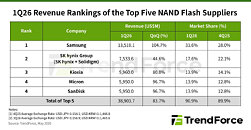 Looking at individual suppliers' performances in 1Q26, Samsung firmly maintained its top position in the revenue rankings. The company capitalized on quarterly contract pricing and a significant increase in server-related bit shipments, which drove a substantial rise in its ASP. Consequently, Samsung posted US$13.51 billion in NAND Flash revenue, marking a staggering 104.7% QoQ increase—the highest growth rate among the top five—while expanding its revenue market share from 28% to 31.6%.
SK hynix Group (which includes SK hynix and Solidigm) secured second place with about US$7.53 billion in revenue, reflecting a 44.6% QoQ increase and bringing its market share to 17.6%. This growth momentum was similarly fueled by soaring ASPs. Additionally, the group's overall revenue was significantly bolstered by its subsidiary, Solidigm, which benefited from a steady influx of orders for high-capacity QLC enterprise SSDs.
Kioxia delivered a strong performance in 1Q26, with revenue climbed 80% QoQ to US$5.96 billion. The company retained its third-place ranking with a 13.9% market share. Buoyed by the overarching surge in NAND Flash prices and highly favorable market dynamics, Kioxia achieved outstanding results in both revenue and profitability.
Micron also benefited from the considerable hike in its NAND Flash ASP. Its 1Q26 NAND Flash revenue jumped 96.7% QoQ to US$5.95 billion, allowing its market share to rebound to 13.9% and tying with Sandisk for fourth place.
Sandisk experienced a massive QoQ revenue increase of over 200% in its data center business, underscoring the success of its strategy to pivot its product mix toward high-value offerings. Its overall 1Q26 NAND Flash revenue matched Micron's at US$5.95 billion, also reflecting a 96.7% QoQ growth and a 13.9% market share.
TrendForce indicates that major NAND Flash suppliers will add virtually no new production capacity in 2026. Due to persistently strong AI-related demand, supply shortages are expected to last throughout the year. By year-end, NAND Flash products featuring 200 layers or more will firmly establish themselves as the undisputed market mainstream. Furthermore, production resources will remain heavily focused on server storage applications, continuing to drive the market penetration of high-capacity QLC enterprise SSDs.
Source:
TrendForce
Moving into 2Q26, the supply-demand imbalance is expected to persist. Although rising memory costs and higher end-product prices have dampened smartphone and PC demand, brisk server orders will fill this gap. NAND Flash suppliers generally anticipate continued growth in their shipments through the second quarter, and their pricing strategies are expected to sustain elevated ASPs.

SK hynix Group (which includes SK hynix and Solidigm) secured second place with about US$7.53 billion in revenue, reflecting a 44.6% QoQ increase and bringing its market share to 17.6%. This growth momentum was similarly fueled by soaring ASPs. Additionally, the group's overall revenue was significantly bolstered by its subsidiary, Solidigm, which benefited from a steady influx of orders for high-capacity QLC enterprise SSDs.
Kioxia delivered a strong performance in 1Q26, with revenue climbed 80% QoQ to US$5.96 billion. The company retained its third-place ranking with a 13.9% market share. Buoyed by the overarching surge in NAND Flash prices and highly favorable market dynamics, Kioxia achieved outstanding results in both revenue and profitability.
Micron also benefited from the considerable hike in its NAND Flash ASP. Its 1Q26 NAND Flash revenue jumped 96.7% QoQ to US$5.95 billion, allowing its market share to rebound to 13.9% and tying with Sandisk for fourth place.
Sandisk experienced a massive QoQ revenue increase of over 200% in its data center business, underscoring the success of its strategy to pivot its product mix toward high-value offerings. Its overall 1Q26 NAND Flash revenue matched Micron's at US$5.95 billion, also reflecting a 96.7% QoQ growth and a 13.9% market share.
TrendForce indicates that major NAND Flash suppliers will add virtually no new production capacity in 2026. Due to persistently strong AI-related demand, supply shortages are expected to last throughout the year. By year-end, NAND Flash products featuring 200 layers or more will firmly establish themselves as the undisputed market mainstream. Furthermore, production resources will remain heavily focused on server storage applications, continuing to drive the market penetration of high-capacity QLC enterprise SSDs.
8 Comments on Combined Revenue of Top Five Global NAND Flash Suppliers Rose by 83.7% QoQ for 1Q26 as Supply Shortages Drove Price Hikes
Primary consumption of Cloud and AI are still your general market where personal devices are your bridge. If by constricting production (needed, because excess is not compensated) while not making those products worthwhile (mind you, it's not like we're off the "this thing lasts 3 years or so") while having to invest more and more, the point is....deal with losses later?
From an analysts' stand-point, that's fine, by then that person will be at another place if we go by the turn-overs, but what exactly are manufacturers as an entity planning on after 2030, realistically? Buyers and merger into Arasaka and Militech?
Right now, that looks like military hardware, unfortunately.
Compression, sure, if it's data you don't use often. And by that I mean on the daily.
Surely, the companies push the AI to their employees, as the C suit want more productivity. And there might be some very specific task, that require AI. But for 99% of workloads, AI is not needed. Heck, it's not like things became miracly better, faster and more reliable, or suddenly couldn't be done by usual HW ans SW anymore. Faster, doesn't mean better.
And... the prices for new "premium" AI tools, are gone up unreasonably higher, than any novelty should be. This actually prevents/hinders the adoption of the said tools and innovations.
They all (AI companies, DRAM makers, SW corps) do this, because money which they flood into each other, are not theirs. It's taxpayers money, the corporations been given by governments. That's why, they are not afraid of paying $1000 for a stick of 64GB RAM, or couple TB Storage/SSD/HDD. And to produce the utterly inefficient models and HW, that requires an absurd amount of power, and natural resources.
Really this madness isn't going to end anywhere soon. Sadly!That's actually great! But.... this doesn't solve the problem, of old and ancient PCs, and people, who were going to upgrade, or outright change to new one. What to do for those, who were stuck in the middle of building new rigs? 😒
Most people do not need a Core Ultra/Ryzen 9. They will not need over 32GB of RAM, for now. They're fine with whatever will actually boot their OS of choice in a stable way, and load browsers, the occasional content App. Slowly, if possible, show alternatives. Teach that ownership and control over their IT-aspect of their lives pays off. Saves them some coin in the process (which can improve their lives, or be donated to causes).
Change is not welcome in most cases and it requires patience and understanding, as well as a lot of dialogue and honesty. Never forced is the way.
Most big companies going about the AI bubble actually are working on the premise that "need" is infinite. If there's one thing sure about our species, is that everything about us is finite.
Therefore, their plan is heavily flawed and we're the ones falling for it if we want. There is a lot of tiredness and insecurity floating about in a lot of minds, which creates the need for "sure things" and "feeling safe", so anybody with a confidence can deliver a speech that sounds that it's fine. You can call it out with your choices, it's just not going to be easy.
Old and ancient still runs Linux or BSD, usually. Now, odds are that is a hard pass for most people because it is not familiar, but just teaching where the equivalence is already does the trick most times for folks.
If that isn't some heavy cyberpunk dystopia playing out in real life, I don't know what is.