Sunday, May 31st 2026

AMD Announces Socket AM5 Longevity till 2029
AMD in its Computex 2026 presentation, celebrated 10 years of the Socket AM4 platform that kickstarted the company's long march to competitiveness with Intel in the desktop PC processor market, and its eventual domination. Socket AM4 supports the original "Zen" and "Zen+," across the Ryzen 1000 and Ryzen 2000; and would go on to support Ryzen 3000 "Zen 2," Ryzen 4000 "Zen 2" APUs, and the vastly successful Ryzen 5000 "Zen 3" series, at which point it had achieved performance leadership over Intel. The company formally launched its "latest" product for AM4, a fresh production run of the Ryzen 7 5800X3D, which is the fastest processor for gaming on the platform.
In 2022, AMD debuted Socket AM5 alongside the Ryzen 7000 series powered by the "Zen 4" architecture. At the time, the company promised a similar cadence of at least two processor generations on the socket, leading up to 2027 (5 years in the market). The company would go on to launch the Ryzen 8000 series APUs, and its current Ryzen 9000 series powered by the "Zen 5" architecture. Its latest product line sees the introduction of Ryzen AI 400 series desktop APUs. Without naming any future processor generation or architecture, AMD announced that AM5 will have platform longevity till 2029. This would mean the introduction of at least one more microarchitecture, "Zen 6," and the product lines derived from it. Since AMD didn't announce "Zen 6" at Computex, the company likely won't debut it in 2026, instead, hold on to the current lineup, and possibly tease or announce "Zen 6" in 2027, with product launches expected that year. This would align with market availability of "Zen 6" for the following two years going into 2029.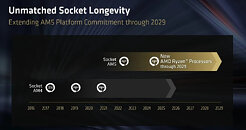
In 2022, AMD debuted Socket AM5 alongside the Ryzen 7000 series powered by the "Zen 4" architecture. At the time, the company promised a similar cadence of at least two processor generations on the socket, leading up to 2027 (5 years in the market). The company would go on to launch the Ryzen 8000 series APUs, and its current Ryzen 9000 series powered by the "Zen 5" architecture. Its latest product line sees the introduction of Ryzen AI 400 series desktop APUs. Without naming any future processor generation or architecture, AMD announced that AM5 will have platform longevity till 2029. This would mean the introduction of at least one more microarchitecture, "Zen 6," and the product lines derived from it. Since AMD didn't announce "Zen 6" at Computex, the company likely won't debut it in 2026, instead, hold on to the current lineup, and possibly tease or announce "Zen 6" in 2027, with product launches expected that year. This would align with market availability of "Zen 6" for the following two years going into 2029.

52 Comments on AMD Announces Socket AM5 Longevity till 2029
Unfortunately I do worry for what will happen if they hold on to AM5 this long. From what I understand it was getting limited in expandability options by '24. Stretching it all the way to '29 might prove painful especially as Intel moves ever forward—albeit they have their own issues with committing to a platform long enough.
As for AM5, it will get Zen 6 for sure. There have been rumors about Zen 7. I didn't think so at first, but with the way the market seems to be going these days, I think it's plausible.
There's no appetite for client DDR6 platform either from Intel or AMD before 2030, as data center market is absolutely crazy thirsty for memory. And it's very expensive. They would be insane to launch such new platforms in such reality.
Tom's leaks suggest that Intel would support 1954 socket for three generations, so it also makes sense that AMD launches Zen7 on AM5.
We just build new systems every 3-4 years. Yes, you can upgrade CPU, ram, etc but ..there will always be some feature on the motherboard chipset that you want every few years. Mostly pcie now these days.
You want the extra bandwidth or more m2 slots, etc.
Yes you can upgrade the motherboard without upgrading CPU, ram, etc .
Lol, but you know you are just going to swap out everything lol
Change in core design or any change in SoC?
I'd say Strix Halo, based on modified Zen 5 architecture, can also be considered a different architecture.
That way, Zen 6 and Strix Halo's successor are enough to justify letter "s" in "architectures".
I'd be really nice to have Zen 7 around on AM5, but let's be honest here - having not enough pins is constraining.
If Intel delivers significant changes in RAM and/or PCIe lanes, AMD will have no other choice than to switch to another socket to stay competitive.
- speedier chipset link
- less restricted licensing, so board makers could connect two chipsets in parallel
- bifurcation ability on Gen5 x4 ports, at least to x2/x2.Also, a plural can mean "any number, we can't tell you yet, maybe even we don't know yet".
But I should take a closer look at used prices to determine wether it wouldn't be a better idea to get a 9800X3D/9800X3D and sell the 7800X3D while it still fetches a decent price.
Either way, we have seen what socket longevity can mean wiht AM4 - the last CPU that was actually a useful upgrade was the 5800X3D and perhaps the 5800XT, everything alese after that was only cheap garbage, often replacing better, but more expansive hardware. AMD is now doing the same thing with the 7800X3D. They won't simply give you the 7800X3D cheaper, that would be to much value, they have to downgrade it to 7700X3D.