Thursday, June 4th 2026

Lexar's "AI Storage Stick" Concept Calls for Treating M.2 NVMe SSDs Like Memory-expansion Cartridges
If you think about it, an M.2 NVMe SSD isn't conceptually different from an NES cartridge, so you shouldn't need a USB/Thunderbolt enclosure to treat your M.2 SSD like a portable storage device, or so argues Lexar. The company innovated a concept for Mini-PCs and desktops that calls for a robust M.2 slot that can take many insertions, and for an M.2 SSD to be encased in a metal jacket (not an enclosure, just a jacket). The SSD is then inserted into a 25 mm-wide slot on the front-panel of a mini PC, directly into the M.2 slot that's wired to the processor or chipset, thereby eliminating all other overheads.
The Mini-PC you see is a prototype by ASUS. There is of course the problem that neither PCIe isn't practically a hot-pluggable standard, which is why Thunderbolt and USB 3 came to existence in the first place as hot-pluggable link layers on top of a serial physical layer. The company also showcased the AI-Grade Gen 5 x4 NVMe SSD. This M.2 NVMe drive that's probably based on a DRAMless controller. Driving Lexar's effort is the ability to treat the SSD like memory, so the LLM can load larger models, using a 3-tiered memory hierarchy. The GPU's video memory is at L1 due to its highest bandwidth and least latency to the GPU. Then comes the system memory, larger but relatively slower; and finally, NVMe SSDs. Lexar claims that this approach has found to relieve memory footprint by at least 40%.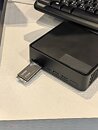
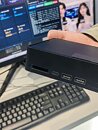
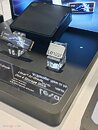
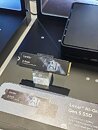
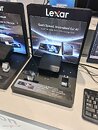

The Mini-PC you see is a prototype by ASUS. There is of course the problem that neither PCIe isn't practically a hot-pluggable standard, which is why Thunderbolt and USB 3 came to existence in the first place as hot-pluggable link layers on top of a serial physical layer. The company also showcased the AI-Grade Gen 5 x4 NVMe SSD. This M.2 NVMe drive that's probably based on a DRAMless controller. Driving Lexar's effort is the ability to treat the SSD like memory, so the LLM can load larger models, using a 3-tiered memory hierarchy. The GPU's video memory is at L1 due to its highest bandwidth and least latency to the GPU. Then comes the system memory, larger but relatively slower; and finally, NVMe SSDs. Lexar claims that this approach has found to relieve memory footprint by at least 40%.


8 Comments on Lexar's "AI Storage Stick" Concept Calls for Treating M.2 NVMe SSDs Like Memory-expansion Cartridges
There is already a standard designed for this specific use case, it's called E1.S, and it can be a carrier for an M.2 SSD. E1.S is rated for 200 to 1000 insertion cycles and is already used in some consumer equipment such as QNAP desktop NAS and Icy Dock adapters.
The important engineering precaution is that the consumer should not be able to insert the SSD in the wrong orientation under any circumstances. I’ve nearly started a fire from attaching a cable to a naked E1.S SSD. The quad-lane connector has no key to prevent incorrect mating.
They ran the demonstration on their 1090 Pro instead of the AI-Grade SSD