Monday, June 15th 2026

AMD Explains FSR 4.1 Upscaling for RDNA 3, Promises Quality Parity with RDNA 4
At Computex 2026, we had the opportunity to interview AMD's Chief Software Officer, Andrej Zdravkovic, and Terry Makedon, Senior Director of Software at AMD, to discuss various developments happening in AMD's labs. One of our questions focused on the FSR 4.1 Upscaling algorithm, which is currently exclusive to the RDNA 4 generation with the Radeon RX 9000 series of graphics cards. However, it is expected to be available this July for RDNA 3-based Radeon RX 7000 series GPUs. We were curious whether the FSR 4.1 Upscaling model that currently runs on RDNA 4 would be the same one used on RDNA 3. AMD explained that the underlying model is slightly different, but the end result will be of the same quality. This is reassuring news for millions of RDNA 3 and RDNA 2 gamers worldwide, especially during a time when upgrading PC hardware is more challenging than it has been in years.
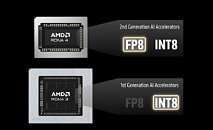
For example, we know there are some fundamental differences in the RDNA generations regarding microarchitecture. For RDNA 3, this means there is no 8-bit floating point support in older generations, as only the latest RDNA 4 uses FP8. To run the FSR 4.1 Upscaling model on RDNA 3, AMD must convert this to 8-bit integer data, since RDNA 3 hardware uses INT8 data types without FP8 support. Generally, integer math is sufficient to optimize these models, but the conversion work is necessary, hence the delay between RDNA 4 and RDNA 3 support. This difference requires AMD to completely modify the FSR 4.1 model for the new data type and ensure there is no quality loss in the final visual output. AMD's software officials have confirmed that the company has been working hard on this issue, and more information will be released next month, in July, as the launch approaches.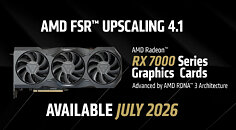
 What about RDNA 2?
For RDNA 2, the situation becomes much more complex. First, RDNA 2 hardware lacks dedicated AI accelerators within the GPU microarchitecture. This means that RDNA 2 GPUs will rely on the Stream Processors in the GPU configuration to power FSR 4.1 upscaling. As a result, the raw GPU compute, without any additional AI compute, will be responsible for the upscaling model. This requires a great deal of optimization to make the process work efficiently. AMD claims that making FSR 4.1 upscaling consume fewer shader cycles is very challenging. Therefore, AMD is taking more time to optimize this but plans to launch support sometime in 2027. While there is no specific timeline for when AMD will achieve this, the necessary background work is still required to deliver a smooth experience for RDNA 2 gamers without affecting performance.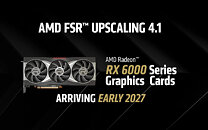 How does AMD run the optimization?
TechPowerUp's team was curious to learn how AMD manages the work behind this development and to understand more about the entire process. AMD described a multi-tier system for the development, refinement, and optimization of the FSR 4.1 upscaling algorithm. The first stage involves general training of FSR 4.1 on Instinct MI accelerators. Since the FSR upscaling algorithm is not as large as many of today's language models that power ChatGPT, Claude, Grok, Gemini, and others, only a few smaller clusters are needed. There is no requirement for supercomputer-scale computing to train this model, as the computational demand is much smaller. Next, AMD uses its workstation-grade Radeon Pro GPUs to further refine the models and prepare the overall environment.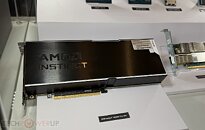 In these Radeon Pro systems, final polishing is carried out using the ROCm platform, which is now supported on regular Radeon, Radeon Pro, and up to the Instinct MI accelerators. With uniform software framework support across all GPUs, development becomes easier. Before AMD can start shipping the FSR model, the company tests hundreds of thousands of PC configurations with regular Radeon GPUs. These tests are conducted across a wide range of PC setups with various CPUs, RAM configurations, motherboards, power supplies, and any other factors that could impact the testing.
For example, we know there are some fundamental differences in the RDNA generations regarding microarchitecture. For RDNA 3, this means there is no 8-bit floating point support in older generations, as only the latest RDNA 4 uses FP8. To run the FSR 4.1 Upscaling model on RDNA 3, AMD must convert this to 8-bit integer data, since RDNA 3 hardware uses INT8 data types without FP8 support. Generally, integer math is sufficient to optimize these models, but the conversion work is necessary, hence the delay between RDNA 4 and RDNA 3 support. This difference requires AMD to completely modify the FSR 4.1 model for the new data type and ensure there is no quality loss in the final visual output. AMD's software officials have confirmed that the company has been working hard on this issue, and more information will be released next month, in July, as the launch approaches.


For RDNA 2, the situation becomes much more complex. First, RDNA 2 hardware lacks dedicated AI accelerators within the GPU microarchitecture. This means that RDNA 2 GPUs will rely on the Stream Processors in the GPU configuration to power FSR 4.1 upscaling. As a result, the raw GPU compute, without any additional AI compute, will be responsible for the upscaling model. This requires a great deal of optimization to make the process work efficiently. AMD claims that making FSR 4.1 upscaling consume fewer shader cycles is very challenging. Therefore, AMD is taking more time to optimize this but plans to launch support sometime in 2027. While there is no specific timeline for when AMD will achieve this, the necessary background work is still required to deliver a smooth experience for RDNA 2 gamers without affecting performance.

TechPowerUp's team was curious to learn how AMD manages the work behind this development and to understand more about the entire process. AMD described a multi-tier system for the development, refinement, and optimization of the FSR 4.1 upscaling algorithm. The first stage involves general training of FSR 4.1 on Instinct MI accelerators. Since the FSR upscaling algorithm is not as large as many of today's language models that power ChatGPT, Claude, Grok, Gemini, and others, only a few smaller clusters are needed. There is no requirement for supercomputer-scale computing to train this model, as the computational demand is much smaller. Next, AMD uses its workstation-grade Radeon Pro GPUs to further refine the models and prepare the overall environment.

35 Comments on AMD Explains FSR 4.1 Upscaling for RDNA 3, Promises Quality Parity with RDNA 4
stop the excuses and start to provide software.
i removed my powercolor 7800xt hellhound and put it in teh cartoon. in very small print it states amd fidelity super resolution 3, the backside claims rt and ai accelators.
the biggest lie is, operating system support linux, w1o and w11. i do not see any of those 3 supported. Basic VGA driver support for 2D Rendering is not system support. No user interfaces, removed hardware interfaces etc.
Reading such boxes reveal a lot of AMD lies. Are those promises? Empty statements? Or empty lines wihtout any proper software.
The big question is, waht is worse, Intel or AMD gpu driver support over the years? Money paid vs software and hardware features over several years. 2 Years usage is not a valid time frame, what amd assumes
--
how was it possible to do floating point math on 8 bit ucontroller with only integer mathematics in C? magic? amd is full of excuses.
My calculator had several years ago, approx. ... imate mode with 16 digits after the comma. i doubt a motorlla 68000 what texas instruments used had any floating arithemtic logic units inside.
AMD - full of excuses
the first question I would have asked those software developers, from the "exclusive TP AMD developers interview". Tell me about embedded systems? what is your experience in years with hardware level coding? how would you implement from scratch a flaoting math library in C?
www.amd.com/en/support/downloads/drivers.html/graphics/radeon-rx/radeon-rx-7000-series/amd-radeon-rx-7800-xt.html
idk, ask second hand resellers & refurbishers? AMD already sold those the first time around, why are you asking them?have you never ever heard of a driver in your life? did you not look up anything about the hardware you bought? do you not know about the Adrenalin software suite?*clearly* you have to sell it to someone more competent than you who'll know how to properly exploit it....ooookay, and?ignoring the free dunk that is this "w1o" mention-- what the fuck are you even talking about?? millions are using those cards on windows 10/11 & Linux, why can't you?since when has the markings on the box been a lie? at this point I have to think you're trolling, FSR3 is supported by all AMD GPUs and the RX7000 series does have AI acceletors, did you assume they were not there because you didn't know how to exploit them?I don't even know what this entire paragraph means. Either this is 4Chan tier trolling or you just took another hit of whatever you are snorting/smokinghave you bothered at all to read the article? RX7000 models have AI accelerators that are INT8 capable, instead of producing the model in FP8 format, they're producing it in INT8, they're not doing floating point math in integer math, they're making another model that natively operates in integer mathah yes, comparing a device that is explicitly designed to do high school level mathematics and run on AAA batteries @ some hundreds MHz with the 300W GPU purposefully designed and optimized to do equivalent calculations on a scale beyond billions times larger. That absolutely makes so much sense.I have far more trust in the engineers of the second leading GPU manufacturer on earth than I have in some random stranger on the internet questioning all about how they're achieving it
and you know the best part? how much of a joke you look like: there ALREADY IS an INT8 model of FSR4, it was accidentally leaked when they put their repo open source for like, 15mn
It's explicitly used in OptiScaler to run FSR4 (specifically 4.0.3) in INT8 on non-RDNA4 GPUs, it's been benched on both RX7000 & RX6000 GPUs and it is already known to work! why do you think there was so much outrage about the lack of official FSR4 support on pre-9000 GPUs, it's not because people were ignorant that it was not possible, it's because AMD themselves accidentally revealed that it was!
pick up your 7800XT, follow the instructions to install OptiScaler, enable the FSR4 toggle, run an FSR3.1 game and voila, FSR4, magically running on your RX7000 GPU, before official support releases in July.
that's a good question actually, I wonder what's the explanation behind that one?the question was about the lack of announcement supporting 3.5, an AMD official said the option was on the table but also not that it was coming (I honestly don't get why they aren't planning to straight support 3.5 the same way they're supporting RDNA3)
Just like rDNA 2 and 3, there is no question that int8 mode works on rDNA 3.5. But knowing AMD, and the fact they didn’t take the more recent blowup to announce support, they will dick around for another year before finally supporting 3.5 properly.
Strangely enough It was reading about the PS5 Pro and it's ray tracing pipeline that convinced me not to go that route, and the likely thousands of dollar cost for a Halo device.
As I said a few days ago, the community should be testing all RDNA3.5 iGPUs with the injection files that are publicly available for INT8. We do not need to wait for AMD to tell us anything about it. Ask Hardware Unboxed, Gamers Nexus, Hardware Canucks and others to do a few rounds of testing on laptops, mini-PCs and desktop APUs. In this way, a range of graphics engines can be compared at different compute and power levels.That's why I keep saying that the community should test all possible iGPUs on 3.5 and publish data. Only then we could see whether all iGPUs could benefit in a meaningful way. Once data is available, the community will know whether putting any pressure on AMD makes sense. At this moment, we don't know this and people are just shooting in dark.
AMD point out that RDNA 3.5 was not just a cut down 7900, it was reconfigured and rearranged for mobile from a hardware perspective. I much prefer them taking their time to develop these things properly and not releasing them when they're "not ready for prime time yet". I also understand their resources, while being better then they were a few years ago, are not limitless or as vast as Nvidia has. They seem to be prioritize these thins according to their largest impact to the customer base. I'd rather have a stable working product rather than a buggy beta release any day.
They've been shafting Radeon customers for well over a year here, with little to no communication, slowly responding to massive pressure from press, customers and their enduring fanbase, and what's the immediate reaction? Rationalize and give them ample room to spin it however feelings seem fit. Come on. It's just far too convenient to claim that they're taking this long because they're going to deliver "flawless execution". I can't wait for the final binaries just so it gets benchmarked against the DLLs we already have. You should be thankful if you get an FSR 4 DLL that was run through Claude for "optimization".
People clamoring for support for the RDNA 3.5 architecture used in their latest $4,000 computer are being met with the usual silence. No one who knows anything can speak because of corporate policy.
I just can't, there's no trust left for me. I don't believe their sob story on "re-engineering the 5800X3D", I don't believe the sob story on FSR, I don't believe in anything these guys say anymore. I'd rather deal with the occasional electrical fire caused by my Nvidia GPU than deal with one second of AMD's drama.
In theory, RDNA 3 has the same matrix throughput for FP16 and INT8 at 512 flops/clock/CU:
gpuopen.com/learn/wmma_on_rdna3/
However, the above is talking about WMMA. For some reason, the leaked INT8 version did not use WMMA at all, only regular DP4A. Given how RDNA3 was famous for issues when it came to double-issuing and instruction packing to achieve its announced performance rates, I have some theories as to why FP16 was not used:
1. FP16 would be bigger, which implies in a bigger model and thus would require more memory bandwidth, which might end up providing bad performance in bandwidth-constrained devices.
2. Packing INT8/FP8 instructions might be easier than packing FP16 instructions, meaning higher peak compute (even if in theory the compute rates should be the same).
An interesting reddit post by Leonard Lin (well known in the LLM community) benchmarked and optimized the leaked kernels using INT8 vs emulating the FP8 instructions through FP16:
radeon/comments/1rlobkk/optimizing_fsr4_for_rdna35_int8_fp8_speedups
INT8 operations ended up always beating the emulated FP8 path. The latter was used in Mesa to enable RDNA3 to run FSR4.1 in Linux:
www.techpowerup.com/344284/modder-runs-amd-fsr-4-redstone-frame-generation-on-rdna-3-but-only-on-linux
With WMMA, the INT8 performance should be even better.Not really, at least when we're talking about RDNA3. See the above link, as well as AMD's own website:
www.amd.com/en/products/graphics/desktops/radeon/7000-series/amd-radeon-rx-7900xtx.html
It might be more of a bandwidth or packing issue, as I said above.
I would've liked to see FSR4 get added sooner to RDNA 3 and 3.5, but I'd rather wait patiently for things to get implemented correctly than rushed broken features, not that I care much about upscaling, but some are too demanding to want something NOW instead of maybe not buying an unoptimized game in the first place which requires upscaling as a crutch to run.
super eager to enjoy the latest upscaler right from the box.
but features while the hardware is relevant
double to triple the performance
reliable driver update schedule
etc. etc.
And who is preaching for the downfall of Radeon?? My guy, the community push was for AMD to do better, not worse. The lessons they learn here, if correctly applied moving forward, build the brand.It has massive overhead on my 5080, with my PL maxed and running an 8k load stress test it's got plenty left to spare (pictured). Sure looks nicer than 3x8 pin too.
Doing something 1yr before, be it "putting it into the then current driver with a 'this is a beta version, image quality and/or performance may be degraded and it might or might not function properly' disclaimer" or saying something like "there are xxx issues (be it legal or performance issues), we don't want to ship it now but we are working on it" sounds a lot better than the current marketing mess.
With 5080 still too much of a fire hazard (subjectively, considering there are 5080s with burnt connectors in the wild, just a lot less than 5090) and Intel not planning to go that high of performance tier, I really want AMD to get their ship together (and hope their next high-end product isn't a fire hazard, or else I'm stuck!).