Monday, June 15th 2026

AMD Explains FSR 4.1 Upscaling for RDNA 3, Promises Quality Parity with RDNA 4
At Computex 2026, we had the opportunity to interview AMD's Chief Software Officer, Andrej Zdravkovic, and Terry Makedon, Senior Director of Software at AMD, to discuss various developments happening in AMD's labs. One of our questions focused on the FSR 4.1 Upscaling algorithm, which is currently exclusive to the RDNA 4 generation with the Radeon RX 9000 series of graphics cards. However, it is expected to be available this July for RDNA 3-based Radeon RX 7000 series GPUs. We were curious whether the FSR 4.1 Upscaling model that currently runs on RDNA 4 would be the same one used on RDNA 3. AMD explained that the underlying model is slightly different, but the end result will be of the same quality. This is reassuring news for millions of RDNA 3 and RDNA 2 gamers worldwide, especially during a time when upgrading PC hardware is more challenging than it has been in years.
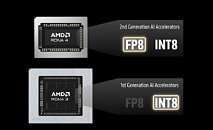
For example, we know there are some fundamental differences in the RDNA generations regarding microarchitecture. For RDNA 3, this means there is no 8-bit floating point support in older generations, as only the latest RDNA 4 uses FP8. To run the FSR 4.1 Upscaling model on RDNA 3, AMD must convert this to 8-bit integer data, since RDNA 3 hardware uses INT8 data types without FP8 support. Generally, integer math is sufficient to optimize these models, but the conversion work is necessary, hence the delay between RDNA 4 and RDNA 3 support. This difference requires AMD to completely modify the FSR 4.1 model for the new data type and ensure there is no quality loss in the final visual output. AMD's software officials have confirmed that the company has been working hard on this issue, and more information will be released next month, in July, as the launch approaches.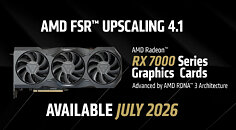
 What about RDNA 2?
For RDNA 2, the situation becomes much more complex. First, RDNA 2 hardware lacks dedicated AI accelerators within the GPU microarchitecture. This means that RDNA 2 GPUs will rely on the Stream Processors in the GPU configuration to power FSR 4.1 upscaling. As a result, the raw GPU compute, without any additional AI compute, will be responsible for the upscaling model. This requires a great deal of optimization to make the process work efficiently. AMD claims that making FSR 4.1 upscaling consume fewer shader cycles is very challenging. Therefore, AMD is taking more time to optimize this but plans to launch support sometime in 2027. While there is no specific timeline for when AMD will achieve this, the necessary background work is still required to deliver a smooth experience for RDNA 2 gamers without affecting performance.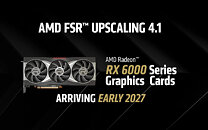 How does AMD run the optimization?
TechPowerUp's team was curious to learn how AMD manages the work behind this development and to understand more about the entire process. AMD described a multi-tier system for the development, refinement, and optimization of the FSR 4.1 upscaling algorithm. The first stage involves general training of FSR 4.1 on Instinct MI accelerators. Since the FSR upscaling algorithm is not as large as many of today's language models that power ChatGPT, Claude, Grok, Gemini, and others, only a few smaller clusters are needed. There is no requirement for supercomputer-scale computing to train this model, as the computational demand is much smaller. Next, AMD uses its workstation-grade Radeon Pro GPUs to further refine the models and prepare the overall environment.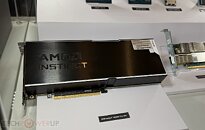 In these Radeon Pro systems, final polishing is carried out using the ROCm platform, which is now supported on regular Radeon, Radeon Pro, and up to the Instinct MI accelerators. With uniform software framework support across all GPUs, development becomes easier. Before AMD can start shipping the FSR model, the company tests hundreds of thousands of PC configurations with regular Radeon GPUs. These tests are conducted across a wide range of PC setups with various CPUs, RAM configurations, motherboards, power supplies, and any other factors that could impact the testing.
For example, we know there are some fundamental differences in the RDNA generations regarding microarchitecture. For RDNA 3, this means there is no 8-bit floating point support in older generations, as only the latest RDNA 4 uses FP8. To run the FSR 4.1 Upscaling model on RDNA 3, AMD must convert this to 8-bit integer data, since RDNA 3 hardware uses INT8 data types without FP8 support. Generally, integer math is sufficient to optimize these models, but the conversion work is necessary, hence the delay between RDNA 4 and RDNA 3 support. This difference requires AMD to completely modify the FSR 4.1 model for the new data type and ensure there is no quality loss in the final visual output. AMD's software officials have confirmed that the company has been working hard on this issue, and more information will be released next month, in July, as the launch approaches.


For RDNA 2, the situation becomes much more complex. First, RDNA 2 hardware lacks dedicated AI accelerators within the GPU microarchitecture. This means that RDNA 2 GPUs will rely on the Stream Processors in the GPU configuration to power FSR 4.1 upscaling. As a result, the raw GPU compute, without any additional AI compute, will be responsible for the upscaling model. This requires a great deal of optimization to make the process work efficiently. AMD claims that making FSR 4.1 upscaling consume fewer shader cycles is very challenging. Therefore, AMD is taking more time to optimize this but plans to launch support sometime in 2027. While there is no specific timeline for when AMD will achieve this, the necessary background work is still required to deliver a smooth experience for RDNA 2 gamers without affecting performance.

TechPowerUp's team was curious to learn how AMD manages the work behind this development and to understand more about the entire process. AMD described a multi-tier system for the development, refinement, and optimization of the FSR 4.1 upscaling algorithm. The first stage involves general training of FSR 4.1 on Instinct MI accelerators. Since the FSR upscaling algorithm is not as large as many of today's language models that power ChatGPT, Claude, Grok, Gemini, and others, only a few smaller clusters are needed. There is no requirement for supercomputer-scale computing to train this model, as the computational demand is much smaller. Next, AMD uses its workstation-grade Radeon Pro GPUs to further refine the models and prepare the overall environment.

35 Comments on AMD Explains FSR 4.1 Upscaling for RDNA 3, Promises Quality Parity with RDNA 4
I would still much prefer the old 8-pin because of the foolproof-ness, but that eases the fear a little...
You may have seen it on a past page, but heres my 5080, with 111% / 400w power limit, running an 8k render stress test for a prolonged period. The wireview was a mix of piece of mind, and case bling becuase who doesn't like another screen/diagnosic, especially as a hardware solution with zero software needed.
I'm not saying AMD is white, I am the first to shit on them -not providing any excuses for the very late RX9000 launch, taking a wholeass year to finally announce FSR4 support pre-RDNA4, removing TSME for non-PRO CPUs in the BIOS even though it's been there since Ryzen 3000...- all the time even if I favor their hardware over NvdiAI's but far too many NvidAI users are far too quick n' happy to excuse the shortcomings of the ones that put us in the deepest shitpit (DRAM shortage) we've seen since the bitcoin mining GPU hoard of 2021 (they didn't cause that one but they sure as hell facilitated it)
It seems some people let their hatred cloud their judgement or maybe they were at Computex eavesdropping on the conversation and what has been posted has clearly been falsified!
A rushed out product that has not been thoroughly tested will be responded with harsh criticism, so as you guys said, better to take their time and bring out a working product
Definitely because of bandwidth; fp16 uses a 16-bit data packet while int8 uses an 8-bit packet. int8 uses half the memory (L0/L1) and bandwidth, which means much better headroom for 'dual-issue' and 'stalls' situations.
And as it turns out, the criticism often leads to better outcomes and more transparency. Perhaps there's elements of this bias people hold that benefits the consumers of 'the other side'. AMD officially bringing FSR4 to previous generations stands as an (at least partially credited) example of that.