Thursday, June 18th 2026

AMD Ryzen Threadripper TR6 "Mustang Peak" Arrives with "Zen 6" and PCIe 6.0
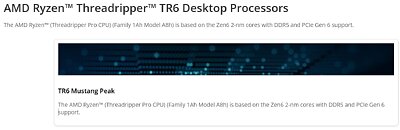
AMD, through its official documentation portal, has confirmed the arrival of the next-generation Ryzen Threadripper TR6 "Mustang Peak" platform, along with some intriguing details about the upcoming CPU lineup. Based on the "Zen 6" CPU architecture, AMD is incorporating the latest I/O standards for these workstation powerhouses, including PCIe 6.0 and DDR5. As the "Zen 6" CPU cores are manufactured on TSMC's 2 nm semiconductor node, we expect AMD to increase the core count over its previous "Zen 5" Ryzen Threadripper workstation platform and deliver a significant performance boost due to advancements in node and microarchitecture. While specific details like TDP, clock speed, core counts, and segmentation are still lacking, we have learned that AMD is retiring its TR5 socket in favor of the new TR6 socket that will accommodate the platform.
With the introduction of PCIe 6.0, which doubles the bandwidth of PCIe 5.0 per lane configuration, AMD needs to add more pins to handle the increased bandwidth. Additionally, with varying core counts and clock speeds, the CPU socket likely requires more electrical capacity to support the new platform, necessitating an overhaul. If readers recall, the previous TR5 socket used 4,844 pins. For the TR6 update, it is possible that the pin count could exceed that number.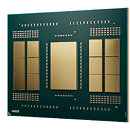
 In previous leaks, we learned that "Zen 6" increased the core count to 12 cores per CCD. This is an improvement over the 8 cores per CCD that "Zen 5" currently offers in non-dense configurations. If the CPU maintains its maximum configuration of 12 CCDs, it would result in 144 cores and 288 threads, which is 50% higher than the 96-core, 192-thread configuration of the AMD Ryzen Threadripper 9995WX. AMD's documentation did not suggest any launch date, indicating that we are still months away from the actual release. AMD is likely to start shipping the first "Zen 6" CPUs in the form of server EPYC SKUs, followed by consumer Ryzen, with the HEDT platform being released later.
Source:
InstLatX64 on X
With the introduction of PCIe 6.0, which doubles the bandwidth of PCIe 5.0 per lane configuration, AMD needs to add more pins to handle the increased bandwidth. Additionally, with varying core counts and clock speeds, the CPU socket likely requires more electrical capacity to support the new platform, necessitating an overhaul. If readers recall, the previous TR5 socket used 4,844 pins. For the TR6 update, it is possible that the pin count could exceed that number.


29 Comments on AMD Ryzen Threadripper TR6 "Mustang Peak" Arrives with "Zen 6" and PCIe 6.0
I know about this item
www.bhphotovideo.com/c/product/1928256-REG/highpoint_r7638d_rocket_7638d_external_pcie.html
But if a big manufacturer like ASUS or GIGA would start doing it, would ease the price - somewhat.Well, since those boards and CPUs are packed with 4 or more times of lanes and the complexity is a lot higher, while they can't really sell that much,
The price will stay in the red.Yupp, we all wish for this.
If you don't need the lanes/slots and more than 16 cores 7950X...9950X3D2 with fast DDR5 ECC is an excellent performance combo even with 9950X3D2 terrible price but finding the right mother board for some kind of reasonable expansion can be a challenge. This is why I picked the B650 LiveMixer because it offered slots x16 + x4 from the CPU and x4 from the chipset while allowing room for 2 slot GPU in the 2nd position from the top. 2 x M.2 usable but +1 shared with the chipset x4 was the tradeoff. Even with that I had to compromise and put my GPU in the CPU x4 slot so I could use the x16 bifurcation for my dual(or quad) Optane AIC and still have room for 10Gbps NIC on the last x4 slot. The only other way I was going to get close to that combo on AM5 was to get one of those premium tier motherboards for like $450 to $600 which was around 2/3 the cost of a TR motherboard anyway. At the time I wasn't gong to do that and the highly underrated B650 $150 motherboard got me there instead amazingly for under $50 what I paid for with X570 with a similar layout.
The motherboards aren't that much more than a "high-end" AM5 motherboard which many wastes money on anyways, and can be found on discounts. (They likely also include a 10G NIC.) Threadrippers are also much easier to cool, so a $70 Arctic Freezer 4U-M will do just fine. Power users who are likely to need storage upgrades can add storage as needed, rather than replacing their SSDs with much larger ones. All of which, when relevant, adds to the value of the platform.
But the big problem is the current price and availability of registered memory. Otherwise I would recommend choosing between low-core AM5 or Threadrippers, rather than the in-between solution.
I experienced some weird hitches with my 7950X3D in Space Marine 2 that I never did with the 7800X3D. That's why I'm back on 8 cores now, and will be until AMD increases cores per CCD.