Tuesday, June 30th 2026

AMD Versal Premium Gen 2 Memory on Package SoCs Integrates up to 32 GB of LPDDR5X
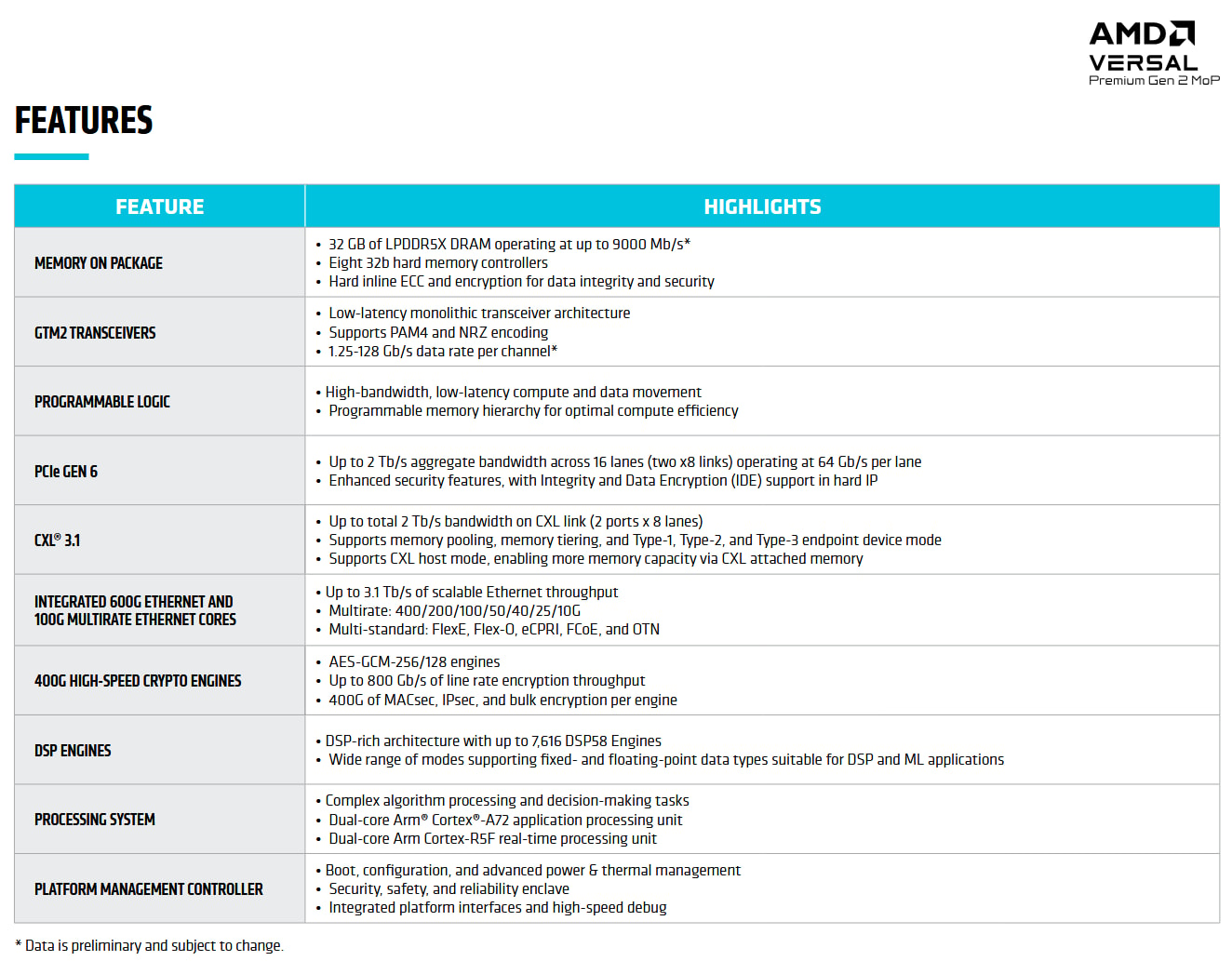
AMD today announced the AMD Versal Premium Gen 2 Memory on Package (MoP) adaptive system-on-chips (SoCs). The MoP architecture integrates up to 32 GB of LPDDR5X into a single package, delivering up to 288 GB/s of bandwidth in up to 60% less board area, letting engineers build high-bandwidth systems without the risk and time of board-level memory design. As physical AI, networking, and aerospace and defense workloads push more data through ever-tighter space and power budgets, MoP targets the designs that need it most: test and measurement, professional video editing, and VPX systems for secure communications and defense acceleration.
"For years, system architects had to choose between the memory bandwidth they wanted and the space, power and longevity their programs could actually live with. Memory on Package removes that tradeoff. Our customers can design for the system they want to build, not the one their memory constraints allow, and bring it to market faster."—Sumit Shah, head of product management and marketing, Adaptive and Embedded Computing Group, AMD Shrink the Footprint and Scale the Bandwidth
With our new memory on package adaptive SoC, we are redefining what is possible in compact system designs. By integrating LPDDR5X directly into the package, the device enables higher performance compared to onboard LPDDR5X while using less area than discrete implementations.
This opens the door to form factors that have been difficult or impractical with external memory, such as the Enterprise and Datacenter Standard Form Factor (EDSFF) and 3U VPX systems, while also helping designers meet telecom and VPX requirements that discrete memory approaches often cannot match.
Versal Premium Gen 2 MoP devices integrate CXL 3.1 and PCIe 6.0 at 64 Gb/s in hard IP, enabling high-speed data movement when paired with AMD EPYC CPUs to accelerate data-intensive applications. We help system architects gain greater flexibility to scale memory resources with LPDDR5X support of up to 9,000 Mb/s and connectivity to CXL memory pooling and expansion modules.
Built for Long Life Cycle Deployments
Designed with demanding physical and enterprise AI environments in mind, Versal Premium Gen 2 MoP adaptive SoCs support industrial-grade operation from -40 degrees Celsius to 110 C. They are well suited for always-on, mission-critical systems where performance and resilience must go hand in hand.
With LPDDR5X and 15-plus-year life cycle support, Versal Premium Gen 2 MoP devices help decouple product availability from high-bandwidth memory's (HBM) shorter, data-center-driven refresh cycles, reducing the risk of forced redesigns caused by memory end of life or limited accessibility.
PCIe Integrity and Data Encryption (IDE), a feature introduced in PCIe 6.0, helps protect against physical attacks by securing data in flight at the link layer. DDR memory encryption in integrated controllers helps protect data at rest without consuming programmable logic resources. Hard 400G High-Speed Crypto Engines enable high-bandwidth secure processing, strengthening security without sacrificing throughput.
Accelerate Time-to-Market
Versal Premium Gen 2 MoP devices include a pre-validated, in-package LPDDR5X interface that eliminates high-speed memory routing across the circuit board to reduce board-level simulation and validation while helping shorten development cycles, lower design risk and minimize costly re-spins.
Users can begin development today with standard AMD Versal Premium Series Gen 2 devices, which are now shipping. Support for established AMD Vivado and Vitis tool workflows, compatible IP and available reference designs helps quickly move designs from concept to deployment while enabling existing customers to adopt new MoP devices with no rework or relearning.
AMD Versal Premium Gen 2 MoP devices begin sampling at the end of 2026 with production shipments expected to begin in the second half of next year.
Source:
AMD blog
"For years, system architects had to choose between the memory bandwidth they wanted and the space, power and longevity their programs could actually live with. Memory on Package removes that tradeoff. Our customers can design for the system they want to build, not the one their memory constraints allow, and bring it to market faster."—Sumit Shah, head of product management and marketing, Adaptive and Embedded Computing Group, AMD

With our new memory on package adaptive SoC, we are redefining what is possible in compact system designs. By integrating LPDDR5X directly into the package, the device enables higher performance compared to onboard LPDDR5X while using less area than discrete implementations.
This opens the door to form factors that have been difficult or impractical with external memory, such as the Enterprise and Datacenter Standard Form Factor (EDSFF) and 3U VPX systems, while also helping designers meet telecom and VPX requirements that discrete memory approaches often cannot match.
Versal Premium Gen 2 MoP devices integrate CXL 3.1 and PCIe 6.0 at 64 Gb/s in hard IP, enabling high-speed data movement when paired with AMD EPYC CPUs to accelerate data-intensive applications. We help system architects gain greater flexibility to scale memory resources with LPDDR5X support of up to 9,000 Mb/s and connectivity to CXL memory pooling and expansion modules.
Built for Long Life Cycle Deployments
Designed with demanding physical and enterprise AI environments in mind, Versal Premium Gen 2 MoP adaptive SoCs support industrial-grade operation from -40 degrees Celsius to 110 C. They are well suited for always-on, mission-critical systems where performance and resilience must go hand in hand.
With LPDDR5X and 15-plus-year life cycle support, Versal Premium Gen 2 MoP devices help decouple product availability from high-bandwidth memory's (HBM) shorter, data-center-driven refresh cycles, reducing the risk of forced redesigns caused by memory end of life or limited accessibility.
PCIe Integrity and Data Encryption (IDE), a feature introduced in PCIe 6.0, helps protect against physical attacks by securing data in flight at the link layer. DDR memory encryption in integrated controllers helps protect data at rest without consuming programmable logic resources. Hard 400G High-Speed Crypto Engines enable high-bandwidth secure processing, strengthening security without sacrificing throughput.
Accelerate Time-to-Market
Versal Premium Gen 2 MoP devices include a pre-validated, in-package LPDDR5X interface that eliminates high-speed memory routing across the circuit board to reduce board-level simulation and validation while helping shorten development cycles, lower design risk and minimize costly re-spins.
Users can begin development today with standard AMD Versal Premium Series Gen 2 devices, which are now shipping. Support for established AMD Vivado and Vitis tool workflows, compatible IP and available reference designs helps quickly move designs from concept to deployment while enabling existing customers to adopt new MoP devices with no rework or relearning.
AMD Versal Premium Gen 2 MoP devices begin sampling at the end of 2026 with production shipments expected to begin in the second half of next year.
28 Comments on AMD Versal Premium Gen 2 Memory on Package SoCs Integrates up to 32 GB of LPDDR5X
But hey, one can dream, yes ? :D
ARM cores, memory controllers, serdes blocks, pcie root complexes, ethernet controllers, even dsp blocks
think about it, if the RAM is integrated with the northbridge, and if they can price it right, that cuts outs the major memory makers
This would suck for O/C'ers, but, for pretty much everyone else, it's a win-win
It would not work on desktop because of cost and economies of scale and the "open" nature of desktop, not to mention rate of failure, when your ram fails(it's not if, it's when on a normal pc) you simply chuck another dimm, with this you have to change your thousand+ usd cpu (because with ram it will cost that much), not to mention that the footprint of the chip will be HUGE -this works on a fpga because the die is already massive- making retention mechanism and socket extremely expensive, plus you're concentrating even more heat on the cpu package leading to cooling challenges(even bigger and heavier coolers, which in turn need even bigger and heavier anchor points to not rip the motherboard when shipped)
I was thinking more along the lines of licensing the tech for the RAM chips, not buy the chips from the memory makers, then TSMC would make everything in one package
Think about it, every phone out there gets thrown around, exposed to massive temperature swings, and is exposed to far more movement then any stationary machine. How often do you hear of RAM failure on phones?
Cooling is easy to fix, if the coolers are too big...mount them tot he case. OEMs ahve been doing this for years, and this is an area when the ATX standard shows its advanced age. BTX fixed this, but nobody wanted it. And again, OEMs solved this already, Apple devices anyone?
Oh but you do hear about ram failure in phones, unstability, crashes, bricking it's just you don't associate it to it.
And ram failure is not uncommon, it's true it's got a lot better but i wouldn't want it, i couldn't tell you how many soldered ram+cpu laptop motherboards we4 had to throw away because they're unfixable
That is exactly what Nanya is doing to making their own RAM, they license the tech from Micron
that's the whole point of licensing the IP of other companies, so you don't have to reinvent things, and find your way around patents
If licensing highly profitable IP was so easy we'd have had a dozen x86 chipmakers & probably two dozen from ARM as well.
Apple, Nvidia, amd, intel, Qualcomm, TI, mediatek... loads more
There were a bunch of dram manufacturers, just like there were a bunch of HDD manufacturers.
it's not unlikely market and government collusion killed a load of those.
To bad we can't just setup a company, spin up a plant and just make the stuff
Not even leather jacket guy's done it in well over a decade! Competing at the high end/bleeding edge is no cakewalk.
Now that technology is stagnating it might get easier and less financially difficult to enter the market relatively.