Wednesday, July 15th 2026

Samsung Launches 990 QLC DRAMless SSD, $270 for 1TB, $530 for 2TB
Samsung on July 14 formally launched the 990, its value-segment M.2 NVMe SSD. Not to be confused with the 990 EVO, another DRAMless SSD from the company that uses TLC NAND flash, the new 990 implements QLC NAND flash, and relies on controller-level optimization to shore up performance. Built in the M.2-2280 form-factor, the Samsung 990 features an M.2 NVMe Gen 4 (PCI-Express 4.0 x4) host interface, and is driven by a Samsung Piccolo-Q DRAMless controller. It uses the company's in-house V9 series 280-layer 3D QLC NAND flash memory.
The Samsung 990 comes in two capacity variants, 1 TB and 2 TB, priced at $270 and $530, respectively. The 1 TB variant offers sequential reads of up to 7150 MB/s with up to 6450 MB/s sequential writes, with up to 700,000 IOPS 4K random reads and up to 1.1 million IOPS 4K random writes; while the 2 TB variant offers slightly higher performance, with up to 7250 MB/s sequential reads, up to 6450 MB/s sequential writes, up to 850,000 IOPS 4K random reads, and up to 1.2 million IOPS 4K random writes. Where the 990 differs significantly from the TLC-based 990 EVO Plus, is write-endurance. The 2 TB variant offers 800 TBW, while the 1 TB variant offers a paltry 400 TBW. For reference, the 2 TB 990 EVO Plus offers 1200 TBW, and 1 TB 990 EVO Plus offers 600 TBW. Both variants are backed by 3-year warranties.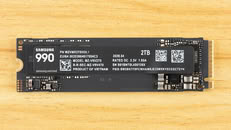
Source:
Tom's Hardware
The Samsung 990 comes in two capacity variants, 1 TB and 2 TB, priced at $270 and $530, respectively. The 1 TB variant offers sequential reads of up to 7150 MB/s with up to 6450 MB/s sequential writes, with up to 700,000 IOPS 4K random reads and up to 1.1 million IOPS 4K random writes; while the 2 TB variant offers slightly higher performance, with up to 7250 MB/s sequential reads, up to 6450 MB/s sequential writes, up to 850,000 IOPS 4K random reads, and up to 1.2 million IOPS 4K random writes. Where the 990 differs significantly from the TLC-based 990 EVO Plus, is write-endurance. The 2 TB variant offers 800 TBW, while the 1 TB variant offers a paltry 400 TBW. For reference, the 2 TB 990 EVO Plus offers 1200 TBW, and 1 TB 990 EVO Plus offers 600 TBW. Both variants are backed by 3-year warranties.

41 Comments on Samsung Launches 990 QLC DRAMless SSD, $270 for 1TB, $530 for 2TB
I can't possibly in good conscience recommend something this horrible at any price. Buy a quality drive instead, a smaller one in size if needed.
I bet that there's better data management in a ransomware group than for this drive.
2026, ffs.
The SSD we don't need at around $300 MSRP you call that value?
I rather Samsung re-release Gen 3 SSD like Samsung 970 series than this piece of trash.
Using hyperbole when talking about performance is grounds for heavy misunderstanding. If the HDD NAS is slower at reading/writing a single 5GB file, then that equivalency is false. Edge case scenarios shouldn't be the norm to make claims like that.
Finding a drive that suits your standards seems very hard; so far, they all seem to fall that 4000mb/s mark at some point. Sounds like you need very high-end and professional solution rather than a mainstream drive.
I often wish someone just used a smidgen of common sense and released some truly great but basic SSDs; like a true pro SSD using SLC flash, DRAM cache and power loss protection, starting from ~128 GB, perfect for an OS drive, and released a PCIe version in addition to a M.2 version. Instead of all these pointless white label SSDs released by most makers today.That's probably the point. Well informed buyers will not buy this crap, but the various prebuilts usually "scam" people by using inferior parts like this; parts which looks great on paper, in addition to cooling, PSUs etc.
so in this case, they shave a few $ getting rid of the DRAM, but NAND is still very expensive
Prices on amazon.de include our 22% VAT. We're going to see more Optimusation, not less, from all brands.It's just nitpicking but data rates are used with decimal prefixes which stand for decimal multipliers, over any interface or network, since ever. By converting 220 M to Mi, you would get, well, even less.
They might have it available in their fabs, because it has been used in semiconductor industry to remove oxides from surfaces.
www.science.org/content/blog-post/sand-won-t-save-you-time