Sunday, September 6th 2026
PC GPU Shipments Grow 10% Quarterly Despite Record-High Prices
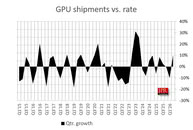
PC GPU shipments are actually increasing despite record-high prices, according to Jon Peddie Research. However, the details reveal more complexity. JPR measures shipments of all PC GPUs, and since PCs come in various forms, so do GPUs. Overall, in Q2 of this year, there was a significant 10.4% increase quarter-over-quarter and about 1.1% year-over-year compared to Q2 2025, reaching 75.5 million GPUs this quarter. This large increase is primarily driven by shipments in the notebook graphics card sector, which saw a massive 16.8% jump, while dedicated desktop GPUs experienced a 4% reduction on a quarterly basis.
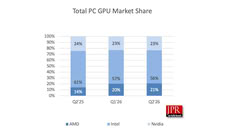
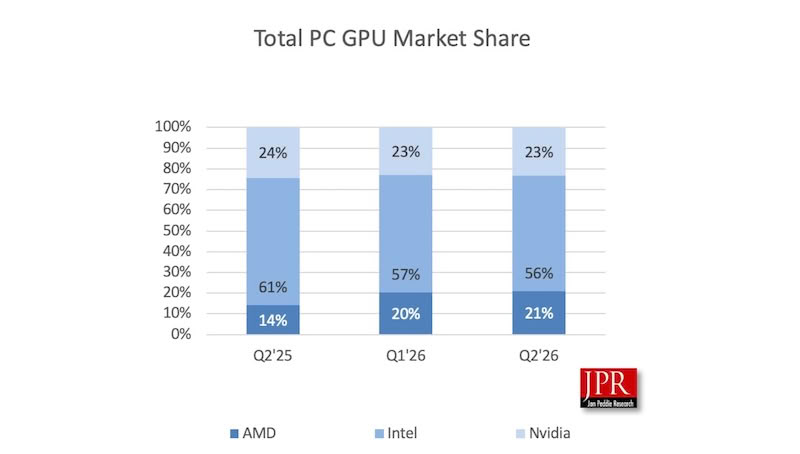
Looking at the per-vendor statistics of PC GPUs, the three major GPU designers—AMD, Intel, and NVIDIA—show some changes compared to the same period a year ago, with slight adjustments to quarterly changes. Intel continues to dominate, with 56% of all PC GPU shipments being Intel-derived. Although the discrete desktop GPU segment might not be Intel's strongest area, it's important to remember that Intel sells millions of GPUs in laptop form factors and with integrated graphics across its SoCs. Most modern Intel CPUs include some form of integrated graphics. However, Intel's lead decreased by 1% quarter-over-quarter and about 5% year-over-year. NVIDIA saw a 0.46% increase, while AMD experienced a marginal 0.6% increase in market share quarterly.
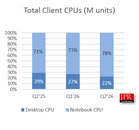
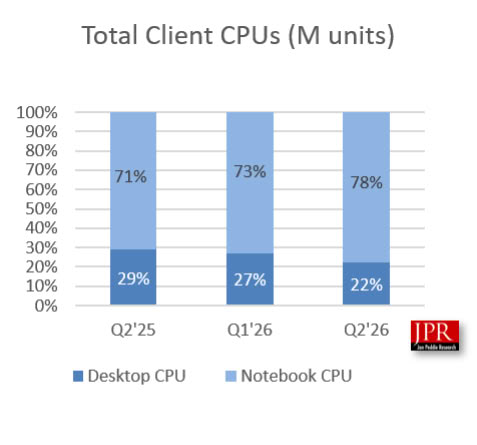
 JPR reports also cover CPU shipments, showing that AMD's CPU shipments grew by 12.74%, while Intel's increased by 8.99% in the client sector. In recent quarters, the recurring theme is that desktop CPUs are driving a minority of shipments, while laptop shipments account for the majority. Currently, desktops make up nearly a fifth (22%) of shipments, while a record 78% of client CPU shipments are going to the notebook segment.
Source:
JPR
Looking at the per-vendor statistics of PC GPUs, the three major GPU designers—AMD, Intel, and NVIDIA—show some changes compared to the same period a year ago, with slight adjustments to quarterly changes. Intel continues to dominate, with 56% of all PC GPU shipments being Intel-derived. Although the discrete desktop GPU segment might not be Intel's strongest area, it's important to remember that Intel sells millions of GPUs in laptop form factors and with integrated graphics across its SoCs. Most modern Intel CPUs include some form of integrated graphics. However, Intel's lead decreased by 1% quarter-over-quarter and about 5% year-over-year. NVIDIA saw a 0.46% increase, while AMD experienced a marginal 0.6% increase in market share quarterly.


18 Comments on PC GPU Shipments Grow 10% Quarterly Despite Record-High Prices
AMD going from an architecture for everything like GCN to a gaming architecture like RDNA came at the worst possible timing. AMD should have never split it's architectures and selling CDNA/UDNA everywhere.
Manufacturers don't just send their products to retailers for free, hoping they'll get paid later when the products are sold to individuals or companies.
But I don't understand why jpr is still somehow seen as a valid source for these sort of metrics, not when they're obfuscating dedicated GPU sales, and hide data behind a paywall.
this is a bit more interesting, Intel is still leading the pack by a wide margin
The sheer number of 5090 reviews shows they are in fact selling well. I've personally decided I don't want to spend that much money on a single AIB but others have decided they can and will.
The report distinguishes between the 2 and provides numbers for both. It seems a lot of people on this thread just looked at the pictures and didn't read any of the text in the article, especially since folks are posting that dGPU shipments fell when in fact they rose by double digits but were outnumbered by iGPU shipments and so their share of shipment fell.
My favorite comment so far is the one that put the 30 second article into an AI model because apparently the poster couldn't be arsed to actually read it. Ironically the biggest critics of the AI age are behaving like 0.1 gen AIs themselves.
I get that many are upset that AIBs are unaffordable, and that's a legit complaint. But that doesn't mean other people can't afford them. In fact, I suspect a lot of the shipment increase is from users who are buying multiple AIBs at once. Over at Neogaf I saw people talking about building mutli-RTX 6000 Pro workstations like they were discussing the weather. The market has stratified into folks who can afford nearly anything and folks who can't afford anything at all.
Intel, AMD, Nvidia don't publish their sales numbers, so these analysts resorted to all kinds of estimates to get approximate numbers from publicly available numbers, they don't just magically get some special insight other mortals can't - exact sales numbers are closely guarded trade secrets.
And these estimates were probably comparable in normal market conditions in the past. But we're not in normal market conditions - most companies that actually benefit now do do from the sales to servers, AI, datacenter sector. But stating so directly in their earnings reports would expose the weakness of such growth in a single sector, so they creatively spread the revenue around - we know Nvidia did that with cryptomining revenue, got sued by their shareholders multiple times, some lawsuits were dismissed outright, and even the one that Nvidia lost they just don't agree with the result and refuse to pay. And to make such lawsuits harder in the future Nvidia actually clouded their revenues by combining and mixing stuff that could cover almost anything in their new "Edge Computing".
And I don't believe other companies don't treat their fiscal reports as anything else as another PR opportunity. Even if prosecuted, the fines are laughably small compared to the benefit of appearing healthy and non vulnerable to AI bubble bursting.
So I think these estimates are widely off, calculated from the earnings reports that spread the AI, datacenter, server earnings around.