Wednesday, September 16th 2026

Apple Weighs Return to Server Market with NVIDIA Networking Technology
Apple is reportedly considering a return to the server market, where the company was once active with its Xserve rack technology. According to The Information, Apple is developing AI-focused M-series chips, which could incorporate several NVIDIA components, including the NVLink Fusion portfolio of technologies and IP. This includes the possibility of interconnecting two or four Apple M8 Ultra chips using NVIDIA NVLink for socket-to-socket communication, while NVIDIA NVLink-C2C manages die-to-die interconnection. Currently planned for launch in 2029, this product would mark Apple's first entry into the server space since debuting Xserve in 2002 and discontinuing it in 2011. Nearly two decades later, Apple's server offering might be making a comeback, building on the success that the Mac mini and Mac Studio are experiencing among AI developers.
For instance, Apple's Mac lineup achieved a record $10.4 billion in sales last quarter, with strong demand from the AI community. Enterprises are even constructing custom racks, mounting multiple Mac Studios to set up local AI inferencing efforts. For the new server design, Apple would delegate every interconnect question to NVIDIA NVLink Fusion, while it focuses on the actual system-on-chip as before. The new rack design would target enterprises and governments, who may already be running Mac clusters locally.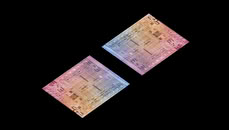 Readers might recall that Apple is already working on a custom AI inference accelerator with Broadcom, codenamed "Baltra." It reportedly uses TSMC's 3 nm N3E or N3P nodes and is scheduled for late 2026 or early 2027. Perhaps Apple, which also develops Apple Foundation Models (AFM), will use the "Baltra" AI accelerator to run large-scale inference and serve its massive customer base with its models using that chip, and later offer its M8 Ultra chips as standalone racks. However, for a company as secretive as Apple, schedules might change, and we could see more information in the future. With the new CEO John Ternus at the helm, hardware offerings might expand significantly.
Source:
The Information
For instance, Apple's Mac lineup achieved a record $10.4 billion in sales last quarter, with strong demand from the AI community. Enterprises are even constructing custom racks, mounting multiple Mac Studios to set up local AI inferencing efforts. For the new server design, Apple would delegate every interconnect question to NVIDIA NVLink Fusion, while it focuses on the actual system-on-chip as before. The new rack design would target enterprises and governments, who may already be running Mac clusters locally.

18 Comments on Apple Weighs Return to Server Market with NVIDIA Networking Technology
That aside, if they're entering the server market, their support needs to be better than what it was back in Jobs' era
2. Better scaling and performance for their on-prem hardware
It's unlikely that they'll enter the server market at all.
Enterprises want support, not just hardware that blows their minds performance wise.
Apple has tons of third-party hardware in their own datacenters and he undoubtedly understands that connecting a Mac to the rest of the equipment is the bottleneck hence the selection of NVLink as a possible solution (for these time being).
If Apple wanted to market a standalone server they could have squashed the Mac Studio into a 1U rack pizza box three years ago and shipped it.
John probably said to himself, “the devs who are buying up Mac Studios want easier connectivity to the rest of the data center.” That’s the issue, the form factor not as much.
Working backwards from the customer experience back to the hardware design is a classic Steve Jobs approach. Don’t build hardware then try to figure out how to sell it and to whom.
He did this with the MacBook Neo. He pictured a certain class of users and worked backwards to the hardware and ended up with a notebook powered by a smartphone SoC.
There are many people on tech discussion forums like TPU who don’t understand the Neo. That’s because they don’t understand that there’s a planet full of people who have different usage cases than them. John Ternus gets it.
Doesn't really matter how fast the cores/GPUs are if the systems can't talk to each other fast enough and move data efficiently.Yeah if Apple enters the server market their cores will immediately be the top performers.
NVIDIA has also made it easy to integrate third party IP with their hardware.
Even if there is an interconnect technology that has faster peak transfer speeds, NVLink is currently the most prevalent right now.
A brand new awesome interconnect is useless if you have nothing to plug into.
Apple already has a lot of customers who are buying high-spec Mac Studios and Mac minis for AI development. The demand is already there. Mac minis have been present in data centers since their early years and yes there are still companies that provide this service (Mac Mini Vault is one).
It's up to each business to decide what their product mix should be and to adapt to an ever changing market if they want to survive, both short term and long term. Nintendo still makes hanafuda playing cards like they did at their founding in the 19th century but today they make more revenue from Switch software and Pokémon cards.
This is just an exploratory phase just like Apple's self-driving vehicle never hit the market. But for sure Apple will learn something they can take away from this even if this product never launches.
The reality is that if NVIDIA designs the hardware that Apple requires, they will make the deal. Same goes for a lot of the long time vendors like Cirrus and ImgTech.
Pretty advanced and mostly only comparable to Nvidia GPUs and what Intel is starting to build for next year.
www.techpowerup.com/cpu-specs/epyc-9996.c4532
On level of IPC, it looks like AMD is not going to touch what Apple is doing.