Tuesday, October 13th 2026

NVIDIA DLSS 5 Gets 2x Performance Boost with 20% Less VRAM Usage
NVIDIA's continuous optimization of software and its technology stack has yielded another great improvement. The latest DLSS 5 update, scheduled for October 16, will deliver another 2x performance boost, meaning that previously DLSS 5-optimized workloads will literally run twice as fast. Alongside this significant performance uplift, NVIDIA promises that in 4K gameplay with DLSS 5 enabled, the neural rendering technology will use 20% less VRAM, leaving more room for game textures to load without DLSS 5 interfering with capacity or hogging resources. NVIDIA updates its DLSS by running a continuous loop on top of an internal supercomputer that constantly optimizes DLSS technology for performance, efficiency, and visual fidelity. Specifically for this week's DLSS 5 update, NVIDIA states that the company used a combination of systematic pipeline optimizations and neural model refinements to achieve that 2x performance boost.
Originally in late August, we saw that the leaked DLSS 5 file was roughly a 148 million parameter model. Our analysis turned out to be accurate, and we see that, according to NVIDIA, the DLSS 5 October update shrinks the footprint of this model by another 24% to roughly 118 million parameters, meaning that our original estimation was correct. Consequently, the smaller model scales memory usage almost linearly and cuts VRAM usage by about 20%. Compared to the initial launch in mid-March, when the DLSS 5 was showcased on two GeForce RTX 5090 GPUs, we see that NVIDIA managed to scale the performance by 10x in the span of a couple of months.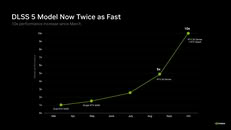 You can see the DLSS 5 September versus October update below.
Source:
NVIDIA
Originally in late August, we saw that the leaked DLSS 5 file was roughly a 148 million parameter model. Our analysis turned out to be accurate, and we see that, according to NVIDIA, the DLSS 5 October update shrinks the footprint of this model by another 24% to roughly 118 million parameters, meaning that our original estimation was correct. Consequently, the smaller model scales memory usage almost linearly and cuts VRAM usage by about 20%. Compared to the initial launch in mid-March, when the DLSS 5 was showcased on two GeForce RTX 5090 GPUs, we see that NVIDIA managed to scale the performance by 10x in the span of a couple of months.

25 Comments on NVIDIA DLSS 5 Gets 2x Performance Boost with 20% Less VRAM Usage
"will deliver another 2x performance boost, meaning that previously DLSS 5-optimized workloads will literally run twice as fast."
Let's wait and see benchmarks from other people.
However, the most important question remains unanswered:Who or what benefits?
Regards,
RTX. It’s On.
So, they are still busy I see. Good.
Hope to see some of these results on non RTX-50 Series GPU's.
I'm astonished at the rate of development and performance optimization, I wonder what modders will be able to eek out of this, its going absolutely bananas out there.
Like I said before everyone is eventually going to have a decent neural network renderer. Nvidia is racing to corner the market and need to maximize it efficiency as quickly as possible.
Gamers are adding neural rendering to even PS5 video pass through, capture card and midrange rtx cards as of late.
Gta 6 with Neural rendering is already a possibility.
This is how AAA is getting rid of indie competition.
It should absolutely work on prio gen cards. The only feature that could improve performance on the 5000 series is 4-bit support and 4-bit support has never resulted in a 2x increase in any AI model. It's often 10% or less. Smaller models (like this) also see a larger quality drop when going from 8 bit to 4 bit.
Given that, I'm not surprised they've redone the model now with less VRAM requirement because it was pretty silly given they're only selling 16GB or (mostly) less cards.
This is probably gonna be locked to 50 series, but 40 series and older can still run fp8.
- You are a brand new account created today.
- This is your first and only post.
- Regurgitates Nvidia's market numbers
Nice to meet you JensenBot.You are leaving out the fact that the scenario in which those gains are had is at higher interactivity values.
Nevermind that the full DeepSeek R1 model is 1.36TB in size. DLSS5 5 is 150 MB. They aren't in the same universe, let alone the same type of models.
Any claims of Flux Dev getting a 390% speedup are complete BS. Stop regurgiating Gemi answers which cites Nvidia marketing material of all things as it's source.
VRAM savings going from 8 bit to 4 bit at this model size are basically irrelevant. I'd much rather take the higher qualty over 20-50 MB of saved space.
But a 5080 is tempting, even at the 2 grand price tag in the current market?
With that said, I don't think they changed the data types of the weights for the model at hand, but rather just adjusted the model's architecture.