Monday, October 26th 2026

28-Core Intel Nova Lake-S CPU Shows Promising Performance Boost in Leaked Benchmark

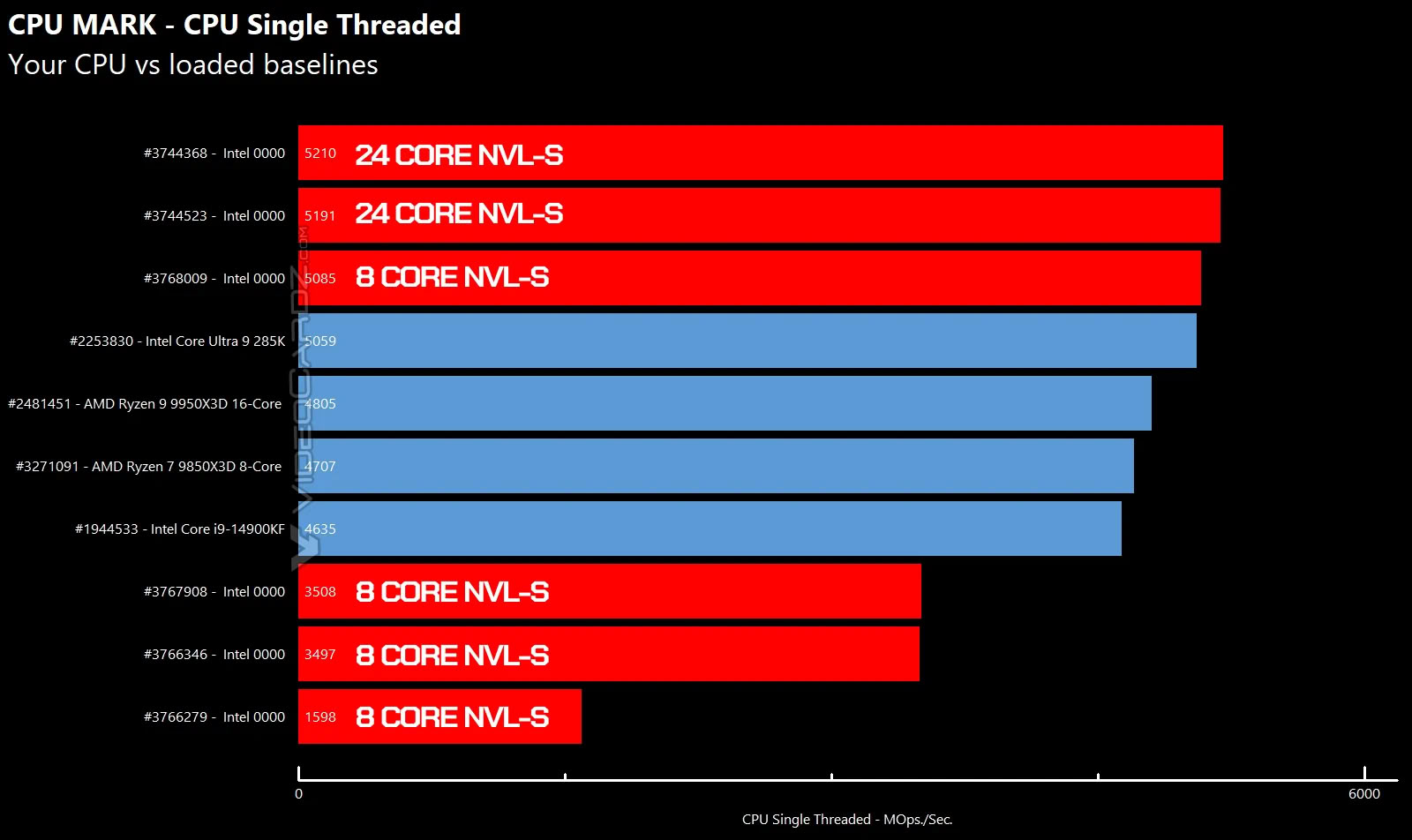
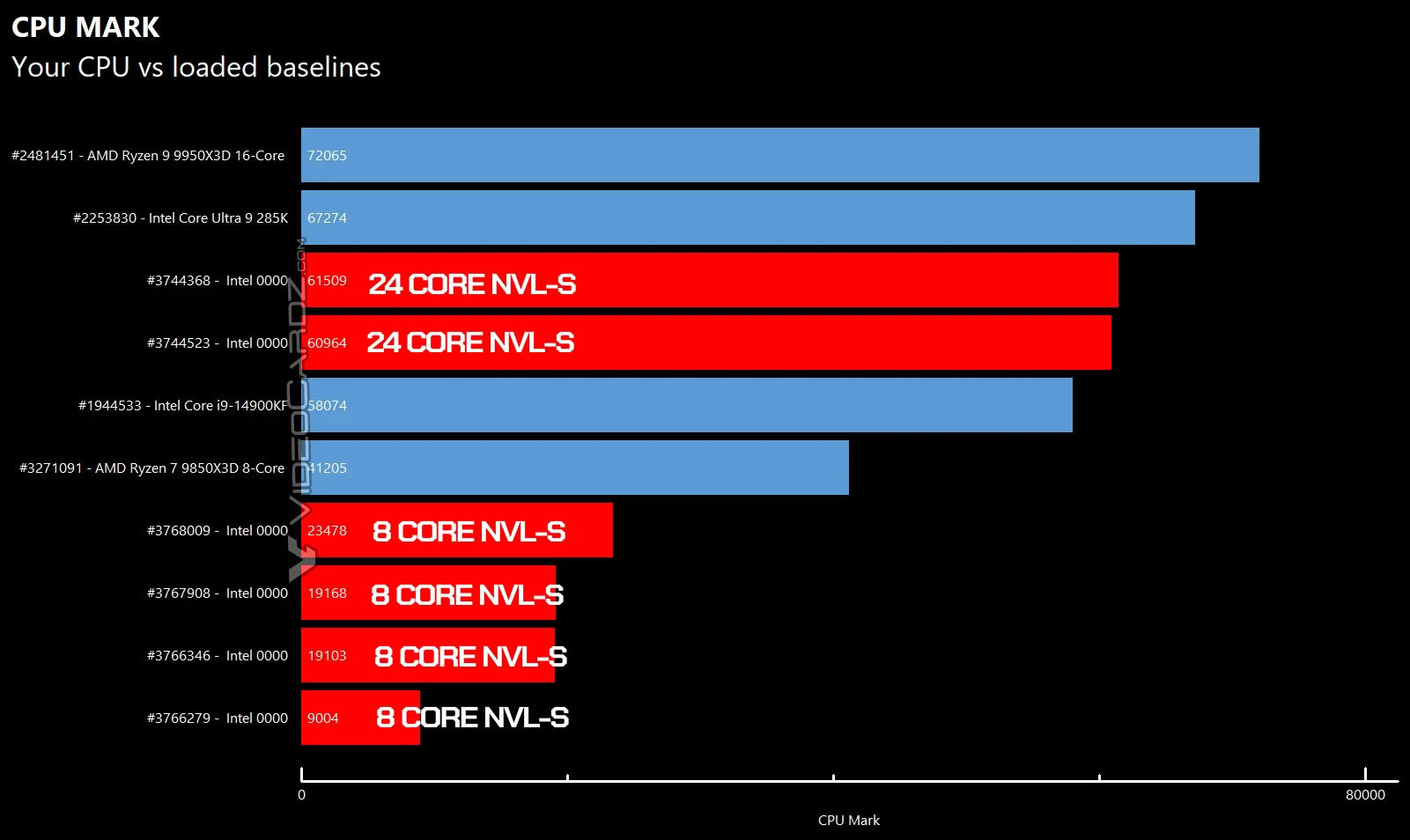
It looks as though the upcoming Intel Nova Lake-S CPU family will launch soon, headed-up by a 28-core Core Ultra 9 CPU. A new PassMark benchmark spotted by VideoCardz now purports to show expected performance of that 28-core Nova Lake-S CPU in two separate benchmark runs. The CPU, which is listed as "Nova Lake Client Platform," with the motherboard model giving it away as "NVL-S Embedded CRB 1 Fab2 Board," appears alongside an eight-core NVL-S CPU, and both CPUs achieve decent scores in the single-threaded performance benchmarks.

According to the PassMark database scores, the eight-core NVL-S scores up to 5,085 points, while the 24-core variant tops out at 5,210 points. Meanwhile, the 28-core—ostensibly the Core Ultra 9 4970K BFC—scores as high as 61,509 points in the multithreaded CPU test, and the eight-core variant, likely a Core Ultra 3 or 5 CPU, scores 23,478 points. If these PassMark scores are accurate, this puts the Core Ultra 9 4970K BFC at around 85% of the performance of an AMD Ryzen 9 9950X3D in multicore performance, while the CPU beats out the Intel Core Ultra 9 285K on single-threaded performance but misses out on matching the outgoing Intel chip by 5,721 points or around 8.5%.
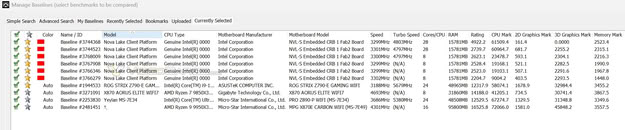
It should be noted that these are not official benchmarks, despite the rapidly approaching claimed Q1 2027 launch date. This means that there could be both driver and hardware improvements ahead of the launch, as well as memory compatibility improvements. That last point is especially important, since NVL-S scored very low in the Memory Mark benchmark, with the highest score coming in at 2,523.4, as opposed to the ~3,500 score usually associated with the Core Ultra 9 285K.
Source: VideoCardz
Add your own comment

23 Comments on 28-Core Intel Nova Lake-S CPU Shows Promising Performance Boost in Leaked Benchmark

#1
PierreJG
I never really follow leaks, as they usually do the test in the best-case scenario. I personally am not even a fan of the X3D models, as people try to make you believe you need one for gaming. I play Borderlands 4 on high with a Ryzen 5 5500 and RX6600XT. If I were in the market to go with Intel, I would also skip the first gen. I call them beta parts. I skipped first-gen Ryzen, and luckily I did, as it had a lot of problems. I bought a 2600 and had no memory issues, etc.
Posted on Reply
#2
XeonsNOpterons
The multicore performance gives little meaning right now as these are early samples and likely have lower unknown all-core clocks. PassMark does at least give the turboclock that was reached in the single-thread test which is 4.8GHz for these samples. Given that rough early number, this is a comparison of single thread IPC:

ST -> single thread score

Nova Lake: 1085 ST/GHz
Arrow Lake: 945 ST/GHz
Zen 5: 855 ST/GHz
Raptor Lake: 845 ST/GHz

However, I will note that when I checked through my PassMark portal, the Nova Lake samples are reporting AVX 512 performance in the extended instruction tests. Not wildly amazing scores though. AVX and FMA performance seems to be drastically up from Arrow Lake though. I am willing to bet the "8 core Nova Lakes" are just 24/28-core chips with the E-cores disabled.
Posted on Reply
#3
kazuviking
4.8GHz looks extremely slow and its not beating the 285K with more advanced node and design.
Posted on Reply
#4
XeonsNOpterons
kazuviking4.6GHz looks extremely slow and its not beating the 285K with more advanced node and design.
Where do you see 4.6GHz? Also, these are ES samples most likely still, so the multicore is not to be trusted much for final models. PassMark only gives a single core turbo clock report, not all-core for P and E cores.
Posted on Reply
#5
kazuviking
XeonsNOpteronsWhere do you see 4.6GHz? Also, these are ES samples most likely still, so the multicore is not to be trusted much for final models. PassMark only gives a single core turbo clock report, not all-core for P and E cores.
4.8GHz, my bad. Its still extremely slow for both engineering samples unless intel ran into cache speed bottlenecks.
Posted on Reply
#6
XeonsNOpterons
kazuviking4.8GHz, my bad. Its still extremely slow for both engineering samples unless intel ran into cache speed bottlenecks.
For ES, no that is not slow. ES are usually heavily downclocked with some production processors clocking 4.8GHz all-core, but their ES versions only doing 2-3GHz. If these are QS, then I would be more worried but still not too much. As I point out above, their IPC would still likely put them ahead of Zen 6. I expect final Nova Lake chips to clock up to 5.5-6 GHz.
Posted on Reply
#7
freeagent
XeonsNOpteronsFor ES, no that is not slow. ES are usually heavily downclocked with some production processors clocking 4.8GHz all-core, but their ES versions only doing 2-3GHz.
There are different levels of ES. All of the ones that I have had were ready for production, and clocked as good, or better than retail samples.. but I think those days maybe long gone now.
Posted on Reply
#8
XeonsNOpterons
freeagentThere are different levels of ES. All of the ones that I have had were ready for production, and clocked as good, or better than retail samples.. but I think those days maybe long gone now.
There are different levels, but I have never heard of an ES of any processor in the last 15 years being clocked better or close. They also are generally very finicky with what motherboards you can even use them in. We shall see for sure in probably only two-three months!
Posted on Reply
#9
RogueSix
If these PassMark scores are accurate, this puts the Core Ultra 9 4970K BFC at around 85% of the performance of an AMD Ryzen 9 9950X3D in multicore performance
Reaching 85% performance of a competitor's CPU that was made on a previous node and that will be 2+ years old when Core Ultra 4970K launches is "promising"? :wtf:

Intel is still not even capable of manufacturing the compute dies on an in-house process, right?

Sounds to me like there is a huge discrepancy between the reporting from the media and Intel marketing on the one side and real world results on the other. To me, this all sounds like a mere continuation of the endless failure after failure saga that started ~10 years ago with the failed 10nm transition.
Posted on Reply
#10
Arctucas
Am I missing something? The charts show '24 core'.

Where is the 28 core?
Posted on Reply
#11
kazuviking
ArctucasWhere is the 28 core?
Passmark probably doesn't have access to the 4 LPE cores.
RogueSixReaching 85% performance of a competitor's CPU that was made on a previous node and that will be 2+ years old when Core Ultra 4970K launches is "promising"? :wtf:
When checking leaked arrowlake passmark scores, it was way less that what we have after bios and software optimzation.
Posted on Reply
#12
XeonsNOpterons
RogueSixReaching 85% performance of a competitor's CPU that was made on a previous node and that will be 2+ years old when Core Ultra 4970K launches is "promising"? :wtf:

Intel is still not even capable of manufacturing the compute dies on an in-house process, right?

Sounds to me like there is a huge discrepancy between the reporting from the media and Intel marketing on the one side and real world results on the other. To me, this all sounds like a mere continuation of the endless failure after failure saga that started ~10 years ago with the failed 10nm transition.
I think you need to take a look at the actual facts over the past 5 years: Intel and AMD have competed pretty much on par with their flagships in multicore performance apart from power consumption on Raptor Lake. So not sure where you get the "endless failures". Also, as I stated above, do not trust the multicore figures. These are likely still early samples with completely unknown all-core clocks. If you look at the single thread IPC I calculated for the various generations based on the turbo clock of these Nova Lake samples, Nova Lake P-cores are posting a pretty decent IPC lead. It will easily beat Zen 6 in IPC. So yes, they are very promising figures.

And Intel is absolutely capable of producing compute dies on in-house nodes. Diamond Rapids is all 18A-P and honestly, I am skeptical about the leaks that Nova Lake's compute tiles will be N2P. We will see at launch itself, then you can fully state that Intel has not produced a compute tile on their nodes for desktop.
kazuvikingWhen checking leaked arrowlake passmark scores, it was way less that what we have after bios and software optimzation.
Again, as I have said, these sorts of leaks are nearly always not from commercial samples. So it was not the BIOS and software optimizations that boosted performance much for Arrow Lake compared to the PassMark leaks but the fact the clocks were much higher on commercial samples.
Posted on Reply
#13
MrYuns
XeonsNOpteronsI think you need to take a look at the actual facts over the past 5 years: Intel and AMD have competed pretty much on par with their flagships in multicore performance apart from power consumption on Raptor Lake. So not sure where you get the "endless failures". Also, as I stated above, do not trust the multicore figures. These are likely still early samples with completely unknown all-core clocks. If you look at the single thread IPC I calculated for the various generations based on the turbo clock of these Nova Lake samples, Nova Lake P-cores are posting a pretty decent IPC lead. It will easily beat Zen 6 in IPC. So yes, they are very promising figures.

And Intel is absolutely capable of producing compute dies on in-house nodes. Diamond Rapids is all 18A-P and honestly, I am skeptical about the leaks that Nova Lake's compute tiles will be N2P. We will see at launch itself, then you can fully state that Intel has not produced a compute tile on their nodes for desktop.


Again, as I have said, these sorts of leaks are nearly always not from commercial samples. So it was not the BIOS and software optimizations that boosted performance much for Arrow Lake compared to the PassMark leaks but the fact the clocks were much higher on commercial samples.
Nice thank you very much for that answer so nova lake will beat zen 6 in ipc and generally i hope that
Posted on Reply
#14
KFCeater
RogueSixReaching 85% performance of a competitor's CPU that was made on a previous node and that will be 2+ years old when Core Ultra 4970K launches is "promising"? :wtf:

Intel is still not even capable of manufacturing the compute dies on an in-house process, right?

Sounds to me like there is a huge discrepancy between the reporting from the media and Intel marketing on the one side and real world results on the other. To me, this all sounds like a mere continuation of the endless failure after failure saga that started ~10 years ago with the failed 10nm transition.
AMD fanbois at it again. the rival of 9950X3D will be the dual tile nova lake, releasing on May. That one will decimate both the 9950X3D and the Zen 6 ryzen. Possibly matching the threadripper pro 9985wx in multicore.
Posted on Reply
#15
kazuviking
KFCeaterAMD fanbois at it again. the rival of 9950X3D will be the dual tile nova lake, releasing on May.
Depends on the price ofc.
Posted on Reply
#16
bug
kazuvikingPassmark probably doesn't have access to the 4 LPE cores.
Even if it did, it would still show the same thing. Because afaik LPE cores are only usable by the OS to schedule background tasks. Apps, not so much. But I haven't looked into this in a while, I could be wrong.
Posted on Reply
#17
Rulumi
bugEven if it did, it would still show the same thing. Because afaik LPE cores are only usable by the OS to schedule background tasks. Apps, not so much. But I haven't looked into this in a while, I could be wrong.
I think LP-E cores can be used by normal software just fine, but given their nature and point there's usually not much reason to schedule to them in normal conditions when normal E-cores are present, apart from all core workloads I imagine.
Posted on Reply
#18
Geddagod
XeonsNOpteronsAnd Intel is absolutely capable of producing compute dies on in-house nodes. Diamond Rapids is all 18A-P
Capable? Sure. Capable while remaining competitive... well that doesn't seem to be the case.
XeonsNOpteronsWe will see at launch itself, then you can fully state that Intel has not produced a compute tile on their nodes for desktop.
I mean that's already the case with ARL-S right?
KFCeaterthe rival of 9950X3D will be the dual tile nova lake, releasing on May. That one will decimate both the 9950X3D
Not if Kopite is to be believed tbh
Posted on Reply
#19
bug
RulumiI think LP-E cores can be used by normal software just fine, but given their nature and point there's usually not much reason to schedule to them in normal conditions when normal E-cores are present, apart from all core workloads I imagine.
You are right, I looked it up.
Posted on Reply
#20
kazuviking
GeddagodNot if Kopite is to be believed tbh
16P and 32E cores are 100% to beat 16 cores in the 9950X3D.
GeddagodI mean that's already the case with ARL-S right?
Intel pulled production of NVL halfway through as TSMC lacked capacity and wafers were way to expensive due the AI crap. So expect half of NVL on N2P and rest produced on 18A.
Posted on Reply
#21
XeonsNOpterons
GeddagodCapable? Sure. Capable while remaining competitive... well that doesn't seem to be the case.
They are certainly competitive in performance, unless you mean if they can offer the quantity needed to satisfy the consumer market. There I agree it might be a challenge, but Intel has in the past used the same node for consumer, server and workstation in the same generation.
GeddagodI mean that's already the case with ARL-S right?
Well, yes, but that is one generation. Intel had no real new nodes at the time in sufficient yields to go with anything but TSMC for Arrow Lake. They honestly should have just gone with Intel 4 or Intel 3, but hey, I guess they did not have the capacity to supply Intel 3 when Granite Rapids was using it :shadedshu:
GeddagodNot if Kopite is to be believed tbh
What does you mean? That the 52-core and 44-core parts are not meant to compete with the hypothetically named 10950X3D?
KFCeaterAMD fanbois at it again. the rival of 9950X3D will be the dual tile nova lake, releasing on May. That one will decimate both the 9950X3D and the Zen 6 ryzen. Possibly matching the threadripper pro 9985wx in multicore.
I have no doubt the 52-core will beat the 9985WX and 9980X in multicore performance for tasks like rendering and video rendering, but I can almost guarantee the WS/HEDT chips like GNR-WS and Shimada Peak will still win in larger compute tasks like CFD and molecular dynamics due to the much higher memory bandwidth. Unfortunately, Intel is still going with just two channels for Nova Lake.
Posted on Reply
#22
MufasaV
bugEven if it did, it would still show the same thing. Because afaik LPE cores are only usable by the OS to schedule background tasks. Apps, not so much. But I haven't looked into this in a while, I could be wrong.
Intel shows that since Lunarlake, LPE cores are first response cores. They are the priority, and other cores only take over if the work is too difficult.

However in this case, any and all core clusters can be independantly shut down except LPE cores so I wonder how the benchmark leak scene will be affected
Posted on Reply
#23
Geddagod
XeonsNOpteronsThey are certainly competitive in performance, unless you mean if they can offer the quantity needed to satisfy the consumer market.
If they were competitive in performance, Intel wouldn't be going external.
XeonsNOpteronsThere I agree it might be a challenge, but Intel has in the past used the same node for consumer, server and workstation in the same generation.
Exactly, supply is not a problem for Intel (except for this year thanks to the AI CPU boom)
XeonsNOpteronsIntel had no real new nodes at the time in sufficient yields to go with anything but TSMC for Arrow Lake
Intel was fabbing DC products with chiplets like what, 4x the size?
XeonsNOpteronshey honestly should have just gone with Intel 4 or Intel 3, but hey, I guess they did not have the capacity to supply Intel 3 when Granite Rapids was using it :shadedshu:
Seemed like they had enough capacity for MTL-H to launch before it, and then have "ARL-U" also be built on Intel 3... while they simultaneously offered ARL-H and LNL on TSMC N3.
Also, I just want to point out, Intel has the capability to plan for capacity, even though they mess it up all the time. If the truly thought Intel 3 would have been the best node for ARL, they would have been able to build out capacity, especially with Gelsinger being as aggressive with capacity planning as he was being.
XeonsNOpteronsWhat does you mean? That the 52-core and 44-core parts are not meant to compete with the hypothetically named 10950X3D?
kazuviking16P and 32E cores are 100% to beat 16 cores in the 9950X3D.
No, I mean that bLLC NVL will not decimate the 9950x3d in gaming, but it seems like I skimmed over that too fast, I thought he was talking about gaming rather than multi threading.
kazuviking16P and 32E cores are 100% to beat 16 cores in the 9950X3D.

Intel pulled production of NVL halfway through as TSMC lacked capacity and wafers were way to expensive due the AI crap. So expect half of NVL on N2P and rest produced on 18A.
We will see. Both NVL-H an NVL-S compute tiles are rumored to be on N2P.
Posted on Reply
Add your own comment
Nov 12th, 2026 04:40 CST change timezone

New Forum Posts

Popular Reviews

TPU on YouTube

Controversial News Posts