Thursday, October 29th 2026

DirectX Raytracing Gets Clustered Geometry for Higher FPS and Up to 90% VRAM Savings
Microsoft has released one of the most significant updates to its DirectX Raytracing (DXR) since its debut in 2018. This update officially introduces clustered geometry and partitioned top-level acceleration structure (PTLAS). With clustered geometry, Microsoft envisions scenes where all animated and generated geometry is broken down into simple, reusable clusters of triangles. Typically, scenes repeatedly build large bottom-level acceleration structures, which incur additional compute costs. By using clustered geometry, ray tracing can utilize full detailed geometry used for standard rasterization instead of proxies, ensuring that ray-traced shadows and reflections match the currently visible scene.
In open-world games, using a top-level acceleration structure (TLAS) can lead to massive VRAM and compute demands. To address this, DXR now introduces partitioned TLAS (PTLAS), allowing ray tracing to focus on changes in a specific region while retaining acceleration-structure data elsewhere. Clustered geometry and PTLAS can be used together or separately, with no limitations. Below image is NVIDIA's sample of clustered geometry in action, visualized in three stages: default, clusters, and triangles applied. Benchmarks follow.
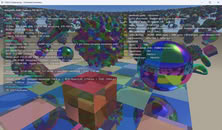
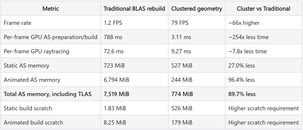
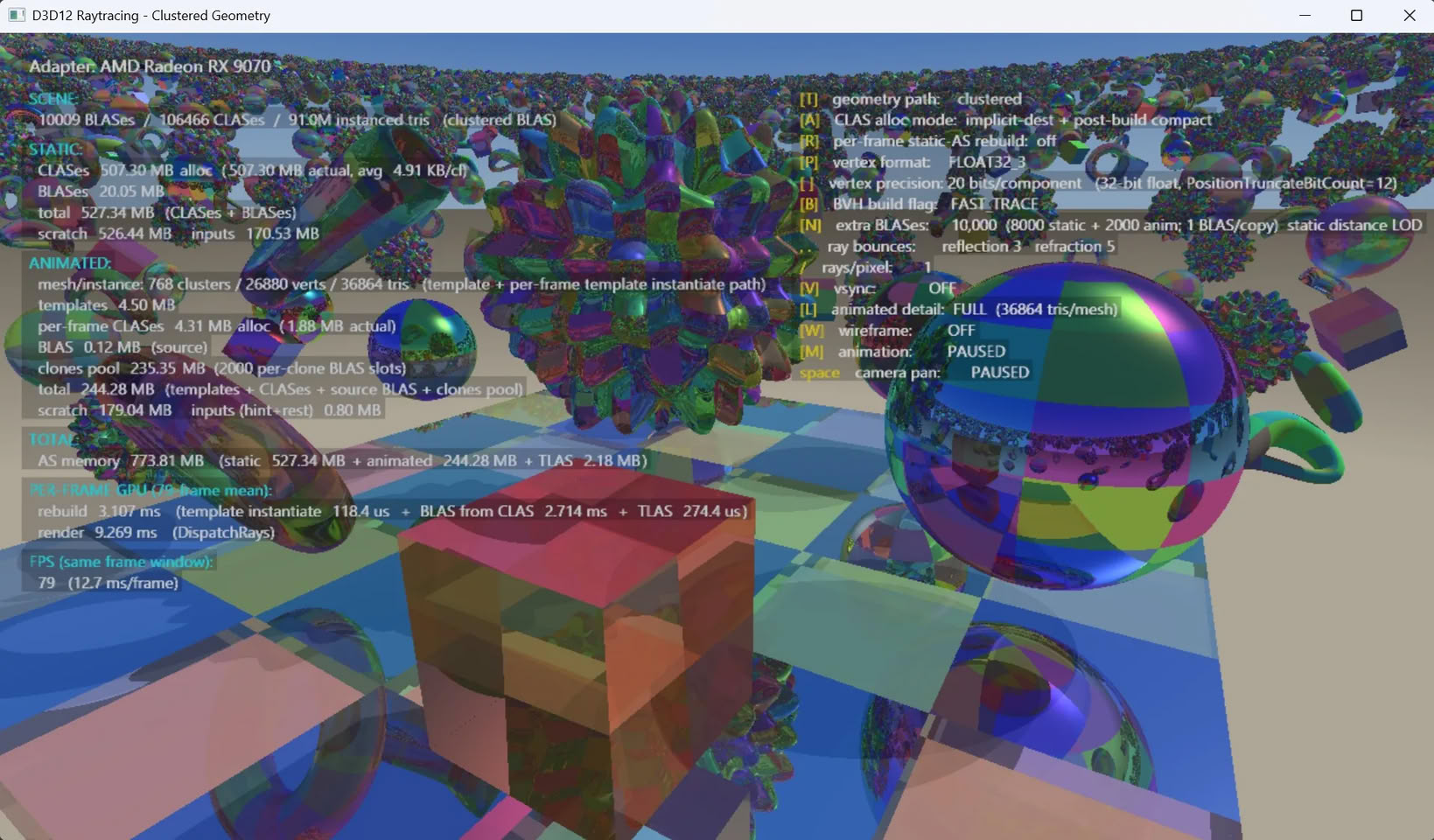
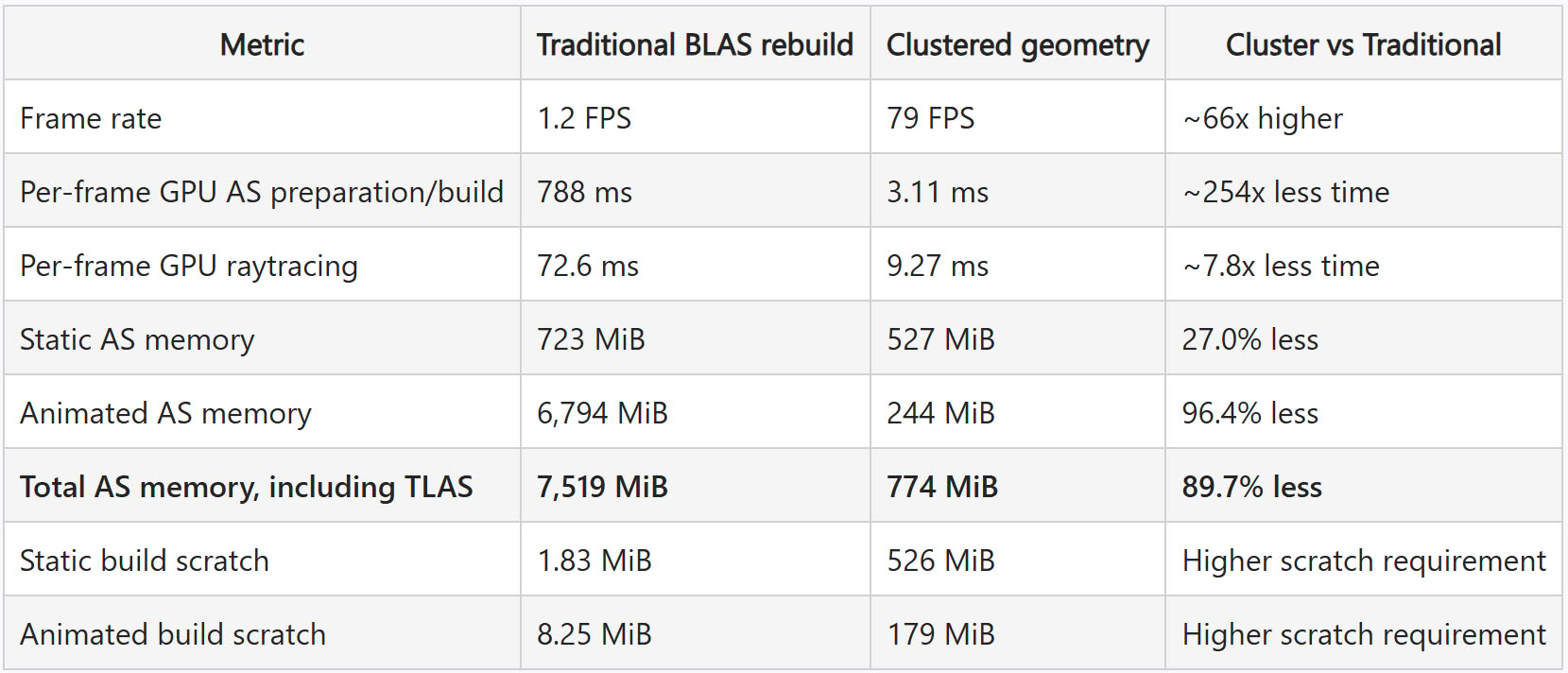
Benchmarking clustered geometry on the AMD Radeon RX 9070 GPU shows that the improvements in FPS are significant, and VRAM savings are substantial. Frame rates can be up to 66 times higher, though in real games, we can generally expect a few percentage points of improvement. However, VRAM consumption has been reduced by nearly 90%. All current-generation hardware supports these features, with day-one support from AMD, Intel, NVIDIA, and Qualcomm for their graphics solutions.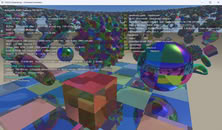
Sources:
Microsoft, Thanks TPU Forum member TumbleGeorge for the tip!
In open-world games, using a top-level acceleration structure (TLAS) can lead to massive VRAM and compute demands. To address this, DXR now introduces partitioned TLAS (PTLAS), allowing ray tracing to focus on changes in a specific region while retaining acceleration-structure data elsewhere. Clustered geometry and PTLAS can be used together or separately, with no limitations. Below image is NVIDIA's sample of clustered geometry in action, visualized in three stages: default, clusters, and triangles applied.

Benchmarking clustered geometry on the AMD Radeon RX 9070 GPU shows that the improvements in FPS are significant, and VRAM savings are substantial. Frame rates can be up to 66 times higher, though in real games, we can generally expect a few percentage points of improvement. However, VRAM consumption has been reduced by nearly 90%. All current-generation hardware supports these features, with day-one support from AMD, Intel, NVIDIA, and Qualcomm for their graphics solutions.

11 Comments on DirectX Raytracing Gets Clustered Geometry for Higher FPS and Up to 90% VRAM Savings
AMD Shows Off Ray Tracing Tech That Slashes GPU Memory Use By 47x | TechPowerUp Forums
They call it hurdles; I just call it AMD and Microsoft being AMD and Microsoft. This could actually benefit both the RX 6xxx series and the 7xxx series.