Wednesday, November 11th 2026
Mounting Finished-Goods Inventories Prompt Some PC OEMs to Adjust Memory Procurement Plans for 2027
More than a year of rising memory prices has placed mounting cost pressure on the consumer electronics industry, according to TrendForce's latest memory industry research. Notebook shipments, in particular, are expected to decline sharply quarter-over-quarter beginning in 3Q26, leaving PC OEMs grappling with sluggish sales and swelling finished-goods inventories.
Against this backdrop, some manufacturers are planning to adjust memory procurement for 4Q26—and even 1Q27—while considering a greater reliance on private-label models in their shipment mix.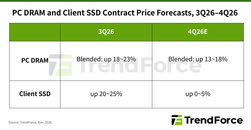 TrendForce notes that PC OEMs brought forward some of their procurement and production schedules to the first half of 2026 in anticipation of further memory price increases. However, higher retail prices have dampened sales across Asia and Europe, while finished-goods inventories have been gradually rising among OEMs and in North American distribution channels.
Notebook shipments fell 15.8% QoQ in 3Q26, with a further single-digit percentage decline possible in 4Q26. These mounting inventory pressures are prompting some OEMs to reassess their product strategies for 2027, including plans to expand the share of private-label models while incorporating lower-specification memory chips and CPUs with fewer cores.
PC DRAM contract prices forecast to rise 13-18% QoQ in 4Q26, while client SSD price increases expected to stay below 5%
In the PC DRAM market, TrendForce observes that earlier rounds of steep price increases prompted some PC brands to place orders beyond their actual requirements. Overall, declining finished-product shipments have led to a steady increase in DRAM inventory weeks among OEMs since 3Q26, with inventories expected to build further in 4Q26. Some manufacturers have already begun renegotiating their product mix requirements for 2027 with memory suppliers.
On the supply side, robust demand from AI applications has led memory manufacturers to tentatively plan cuts to PC DRAM supply in 2027. However, suppliers have some flexibility to slightly moderate price increases because there is relatively little pressure to absorb the production capacity involved. Maintaining strategic partnerships with PC customers also remains a priority as manufacturers prepare for longer-term opportunities in edge AI.
Against a backdrop of softening PC demand and changing supply strategies, TrendForce forecasts that PC DRAM contract prices will rise 13-18% QoQ in 4Q26, with increases slowing from the previous quarter.
A similar shift is emerging in the client SSD market, where escalating costs across the entire bill of materials (BOM) have pushed retail prices higher and dampened consumer appetite. As a result, PC OEMs have little choice but to impose strict cost controls on components such as SSDs while firmly resisting additional price increases.
PC brands have broadly curtailed client SSD procurement in 4Q26 as end-market demand remains subdued and finished-goods inventories stay at elevated levels, purchasing only what is necessary to maintain essential production schedules. This cautious approach is also extending into 1Q27, with procurement plans already being revised downward.
Meanwhile, client SSD production capacity continues to be squeezed by the growing demands of AI-related applications. Seeking to improve their product mix and production economics, suppliers are imposing steeper price increases on lower-capacity SSDs to discourage demand for these less profitable products.
In mainstream capacity segments, however, Chinese suppliers and module manufacturers have gained traction by offering comparatively modest price increases, attracting a larger share of orders. Their increasingly competitive quotations have helped soften the broader impact of higher prices maintained by other suppliers.
As a result, TrendForce expects client SSD contract prices to rise by less than 5% QoQ in 4Q26, marking a notable moderation from the previous quarter.
Source:
TrendForce
Against this backdrop, some manufacturers are planning to adjust memory procurement for 4Q26—and even 1Q27—while considering a greater reliance on private-label models in their shipment mix.
Notebook shipments fell 15.8% QoQ in 3Q26, with a further single-digit percentage decline possible in 4Q26. These mounting inventory pressures are prompting some OEMs to reassess their product strategies for 2027, including plans to expand the share of private-label models while incorporating lower-specification memory chips and CPUs with fewer cores.
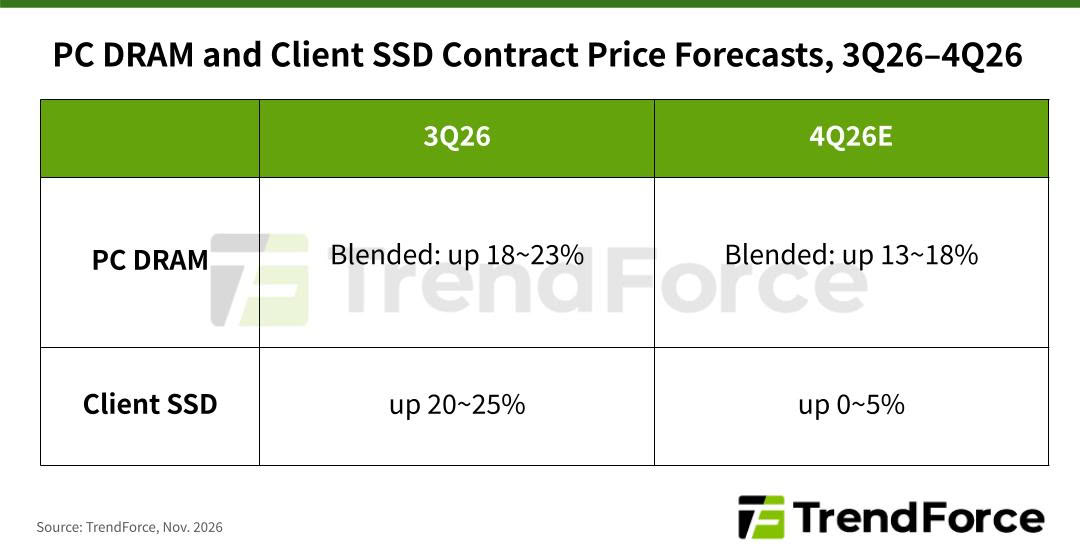
PC DRAM contract prices forecast to rise 13-18% QoQ in 4Q26, while client SSD price increases expected to stay below 5%
In the PC DRAM market, TrendForce observes that earlier rounds of steep price increases prompted some PC brands to place orders beyond their actual requirements. Overall, declining finished-product shipments have led to a steady increase in DRAM inventory weeks among OEMs since 3Q26, with inventories expected to build further in 4Q26. Some manufacturers have already begun renegotiating their product mix requirements for 2027 with memory suppliers.
On the supply side, robust demand from AI applications has led memory manufacturers to tentatively plan cuts to PC DRAM supply in 2027. However, suppliers have some flexibility to slightly moderate price increases because there is relatively little pressure to absorb the production capacity involved. Maintaining strategic partnerships with PC customers also remains a priority as manufacturers prepare for longer-term opportunities in edge AI.
Against a backdrop of softening PC demand and changing supply strategies, TrendForce forecasts that PC DRAM contract prices will rise 13-18% QoQ in 4Q26, with increases slowing from the previous quarter.
A similar shift is emerging in the client SSD market, where escalating costs across the entire bill of materials (BOM) have pushed retail prices higher and dampened consumer appetite. As a result, PC OEMs have little choice but to impose strict cost controls on components such as SSDs while firmly resisting additional price increases.
PC brands have broadly curtailed client SSD procurement in 4Q26 as end-market demand remains subdued and finished-goods inventories stay at elevated levels, purchasing only what is necessary to maintain essential production schedules. This cautious approach is also extending into 1Q27, with procurement plans already being revised downward.
Meanwhile, client SSD production capacity continues to be squeezed by the growing demands of AI-related applications. Seeking to improve their product mix and production economics, suppliers are imposing steeper price increases on lower-capacity SSDs to discourage demand for these less profitable products.
In mainstream capacity segments, however, Chinese suppliers and module manufacturers have gained traction by offering comparatively modest price increases, attracting a larger share of orders. Their increasingly competitive quotations have helped soften the broader impact of higher prices maintained by other suppliers.
As a result, TrendForce expects client SSD contract prices to rise by less than 5% QoQ in 4Q26, marking a notable moderation from the previous quarter.
6 Comments on Mounting Finished-Goods Inventories Prompt Some PC OEMs to Adjust Memory Procurement Plans for 2027
Demand for computers has not dropped.
Willingness to pay the extortion pricing has dropped and people are trying to find alternate solutions.
People aren't buying anything until they really have to as prices are prohibitive
but I don't see my self as doing anything to the demand on those boats.
I'm currently priced out of anything tech just like I'm priced out of those boats