

CES 2026 News Coverage

Jan 6 - 9

CES is North America's largest and most important technology trade show, held every year in Las Vegas, Nevada. It brings together the tech world to debut new hardware, consumer electronics, AI breakthroughs, and next-generation technologies.

Just like every year, we're covering CES live from Las Vegas with our on-site team, backed by editors at home, to deliver the quickest and most comprehensive updates from the show floor.

On this page you can find all of our news coverage for the event.

AMD Ryzen 7 9850X3D OEM CPU Already Delidded

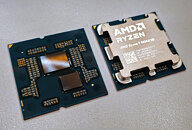
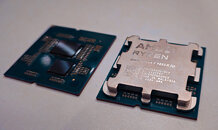
AMD officially unveiled its new 8-core Ryzen 7 9850X3D desktop gaming processor earlier in the week; in virtual and specification form. A day later, select members of the press have inspected physical examples at CES 2026. Lately, PCGamesHardware Germany and Club386 have presented photos of OEM hardware—as evidenced by a visible OPN code, reading as "100-000001973." A few e-tailers have started listing the retail version—web searches of the related "100-100001973WOF" designation bring up Team Red's boxed product. It is not clear whether AMD reps presented physical units behind closed doors, or an in-person preview session was organized by a manufacturing partner.

The PCGH.de report contains shots of a delidded example, with a gory view of the emerging Ryzen 7 9850X3D's innards on full display. As expected, a lone CCD is positioned just below the central I/O die—corresponding to the layout present within readily available Ryzen 7 9800X3D CPUs. Additionally, analysis of the markings on AMD's heat spreader point to this particular Ryzen 7 9850X3D sample bearing a mid-September 2025 production window. Like other "Granite Ridge" models, it was made in Malaysia—and tagged with a "PGY" manufacturing location reference.
AMD Reportedly Hints About Later Launch of Ryzen 9 9950X3D2 CPU

According to a fairly fresh ComputerBase social media post, AMD has confirmed the existence—reportedly to a select group of journalists—of their unreleased 16-core Ryzen 9 9950X3D2 SKU. During CES 2026 proceedings, the German computer hardware news outlet was seemingly briefed about an upcoming second quarter launch of Ryzen AI 400 series desktop APUs, and were told to "stay tuned" for future updates regarding the rollout of Team Red's dual 3D V-Cache flagship gaming chip. Officially, AMD has already unveiled its 8-core Ryzen 7 9850X3D processor model at this week's highly important trade show. Since late last year, the two additional "Granite Ridge" products were mentioned multiple times via online leaks.

Past NDA-busting Ryzen 9 9950X3D2 information appeared less frequently; leading to speculation about it not being debuted at CES 2026. Despite a notable absence of concrete information, several members of the press did spot curious promo renders that showed a dual CCD design within Ryzen 7 9850X3D-related PR folders. Throughout late 2025/early 2026 PC gaming online communities have fretted over a possible uncertain future for AMD's Ryzen 9 9950X3D2 SKU, but the latest revelation (courtesy of ComputerBase) and recent benchmark database entries signal a promising path going forward.

AMD Ryzen AI Halo: More Than a Mini-PC, an AI Development Platform Challenging NVIDIA's DGX Spark

AMD at the 2026 International CES showed off its Ryzen AI Halo box, which is a first-party compact desktop based on AMD Ryzen AI Max+ "Strix Halo" processors. It turns out that this product isn't being touted as just a consumer desktop, but rather a fully-fledged AI development platform rivaling NVIDIA's DGX Spark. While not exactly competing with the DGX Spark in compute power, the box is meant for development of consumer AI applications.

The box packs a full-featured Ryzen AI Max 395+ with a 16-core/32-thread "Zen 5" CPU, a large iGPU powered by the RDNA 3.5 graphics architecture, featuring 40 compute units, and a Microsoft Copilot+ ready NPU with 50 TOPS, held together with up to 128 GB of unified LPDDR5X memory, support for Windows 11 and Linux, and pre-loaded AI models that are optimized for the hardware of this box. AMD innovated a cooling solution for the "Strix Halo" SoC featuring a baseplate, a network of direct-touch flat heatpipes, an aluminium channel heatsink, and two lateral airflow blowers. AMD says that the Ryzen AI Halo AI developer platform will be available from Q2 2026, and pricing will be shared closer to launch.

AMD Zen 6 EPYC "Venice" Introduces a Radical Package Redesign

AMD CEO Dr Lisa Su at the company's 2026 International CES event held up the next generation EPYC "Venice" enterprise processor driving the company's 2026 "Helios" AI racks powered by AMD MI455X AI GPUs. Each node in the rack features four MI455X GPUs, and one EPYC "Venice" processor with a 256-core/512-thread configuration. The package features a significantly different layout of chiplets compared to current EPYC chips. It sees two slender, centralized server I/O dies built on the 4 nm node, which are flanked on either sides by no more than eight CCDs, each built on the 2 nm foundry node, and packing 32 "Zen 6" cores.

At this point we don't know if these are full-sized "Zen 6" cores that can sustain high clock speeds, or compacted "Zen 6c" cores that feature identical ISA and IPC, but at lower maximum clock speeds. Each "Venice" package features a 16-channel DDR5 memory interface (32 sub-channels), which explains why AMD probably needed to disaggregate the sIOD into two chips that are joined at the hip using high-speed switching fabric. AMD is also expected to significantly increase the PCIe and CXL lane counts of "Venice" over the current-generation to support those four AI GPUs, DPUs, and 800G NICs.

AMD Expands Ryzen AI MAX "Strix Halo" Processor Lineup

AMD today expanded its Ryzen AI MAX "Strix Halo" line of super-APUs with two new processor models, the Ryzen AI Max+ 392 and Ryzen AI Max+ 388. Both are based on the existing "Strix Halo" package, which combines a 16-core/32-thread "Zen 5" CPU based on standard "Zen 5" CCDs, with a large I/O die featuring a powerful iGPU based on RDNA 3.5 graphics architecture that has 40 compute units (2,560 stream processors), a Copilot+ ready NPU with 50 TOPS on tap, and a unified 256-bit LPDDR5X memory interface.

The Ryzen AI Max+ 392 is configured with a 12-core/24-thread CPU using two CCDs, clock speeds of 3.20 GHz base and 5.00 GHz maximum boost, a full-featured iGPU with all 40 CU enabled, a 50 TOPS NPU, and a configurable TDP range of 45 W to 120 W. Then there's the Ryzen AI Max+ 388, featuring an 8-core/16-thread CPU using a single CCD, which ticks at 3.60 GHz base with 5.00 GHz boost, again, the fully unlocked iGPU with all 40 CU enabled, the 50 TOPS NPU, and 45 W to 120 W cTDP. The key difference with these two SKUs over the others in the lineup within their brand extension, is the focus on increased graphics power at the expense of CPU core count, which should make these formidable gaming chips at lower price-points.

AMD Launches Ryzen 7 9850X3D, The World's Fastest Gaming CPU Gets Even Faster

AMD today launched the Ryzen 7 9850X3D desktop processor. This 8-core/16-thread processor is powered by the "Zen 5" microarchitecture supercharged with 3D V-Cache technology, and is essentially a speed-increase over the current 9800X3D. The chip comes with a base frequency of 4.70 GHz, and maximum boost frequency of 5.60 GHz, a significant increase over the 4.70 GHz base and 5.20 GHz maximum boost of the 9800X3D. This 400 MHz increase in maximum boost frequency should increase boost frequency residency across thread counts. The chip is configured with 120 W TDP. The 3rd Gen 3D V-Cache technology sees the 64 MB L3D located below the 8-core CCD, as opposed to being above it in the past two generations, which should let the CCD enjoy similar thermal characteristics to non-X3D Ryzen processors, letting them sustain higher boost frequencies and overclocking capabilities. AMD said retail availability of the 9850X3D should commence in Q1 2026, the company didn't reveal pricing.

No Ryzen 9000G: Next-Gen Socket AM5 APUs are Branded Ryzen AI 400 Series

AMD announced in its CES media briefing that its upcoming Socket AM5 desktop APUs that succeed the Ryzen 8000G series will be branded under the Ryzen AI 400 series, in line with its new Ryzen AI 400 series mobile processors that these share the underlying silicon with. While the company did not release specifics such as processor models, it dropped enough material to show that Ryzen AI 400 series desktop APUs will be based on the same 4 nm "Gorgon Point" monolithic silicon as the mobile Ryzen AI 400 series. These will be the world's first socketed desktop processors with an NPU that meets Microsoft Copilot+ hardware requirements. Until now, only mobile-on-desktop (MoD) platforms offered Copilot+, by using mobile processors in desktop form-factors such as mini PCs and AIOs.

The "Gorgon Point" silicon is physically identical to "Strix Point," with the same exact IP blocks, but AMD has refreshed its power management logic to carve out increased clock speeds across its three main logic components, the CPU, the iGPU, and the NPU. The CPU now boosts up to 5.20 GHz for its "Zen 5" cores, while the iGPU engine clock now goes up to 3.10 GHz. The NPU clock is increased, too, and now offers a throughput of 60 TOPS over the 55 TOPS of "Strix Point." AMD did not disclose the processor models of its Socket AM5 Ryzen AI 400 series chips, but these could be a handful of SKUs (2-3 in the consumer segment), with one maxed-out SKU that has all 12 CPU cores (4x Z5 + 8x Z5c), iGPU with all 16 CU, and 60 TOPS NPU; followed by another SKU that comes with a 10-core/20-thread CPU, 12 iGPU CU, and a 55 TOPS NPU; and a mid-range chip with 8-core/16-thread CPU, 8 or 12 iGPU compute units, and a 50 TOPS NPU. All three chips could come with a TDP of 65 W, with PPT nearing the 100 W-mark.

AMD Announces Ryzen AI 400 Series "Gorgon Point" Mobile Processors

AMD at the 2026 International CES announced the new Ryzen AI 400 series "Gorgon Point" mobile processors powering the company's client processor lineup through 2026. These chips are based on the new 4 nm "Gorgon Point" silicon that is a refresh of the current "Strix Point" monolithic processor supporting higher clock speeds across its various compute components, and updates to its power management. The processor implements the "Zen 5" microarchitecture, and uses a dual-CCX CPU with four full-sized "Zen 5" cores sharing a 16 MB L3 cache, and eight compact "Zen 5c" cores sharing an 8 MB L3 cache. The "Zen 5" cores boost up to 5.20 GHz, while the iGPU goes up to 3.10 GHz engine clock. The chip features an iGPU based on the RDNA 3.5 graphics architecture with 16 compute units (CU). Both the CPU and iGPU feature improved boost residency over "Strix Point."

Besides the CPU and iGPU, the integrated NPU also gets a performance uplift, with increased NPU clock speeds enabling a peak throughput of 60 TOPS, up from 55 TOPS on Ryzen AI 300 series processors. AMD has also given the processor a feature-packed ROCm software stack, so client AI software can leverage this 60 TOPS NPU and the AI acceleration capabilities of the iGPU and CPU. Lastly, AMD has updated the integrated memory controllers, giving them native support for LPDDR5X 8533 MT/s memory speeds, an increase from the 8000 MT/s that "Strix Point" natively supports. Despite these improvements, "Gorgon Point" remains mostly similar to "Strix Point" at a physical level, and so AMD took the opportunity to refresh the way the various Ryzen AI 400 series processor models are segmented from this silicon, giving each SKU an improvement over its Ryzen AI 300 series predecessor. This could be anything from CPU clock speeds, to CPU core-count, to iGPU CU count, and NPU throughput.

AMD Ryzen 9 9950X3D2 and Ryzen 7 9850X3D are Real, Coming this CES?

AMD is preparing to refresh its Ryzen 9000 series "Zen 5" desktop processor lineup with two high-end chips targeting gamers and PC enthusiasts, the 8-core Ryzen 7 9850X3D, and the 16-core Ryzen 9 9950X3D2. The 9850X3D is a speed-bumped 9800X3D, while the 9950X3D2 comes with 3D V-Cache on both its 8-core chiplets, compared to the 9950X3D, which only has it on one of its chiplets. The Ryzen 7 9850X3D comes with a maximum turbo frequency of 5.60 GHz, a 400 MHz increase over the 9800X3D, along with a TDP of 120 W, which is expected to increase its single-thread performance by 5-7%.

The Ryzen 9 9950X3D2 is a different beast. It comes with a maximum boost frequency of 5.60 GHz, which is a 100 MHz reduction over the 5.70 GHz that the 9950X3D comes with, but both its chiplets have 3D V-Cache, allowing for more flexible scheduling and thread migration. With a combined L3 cache of 192 MB, this chip could also be vastly preferred by the workstation and creator crowd that's working on memory-intensive workloads. All this comes at a cost, though, with AMD rumored to increase TDP to 200 W, up from the 170 W of the 9950X3D, which could mean a PPT value nearing the 250 W-mark. Geekbench and PassMark numbers of the 9950X3D2 just surfaced on the web, which show the newer chip to be 2% faster than the 9950X3D despite the marginally lower clock speed, however, the real heft of this chip will be felt in memory/cache sensitive workloads.
Nov 14th, 2026 16:26 CST change timezone

New Forum Posts

Popular Reviews

TPU on YouTube

Controversial News Posts