

CES 2026 News Coverage

Jan 6 - 9

CES is North America's largest and most important technology trade show, held every year in Las Vegas, Nevada. It brings together the tech world to debut new hardware, consumer electronics, AI breakthroughs, and next-generation technologies.

Just like every year, we're covering CES live from Las Vegas with our on-site team, backed by editors at home, to deliver the quickest and most comprehensive updates from the show floor.

On this page you can find all of our news coverage for the event.

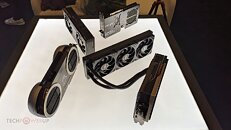
GIGABYTE RTX 5090 AORUS Infinity, ASUS RTX 5090 ProArt, and MSI RTX 5090 Lightning Z, Hands On

At the 2026 International CES, we went hands on with a new crop of ultra-premium custom-design GeForce RTX 5090 graphics cards that launched in quick succession of each other this year, exactly 1 year following the RTX 5090's original launch. Earlier today, we also held the Inno3D iChill RTX 5090 Frostbite PRO, another such recently announced premium RTX 5090 custom-design. The GIGABYTE RTX 5090 AORUS Infinity and ASUS RTX 5090 ProArt stand out as being the first custom design implementations of NVIDIA's Dual Flow-Through cooler design that it introduced with the RTX 5090 Founders Edition graphics card, the company's de facto reference design.

This design involves placing the main PCB of the card with the GPU, memory, and VRM, as a separate, centrally located component, with heat drawn from these hot components projecting along the length of the card, and fans located at both ends, push air through the cooler and out of the backplate, through cutouts. The PCB relies on additional breakout PCBs for the PCI-Express gold fingers, and the display I/O. GIGABYTE's design sees two large 120 mm fans pump air through the heatsink, with some of it being guided through the central region of the cooler. GIGABYTE has used a similar two-tone color scheme as NVIDIA Founders Edition. We can't wait to get our hands on this card to see how the cooler fares against rival custom designs.


GeForce NOW Recaps CES & Announces Early January Game Lineup

NVIDIA is wrapping up a big week at the CES trade show with a set of GeForce NOW announcements that are bringing more ways to play and more games to the cloud. From new native apps for Linux and Amazon Fire TV streaming sticks to hands-on throttle-and-stick (HOTAS) support for simulation fans and a new single sign-on option, GeForce NOW is expanding across devices and making it easier to jump straight into gameplay.

Topping it off, a new wave of AAA titles—including IO Interactive's 007 First Light, Capcom's Resident Evil Requiem and Pearl Abyss' Crimson Desert—is gearing up to join the GeForce NOW library for high-fidelity, low-latency streaming across the globe. Get ready with the six new games available to stream this week.

4K AI Video Generation Accelerated by NVIDIA RTX with LTX-2 and ComfyUI Upgrades

2025 marked a breakout year for AI development on PC. PC-class small language models (SLMs) improved accuracy by nearly 2x over 2024, dramatically closing the gap with frontier cloud-based large language models (LLMs). AI PC developer tools including Ollama, ComfyUI, llama.cpp and Unsloth have matured, their popularity has doubled year over year and the number of users downloading PC-class models grew tenfold from 2024.

These developments are paving the way for generative AI to gain widespread adoption among everyday PC creators, gamers and productivity users this year. At CES this week, NVIDIA has announced a wave of AI upgrades for GeForce RTX, NVIDIA RTX PRO and NVIDIA DGX Spark devices that unlock the performance and memory needed for developers to deploy generative AI on PC.

NVIDIA Announces Major Updates to GeForce NOW: Sim Controllers, Linux and Fire TV Clients

NVIDIA today announced major updates to its GeForce NOW cloud gaming platform that turns practically any screen with a game controller into a powerful gaming platform with graphics akin to PCs. The company brought NVIDIA GeForce RTX 5080 performance tier to GeForce NOW in 2025, priced at $19.99 a month to be able to play on any device, at resolutions of up to 5K @ 120 FPS or 1080p @ 360 FPS, with NVIDIA Reflex low latency, and Cinematic quality streaming, with a game library spanning over 4,000. In 2026, NVIDIA is announcing a handful interesting updates.

Perhaps the biggest GeForce NOW update today is support for exotic game controller types, such as slight control, racing wheels, and newer kinds of simulator hardware. Your client device should be able to recognize the controller and let GeForce NOW use it, so you can use the controller for playing titles such as Microsoft Flight Simulator 2024, etc. Next up, NVIDIA announced the addition of more AAA games to GeForce NOW, including Resident Evil Reqium, 007 First Light, Crimson Desert, and Active Matter.

NVIDIA Updates G-SYNC Pulsar Standard and Ambient Adaptive Technology

NVIDIA today announced updated G-SYNC Pulsar display standard for fast-paced competitive e-sports gaming. The standard builds on NVIDIA's proven G-SYNC variable refresh-rate technology that ensures that the display and GPU are in perfect sync with output framerates and display refresh-rates, to eliminate screen tearing and stuttering. The new G-SYNC Pulsar spec calls for a standardized 27-inch QHD (2560 x 1440 pixels) gaming display with refresh rate of 360 Hz on the display's side, and the capability of over 1000 Hz perceived motion clarity that works at the game rendering level to eliminate motion blur. In the example shown below, G-SYNC Pulsar in "Counter Strike 2" is shown improving effective motion clarity by 4 times.

The other new standard being introduced today is Ambient Adaptive Technology. Similar to your smartphone, which uses its front-camera to gauge ambient lighting conditions to dynamically adjust display and color temperature, this feature relies on an optical sensor on the display to analyze ambient lighting conditions, and respond to broad daylight with 100% brightness, cooler white colors (higher color temperatures); and nighttime with 36% brightness, and warmer colors (lower color temps). At CES, popular gaming monitor manufacturers are announcing their G-SYNC Pulsar capable monitors, which include Acer Predator XB273U F5, AOC AGON Pro AG276QSG2, ASUS ROG Strix Pulsar XG27AQNGV, and MSI MPG 272QRF X36. These displays will be available from tomorrow (January 7), with prices starting at $599.

NVIDIA Announces DLSS 4.5 with Increased Image Quality, 6x FrameGen, and 240 FPS Mode

NVIDIA today announced the new DLSS 4.5 technology at its 2026 International CES media event, to improve gaming performance and image quality, bringing higher resolutions and refresh rates within reach of PC gamers. DLSS 4.5 is a major update over DLSS 4 that debuted in 2024 with the GeForce RTX 50-series "Blackwell" graphics cards. It is designed to bring games with performance-intensive path tracing effects to a broader audience, with the fastest RTX 50-series GPU models being able to play path-traced games at 4K Ultra HD with 240 Hz.

At the heart of the DLSS 4.5 update are two key announcements—2nd Generation Super Resolution Transformer, and Dynamic Multi Frame Generation. One of the defining features of DLSS 4 is its high-quality upscaler, which replaced convolutional neural network (CNN) based AI models with a newer Transformer-based model, resulting in a significant improvement in image quality. Now, at CES, NVIDIA announced that they have updated their algorithm with an even newer Transformer-based model that has been trained on a much larger dataset. This 2nd Gen Transformer was developed using five times the compute power that went into the first-gen DLSS 4 Transformer upscaler, and leverages the FP8 data format that's supported by the Tensor cores of GeForce RTX 40-series "Ada" and 50-series "Blackwell" GPUs. DLSS 4.5 is still supported on older 30-series "Ampere" and 20-series "Turing" GPUs, however these generations lack FP8 acceleration, so the performance uplift over native wouldn't be as significant as with newer GPUs.

NVIDIA DGX SuperPOD Sets the Stage for Rubin-Based Systems

NVIDIA DGX SuperPOD is paving the way for large-scale system deployments built on the NVIDIA Rubin platform—the next leap forward in AI computing. At the CES trade show in Las Vegas, NVIDIA today introduced the Rubin platform, comprising six new chips designed to deliver one incredible AI supercomputer, and engineered to accelerate agentic AI, mixture-of-experts (MoE) models and long-context reasoning. The Rubin platform unites six chips—the NVIDIA Vera CPU, Rubin GPU, NVLink 6 Switch, ConnectX-9 SuperNIC, BlueField-4 DPU and Spectrum-6 Ethernet Switch—through an advanced codesign approach that accelerates training and reduces the cost of inference token generation.

DGX SuperPOD remains the foundational design for deploying Rubin-based systems across enterprise and research environments. The NVIDIA DGX platform addresses the entire technology stack—from NVIDIA computing to networking to software—as a single, cohesive system, removing the burden of infrastructure integration and allowing teams to focus on AI innovation and business results. "Rubin arrives at exactly the right moment, as AI computing demand for both training and inference is going through the roof," said Jensen Huang, founder and CEO of NVIDIA.

NVIDIA BlueField-Powered Cybersecurity and Acceleration Arrive on NVIDIA Enterprise AI Factory Validated Design

AI is powering breakthroughs across industries, helping enterprises operate with greater intelligence and speed. As AI factories scale, the next generation of enterprise AI depends on infrastructure that can efficiently manage data, secure every stage of the pipeline and accelerate the core services that move, protect and process information alongside AI workloads.

NVIDIA has expanded the NVIDIA Enterprise AI Factory validated design to include NVIDIA BlueField cybersecurity and infrastructure acceleration capabilities. This accelerates the data center services that keep AI factories running and delivers security that can operate at the same speed as AI. Leading software platforms from NVIDIA BlueField ecosystem partners Armis, Check Point, F5, Fortinet, Palo Alto Networks, Rafay, Red Hat, Spectro Cloud and Trend Micro are now validated as part of NVIDIA Enterprise AI Factory, helping enterprises enhance runtime protection, streamline operations and strengthen the infrastructure that powers AI.
Nov 14th, 2026 16:26 CST change timezone

New Forum Posts

Popular Reviews

TPU on YouTube

Controversial News Posts