News Posts matching #2019

Return to Keyword Browsing

NVIDIA Raises Shield TV Pro Price to $299, Discontinues Standard Shield TV

NVIDIA has raised the price of the Shield TV Pro from $199.99 to $299.99, effective October 2. The streaming box launched in October 2019 at $199.99 and held that price for almost seven years. Earlier this year, NVIDIA promised to keep updating the Shield TV, with hardware engineering SVP Andrew Bell saying the company had no plans to abandon it anytime soon. NVIDIA has also stopped making the standard, tube-shaped Shield TV, which had reportedly been out of stock for months. That leaves the Pro as the only Shield model in production. NVIDIA confirmed both changes in a statement. Here's what the company said:
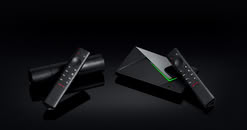
Starting October 2, SHIELD Pro will be priced at $299. The cost of components, including memory, has increased substantially across the industry. We've also stopped producing the standard SHIELD TV model as we focus on production for SHIELD TV Pro.


Apple and Qualcomm Renew Partnership for 5G Modem Supply

Qualcomm announced today that it is continuing its licensing agreement with Apple, as the previous agreement has ended. In a brief press statement, John Han, Executive Vice President and General Manager of Qualcomm Technology Licensing (QTL), stated that the company is "pleased to extend the Apple license agreement," which will take effect starting April 1, 2027. The end date of this new licensing agreement is still unknown, as the company did not disclose the exact terms, monetary value, or end date.

As readers may recall, in September 2023, Apple renewed its licensing deal with Qualcomm to obtain 5G modems for its products. This license was valid for three years and is now expiring, requiring a renewal. In its iPhones, Apple has started using a combination of in-house modems, known as C-series SoCs, along with Qualcomm-provided 5G modems. In 2019, Apple purchased Intel's modem business for $1 billion, acquiring the engineers and patents needed to jumpstart its own modem design and production. Early last year, with the launch of the iPhone 16e, Apple unveiled the C1 modem, its first-generation in-house 5G modem, which has since evolved into the upgraded C2 5G cellular modem design, now shipping with the iPhone 18 Pro lineup.

United States Government May Restrict ASML's DUV Tool Exports to China

According to the Netherlands-based NU portal, the United States government (USG) might pressure the Dutch government to compel ASML to halt nearly all exports of chip-making equipment to China. The report indicates that the Netherlands-based ASML is under pressure to stop exporting its machinery to Chinese clients, as the USG is lobbying against the export of these machines to mainland customers. Readers may recall that the most advanced Extreme Ultraviolet (EUV) lithography tools are already banned from being sold in China, as the USG previously pressured the Dutch government to halt sales of these advanced tools. In fact, ASML has never shipped a single EUV scanner to China, as the Dutch government, under USG pressure, blocked exports in 2019.

In the years following that ban, export restrictions have shifted focus to older Deep Ultraviolet (DUV) scanners, requiring a national export license before shipping to China. However, a new bipartisan bill is now before Congress to tighten export controls even further. Called the Multilateral Alignment of Technology Controls on Hardware (MATCH) Act, the USG is considering forcing allied countries to implement a technological ban on exporting even the older DUV machines. This could mean that ASML might nearly cease all exposure to China, as the older DUV tools are targeted by US export restrictions.

End of an Era: macOS 27 Drops Support for Intel-Based Macs

Apple is making its latest macOS 26 release the last official operating system that will run on Intel-powered Macs. This means that starting with next year's macOS 27 release, new operating system updates will be available only on the M-Series of Apple Silicon. For macOS 26, codenamed "Tahoe," several Intel-based Macs will still support this latest release. These include the 2019 Mac Pro, 2019 MacBook Pro 16-inch, 2020 MacBook Pro 13-inch, and the 2020 release of the 27-inch iMac. These models will receive the latest macOS "Tahoe" operating system support this year, while next year's macOS 27 will officially end the rollout for Intel-based Macs. This marks the end of an era for Intel-based Macs and represents the Hackintosh community's final efforts to get this operating system on non-Apple PCs.

The transition to Apple Silicon officially began in late 2020 with the introduction of the M1 SoC—Apple's first custom silicon processor that features an in-house developed CPU, GPU, and much of the surrounding IP that make up an SoC. This initiated a series of M-Series designs over the years, with the current latest being the M5 generation, led by the M5 Pro and M5 Max. The Cupertino giant has been creating custom silicon for years with its A-Series of smartphone SoCs, but only recently started a special line for Macs. The company even offers the A18 Pro-based MacBook Neo, incorporating some smartphone silicon into a $599 Mac computer for basic PC work.

NVIDIA Keeps SHIELD TV Updated a Decade Later, Promising More Updates

Believe it or not, NVIDIA launched its first SHIELD TV in 2015, marking nearly a decade of continuous support for the platform. In an interview with Ars Technica, Andrew Bell, NVIDIA's senior VP of hardware engineering, reassured the company's loyal fan base that they have no plans to abandon the SHIELD TV anytime soon, promising ongoing updates in the years to come. Bell expressed frustration with the limited updates typically provided for phones and tablets, saying, "Early on when we were building SHIELD TV, we decided we were going to support it for a long time." He recalled a conversation with CEO Jensen Huang about the duration of support, to which Huang responded, "For as long as we shall live."

As NVIDIA enters the second decade of supporting the SHIELD TV, they continue to produce the 2019 version, featuring the NVIDIA Tegra X1+ processor, 3 GB of RAM, and 16 GB of storage. There was once talk within the gaming community and among NVIDIA engineers about venturing into making a gaming console. "Pretty much everybody who worked at NVIDIA in the early days really wanted to make a game console," Bell confirmed. However, the complexity of building a console, which requires not just a GPU but also a CPU, an OS, games, and a user interface, deterred the company from pursuing this path.

Compulab Refreshes Airtop3 SFF Fanless IoT Edge Server Model with GeForce RTX 4060 dGPU Option

Compulab has updated its "ruggedised" Airtop3 compact form factor PC line with a new configuration that includes a pre-installed "Ada Lovelace" GeForce RTX 4060 8 GB discrete graphics card. Back in 2018, TechPowerUp's news section covered the Israeli firm's initiation of a crowdfunding campaign for their fanless Airtop2 Inferno Mini-PC. This second generation design launched with a desktop GeForce GTX 1080 "Pascal" card onboard. Compulab's current-gen SFF fanless IoT Edge server model was first revealed in 2019; debuting with passively cooled Intel Core i9-9900K (Coffee Lake Refresh) processors and Team Green's Quadro RTX 4000 (Turing) graphics cards. Going further back—to February 2018—the brand introduced its vanilla Airtop2 design.

The latest Airtop3 revision still utilizes an old LGA1151 socket platform; compatible with a small selection of Team Blue "Coffee Lake"—original and refreshed—CPUs. The best configuration can be equipped with a workstation grade Xeon E-2278GE processor. The cheapest option is outfitted with an entry level Celeron G4900T unit. As noted by VideoCardz, Compulab's starting price for an Airtop3 + GeForce RTX 4060 dGPU is $2780. A GPU-less setup costs $1790. Customers can pick between the GeForce RTX 4060 or an older "Ampere" RTX A2000 6 GB card. No matter the specification, CPU/APU and GPU aspects are passively cooled via sizeable copper plates.

Days Gone Remastered's Horde Assault Mode Previewed by Bend Studio

Days Gone Remastered comes to PlayStation 5 on April 25. Experience the definitive version of Days Gone with new modes, features, and technical enhancements to leverage the PS5 and PS5 Pro consoles. The new game modes including Horde Assault, Permadeath, and Speedrun—also arriving on PC; via the Broken Road DLC. Whether you're visiting Days Gone for the first time or jumping back on the Drifter bike, there's plenty of content to explore and new things to discover. If you haven't already, be sure to read our Days Gone Remastered announcement post for more details on all the new content and features. Introducing one of our most expansive new additions to Days Gone Remastered, Horde Assault—a survival arcade mode. Before we dive in, watch the gameplay trailer for the new mode below.

What is Horde Assault mode?
Horde Assault offers fresh and unexpected gameplay designed to challenge your skills as you try to achieve a high score, while surviving as long as possible against increased horde sizes and various other enemies, like Breakers, Reachers, and Rager bears, oh my! Fight your way through a brutal, ever-changing landscape where enemies escalate in difficulty the longer you survive. Horde Assault was built from the promise of "This World Comes For You," showcasing the core gameplay of the Days Gone open world in a unique way. Horde Assault is your playground for a truly endless game mode, go show them Freakers who's boss.

China Launches Massive $47.5 Billion "Big Fund" to Boost Domestic Chip Industry

Beijing has doubled down on its push for semiconductor self-sufficiency with the establishment of a new $47.5 billion investment fund to accelerate growth in the domestic chip sector. The fund, officially registered on May 24th under the name "China Integrated Circuit Industry Investment Fund Phase III", represents the largest of three state-backed vehicles aimed at cultivating China's semiconductor capabilities. The announcement comes as tensions over advanced chip technology continue to escalate between the U.S. and China. Over the past couple years, Washington has steadily ratcheted up export controls on semiconductors to Beijing over national security concerns about potential military applications. These measures have lent new urgency to China's quest for self-sufficiency in chip design and manufacturing.

With a war chest of 344 billion yuan ($47.5 billion), the "Big Fund" dwarfs the combined capital of the first two semiconductor investment vehicles launched in 2014 and 2019. Officials have outlined a multipronged strategy targeting key bottlenecks, focusing on equipment for chip fabrication plants. The fund has bankrolled major projects such as flash memory maker Yangtze Memory Technologies and leading foundries like SMIC and Huahong. China's homegrown chip industry still needs to catch up to global leaders like Intel, Samsung, and TSMC. However, the immense scale of state-directed capital illustrates Beijing's unwavering commitment to developing a self-reliant supply chain for semiconductors—a technology viewed as indispensable for economic and military competitiveness. News of the "Big Fund" sent Chinese chip stocks surging over 3% on hopes of fresh financing tailwinds.

Biden Administration to Revive Trump-Era Tariffs on China-made GPUs and Motherboards

The US Trade Representative (USTR) under Biden administration is preparing to reinstate tariffs on certain technology products imported from China, including GPUs and motherboards. The 25% duties, initially imposed by the Trump administration in 2019 but later suspended, are being revived as part of broader efforts to address concerns over China's economic and trade practices. The tariffs are intended to protect American companies from what the administration describes as unfair Chinese trade actions like intellectual property theft and forced technology transfers that undermine U.S. competitiveness. While no specific effective date was provided, the reinstated tariffs are expected to impact major Chinese computing component suppliers significantly. The revival of the Trump-era tariffs marks a reversal from the previous administration's move to temporarily suspend the duties in 2020 as a goodwill gesture during broader trade negotiations with Beijing.

However, those talks ultimately stalled amid the COVID-19 pandemic and rising bilateral tensions over economic and national security issues. Industry groups have expressed concerns that reviving the tariffs could disrupt tech supply chains, increase costs for U.S. companies and consumers, and potentially invite further Chinese retaliation. The tariffs would apply to GPUs, motherboards and other computing components assembled in China regardless of whether the raw components themselves originated from the country. With tensions already elevated over issues like Taiwan and advanced semiconductor production, the tariff announcement could set the stage for further economic friction between the world's two largest economies absent a negotiated resolution on tech trade.

Wacom Takes Care of Artists with Digital Rights Management and the new Cintiq Pro 27 and Wacom One Tablets

During the CES 2024 international show, Wacom, one of the leaders in the digital design space, unveiled the new Wacom Cintiq Pro and Wacom One tablets. The company also showcased its digital rights management software, Yuify, and introduced Wacom Bridge, a tool designed to enhance remote collaborative workflows for studios. The new Wacom Cintiq Pro line, including the Pro 27, 22, and 17, was developed in collaboration with professionals in virtual production, VFX, CG, and animation. The latest Wacom Cintiq Pro 27, with its precision and best-in-class color fidelity, is poised to take virtual production workflows to the next level. Color accuracy is crucial in virtual production workflows, and the Wacom Cintiq Pro 27 delivers 100% Rec. 709 and 98% DCI-P3 color accuracy. Its 4K display, with 10-bit color, offers high color performance and calibration options, reducing the traditional setup footprint without compromising performance.

The new Wacom Pro Pen 3, redesigned for ergonomic comfort and customization, complements the Cintiq Pro 27's eight Express Keys and multi-touch screen, offering a harmonious workflow. Wacom Bridge, developed in partnership with AWS NICE DCV and Splashtop, is a technology solution that enhances the use of Wacom products on supported remote desktop connections, catering to the needs of remote and hybrid work environments. The Wacom One line, first launched in 2019, has been redesigned and upgraded, offering more options and customization opportunities. The line includes the Wacom One 13 and 12 displays and the Wacom One Medium and Small pen tablets. Finally, Wacom's commitment to protecting artists' work is embodied in "Yuify", a service that allows artists to protect their artwork, manage usage rights, and establish legally binding license permissions. This digital rights management platform enables creators to conveniently manage their authorship records and sign licenses and contracts.

NVIDIA GeForce NOW Adds Xbox's Gears 5 to Library

Get ready for action - the first Xbox game title is now streaming from GeForce GPUs in the cloud directly to GeForce NOW members, with more to come later this month. Gears 5 comes to the service this GFN Thursday. Keep reading to find out what other entries from the Xbox library will be streaming on GeForce NOW soon. Also, time's almost up on an exclusive discount for six-month GeForce NOW Priority memberships. Sign up today to save 40% before the offer ends on Sunday, May 21.

All Geared Up
NVIDIA and Microsoft have been working together to bring the first Xbox PC titles to the GeForce NOW library. With their gaming fueled by GeForce GPU servers in the cloud, members can access the best of Xbox Game Studios and Bethesda titles across nearly any device, including underpowered PCs, Macs, iOS and Android mobile devices, NVIDIA SHIELD TV, supported smart TVs and more.

Intel Gemini Lake Refresh Reaches End of Life

Intel has posted two product change notifications regarding the Gemini Lake Refresh, which is now reaching the end of its life. Launched in 2019 as a refresh to the original Gemini Lake, these low-end products had a longer lifespan than the original Gemini Lake (2017-2020). Most commonly found on low-end PCs, AIOs, and Mini PCs, these Gemini Lake Refresh CPUs were based on the 14 nm Goldmont Plus microarchitecture. Coming with up to four cores without HyperThreading, these CPUs were ideal for lower-power applications as their TDP was rated between 6-10 Watts.

Intel has separated the product change into two categories, with the first consisting of Celeron N4120, Celeron 4020, and Pentium Silver N5030, while the other features Celeron J4025, Pentium Silver J5040, Celeron N4020C, and Celeron J4125. Intel will ship the first group of CPUs by May 24, 2024, and the second by February 23, 2024. The last round of orders will go out by November 24, 2023, and August 25, 2023, respectively.

NVIDIA to Lose Two Major HPC Partners in China, Focuses on Complying with Export Control Rules

NVIDIA's presence in high-performance computing has steadily increased, with various workloads benefiting from the company's AI and HPC accelerator GPUs. One of the important markets for the company is China, and export regulations are about to complicate NVIDIA's business dealing with the country. NVIDIA's major partners in the Asia Pacific region are Inspur and Huawei, which make servers powered by A100 and H100 GPU solutions. Amid the latest Biden Administration complications, the US is considering limiting more export of US-designed goods to Chinese entities. Back in 2019, the US blacklisted Huawei and restricted the sales of the latest GPU hardware to the company. Last week, the Biden Administration also blacklisted Inspur, the world's third-largest server maker.

In the Morgan Stanley conference, NVIDIA's Chief Financial Officer Colette Cress noted that: "Inspur is a partner for us, when we indicate a partner, they are helping us stand up computing for the end customers. As we work forward, we will probably be working with other partners, for them to stand-up compute within the Asia-Pac region or even other parts of the world. But again, our most important focus is focusing on the law and making sure that we follow export controls very closely. So in this case, we will look in terms of other partners to help us." This indicates that NVIDIA will lose millions of dollars in revenue due to the inability to sell its GPUs to partners like Inspur. As the company stated, complying with the export regulations is the most crucial focus.

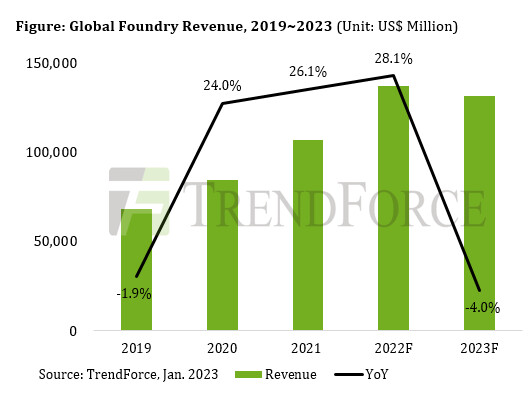
Foundry Revenue is Forecasted to Drop by 4% YoY for 2023, TrendForce Notes

TrendForce's recent analysis of the foundry market reveals that demand continues to slide for all types of mature and advanced nodes. The major IC design houses have cut wafer input for 1Q23 and will likely scale back further for 2Q23. Currently, foundries are expected to maintain a lower-than-ideal level of capacity utilization rate in the first two quarters of this year. Some nodes could experience a steeper demand drop in 2Q23 as there are still no signs of a significant rebound in wafer orders. Looking ahead to the second half of this year, orders will likely pick up for some components that underwent an inventory correction at an earlier time. However, the state of the global economy will remain the largest variable that affect demand, and the recovery of individual foundries' capacity utilization rates will not occur as quickly as expected. Taking these factors into account, TrendForce currently forecasts that global foundry revenue will drop by around 4% YoY for 2023. The projected decline for 2023 is more severe when compared with the one that was recorded for 2019.

India PC Market Ships 4.5 Million Units in 3Q21, Reports All-Time High Shipments, According to IDC

The India traditional PC market (inclusive of desktops, notebooks, and workstations) continued its growth momentum despite ongoing supply and logistical challenges. The traditional PC shipments witnessed a 30% year-over-year (YoY) growth in 3Q21 (Jul-Sep), marking the fifth consecutive quarter of growth in India, according to new data from the International Data Corporation 's (IDC) Worldwide Quarterly Personal Computing Device Tracker. A total of 4.5 million PCs were shipped during the quarter, making it India's biggest-ever single quarter. To put this in perspective, it is bigger than the total yearly consumer shipments in 2019, a year before the pandemic hit us. As a result, many brands also reported their biggest quarter of PC shipments.

Notebook PCs continue to dominate the overall category with more than 80% share. Enterprise and consumer demand helped the Notebook category to reach over 3 million units for the first time, and the desktop category also continued its upward momentum as it grew by 30.5% YoY in 3Q21.

Apple Announces Self Service Repair

Apple today announced Self Service Repair, which will allow customers who are comfortable with completing their own repairs access to Apple genuine parts and tools. Available first for the iPhone 12 and iPhone 13 lineups, and soon to be followed by Mac computers featuring M1 chips, Self Service Repair will be available early next year in the US and expand to additional countries throughout 2022. Customers join more than 5,000 Apple Authorized Service Providers (AASPs) and 2,800 Independent Repair Providers who have access to these parts, tools, and manuals.

The initial phase of the program will focus on the most commonly serviced modules, such as the iPhone display, battery, and camera. The ability for additional repairs will be available later next year.

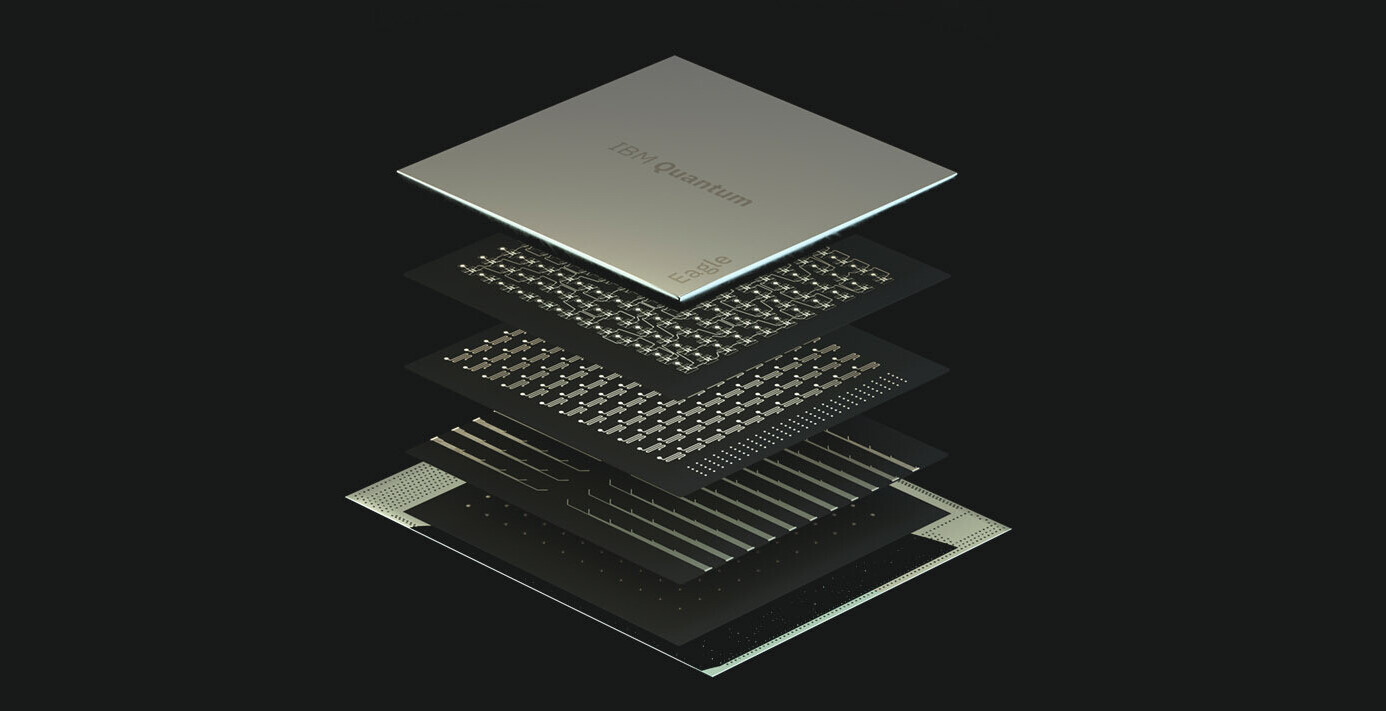
IBM Unveils Breakthrough 127-Qubit Quantum Processor

IBM today announced its new 127-quantum bit (qubit) 'Eagle' processor at the IBM Quantum Summit 2021, its annual event to showcase milestones in quantum hardware, software, and the growth of the quantum ecosystem. The 'Eagle' processor is a breakthrough in tapping into the massive computing potential of devices based on quantum physics. It heralds the point in hardware development where quantum circuits cannot be reliably simulated exactly on a classical computer. IBM also previewed plans for IBM Quantum System Two, the next generation of quantum systems.

Quantum computing taps into the fundamental quantum nature of matter at subatomic levels to offer the possibility of vastly increased computing power. The fundamental computational unit of quantum computing is the quantum circuit, an arrangement of qubits into quantum gates and measurements. The more qubits a quantum processor possesses, the more complex and valuable the quantum circuits that it can run.

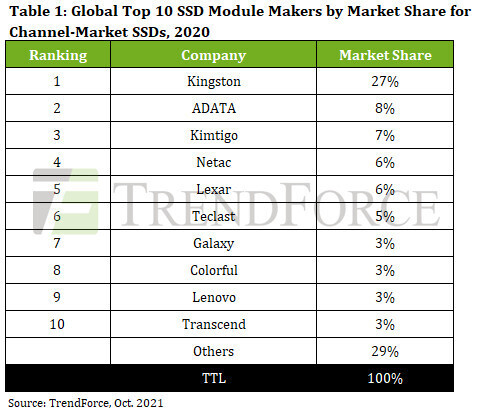
Global Ranking of Top 10 SSD Module Makers for 2020 Shows 15% YoY Drop in Annual Shipment, Says TrendForce

The emergence of the COVID-19 pandemic led to severe delays in manufacturing and logistics. In particular, governments worldwide began implementing border restrictions in 2Q20 to combat the ongoing health crisis, leading to a sudden decline in order volumes for channel-market SSDs, according to TrendForce's latest investigations. Annual shipment of SSDs to the channel (retail) market reached 111.5 million units in 2020, a 15% YoY decrease. In terms of market share by shipment, Kingston, ADATA, and Kimtigo once again occupied the top three spots, respectively.

Looking at the channel market for SSDs as a whole, NAND Flash suppliers (among which Samsung possessed the largest market share) accounted for around 35% of the total shipments in 2020, while SSD module makers accounted for the other 65%. The top 10 module makers accounted for 71% of channel-market SSD shipments from all SSD module makers. Taken together, these figures show that the market remained relatively oligopolistic in 2020. However, it should be noted that TrendForce's ranking of SSD module makers for 2020 takes account of only products bound for the channel market and under brands owned by the module makers themselves; NAND Flash suppliers were therefore excluded from the top 10 ranking.

Annual Notebook Shipment for 2021 Projected to Reach 240 Million Units, Though Demand in 4Q21 Remains Contingent on Market Trends, Says TrendForce

As growing vaccination rates worldwide starting in July lead to a gradual easing of lockdowns, the overall demand for notebook computers has also experienced a corresponding slowdown, with Chromebook demand dropping by as much as 50%, according to TrendForce's latest investigations. However, factors such as a wave of replacement demand for commercial notebooks in Europe and North America due to the return to physical workplaces, as well as brands' aggressive efforts to rush out their 4Q21 shipments ahead of time due to global port congestions, became the primary drivers of notebook demand in 3Q21. Hence, annual notebook shipment for 2021 will likely reach 240 million units, a 16.4% YoY increase.

TrendForce further indicates that 4Q21 will welcome both the gradual release of new models equipped with Intel's next-gen CPUs and a wave of replacement demand for notebooks featuring Windows 11. Even so, overall notebook shipment in 4Q21 will depend on the status of the COVID-19 pandemic and the demand for commercial notebooks. As vaccinations become even more widespread in 2022, pandemic-related spending is expected to decline as a result. TrendForce therefore expects global notebook shipment to decline by 7-8% YoY next year and reach approximately 220 million units, although this still represents a growth of 60 million units over the shipment volume for 2019, prior to the emergence of the pandemic.

Worldwide Enterprise WLAN Market Continued Strong Growth in Second Quarter 2021, According to IDC

Growth rates remained strong in the enterprise segment of the wireless local area networking (WLAN) market in the second quarter of 2021 (2Q21) as the market increased 22.4% on a year-over-year basis to $1.7 billion, according to the International Data Corporation (IDC) Worldwide Quarterly Wireless LAN Tracker. In the consumer segment of the WLAN market, revenues declined 5.7% in the quarter to $2.3 billion, giving the combined enterprise and consumer WLAN markets year-over-year growth of 4.6% in 2Q21.

The growth in the enterprise-class segment of the market builds on a strong first quarter of 2021 when revenues increased 24.6% year over year. For the first half of 2021, the market increased 23.5% compared to first two quarters of 2020. Compared to the second quarter of 2019, 2Q21 revenues increased 10.8%, indicating that demand in the enterprise WLAN is strong.

DRAM Module Revenue Undergoes 5% YoY Growth for 2020, with Varying Performances Among Suppliers, Says TrendForce

Annual shipment of notebook computers and desktop PCs underwent a massive increase in 2020 thanks to the proliferation of the stay-at-home economy brought about by the COVID-19 pandemic last year, according to TrendForce's latest investigations. In particular, notebook shipment increased by a staggering 26% YoY, thereby generating a corresponding demand for DRAM chips. Although the movement of DRAM prices remained stable in 2020, there was a palpable growth in actual DRAM bit demand. Hence, global DRAM module revenue increased by about 5% YoY to US$16.9 billion for 2020.

Looking back at the price trend of DRAM modules for 2020, TrendForce indicates that the market adopted a relative conservative outlook going forward in view of the ongoing pandemic. In turn, various end-products differed wildly in their respective market performances as well. For instance, while demand for notebooks remained strong, smartphone demand was relatively bearish. Server shipment, on the other hand, was at the same time consistent yet indicative of uncertainties, to some degree. In light of the varying performances in the end-markets, PC DRAM prices did not undergo drastic fluctuations throughout the year, and DRAM module suppliers posted earnings performances that were a direct result of their sales strategies, with certain suppliers, including Kimtigo and ADATA, able to raise their revenues by a massive margin.

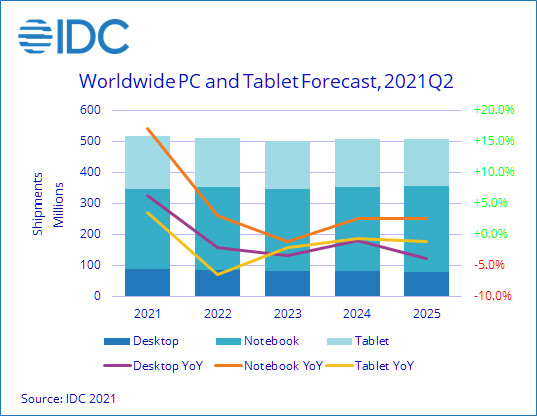
Worldwide Shipments of PCs and Tablets Will Maintain Growth Through 2021 But Future Opportunity Leans Towards Notebook PCs, According to IDC

According to a new forecast from the International Data Corporation (IDC) Worldwide Quarterly Personal Computing Device Tracker, worldwide shipments of PCs are expected to grow 14.2% to 347 million units in 2021. This is down from IDC's May forecast of 18% growth with continued supply chain and logistical challenges cited as the main reasons. The Tablet market is also expected to grow in 2021 but at a much slower pace of 3.4%.

"We continue to believe the PC and tablet markets are supply constrained and that demand is still there," said Ryan Reith, program vice president with IDC's Worldwide Mobile Device Trackers. "The lengthening of the supply shortages combined with on-going logistical issues are presenting the industry with some big challenges. However, we believe the vast majority of PC demand is non-perishable, especially from the business and education sectors."

NVIDIA Founder and CEO Jensen Huang to Receive Prestigious Robert N. Noyce Award

The Semiconductor Industry Association (SIA) today announced Jensen Huang, founder and CEO of NVIDIA and a trailblazer in building accelerated computing platforms, is the 2021 recipient of the industry's highest honor, the Robert N. Noyce Award. SIA presents the Noyce Award annually in recognition of a leader who has made outstanding contributions to the semiconductor industry in technology or public policy. Huang will accept the award at the SIA Awards Dinner on Nov. 18, 2021.

"Jensen Huang's extraordinary vision and tireless execution have greatly strengthened our industry, revolutionized computing, and advanced artificial intelligence," said John Neuffer, SIA president and CEO. "Jensen's accomplishments have fueled countless innovations—from gaming to scientific computing to self-driving cars—and he continues to advance technologies that will transform our industry and the world. We're pleased to recognize Jensen with the 2021 Robert N. Noyce Award for his many achievements in advancing semiconductor technology."

Epic Games Store Keeps Losing Money, Expected Unprofitable Until 2027, Even with a Massive $500 Million Investment Behind It

Epic Games Store, one of the many products of the Epic Games company, is the current number one contender of Steam game store, which used to be Valve's monopoly in the gaming market. Having another contender is nice and competition is always welcome, however, it doesn't seem like running a games store is a cheap venture. In the recent legal dispute between Apple and Epic in California state, we have discovered some interesting details about Epic Games Store (EGS) and its financial background. According to the documents appearing in the court, EGS is not considered profitable until 2027, at least.

Apple has told the court that "Epic lost around $181 million on EGS in 2019. Epic is projected to lose around $273 million on EGS in 2020. Indeed, Epic committed $444 million in minimum guarantees for 2020 alone, while projecting, even with 'significant' growth, only $401 million in revenue for that year. Epic acknowledges that trend will continue in the immediate future: Epic projects to lose around $139 million in 2021." This information shows that Epic has sunk a lot of cash in the store, however, the company expects EGS to become profitable at some point, where the original investment will be returned.

Growth in Total Smartphone Production for 2021 Drops to 8.5% YoY Due to India's Second Wave of Coronavirus, Says TrendForce

TrendForce's investigations find that India has become the second largest market for smartphones since 2019. However, the recent worsening of the COVID-19 pandemic in the country has severely impaired India's domestic economy and subsequently dampened various smartphone brands' production volume and sales (sell-in) performances there. TrendForce is therefore revising the forecasted YoY growth in global smartphone production for 2021 from 9.4% down to 8.5%, with a yearly production volume of 1.36 billion units and potential for further decreases going forward.

TrendForce further indicates that the top five smartphone brands (Samsung, Apple, Xiaomi, OPPO, and Vivo) have either set up assembly plants in India or sought assistance from EMS providers with operations in the country. Hence, the share of made-in-India smartphones has been on the rise over the years, even though the majority of the domestically manufactured devices are still for meeting the demand of the home market. Judging from the current state of Indian smartphone manufacturing, TrendForce expects the second wave to reduce the country's smartphone production volume for 2Q21 and 3Q21 by a total of 12 million units, in turn resulting in a 7.5% YoY decrease in smartphone production in India for the whole year.
Return to Keyword Browsing
Nov 11th, 2026 17:24 CST change timezone

New Forum Posts

Popular Reviews

TPU on YouTube

Controversial News Posts