News Posts matching #Intel

Return to Keyword Browsing

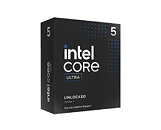
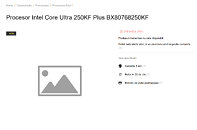
Intel Core Ultra 5 250KF Plus "Arrow Lake Refresh" Listed by Romanian Retailer

Intel's upcoming "Arrow Lake Refresh" are weeks away from the final release, but new listing suggests that there might be more SKUs getting a refresh makeover than we initially thought. In the latest listing by a Romanian retailer, there is a new SKU called Core Ultra 5 250KF Plus, with a code number BX80768250KF. The SKU is supposed to be the first version of the ARLR family with a "KF" mark, meaning that there won't be an integrated GPU in this processor Instead, only the CPU is provided, meaning that a GPU is mandatory, much like the previous KF SKUs. In the listing there is a mention of 4.2 GHz frequency, which aligns with the previously rumored Core Ultra 5 250K Plus and its P-core base speed of 4.2 GHz. This means that other specifications will remain similar to the Core Ultra 5 250K Plus, like the E-Core base speed of 3.5 GHz, E-Core turbo of 4.7 GHz, and P-Core boost frequency of 5.3 GHz. The only difference will be the lack of iGPU, as it has been a case with previous KF SKUs.

Interestingly, the Romanian retailer is also listing the Core Ultra 250K Plus (BX80768250K) and Core Ultra 270K Plus (BX80768270K), while the flagship Ultra 9 290K Plus is not yet listed. This doesn't necessarily mean the SKU won't exist, but rather that this preliminary listing is incomplete for now. For the Core Ultra 5 250KF Plus, the retailer listed it at 1,049 Romanian Leu, which is about $243. As previous leaks suggest a March or April release of the ARLR family, we can expect the information and listings to intensify in the coming weeks. Some early benchmark runs also point to a 10% performance boost in flagship SKUs with the new refresh, so we have to wait and see how these mid-range chips perform in more testing.

OCCT Tool Gets Intel Xeon 600 "Granite Rapids-WS" Overclocking Support

OCBASE has updated its OCCT tool to include overclocking support for Intel's latest Xeon 600 "Granite Rapids-WS" workstation processors, designed for precise tuning of Intel's best HEDT offering. While OCCT is traditionally known for hardware stability testing, OCBASE aims to transform it into a universal platform that combines fine-tuning, including overclocking, with stability testing in a single application. The company has worked with Intel to create a special skin for the OCCT tool, featuring an Intel-like blue and white theme. Besides the visual makeover, lots of under the hood changes follow.

For instance, Intel's flagship Xeon 698X, with 86 cores and 172 threads and 336 MB of L3 cache, can be overclocked from the application UI. The processor operates at a 2.0 GHz base clock and can boost up to 4.8 GHz with Turbo Boost Max 3.0 or 4.6 GHz with Turbo Boost 2.0. Intel confirms that the 698X is fully unlocked, which is unusual for the Xeon processor family. With OCCT, users can now make per-core clock adjustments and live parameter edits while running continuous stress tests. Currently in a closed beta program, the public release is expected within weeks and will include Linux compatibility.

Intel Launches Xeon 600 Series Workstation CPUs

After a long wait, Intel has launched its Xeon 600 Series processors dedicated to workstations. Codenamed Granite Rapids-WS, the new lineup is targeting single-socket workstations, with a strong emphasis on high core counts, large memory capacity, and extensive I/O for multi-GPU and storage-heavy configurations. The new chip family will replace the existing Sapphire Rapids-based Xeon W-2500 and W-3500 Series workstation chips and will go up against AMD high-end workstation equivalent, the Ryzen Threadripper Pro 9000 Series. In total, Intel has 11 SKUs for Xeon 600 series and all are built around Redwood Cove P-cores, with no E-cores present. At the top of the stack sits the Xeon 698X, featuring 86 cores and 172 threads, backed by 336 MB of L3 cache. The chip runs at a 2.0 GHz base clock, boosting up to 4.8 GHz with Turbo Boost Max 3.0, or 4.6 GHz under Turbo Boost 2.0. Intel confirms that the 698X is fully unlocked, allowing overclocking, something still relatively rare in the Xeon workstation space.

They are paired with the Intel W890 chipset that offers up to 128 PCIe 5.0 lanes directly from the CPU. It features eight memory channels supporting DDR5-6400 RDIMMs, and up to 4 TB of system memory. Compared to the previous Xeon WS generation, Granite Rapids-WS brings larger L2 and L3 caches, CXL 2.0 support and updated platform features. Intel also highlights support for vPro Enterprise, as well as Intel Deep Learning Boost, including VNNI, AVX-512, and AMX, targeting AI inference and advanced compute workloads.

Intel Mandates 7,467 MT/s+ Memory for "Panther Lake" Arc B390/B370 Integrated Graphics

Intel is reportedly mandating OEM integrators of the latest "Panther Lake" SoCs to use LPDDR5X memory starting at 7,467 MT/s and beyond, with an interesting software differentiator between adequate speeds or those below. According to Golden Pig Upgrade, LDDR5X memory running below the 7,467 MT/s threshold will force the software to display a generic mark of "Intel (R) Graphics," while configurations with that exact memory speed or higher will display the full name of "Intel (R) Arc (TM) Graphics B390" or "Intel (R) Arc (TM) Graphics B370" marking in Windows 11 Task Manager. Reportedly, Intel is doing this to stop OEMs from cutting corners with their "Panther Lake" laptop configurations, where they could bundle a lower-speed LDDR5X memory out of the Intel specification.

Without the required memory, Intel's Arc B390/B370 iGPUs would likely be left starving for bandwidth, as the whole SoC is being powered by that memory. At higher speeds, memory can do the data transfer faster, resulting in a boost of the overall system performance, and most importantly, the frame rate that these chips can push out. Especially for single-package systems like "Panther Lake" is, faster memory is a great way to get extra performance boost. Intel's flagship SKUs are advertised as capable of running with LPDDR5X memory at speeds up to 9,600 MT/s, which is just below the point where LPDDR5X technology tops out at 10,700 MT/s. Interestingly, there are lots of options from Intel's OEM partners that integrate top-end memory, which is a positive sign for the ecosystem.

Intel XeSS 3 Runs on Arc B580 Before Official Support Lands

Intel XeSS 3 with multi-frame generation (MFG) is expected to be available this month for the Arc B580 "Battlemage" graphics cards. However, some Redditors suggest there's a workaround to enable XeSS 3 and gain the FPS boost from MFG through a simple file swap. Gamers using Intel's Arc B580 have discovered that by installing Intel's driver package for "Panther Lake"—which includes XeSS 3 with MFG—and renaming certain dynamic link libraries, the drivers for Arc B580 can use libraries intended for Arc B390 and Arc B370 integrated graphics. The process is straightforward, allowing gamers to download, extract, rename, and activate XeSS 3 on their non-PTL systems without issues. This raises the question of why Intel chose not to officially support the discrete "Battlemage" GPUs for XeSS 3 on the new driver release day. Possible reasons could include marketing strategies or additional beta-testing before the official release.
Here is a complete step-by-step solution.

Leaked Intel Core Ultra 7 356H Benchmark Scores Reveal Middling Gains

Intel's Core Ultra 356H is an upcoming 16-core (4 P-cores, 12 E-cores) mobile Panther Lake CPU. Although official review embargoes for the rest of Intel's Panther Lake CPUs are said to be right around the corner, supposed performance benchmarks for Intel's latest have already started to leak, with Cinebench R23 and 3DMark Steel Nomad Light results coming by way of @realVictor_M on X. The results indicate strong multicore performance but stagnant single-core scores compared to Intel's last-generation chips. The iGPU is also notably slower, since the Arc 140V iGPU in the outgoing Core Ultra 7 255H has significantly more cores than the new Intel Graphics 4 Xe3 iGPU in the Panther Lake chip.

According to the leaker, whose results are so far unverified, the Core Ultra 7 356H scored 2013 points in the Cinebench R23 single-core benchmark and 20,721 points in the Cinebench R23 multicore test. For reference, this is slightly ahead of the outgoing Core Ultra 7 255H, which features two more P-cores and two fewer E-cores and averages around 18,679 points in the Cinebench R23 multicore benchmark. Single-core scores, for their part, are about dead even, with the 255H averaging around 2060 points in the R23 single-core benchmark. In the 3DMark Steel Nomad Light test, the Panther Lake iGPU scored 2,110 points. By comparison, its predecessor's average score in the same benchmark ranges between 3,279 and 3,532 points, depending on whether the benchmark is running in DX12 or Vulkan mode. The upcoming laptop CPUs will have to contend with AMD's new Ryzen AI 400 APUs, which have already started showing up in laptops and have shown to perform admirably in comparison with current-gen Intel CPUs.

NVIDIA to Build GPUs on Intel Foundry from 2028: Report

NVIDIA's upcoming "Feynman" AI GPU will partially use Intel Foundry nodes, a DigiTimes report says. NVIDIA recently invested a 5% stake in Intel, and is exploring tapping into Intel Foundry manufacturing capacity. In particular, NVIDIA is interested in the Intel 18A and 14A foundry nodes for certain components of its upcoming "Feynman" AI GPU that launches in 2028, succeeding the current "Rubin" AI GPU. NVIDIA also intends to tap into Intel's EMIB technology for its chiplet interconnectivity, the report says.

The "Feynman" AI GPU will still be majorly TSMC-based, with its core IP being built on die(s) leveraging TSMC A16 (1.6 nm) foundry node, which is expected to make up 75% of the chip's value. The remaining silicon content will be built on Intel 18A or Intel 14A nodes, and the chip's final packaging is expected to take place in U.S. soil, at Intel Foundry. This way, it will be Intel handling the EMIB chiplet bonding. "Feynman" is expected to implement a newer memory standard, such as HBM4e or even HBM5, and significantly increase memory per package, so each chip can handle trillion-parameter scale models.

Intel Changes Core Ultra 9 285K Box in the Latest Product Change Notice

Intel has updated the retail packaging for its flagship Core Ultra 9 285K "Arrow Lake-S" desktop processor, as detailed in a recent product change notice (PCN). Initially reported by @momomo_us, the PCN indicates that the previous packaging, which featured visuals suggesting a rock-like product inside, will be replaced by a plain, dark box displaying only the product name on the front. Intel explains that this change will alter the packaging's appearance and reduce its dimensions, thereby improving pallet density. The primary objective is to optimize pallet density, allowing Intel to ship more CPUs at a lower cost.

The old packaging measured 165x150x64 mm, with a volume of approximately 1.58 liters, while the new packaging measures 116x101x44 mm, totaling about 0.55 liters. This represents a reduction of roughly 65%, enabling Intel to package significantly more units in its parcels. It's important to note this PCN for consumers who have seen unboxing videos of these CPUs online, as they might now encounter a different box at retail stores, helping to prevent any potential confusion. Finally, Intel notes that its Material Master (MM) number won't be changing with this box "rebrand."

NVIDIA Offers "Vera" CPU as a Standalone Competitor to Intel's Xeon and AMD's EPYC Processors

NVIDIA's integration of AI systems now extends beyond GPUs with generic Arm CPUs. The company is introducing its high-performance "Vera" CPUs as a standalone product, marking its first entry as a competitor to Intel Xeon and AMD EPYC server-grade CPUs. NVIDIA CEO Jensen Huang confirmed this new venture in an interview with Bloomberg, stating, "For the very first time, we're going to be offering Vera CPUs. Vera is such an incredible CPU. We're going to offer Vera CPUs as a standalone part of the infrastructure. You can now run your computing stack not only on NVIDIA GPUs but also on NVIDIA CPUs. Vera is completely revolutionary... Coreweave will have to act quickly if they want to be the first to implement Vera CPUs. We haven't announced any of our CPU design wins yet, but there will be many."

The "Vera" CPU is equipped with 88 custom Armv9.2 "Olympus" cores that utilize Spatial Multithreading technology, allowing it to handle 176 threads through physical resource partitioning. These custom cores support native FP8 processing, enabling some AI workloads to be executed directly on the CPU with 6x128-bit SVE2 implementation. The chip offers 1.2 TB/s of memory bandwidth and supports up to 1.5 TB of LPDDR5X memory, making it ideal for memory-intensive computing tasks. However, with the CPU now being offered as a standalone solution, it is unclear whether there will be any classic memory options like DDR5 RDIMMs, or if the CPU will rely solely on SOCAMM LPDDR5X. A second-generation Scalable Coherency Fabric provides 3.4 TB/s of bisection bandwidth, connecting the cores across a unified monolithic die and eliminating the latency issues common in chiplet architectures. Additionally, NVIDIA has integrated a second-generation NVLink Chip-to-Chip technology, delivering up to 1.8 TB/s of coherent bandwidth for external "Rubin" GPUs.

Intel Arc Pro B70 and B65 "Battlemage" GPUs: Up to 32 Xe2 Cores and 32 GB GDDR6 Memory

If you're wondering where the big "Battlemage" GPUs are, they are reportedly being shipped, but primarily for the professional visualization sector and AI builders. According to a leak from VideoCardz, Intel's upcoming Arc Pro B70 and Arc Pro B65 GPUs are part of this release, using the long-rumored BMG-G31 GPU die that Intel has prepared for the higher-end GPUs. Starting with the higher-end Arc Pro B70, Intel plans a BMG-G31 configuration with 32 Xe2 cores and 32 GB of GDDR6 memory on a 256-bit bus. This will equal to about 4,096 FP32 cores in its full configuration, which is exactly twice the core count of the Arc Pro B60, and twice its memory capacity on a single-GPU version. For its smaller sibling Arc Pro B65, Intel has cut BMG-G31 die to support 2,560 FP32 cores, with 20 Xe2 cores in total. This is the same core configuration as the Arc Pro B60, but this card comes with 32 GB of GDDR6 memory out of the box, 8 GB higher than the Arc Pro B60.

Intel will launch both GPUs in the first quarter of this year. With January almost over, a February or March release seems likely. For local AI LLM development and workstations needing more computational power, Intel is gradually entering this market to address the gap left by AMD and NVIDIA, offering high memory capacities and a good price/performance ratio. However, the situation is different for gaming GPUs. According to VideoCardz, Intel's board partners have received the BMG-G31 dies for testing and integration into customized designs, but only for the Pro SKU. No gaming chips have been shipped. Intel is reportedly delaying the larger Arc B770 gaming GPU to focus on the Pro-Viz segment. As a result, no near-term launch is planned for the gaming version, leaving the release of the B770 uncertain.

Intel's Tom Petersen Bemoans AMD Strix Halo Inefficiency, Banks on dGPUs For High Performance

Intel apparently has no plans to compete with the high-power iGPUs in AMD's Strix Halo APUs. This is according to Intel's Tom Petersen, who recently spoke to Club386 about the potential for a Panther Lake Halo, as it were, explaining that there are many factors currently preventing Intel from going down that route. While Intel's Arc B390 iGPU currently appears to only be outmatched by AMD's Radeon 8060S in the Ryzen AI Max+ 395 and similar, it seems as though that's where Intel will stop for now, with Petersen reportedly saying that that sort of performance segment is "primarily discrete," and that those looking for that sort of performance "would be better served by a small, discrete GPU that's going to be provided by third parties."

He goes on to explain that AMD's Strix Halo APUs aren't as efficient, stating that "AMD's current product is not that competitive either, on a power or a performance-per-watt basis," and that Intel is "focused on integrated graphics performance, primarily for gaming." Much like AMD, Intel produces both integrated and discrete graphics solutions, with the latest Arc GPU rumors pointing to a workstation-grade Battlemage BMG-G31 GPU, which is supposed to arrive later this year in the form of the Arc Pro B70 GPU with 32 GB of VRAM. Currently, the Intel Arc B580 is Intel's most powerful gaming GPU, and that delivers markedly better performance than the AMD Radeon 8060S, depending on the specific workload.

Intel Arc Pro B70 "Big Battlemage" dGPU Could Come Out in Q1'26

The mid-January rumor mill seemed to indicate Intel's deprioritization of the speculated Arc B770 16 GB gaming graphics card model, possibly in favor of getting workstation-grade designs out into the wild. Last week, VideoCardz connected the oft-leaked "BMG-G31" GPU die—allegedly the largest example of Team Blue's Xe2-HPG "Battlemage" chip family—to mysterious Arc Pro "B70 and B65" models. In a follow-up report, the online publication cited new information—as disclosed by Bionic_Squash—that concentrated on Intel's supposed "Big Battlemage" flagship card. In a social media interaction with Orlak29 (another source of pre-release info), Bionic_Squash predicted a potential first quarter launch of the claimed "Arc Pro B70 32 GB SKU," probably alongside a Core Ultra 200K+ "Arrow Lake Refresh" processor family announcement. Previously, the latter product range was linked to a probable March/April release window.

When asked about Team Blue's revised plans for the consumer graphics card market, Bionic_Squash posited that: "(the B770 is) not financially viable, I don't think it's going to launch anytime soon...if at all." According to VideoCardz's mid-month insider report, two unnamed contacts—allegedly involved with Intel AICs—suggested a non-supply of "Arc B770 test boards and finalized specifications" to interested parties. This particular model likely faces an uncertain future, due to the ongoing memory crisis and current-gen competition. Additionally, some of the PC gaming community's perception of "Battlemage" being old hat, at this point in time, could be another factor. Many would prefer that Intel simply move onto getting "Celestial" graphics architecture deployed in next-gen desktop cards.

Lip-Bu Tan Mentions Making of Custom Xeon CPU that Fully Integrates NVIDIA NVLink Tech

Around mid-September of last year, Intel and NVIDIA announced a somewhat surprising joint venture. At the time, the two partners teased an eventual deployment of unspecified GeForce RTX iGPU designs within futuristic Intel x86 System-on-Chips (SoCs). We have not heard much about this mainstream project since autumn time—in the meantime, Team Blue has gone all in on hyping up next-gen "Panther Lake-H" mobile processors, that utilize in-house Arc Xe3 graphics architecture. Lately, Lip-Bu Tan—CEO of Intel—has mentioned the existence another co-development with the Green Team. In a recent earnings call, regarding Q4 2025 results, the boss slipped in a brief teaser about an in-progress enterprise-grade processor design.

When discussing his company's ongoing simplification of server product roadmaps, Tan disclosed that: "we also continue to work closely with NVIDIA to build a custom Xeon fully integrated with their NVLink technology, to bring best-in-class x86 performance to AI host nodes." He swiftly moved onto talking about the Xeon division being laser-focused on getting 16-channel "Diamond Rapids" out into the wild. Naturally, it is too early to tell whether the latest Intel + NVIDIA collab will leverage sixth or seventh generation Xeon technologies. The further out "Coral Rapids" family is expected to resurrect Hyper-Threading for datacenter workflows. Tan stated that another main goal is the acceleration of Xeon "Coral Rapids" series' introduction to market. Prior to publication of Intel's Q4 '25 financial results, the semiconductor industry rumor mill proposed a second half of 2027 release window.

Intel Core Ultra Series 4 "Nova Lake" Processors Launch in Late-2026

Intel is preparing to launch its Core Ultra Series 4 "Nova Lake" processor generation toward the end of 2026, CEO Lip-Bu Tan confirmed. This processor generation would span various form-factors, including importantly, desktop. Intel is building its next-generation "Nova Lake-S" desktop processor around the new Socket LGA1954 platform that replaces the current LGA1851. The company is planning to release Core Ultra Series 3 "Arrow Lake Refresh" for LGA1851 in the run-up to "Nova Lake-S" by yearend.

With "Nova Lake," Intel is expected to make fundamental changes to its processor design to help the company claw back performance leadership over AMD in the desktop segment. These changes include a doubling in CPU core counts going up to 16P+32E, a new iGPU based on the Xe3 "Celestial" graphics architecture, a new NPU that meets Copilot+ requirements, and the introduction of special SKUs with BLLC (big last-level cache), Intel's answer to AMD's 3D V-Cache. Intel will update the CPU complex with new "Coyote Cove" P-cores, and "Arctic Wolf" E-cores, both of which are expected to improve IPC over the current "Lion Cove" and "Skymont" combo. "Coyote Cove" does not feature HyperThreading, something the Intel CEO wants to see restored on the company's P-cores, but "Nova Lake" will make up for it with a numerical increase in P-core counts.

Intel Core Ultra X9 388H PassMark Results Show Impressive Gains

Intel revealed the Panther Lake Core Ultra Series 3 mobile CPUs headed up by the Core Ultra X9 388H, at CES 2026 earlier this year. Intel promised that the flagship CPU would deliver up to 60% better multi-thread performance than the predecessor. While laptops with the Core Series 3 CPUs are only slated to arrive on January 27, some early benchmarks have appeared online ahead of the official launch date, courtesy of x86 is dead&back on X. According to the PassMark benchmark results, the Core Ultra X9 388H scored 37,904 points in the multi-thread benchmark and 4,451 points in the single-thread benchmark. This is a good 10% faster than the Core Ultra 9 285H (34,436 points) it is replacing and a solid 29% faster than the aging Core Ultra 9 185H in the multicore benchmarks. When it comes to single-core benchmarks, the Core Ultra X9 388H is basically only on-par with the 285H, but around 20% faster than the Core Ultra 9 185H.

It is, however, worth noting that these numbers are based on the average between two benchmarking runs, which varied greatly. During one benchmarking session, the Core Ultra X9 388H scored a whopping 40,523 points, although the hardware configurations don't seem to have changed from run to run. The test laptop, memory, and CPU clocks all appear to be the same, suggesting that environmental differences or software configuration may be to blame. The high score was actually the second one registered, so while these early benchmarks should still be taken with a pinch of salt, the numbers indicate that the new Intel Panther Lake CPUs might be impressive performers. For reference, the AMD Ryzen AI 9 HX Pro 470 scored 36,591 points in the PassMark multicore tests and 4,216 points in the single-score tests. The iGPU in the X9 388H was also previously benchmarked in Cyberpunk 2077, effectively doubling the performance of AMD's Strix Halo Radeon 890M iGPU. These latest results show reasonable performance gains, although we have yet to see the mid-range Panther Lake CPUs, which showed middling results in early benchmarks in late 2025.

Intel Reports Q4 and Full-Year 2025 Financial Results, Shares Down 11%

Intel Corporation today reported fourth-quarter and full-year 2025 financial results. "Our conviction in the essential role of CPUs in the AI era continues to grow," said Lip-Bu Tan, Intel CEO. "We delivered a solid finish to the year and made progress on our journey to build a new Intel. The introduction of our first products on Intel 18A - the most advanced process technology developed and manufactured in the United States - marks an important milestone, and we're working aggressively to grow supply to meet strong customer demand. Our priorities are clear: sharpen execution, reinvigorate engineering excellence, and fully capitalize on the vast opportunity AI presents across all of our businesses."

"We exceeded Q4 expectations across revenue, gross margin, and EPS even as we navigated industry-wide supply shortages," said David Zinsner, Intel CFO. "We expect our available supply to be at its lowest level in Q1 before improving in Q2 and beyond. Demand fundamentals across our core markets remain healthy as the rapid adoption of AI reinforces the importance of the x86 ecosystem as the world's most widely deployed high-performance compute architecture."

Intel Unveils Glass Core Substrate with EMIB Multi-Chip Connection

At NEPCON Japan 2026, Intel showcased its latest glass substrate technology designed to power the next generation of advanced AI and HPC accelerators. According to SemiVision Taiwan, which shared one of the slides, Intel has developed a new high-performance core glass substrate measuring 78x77 mm for the entire package. This substrate can accommodate approximately twice the reticle size with silicon, equating to about 1,716 mm² (2x858 mm²) of silicon area for logic and memory. It is the first 10-2-10-thick glass core substrate featuring Intel's EMIB multi-chip module technology. This configuration includes 10 redistribution layer (RDL) build-up layers on the top of the substrate, which are used to redistribute signals from the die. These layers handle fine pitch routing, with Intel dedicating as many as 10 layers for this purpose.

The core of the glass substrate consists of two layers and is made of 800 μm (or 0.8 mm) class material, which may include embedded metal layers for through-glass-vias (TGVs) or power/ground planes. The final "10" number denotes the number of build-up layers on the bottom (or back) side, mirroring the top for symmetric routing to connect to the motherboard/PCB. This layer also serves to "declutter" the sea of wires that the silicon die exposes, but makes it much more approachable to a standard motherboard/PCB that the chip mounts on. Intel's 10-2-10 glass core substrate is also equipped with some of the finest bump pitches in the market, with 45 μm (only 0.045 mm) bump pitch. Finally, Intel embeds two EMIB bridges for multi-chip-module packaging so you can manufacture several smaller dies and interconnect them via EMIB bridge, present on the glass core.

Apple Silicon Approaches AMD's Laptop Market Share Only Five Years In

According to data collected by Mercury Research and analyzed by Bernstein Research, Apple Silicon has made significant progress, achieving a laptop market share comparable to that of AMD, a long-time supplier in this sector. When Apple launched its first Arm-based custom M1 SoC, it transitioned away from Intel processors in favor of customized designs aimed at enhancing battery life and optimizing performance for macOS. This shift began in November 2020. Now, five years into the Apple Silicon ecosystem, the company has established a substantial laptop market share that rivals AMD.

According to these charts below, AMD's share in the laptop sector hovers just above 20%, at roughly 21-22%, with Apple slightly below the 20% mark, around 18-19%. This difference is fascinating as Apple has just entered year six of its custom silicon for MacBook laptops and Mac desktops, with no stopping in sight. Additionally, Intel's market share in the laptop sector has been steadily declining and now grabs the remaining 60%+ share, with fluctuations. For desktop segment, Apple also made an interesting market penetration as the company holds about 10% share in the sector which has typically been dominated by Intel and AMD. Any market share deducted from Intel is going directly to AMD in the desktop sector, as the charts show, meaning that the recent trend among consumers is again loud and clear that AMD is slowly becoming a more popular choice.

Intel to Discontinue Select 12th Gen "Alder Lake-S" & 4th Gen Xeon "Sapphire Rapids" CPUs

Earlier in the month, Intel issued two product change notifications (PCNs) affecting certain previous-gen processor products. A January 6 document—numbered #869847-00—outlines end-of-life status for "select" retail box and OEM tray 12th Gen Alder Lake desktop CPU models, encompassing from the top (Core i9) to bottom (Pentium Gold). TechPowerUp previewed the "Alder Lake-S" range around late 2021, followed a few weeks later by evaluations of launch era silicon. The recent low-key EOL announcement has not arrived as a major surprise, given that Team Blue detailed a retirement of 12th Gen Core "Alder Lake-H" mobile series last year, although high performance laptop-oriented "-HX" variants continue to live on in 2026. Last 12th Gen Core "Alder Lake-S" product orders can be placed up until July 24. The aforementioned PCN document lists a "January 22, 2027" last product discontinuance shipment date. Elements of "Alder Lake" could survive longer in emergent "Bartlett Lake-S" hybrid designs. Team Blue leadership is likely freeing up extra elbow room for an eventual arrival of "Alder Lake Refresh" desktop and mobile products.

Looking at the future of Intel's 4th Gen Xeon "Sapphire Rapids" scalable processor series, a January 14 publication (#842299-02) informs online visitors about the forthcoming sunsetting of seventeen (boxed and tray) server-class SKUs. For whatever reason, a small update details the sparing of a specific Xeon Gold 6414U model. Tom's Hardware points out that Team Blue is keeping its 4th Gen workstation families—Xeon W-2400, W-3400, W-2500, and W-3500—around for a little longer. The document's timeline lists a historical date—last product discontinuance orders occurring on "September 26, 2025." Last shipments are expected to go out on "March 31, 2028." The much delayed "Sapphire Rapids" Xeon scalable range finally tumbled into customer hands in 2023, but was swiftly succeeded by the 5th Gen Xeon "Emerald Rapids-SP" series. Intel's Xeon 6 "Granite Rapids-SP" scalable server CPUs were released last September.

Sparkle Launches Intel Arc Pro B60 24 GB Blower and 48 GB Passive GPUs

SPARKLE, a leading manufacturer of AI computing platforms and professional graphics solutions, today announced the launch of the SPARKLE Intel Arc Pro B60 Series graphics cards on January 12, 2026. The initial release introduces the Arc Pro B60 24 GB Blower Edition, delivering stable and efficient performance for professional workstations and AI inference workloads. In parallel, the Arc Pro B60 Passive 24 GB and Passive 48 GB models are also introduced, targeting industrial, server, and enterprise project-based deployments.

Following the launch on January 12, 2026, the SPARKLE Intel Arc Pro B60 24 GB Blower Edition is planned to be introduced through select retail partners, including Micro Center and Newegg. Product availability will vary by region and channel, subject to local distribution schedules. Designed for modern AI and professional applications, the Intel Arc Pro B60 Series supports up to 48 GB of GDDR6 memory (Passive Edition), 456 GB/s memory bandwidth, and 160 XMX AI engines, enabling reliable performance for LLM inference, 3D modeling, engineering visualization, and high-resolution content creation.

Intel Stock Hits $54, Up Nearly 45% in 2026 Alone

Intel's stock has climbed back to levels not seen since the company's downturn in 2022, as the stock later fell to its tangible book value according to some Wall Street estimates. Over the years, the company has faced challenges such as executive changes, significant capital expenditures, and delayed foundry rollouts. Despite these issues, the stock has now recovered to its 2022 levels, reaching a high of $54.16 per share, a price last seen in January 2022. There have been no stock splits or similar events since then, apart from a gradual erosion of Wall Street's confidence in Intel's ability to execute effectively. During tough financial times, investors lost faith in Intel. However, as the company began to rebuild its reputation in the semiconductor sector, it emerged as a key player in supporting the United States' vision of semiconductor independence.

Intel's stock reached a low of $17.63 in April 2025 when the United States, under the Trump administration, imposed tariffs on several countries. However, the U.S. government invested $8.9 billion in Intel, securing the investment when the stock traded at $20.47 per share. This led to the government acquiring a 9.9% stake in the company through public market participation. Since then, several factors have influenced Intel's stock price, including new product rollouts, increased momentum in Intel Foundry after a period of stagnation and capital losses, and more confident roadmaps. Intel's internal restructuring under new CEO Lip-Bu Tan, who projected $10 billion in savings in operating expenses compared to the previous roadmap, has also contributed to the company's progress.

Intel Recruits Eric Demers - Veteran GPU Architect Could be Part of New AI Group

Late last week, semiconductor industry trackers were astonished by Intel's fresh recruitment of Eric Demers. Until very recently, the seasoned GPU architect had spent almost fourteen years at Qualcomm—ending this spell as senior vice president of engineering. On Friday (January 16), Demers announced this major change—a short story mentioned multiple meetings (in 2025) with Intel CEO Lip-Bu Tan. He confirmed, in a private LinkedIn message (sent to CRN), that he would be starting work at Intel within the next week. Complete details of his new job description—chez Team Blue—were not shared with the American computer publication. Instead, a small hint was dropped—according to the CRN article, Demers expects to "lead GPU engineering with a focus on AI." Looking back in the TechPowerUp news archive, one historical section of Demer's career trajectory was brought forth. In early 2012, he moved on from his Corporate VP & CTO role at AMD's graphics division.

At the time, official statements did not mention his intention to join Qualcomm's Adreno GPU department. Prior to his tenure at ATI/AMD, Demers spent time at Silicon Graphics (SGI), Matrox, and then joined a team of former SGI-ers at start-up ArtX. ATI Technologies acquired ArtX almost three years after the latter's founding date. One of Demers' final projects at Qualcomm seems to be the Windows PC-focused Snapdragon X2 Series. Industry experts anticipate the ex-"other Red Team" engineering executive becoming a key figure at Intel's fairly new "AI Group"—this independent entity could be chasing major enterprise rivals; most notably NVIDIA. Team Blue introduced its "Crescent Island" AI data center accelerator a few months ago. A next-gen successor—dubbed "Jaguar Shores"—is reportedly expected to be "design complete" by the middle of 2026.

Minisforum Starts Selling AtomMan G7 Pro Slimline PC, Crams in GeForce RTX 5070 Laptop dGPU

Minisforum's US webstore has listed the new AtomMan G7 Pro model—starting at a special launch price, $1359.90, for the barebones package. By tacking on an extra $320, prospective buyers can order a configuration that is pre-fitted with 32 GB RAM of system memory, and 1 TB SSD of internal storage. TechPowerUp inspected a demonstration unit at the recently concluded CES trade event. Sat nearby was the AMD Ryzen APU-powered AtomMan G1 Pro SKU. Minisforum's Las Vegas booth was definitely very "Panther Lake-H" heavy, but the Chinese compact PC specialist continues to release systems based on older Intel chip designs. Akin to its "Ti" relative, the much newer AtomMan G7 Pro gaming model dips back into the "Raptor Lake-HX Refresh" generation. Team Blue's flagship 14th Gen Core i9-14900HX mobile processor remains in place, but the Minisforum engineering team has moved on from deploying NVIDIA's past-gen "Ada Lovelace" GPU family within this product tier.

The latest AtomMan entrant features a discrete GeForce RTX 5070 Laptop 8 GB graphics card. The AtomMan G7 range's "ultraslim" profiles likely cannot fully accommodate desktop-grade hardware. Recently, Zotac engineers managed to cram a GeForce RTX 5060 Ti 16 GB custom card into their highly-compact ZBOX MAGNUS EN275060TC pre-built desktop system. The AtomMan G7 Pro compact tower can be switched between gaming and office modes, via a physical button present on the outer chassis. Entertainment and productivity modes have been stressed test, according to the manufacturer's promotional material. They claim that a maximum 200 W-rated profile (comprised of max. 85 W CPU and 115 W GPU ratings) delivers flagship-grade gaming performance, without any compromises. The North American Minisforum webshop anticipates first AtomMan G7 Pro shipments going out on January 23.

ADLINK Launches Its First COM Express Module Powered by Intel Core Ultra Series 3 Processors

ADLINK Technology Inc., a global leader in edge AI computing solutions, proudly presents its latest Express-PTL COM modules powered by new Intel Core Ultra Series 3 processors. Express-PTL modules deliver a major performance leap with their advanced AI architecture, featuring an integrated NPU 5.0 that provides up to 50 TOPS of dedicated AI acceleration, offering significantly higher than the previous generation, and a new Intel Arc GPU with up to 12 Xe cores designed for efficient, streamlined operation, and delivering up to 120 TOPS for AI tasks and notably enhanced graphics rendering, supporting up to 16 CPU cores. All processing units provide up to 180 platform TOPS of AI compute, tailored not only for heavy but also for complex edge AI workloads.

High-Performance, Rugged Design for Mission-Critical Edge AI
The Express-PTL incorporates a hybrid CPU architecture with 4 high-performance (P) cores, 8 efficiency (E) cores, and 4 low-power (LPE) cores, offering improved processing efficiency and enhanced transistor performance. Complementing this high-performance computing, the module supports up to 128 GB of DDR5 SO-DIMM with IBECC for low-latency, reliable memory access. Industrial-temperature SKUs are engineered to withstand extreme rugged environments with a temperature range from -40°C to 85°C. Industrial features such as TCC, TSN, In-Band ECC, extended temperature support, and FuSa/FSEDP compliance further ensure robust, mission-critical operation, making the module a versatile and dependable solution for edge AI and general embedded deployments in demanding conditions.

Samsung's Texas Fab Reportedly Attracting Major Customer Interest as AI Boom Continues

A report put together by Deutsche Bank analysts has mentioned an ongoing supply-demand imbalance within the semiconductor market. According to Jukan's summary of the financial institute's findings, TSMC's "share of the advanced-node foundry market" could fall from an impressive 95% level, down to a mere 90% in the coming years. The industry-leading chipmaker continues to enjoy a prime position, but its international operation footprint seemingly cannot keep up with requests—mainly from fabless customers—during the ongoing AI hardware boom. Deutsche Bank believes that the Taiwanese foundry business has an order backlog extending way into 2027, with many clients requiring 3 nm wafer products. TSMC reportedly aims to get 3 nm node production lines pumping out around 190,000 wafers per month, by the end of this year. Even if this major target is met, demand is expected to outweigh supply. AI chip production-centric bottlenecks—mostly involving CoWoS packaging—have been dealt with in the recent past, but industry observers posit that VIP customers are considering alternate providers.

Allegedly, the next best options are the Samsung and Intel Foundries, despite rumors of teething problems—both companies will very likely welcome new requests. In modern times, many of Samsung's big clients have switched over to TSMC, due to (the former's) supposedly troubled development of more advanced nodes. Deutsche Bank analysts have outlined a "big six" group of key customers: AMD, Apple, Broadcom, MediaTek, NVIDIA, and Qualcomm. The fabless firms could be pursuing alternate "production capacity" avenues, with Samsung's 2 nm (SF2) and 4 nm node process lines being of particular interest. Like TSMC, the South Korea megacorp's state-of-the-art fabrication sites and staff expertise are concentrated in home territories. A surprise prediction has highlighted Samsung's main North American foundry—the Deutsche Bank report pinpointed a very specific location: "for customers seeking alternative supply, Samsung's Taylor fab is more likely to become the first destination." In addition, analysts think that the big six will select Samsung's Texas-based foundry over Intel's best native site (perhaps dealing in 18A).

Return to Keyword Browsing
Nov 17th, 2026 14:09 CST change timezone

New Forum Posts

Popular Reviews

TPU on YouTube

Controversial News Posts