News Posts matching #Intel

Return to Keyword Browsing

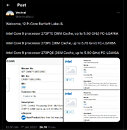
UK-based Wholesaler Lists 12-core Intel Core 9 "Bartlett Lake-S" OEM SKUs

Late last week, a not-yet-released Intel "Core 7 253PE" processor model leaked out via the PassMark CPU benchmark database. This ten P-Core (all performance) candidate signalled the first signs of "Bartlett Lake-S" activity in 2026, after many months of silence. Over the past weekend, additional "Team Blue Refreshed" product discoveries have been made. On Saturday (January 17) Vectral555 highlighted three new SKUs, but did not reveal the actual source of these leaks. Screenshots show model names, codes, and very basic specifications—evidently, these grabs were lifted from premature listings published by Mouser Electronics UK. The three unreleased OEM/tray products are categorized as Core 9 SKUs, all featuring 36 MB of cache, and destined for deployment on Team Blue's "FC-LGA16A" platform—this unusual socket name seems to be another way to refer back to the familiar LGA 1700 insert.

The "273PQE" model is boost clocked the highest at a maximum 5.9 GHz, the "273PE" SKU is specced at a max. 5.7 GHz, and the "273PTE" option makes do with 5.5 GHz. At the time of writing, the British wholesaler is offering both single unit and bulk orders. The fanciest "Core 9 273PQE" model is "on order" with zero units in stock, but tagged with £657.04 (single order) and £579.17 (bulk order, ten or more units) prices. The other options—"273PTE" and "273PE"—seem to be "non-stocked," and cost the same: £629.00 (single) or £554.46 (bulk). Intel could be prepping "Bartlett Lake-S" processors—under "Core Series 2" naming convention—for imminent launch. Two days ago, ITHome shared an impressively comprehensive list of Core 5, 7, and 9 model names plus basic spec credentials.


Tesla Completes AI5 Chip, Revives Dojo 3 with Intel Packaging Deal

Tesla has finalized the development of its AI5 automotive processor, allowing for production at TSMC and Samsung facilities. This advancement also revives the previously halted Dojo 3 supercomputer project. CEO Elon Musk announced that the AI5 chip will offer performance on par with NVIDIA's "Hopper" architecture, with two AI5 units equaling the power of a single "Blackwell" processor. The revival of Dojo 3 project was rumored with Intel joining as a key packaging partner, marking a shift from Tesla's earlier dependence on TSMC for complete manufacturing. Intel will manage assembly and testing using its EMIB technology, which connects multiple dies via silicon bridges instead of a full-wafer interposer. This method is better suited to Tesla's large Dojo modules that combine several 654 mm² chips into a single package.

Also based on previous information, Samsung will produce the D3 training chips at its Texas facility using a 2 nm process, leaving Intel to oversee packaging operations exclusively. This division of labor addresses capacity constraints and provides Tesla with more flexibility in customizing interconnect layouts. For the AI5 automotive chips, both Samsung and TSMC will create distinct versions, but Tesla aims to ensure identical software performance across both. Initial projections suggest the AI5 could operate at just 150 W while matching the performance of NVIDIA's H100 accelerator that requires 700 W. This efficiency is achieved by removing general-purpose graphics subsystems and optimizing the architecture specifically for Tesla's neural processing.

Intel "Panther Lake" Laptops to Carry 20% Price Premium Over "Lunar Lake"

Intel's latest "Panther Lake" designs are set to officially debut in the coming days, with the first reviews expected on January 26. These 18A SoCs are anticipated to come with a significant price premium, as indicated by Samsung. The South Korean company reports that Intel "Panther Lake" based Galaxy Book6 Pro and Galaxy Book6 Ultra models will be approximately 20% more expensive than the previous-generation Galaxy Book5 models, which were based on the "Lunar Lake" SoC. This price increase is noteworthy because it is driven by a combination of new manufacturing technologies and the ongoing DRAM shortage. While Intel used TSMC N3B for "Lunar Lake," it has shifted much of the manufacturing to its internal Fab capacity with the introduction of "Panther Lake" on the 18A node.

On its South Korean official website, Samsung lists the Galaxy Book6 Pro series starting at 3,410,000 KRW (approximately $2,315) for a laptop featuring 32 GB of LPDDR5X memory, a 1 TB SSD, and an Intel Core Ultra X7 "Panther Lake" CPU with integrated Arc graphics. The specific model for the Core Ultra X7 is the Core Ultra X7 368H, which includes 16 cores, a boost clock of up to 5.0 GHz, and an Intel Arc B390 integrated GPU. Intel claims this 12-Xe core model is about 77% faster than the previous generation "Lunar Lake" Arc 140V integrated GPU and roughly 73% faster than the Radeon 890M found in AMD's "Strix Point." Additionally, Intel compares the Arc B390 to a discrete NVIDIA GeForce RTX 4050 laptop GPU, but adds that XeSS3 features like multi-frame generation yield an overall performance win.

Intel Core Ultra 9 290HX Plus in MSI Laptop Stomps 285HX in Leaked PassMark Run

Despite no-showing at CES 2026, leaks still predict that Intel will launch the Arrow Lake Refresh mobile CPUs sometime in March or April 2026, and one of the CPUs slated to launch then is the mobile flagship Core Ultra 9 290HX Plus, which has incidentally showed up in a recent PassMark CPU benchmark (via X86isdeadandback on X). According to the PassMark listing, the Core Ultra 9 290HX Plus, which was supposedly tested in an MSI laptop equipped with an RTX 5090 and 32 GB of Samsung DDR5-5600 memory, the upcoming CPU will handily outpace the former flagship mobile CPU by around 7.5% in single-thread performance and a healthy 12.8% in the multicore benchmark. If the Core Ultra 9 285HX is anything to go by, there may still be some performance on the table with faster DDR5-6400 memory.

The Core Ultra 9 290HX Plus scored 66203 in the multicore benchmark and 5009 in the single-core benchmark. This performance puts it less than 2% away from the Intel Core Ultra 9 285K desktop CPU (which scored 67430 and 5093, respectively), which is certainly an impressive feat. Of course, all the usual caveats apply when it comes to early CPU benchmarks—especially leaked benchmarks. For starters, the official launch is still a while away, and clock speeds and microcode may not be entirely dialed-in yet. This is also a sample size of one, and CPU performance can often vary greatly between different configurations. The new CPU first appeared in a previously leaked Geekbench benchmark of an Acer Predator laptop, which also revealed that the Core Ultra 9 290HX Plus will use the same P-core and E-core layout as the older 285HX, meaning eight P-cores and 16 e-cores.

"Core 7 253PE" CPU Gets PassMarked, 10 P-Core "Bartlett Lake-S" Model Nearing Launch?

Intel's "Bartlett Lake-S" (Performance) P-Core-only processor design has made a surprise appearance, after a long period of developmental silence. Earlier, today X86 is dead&back put a spotlight on the intriguing entry of Team Blue's unreleased "Core 7 253PE" SKU within PassMark's CPU benchmark database. The keen watcher of not-yet-released PC hardware believes that this particular unit is possibly the first sample of Team Blue's 10-core "Bartlett Lake-S" variant to appear in the wild. This further refinement of 14th Gen "Raptor Lake Refresh" tech popped up a few times last year, but the TechPowerUp news archive shows a dry period during third and fourth quarters. An August report alluded to an embedded market target, the existence of a flagship 12 P-core model, and a potential launch under the "Intel Core Series 2" banner—minus an Ultra tag, due to lack of onboard NPUs.

All P-Core configurations could appeal to budget-conscious PC gamers. Efficiency-oriented (E and LPE) units are considered superfluous for these purposes. X86 is dead&back was pleased to find PassMark data that signalled improved multicore performance over the related Core i5 14400 "Raptor Lake-R" processor. They exclaimed: "Core 7 253PE (has) more MT performance than Core i5 14400 (6P + 4E)!" Their comparison shows a 20.6% uplift here, but a slight regression in terms of single-core scores (-2.73%). The sole "Core 7 253PE" sample's PassMark multi-thread rating, of 31802, closes in on the 14-core (6P + 8E) Core i5-14500 model's tally (31121). According yesterday's PassMark diagnostic, the newer chip utilizes Intel's UHD Graphics 770 integrated solution (akin to Core i5-14500), whilst the Core i5 14400 makes do with the UHD 730 iGPU. There are apparent differences across the various levels of cache, but the "Core 7 253PE" SKU seems to enjoy a larger overall pool—36 MB—when cross-examined with its older relatives.

Intel Core Series 3 "Wildcat Lake" Info Buried in Edge Product Document

On Tuesday (January 13) Intel uploaded a "Core Ultra Processors Series 3 for the Edge Product Overview" document to it content site. Akin to their recent CES 2026 presentations, this PDF is very "Panther Lake-H" (PTL-H) product heavy—with the flagship Core Ultra X9 388H SKU getting plenty of attention. Buried within the back of half of Team Blue's mid-January PDF is a lone appearance of "Wildcat Lake" (WCL). On page sixteen, Intel has positioned the four Core Series 3 configurations next to each other—some of this information was available in the run-up and during CES. Unsurprisingly, the entry-level (12 to 25 W) WCL mobile chip design is weaker than its PTL siblings—on a basic level, it features six processor cores (2P+ 0E + 4LPE) and two Xe3 integrated graphics cores. The least elaborate "Panther Lake-H" options (15 to 45 W) leverage up to eight CPU cores (4P+0E+4LPE) and four Xe3 iGPU cores.

An older slide shows "Wildcat Lake" supporting LPDDR5x memory (32 GB maximum capacity) with transfer rates going up to 7467 MT/s, Intel's latest comparison table takes that figure down to 6800 MT/s. The earlier DDR5 6400 MT/s spec point (64 GB max. capacity) remains unchanged. Despite labelling "Wildcat Lake" under the plain Core 300 processor banner, Team Blue's latest edge overview categorizes WCL SKUs as "Intel Core Ultra 3, 5, and 7" products—likely by mistake. Intel will launch a wide range of Core Ultra 300 APUs later this month, but no leaks have pointed out specific "Wildcat Lake" model names or a concurrent arrival at retail. According to a recent update of Team Blue's Compute Runtime, WCL seems to marked as having "pre-release" support. Curiously, whispers from late last year suggested that Intel was already working on a refreshed "Wildcat Lake" product line up.

Intel "Nova Lake-S" and "Crescent Island" Support Added to Graphics Compiler

Earlier in the week, Intel released the latest version of its Graphics Compiler (IGC), now updated to v2.27.10. Phoronix's Michael Larabel noticed that Team Blue software engineers had quietly added initial support for Crescent Island—apparently, official abbreviation for this next-gen data center GPU is "CRI." He also happened upon an identifier that showed "Nova Lake-S" (NVL-S) being in the 2.27.10 update. Both of these product lines reportedly have something in common; notably their utilization of Intel Xe3P graphics architecture. An "NVL_XE3G" enablement for Team Blue's next-gen desktop processor series is present within the compiler's "c430f67" commitment.

"Core Ultra 400/Nova Lake-S" chips are expected to feature an Xe3P-based Arc integrated graphics solution; a more advanced architecture than the "Panther Lake" design's merely Xe3-blessed Arc iGPU. Days later, Larabel discovered more "Nova Lake-S" and "Crescent Island" entries—his resultant report focused on the Intel Compute Runtime v26.01.36711.4 update. A whole bunch of familiar codenames were noted down (see screenshot below), but the addition of Team Blue's "Wildcat Lake" raised an eyebrow. This lower-end mobile processor series was almost entirely overshadowed, by closely related "Panther Lake-H" APUs, at CES 2026.

Core Ultra 9 290K Plus "ARL-S Refresh" CPU Geekbenched - Test Shows ~9% Uplift Over 285K

Recent Geekbench Browser database entries have outed test scores and basic specifications for two of Intel's upcoming "Arrow Lake Refresh" flagships. On January 13, a not-yet-launched Core Ultra 9 290HX Plus mobile unit was tracked in a new Acer Predator Helios gaming laptop. A few hours earlier, Team Blue's Core Ultra 9 290K Plus desktop chip entered the fray onboard a test rig built around Gigabyte's top-level and world record-holding Z890 AORUS TACHYON ICE mainboard configured with 48 GB DDR5-8000 of system memory. This leak shows the future 24-core "Arrow Lake Refresh" range topper posting overall scores of 3456 single-core and 24610 multicore points in Geekbench 6.5 test scenarios. Naturally, news reports have quickly compared the Core Ultra 9 290K Plus to a nearby non-refreshed "Arrow Lake" part—Core Ultra 9 285K.

The newcomer managed to build upon the current flagship's officially ranked achievements (based upon multiple entries); doing 7% better in single-core stakes, and 9% in multicore tests. When compared to AMD's fanciest "Granite Ridge" desktop offering—Ryzen 9 9950X3D—the Core Ultra 9 290K Plus is 2% faster in terms of single-core results, and 11% above in multicore. Interestingly, the lesser Core Ultra 9 270K Plus model was Geekbenched in December—producing 3235 (single-core) and 21368 (multicore) tallies. The flagship "Arrow Lake-S Refresh" SKU is about 7% and 15% faster (respectively) than its (also) 24-core sibling. According to Geekbench diagnostic data and other specification leaks, the two (8P + 16E) siblings feature minor differences in core clock speeds, so it is possible that Team Blue engineers have tuned the more expensive option to a greater degree. Golden Pig Upgrade has proposed a March/April launch window for the Core Ultra 200 Plus desktop family, consisting of the two aforementioned models and an 18-core (6P + 12E) Core Ultra 5 250K Plus SKU.

Report Suggests Non-supply of Intel Arc B770 Test Samples to AIC Partners

Over a week ago, a larger "Battlemage" gaming graphics card model was on a fair few CES 2026 wish lists. Discrete GPU enthusiasts soon found out that Intel and its manufacturing partners had gone all-in on "Panther Lake-H" during the Las Vegas-based event. A non-appearance of the speculated "Arc B770" SKU has caused a stir within the consumer PC hardware community—many questioned whether the (allegedly) troubled Xe2-HPG "Battlemage" dGPU project had encountered another major obstacle. Shortly after the conclusion of CES '26, a promising "BMG-G31" BIOS update was found in a new driver package. Despite popping up in software updates and libraries, the release status of Team Blue's "Arc B770" design remains murky.

In order to find out more, VideoCardz has reached out to contacts within the graphics card industry. According to a fresh report, unnamed sources at two of Intel's add-in-card (AIC) partner companies claim that they have not received Arc B770 test boards. Also, final specifications have not been distributed. The two AIC sources stated that they "cannot confirm whether the product is still on track to launch." Elaborating further, one of the informants believes that test boards are being evaluated at Intel labs, but nowhere else. They do not know when they will receive initial samples. VideoCardz thinks that a board partner can only get up to speed production-wise with healthy lead times—perhaps six weeks at a minimum—once finalized reference hardware and specifications are handed over. The Blue Team could be focusing exclusively on putting together their own Limited Edition design, but previous "Arc graphics on desktop" launches have included a good number of custom options—produced by Acer, ASRock, GUNNIR, MAXSUN, and Sparkle.

Intel Core Ultra 200 Plus "Arrow Lake Refresh" CPUs Could Arrive in March/April

Intel "Arrow Lake Refresh" processors are expected to launch at some point after the prioritized "Panther Lake-H" mobile family. The often leaked Core Ultra 200 Plus desktop and laptop/notebook (HX) did not turn up at CES 2026; indicating a post-Core Ultra Series 3 existence. Yesterday, Golden Pig Upgrade commented on the latest Geekbench Browser findings, with database entries showing tests systems based on flagship "ARL-S Refresh" chips: Core Ultra 9 290K Plus and Core Ultra 9 290HX Plus. The Chinese tech industry watcher proposes a fairly loose March to April release window for the "200 Plus family," but emphasizes that the launch will need to happen within this period.

Team Blue has officially committed to rolling out Core Ultra Series 3 on January 27, followed closely by Xeon 600 "Granite Rapids-WS" processors—these HEDT-grade products could turn up for sale in February. One of Golden Pig Upgrade's followers brought up the subject of Team Blue's further out "Nova Lake" CPU line (aka Core Ultra Series 4). The North American semiconductor giant likely wants to clear the way for this highly important next-gen desktop and mobile processor range. A very vague "late 2026" launch window has been set for "Nova Lake-S" and "Nova Lake-HX" parts.

Schenker Teases Element 16 Modular Gaming Laptop Slated for 2026 Launch

Schenker isn't exactly a household name, but the company is known for making decent enthusiast-class gaming laptops that often come with a reasonable price point and without too much fuss when it comes to design. With its latest design, the Element 16, Schenker seems to be leaning into the recent resurgence in upgradeable and repairable laptops—not unlike the Framework 16, although with less of an emphasis on customization. Schenker designed the Element 16 in collaboration with Intel, and although it has not yet launched properly, it is based on Intel's new Panther Lake Core Ultra Series 3 CPUs. This means that when it eventually launches sometime in 2026, the Element 16 will be powered by Intel's Core Ultra 7 356H CPU and up to 64 GB of RAM.

The Element 16 features the components that are typically upgradeable or replaceable in gaming laptops—RAM, SSD storage, fans, and the battery—but it makes those upgrades easier with a toolless bottom panel and minimal screws to access and replace those internal components. The Element 16 also takes things a step further with a replaceable keyboard and a modular port design not entirely unlike that of the Framework laptops but with its own twist: instead of replacing one port at a time, the side-mounted ports on the Element 16 are part of a single module that can be replaced with a different module that has different ports. Schenker also says the motherboard is designed to be replaced when necessary, as well, although it's unclear if both AMD and Intel CPUs will be supported or if those motherboard replacements will be limited to Intel CPUs. There are still questions surrounding pricing, parts availability, and just how open Schenker will be about the parts on the Element 16, but for now we know that it will be sold by Bestware in the EU.

Intel Reportedly Curating Separate "Panther Lake-H" Review Embargoes - Prioritizing Flagship Chip

Intel fully unveiled its Core Ultra Series 3 mobile processor family last week, just before CES 2026 kick-off time. Official press material outlined an important January 27 launch date. Team Blue's first wave of "Panther Lake-H" chips—designed for laptop/notebook and mini PC platforms—will not face much "new" competition later this month. AMD's Ryzen AI 400 series (aka "Gorgon Point") is reportedly due to arrive a few days earlier (perhaps January 22 in China), but this mild refresh of current-gen "Strix Point" and "Krackan Point" silicon is not expected to step-up in terms of deploying cutting-edge tech.

Curiously, a major prediction—courtesy of Golden Pig Upgrade—alleges that Intel is readying two separate review embargo days. The veteran tech soothsayer believes that reviews of Core Ultra X9 388H-based devices will be given the all clear for publication on January 26; the day before Team Blue's decreed launch date. Everything else from the Core Ultra "Panther Lake-H" APU series will get some attention on January 27, coinciding with relevant hardware getting released at global retail outlets. The North American giant's (rumored) two-tier launch week strategy has a whiff of micromanagement, but their supposed prioritization of the 16-core flagship makes some sense, due to past leaks suggesting that it will compete closely with AMD's range-topping "Strix Halo" option: the venerable current-gen Ryzen AI Max+ 395 model.

ASUS Apparently Unveiled Next-gen W890 Pro WS EBB Motherboard at CES

Days after the conclusion of CES 2026, ASUS has presented a brand-new workstation motherboard design on social media. Today's mid-morning teaser claims that company representatives had already introduced their behemoth EBB format product in Las Vegas—furthermore, they describe their next-gen board as being "built for pros who demand serious performance and rock-solid stability." An included photo shows a demonstration sample sitting on top of a black plinth, emblazoned with the ASUS logo and a customary "in search of incredible" slogan. TechPowerUp and several other PC hardware media outlets did not manage to inspect this particular unit during visits to the Taiwanese brand's showroom space. The ASUS social media account hinted that "the future of workstations" is arriving soon, and included a cryptic link to their ExpertCenter Pro ET900N G3 workstation product page. It should be noted that this specific system is powered by NVIDIA's GB300 "Grace Blackwell" ultra desktop superchip.

It is possible that an Intel-based ExpertCenter workstation variant will emerge in the near future. The teased new-gen W890 Pro WS mainboard could succeed the company's current Pro WS W790E-SAGE SE design. The lone ASUS preview shot shows an LGA 4710 socket. This format will host Team Blue's upcoming Xeon "Granite Rapids-WS" HEDT processor family. Coincidentally, the supposed 86-core flagship "Xeon 698X" SKU has made an appearance this week. Forthcoming compatible motherboards are expected to utilize the W890 workstation platform chipset. The gigantic new ASUS Pro WS layout sports eight DDR5 DIMM slots, seven PCIe x16 slots, and four Gen 5 x4 slots. Various large heatsinks and two active cooling fans temper crucial elements on this feature-rich board. Naturally, pricing information is not available at this point in time. Given that the Pro WS W790E model goes for $1600+, we expect its successor to launch with a price tag closer to $2000.

DDR3 Platforms Make a Comeback Amid Severe Memory Shortages

The year is 2007 2026 and DDR3 memory platforms are becoming popular. Amid a severe memory shortage, technology nearly two decades old is rising in demand as consumers struggle to find modern memory at reasonable prices. According to a report from Chinese Board Channels, Chinese consumers are turning to Intel's old X99 HEDT platform as a way to obtain high memory capacity at a good price. Older Intel Xeon processors offer quad-channel memory, and Chinese aftermarket motherboards have adapted regular DDR3 and ECC DDR3 memory to work with the X99 chipset, which originally supports DDR4 memory, allowing the reuse of older, cheaper modules. With quad-channel support and up to 128 GB of capacity, this approach provides workstation-grade capacity at a fraction of the price. Additionally, we found listings of dual-socket X99 motherboards with LGA 2011-V3 sockets, which offer DDR3 capacity of up to 256 GB across eight total channels.

Board ChannelsThere is one major trend worth watching: DDR3 motherboard sales are growing quickly. This may be driven by a rebound in demand for lower priced builds. Bundles that pair DDR3 motherboards with 6th to 9th gen CPUs are selling well. Based on recent information from domestic motherboard brands, DDR3 motherboard volumes are rising fast, showing a rapid growth trend of roughly 2 to 3 times or more.

Flagship Intel Xeon 698X "Granite Rapids-WS" with 86 Cores and 336 MB L3 Cache Appears

Intel's flagship "Granite Rapids-WS" processor has appeared on Geekbench, confirming the specifications that will power Intel's HEDT platform for the upcoming year. The tested model is a Xeon 698X CPU, featuring 86 cores and 172 threads, with a base frequency of 2.0 GHz and a boost frequency of 4.6 GHz. With 86 cores, it is unclear whether this boost frequency applies to all cores or only select ones. Nonetheless, the CPU achieved a score of 2,532 points in the single-core test and 21,030 points in the multicore test on Geekbench v6.5, running on the Ubuntu 24.04.3 LTS operating system. This CPU SKU also includes an impressive 336 MB of L3 cache. Built on Intel's XCC server compute dies, the design likely involves a multi-chip-module SoC working together to achieve the high core count. These specifications are not yet public, so the exact die configuration will be revealed when the platform launches.

For the W890 workstation platform hosting these CPUs, Intel has chosen a socket E2 design with 4,710 LGA pins, capable of supporting TDP ratings up to 350 watts. Intel is adopting a two-tier approach with distinct "Expert" and "Mainstream" configurations. The Expert-class offers 112 PCIe lanes (96 PCIe 5.0 lanes plus 16 PCIe 4.0 lanes), while the Mainstream tier provides 80 PCIe 5.0 lanes. As for pricing, these CPUs are expected to be expensive. Earlier listings indicated that the lineup peaks at a price point of $8,300 for the flagship Xeon 698X SKU.

GUNNIR Launches Single-slot Arc Pro B60 "Blue Spear" 24 GB Graphics Card in China

Gunnir has launched a brand-new custom Arc Pro B60 graphics card model in China, as demonstrated by its fresh appearance via a JD.com store listing. At the time of writing, the Arc Pro B60 BS 24G SKU is not even present on the brand's main Chinese website. This single-slot design did not turn up at last week's CES trade show, but TechPowerUp did inspect a similarly styled Arc Pro B50 16 GB demonstration sample at the Minisforum booth. Yesterday, an ITHome report focused on the consumer market release of Gunnir's "Blue Spear" (BS) workstation-centric model.

Launched at 5199 RMB (~$746 USD), buyers will be getting their hands on a slimline blower-style cooling solution. Specs-wise, Gunnir's engineering team has implemented a lower TDP—120 W, instead of the reference design's 200 W maximum rating. VideoCardz points out that graphics cards based on Intel's Arc Xe2-HPG "BMG-G21" GPU can operate under a "lower-power mode," sticking to 2000 MHz GPU core base clocks within a 120 to 200 W total board power (TBP) range. An unrestricted reference card can boost up to 2400 MHz. Given that Gunnir has dressed its latest B60 product with a smaller cooling solution (compared to a previous two-slot thick model), it would be reasonable to assume that the very thin design required a lowered power envelope.

Intel Driver Package Reportedly Contains Arc B770 "BMG-G31" BIOS Update

Many Team Blue enthusiasts were looking forward to a potential unveiling of a larger "Battlemage" gaming graphics card model at CES 2026, but keynote presentations and showroom floor exhibitions were devoid of fresh "Xe2 dGPU" content. Past weekend TechPowerUp reportage positioned the heavily speculated Arc "Battlemage" B770 design as the fifth greatest "no-show" at the recently concluded Las Vegas-based trade event. The "BMG-G31" GPU die codename has popped up regularly—via official sources and leaks alike—in recent times; leading to theories of an imminent product reveal. Late last week, web sleuths stumbled upon a downloadable folder that contained a "BMG-G31" firmware update. Apparently, an Intel driver package—relating to an HP-made "Panther Lake" laptop—was thoroughly examined.

Several PC hardware news outlets have broached the "B770" topic with Team Blue contacts at CES 2026, but no further details—of a notable unreleased product—were disclosed during the busy work week. Within the first half of January, Intel's "Panther Lake" mobile chips have taken precedence, although the adjacent "Wildcat Lake" APU was introduced in an extremely low-key way. The latest leak indicates the readying of drivers for some sort of consumer-level "BMG-G31" graphics product. The fourth quarter 2025 rumor mill pointed to a possible 300 W TDP-rated "B770" mainstream gaming card, leveraging 32 Xe2 cores and 16 GB of GDDR6 VRAM—a significant step-up from the over-a-year-old Arc B580 12 GB model.

Hyper Demoed its HyperSpace Trackpad Pro and More at CES

Targus subsidiary Hyper, had some rather interesting products on display at this year's CES, at least if you're looking for accessories for your notebooks that stick out a bit from the crowd. First up is the HyperSpace Trackpad Pro which the company claims is the first "premium haptic trackpad" that has been designed specifically for use with Windows. Hyper claims it has zero latency input, a 240 Hz report rate and pressure sensing for up to 10 fingers.

Next up we have the new HyperDrive Next USB4 M.2 PCIe enclosure that is said to support USB4 V2, suggesting it's based on an Intel JHL9480 Thunderbolt 5 accessory controller, as no other chip supports 80 Gbps throughput (limited to 64 Gbps for data). Note that the product name implies that the device isn't limited to just storage, as Hyper claims it can be used for connecting other M.2 add-in cards to your computer. It's unclear if the second Type-C port allows for daisy changing, but it should support 25 W power input for devices that require more power than the Thunderbolt interface can deliver.

GUNNIR's Ultra-slim Arc Pro B50 Low Profile Graphics Card Spotted at CES

Gunnir has added another custom Arc Pro B50 16 GB custom card design to its lineup of Xe2-HPG "Battlemage" GPU-based workstation products. The Chinese manufacturer's low profile variant was shown off in a low-key manner at the recently concluded CES trade show; specifically at Minisforum's booth. As a quick reminder, it must be noted that the mini PC specialist also exhibited Vastarmor's Radeon RX 9060 XT LP 16 GB custom graphics card on the same table. The single-slot thick Gunnir Arc Pro B50 LP model seems to conform to Intel reference specs; its BMG-G21 GPU is configured with 1700 MHz base and 2600 MHz boost clocks. The card is 70 W TDP-rated.

According to initial press material—issued last month—the company's engineers have crammed this level of professional hardware into a 167 x 69 x 18.4 mm package. Like the majority of modern-day Intel Arc Pro board partners, Gunnir has deployed a blower-style cooling solution. The TechPowerUp team inspected a demonstration sample that still had protective film applied across its shroud and backplate. No details—regarding release times and pricing—were ascertained from Minisforum representatives on the showroom floor. Gunnir tends to favor the PC market in China with launches of Pro-line products.

The 5 Biggest No-Shows of CES 2026

As the Consumer Electronics Show of 2026 comes to an end, our field crew has done of a lot of work to keep readers updated. However, pre-CES expectations were high for several product launches, that sadly didn't happen. In today's piece we are ranking the top five things we didn't get at CES 2026, even with hopes of a product launch occurring during the show.

1) First on our non-weighted ranking is NVIDIA's GeForce RTX 50-series "Blackwell" SUPER refresh. This mid-cycle was originally planned for late Q1 to early Q2 2026, with a possible announcement at CES 2026. The "SUPER" treatment was planned with denser GDDR7 memory modules with 3 GB of capacity per chip, increasing the memory configuration of the standard GeForce RTX 5070, RTX 5070 Ti, and RTX 5080. Initially, the RTX 5070 SUPER was planned with an upgrade to offer 18 GB, while the RTX 5070 Ti SUPER and RTX 5080 SUPER would each provide 24 GB of GDDR7 memory.

Acemagic Shows AMD "Gorgon Point" and Intel "Panther Lake" Mini-PCs at CES 2026

At the CES 2026 International Show, Acemagic was one of the few companies to showcase mini PCs with the newly announced AMD "Gorgon Point" and Intel "Panther Lake" chips. In a Board 3 Dual-C mini PC inspired by the old retro aesthetic, Acemagic has crammed an AMD Ryzen AI 9 HX 470 chip with 12 cores and 24 threads, featuring an embedded Radeon 890M GPU with 16 compute units. With up to 64 GB of system memory, the Board 3 supports up to two 4 TB M.2 PCIe 5.0 NVMe drives, packing quite the punch in a body smaller than an ITX motherboard. At just 140x128x40.8 mm in size, the system is 0.73 liters in volume.

OneXPlayer Shows Off AMD Strix Halo and Panther Lake Gaming Tablet and Handheld With External Liquid Cooling at CES 2026.

OneXPlayer first announced the OneXPlayer Super X, a 14-inch AMOLED gaming tablet powered by AMD's Strix Halo APUs, in early December 2025, with a Kickstarter campaign making some bold claims about 120 W sustained performance. At CES 2026, the TechPowerUp team stopped by the OneXPlayer booth and managed to take a look at the hardware in person. The brand also revealed that the gaming tablet will be available with the newly released Intel Panther Lake Core Ultra X7 358H CPU, which should also put up almost the same GPU performance as the Radeon 8060S, thanks to the included Intel Arc B390 iGPU, but perhaps better efficiency, which will be key for a mobile gaming device.

Entry-level Intel Core Series 3 "Wildcat Lake" Mobile Processor Spotted at CES

Intel did not include coverage of its lesser known "Wildcat Lake" mobile processor family during a main stage presentation of new-gen Core Ultra Series products. Despite talk of various "Ultra Low Power" solutions, the main focus on day one was "Panther Lake." Following the conclusion of Team Blue's big conference, a few news outlets noticed an interesting Core Series 3 "Die Package Configuration" slide; seemingly not deemed worthy of being placed alongside nearby larger "Panther Lake" chip designs (consisting of three configs). According to the loose slide, Intel's smaller "Wildcat Lake" package makes do with six processor cores (2P+4LPE) and two Xe3 iGPU cores. This information matches leaks from last year; with a next-gen chip design destined for eventual deployment in entry-level notebooks.

Surprisingly, a physical sample was handed over to HardwareLuxx.de on the Las Vegas showroom floor. Photos show a tile layout that does not completely align with the chipmaker's official product render. According to Andreas Schilling's news article, Intel representatives have confirmed the existence of their "Wildcat Lake" family—going under "Core Series 3" guises. The Blue Team anticipates a second quarter launch, with "Wildcat Lake" heading to edge systems and embedded platforms. In a separate report, Abhishek Yadav claims that the upcoming "Core Series 3" processor series will replace "older Alder Lake-N lineup." Going into further detail, HardwareLuxx was informed about specific "Core Ultra 5 332" and "Core Ultra 5 322" SKUs being designated as the smallest of "Panther Lake" packages (4P+4LPE & 4 Xe3 cores). Very late last year, rumors of refreshed "Wildcat Lake" products turned up on the internet—finalized examples are likely some distance from release.

ASRock Industrial Details NUC(S) Ultra 300 BOX Series, Powered by Core Ultra Series 3 APUs

ASRock Industrial has announced the launch of its NUC(S) Ultra 300 BOX Series, powered by Intel Core Ultra Series 3 processors. Built to unlock every dimension of AI performance, the new series takes compact computing to the next level, delivering up to 180 TOPS of AI inferencing power with up to 16 CPU cores, advanced Xe3 graphics, and NPU 5.0 for AI acceleration.

Featuring up to dual 2.5G LAN, support for 8K quad displays, high-speed DDR5 7200 MHz memory, and Wi-Fi 7, the NUC(S) Ultra 300 BOX Series delivers exceptional responsiveness for AI-enhanced work environments, digital creation and immersive visual experiences. With its compact form factor and advanced AI capabilities, it empowers users across industries from commercial operations and development to gaming and prosumer innovation to expand what's possible with AI.

ASRock Dips Into AIO Watercooling At CES 2026

ASRock made a splash at CES 2026 by introducing their first line of AIO watercoolers, marking a new venture for the company that has long served PC enthusiasts. The standout models are the flagship Taichi AQUA series, featuring swappable magnetic tops that allow users to choose between a 3.4-inch LCD screen or a clear panel to view the coolant flow. Designed for heavy-duty systems, these models boast dual pumps capable of handling over 500 watts and come with thick 38 mm radiators. The other four series cater to gamers and general PC builders. The Phantom Gaming series offers RGB lighting and additional cooling for VRM components, while the Steel Legend series emphasizes durability with industrial-grade bearings. The Challenger and Pro series are designed for those seeking effective cooling without breaking the bank. The Challenger series is straightforward, featuring a smaller 3-inch display and easy installation, while the Pro series offers a balance with some RGB effects and reliable performance.
Pictures of Challenger and Pro series follow.
Return to Keyword Browsing
Nov 17th, 2026 14:09 CST change timezone

New Forum Posts

Popular Reviews

TPU on YouTube

Controversial News Posts