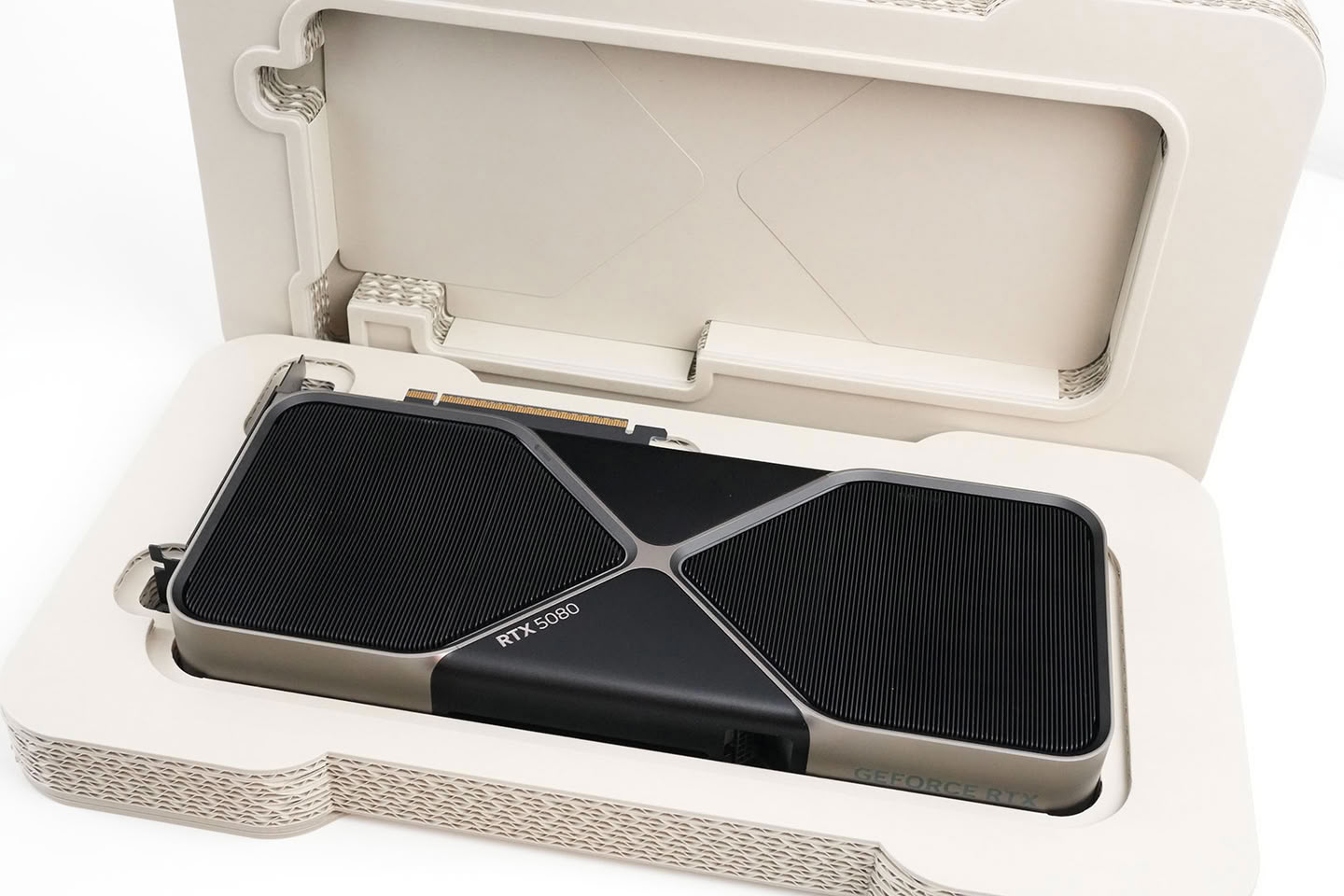
News Posts matching #RTX 5080

Return to Keyword Browsing

MSI's RTX 50-Series Supply in China Reportedly Shrinks Further

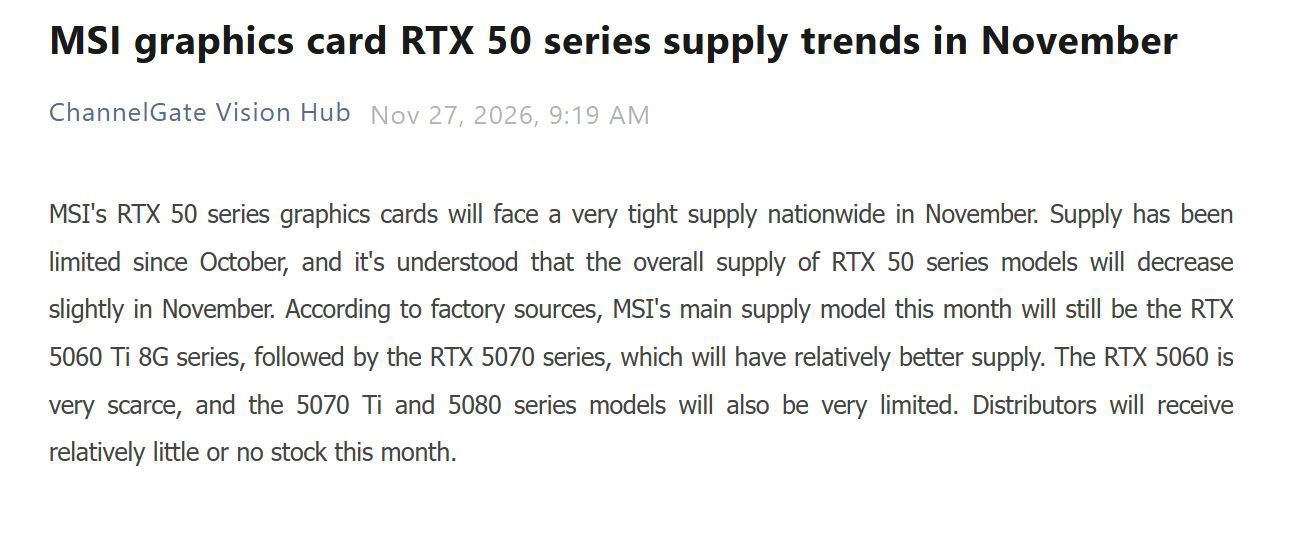
A new report from Chinese supply chain outlet ChannelGate suggests that finding an MSI GeForce RTX 50-series card in China will get even harder in the coming weeks. Apparently, supply is going to be very tight across the entire lineup, which shouldn't come as a surprise to our regular readers. MSI RTX 50-series GPU volumes were already low in October and have dipped slightly again this month, across all models. The report says, citing factory-side sources, that MSI's main supply model this month will be the RTX 5060 Ti 8 GB, followed by the RTX 5070, which is in relatively better supply. The RTX 5070 Ti and RTX 5080 will face extremely limited supply, and so will the RTX 5060 on the opposite end of the stack. Perhaps unsurprisingly, there's no mention of the RTX 5090 in the report.

With this upcoming adjustment, distributors will either receive very small allocations or struggle to get any stock at all. MSI already hiked its distributor prices in China earlier this month, with some models such as the RTX 5080 facing huge price increases of up to 8,000 yuan (about $1,200). Other AIB partners are taking notes too. Colorful and Galax reportedly notified partners of their own RTX 50-series price hikes at the start of the month as well. Some board makers were even steering distributors towards older RTX 3060 and RTX 3050 cards, since the RTX 50-series was in such short supply. This report only covers China, but we have seen GPU manufacturers and AIBs make similar changes in other regions too. With supply this limited, expect RTX 50-series prices to remain high for the foreseeable future.
NVIDIA GeForce 621.40 Stops the SSD Writes, but Now Users Report Black Screens

NVIDIA seems to be having a pretty hard time with this latest round of driver updates. The issue started with a bug that caused excessive writes to the SSD due to an NVIDIA program constantly rewriting itself. NVIDIA released the 621.35 hotfix driver to fix that bug, but reports quickly came out that the issue still exists. We then got the GeForce 621.40 WHQL driver, which fixed the SSD write bug for good, but also brought some new issues. Apparently, some GeForce RTX owners are experiencing black screens and lost display signals after installing the GeForce 621.40 driver. According to replies on NVIDIA's own feedback thread, an RTX 5060 user says the monitor shows no signal right after installation and on every boot afterward. They had to roll back to 621.24 to fix the issue.

Another user, an RTX 5080 owner running a multi-monitor setup, said the primary display keeps switching on and off in extended desktop mode. They rolled back to 617.42 to fix that problem. Several other users mentioned random black screens and flickering. NVIDIA hasn't officially acknowledged this problem yet, and it's hard to say how widespread the issue actually is. As for the SSD write bug, multiple users on the thread confirm that it has been fixed. However, a user claims that the FrameView SDK service wrote 36 GB of data in a day, and the writes apparently disappear when the NVIDIA App is uninstalled. NVIDIA users who are experiencing black screen or display issues should consider rolling back to earlier drivers, but keep an eye out for those SSD writes.

Newegg's RTX 5090 Restock Starts at $6,599, More Than Triple the MSRP

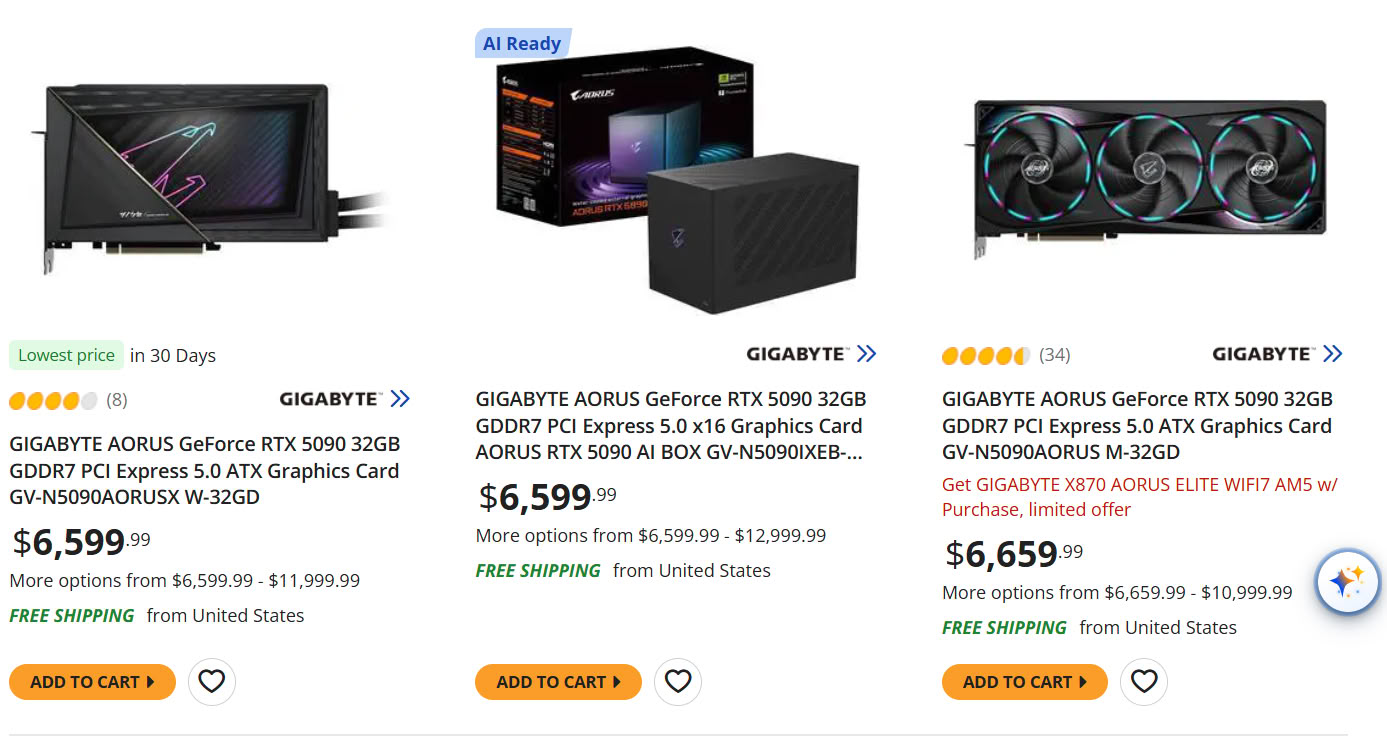
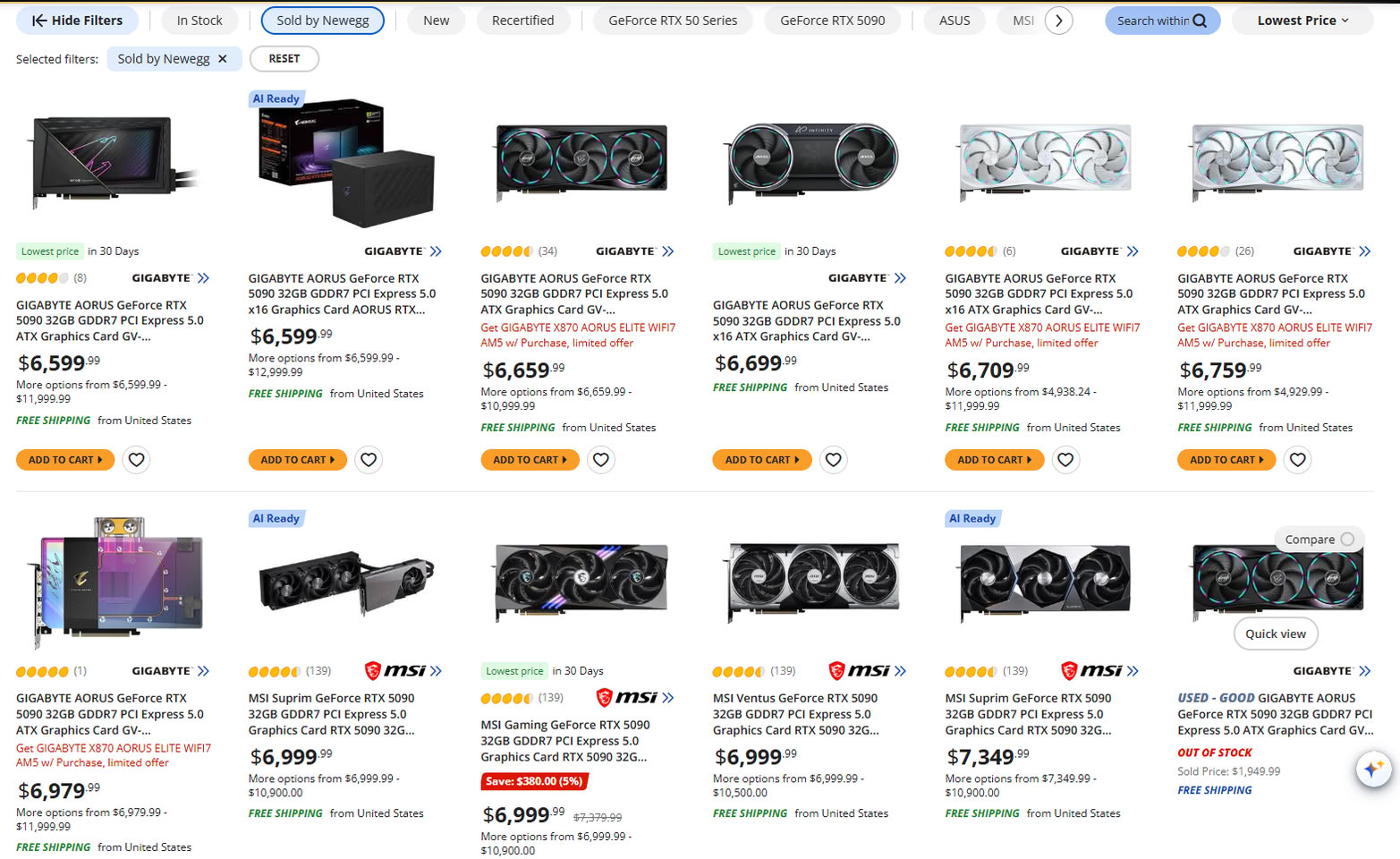
Newegg has restocked some GeForce RTX 5090 variants, but the cheapest RTX 5090 sold directly by Newegg at the time of writing is the GIGABYTE AORUS RTX 5090 Xtreme Waterforce at $6,599.99, about 3.3 times NVIDIA's $1,999 MSRP. The restock includes a handful of ASUS, GIGABYTE, and MSI models as first-party listings that ship from Newegg itself rather than from marketplace sellers. The AORUS Master ICE goes for $6,759.99, while MSI's Gaming Trio OC, Ventus 3X OC, and Suprim Liquid SOC all sit at $6,999.99. An ASUS ROG Astral RTX 5090 OC was reportedly listed for $6,249.99 as well, but it has already sold out. The current ROG Astral RTX 5090 OC listing is at $9,490 instead.

As ridiculous as those prices are, they're actually lower than what the card was going for a few weeks ago. TechSpot's October survey put the cheapest in-stock RTX 5090 in the US at $9,400 at that time, and most models sat comfortably above $11,000. Supply has been tight since early October, when leakers claimed NVIDIA had stopped allocating GB202 silicon to the RTX 5090 in favor of RTX PRO workstation cards, and Micro Center also dropped the card from its catalog shortly after. NVIDIA denied the card was discontinued but admitted supply is constrained. However, an unnamed board partner later said it can't currently order GB202 and GDDR7 as a set, or place backorders like before.

MSI Reportedly Plans RTX 5080 Price Hikes of up to $1,200 in China

MSI's GeForce RTX 5080 cards could cost up to 8,000 yuan (about $1,200) more in China this month, according to a ChannelGate post shared on X by harukaze5719. The post outlines MSI's November distributor pricing compared to October, with RTX 5080 models going up by 1,300 to 8,000 yuan depending on the card. That's roughly $195 at the low end, while the top figure alone is more than the RTX 5080's entire $999 launch MSRP. Yes, that's apparently a $1,200 increase planned for the RTX 5080 at the top end.

The rest of the RTX 50 stack goes up too. RTX 5070 Ti models rise by 800 to 4,000 yuan (about $120 to $600), and the RTX 5070 by 500 to 1,000 yuan (75 to $150). The RTX 5060 Ti 16 GB picks up 400 yuan, its 8 GB sibling 200 yuan, and the RTX 5060 between 200 and 500 yuan. Even the RTX 3050 gets a 100 yuan bump. These are distributor prices in China, not new MSRPs, and the post doesn't say which RTX 5080 models sit at the top of that range. Colorful and Galax reportedly started sharing similar hikes with their partners earlier this month, so MSI seems to be following the same path. We can certainly expect other AIB partners to follow suit soon.

NVIDIA GeForce RTX 5080 24 GB Reportedly Cancelled, 16 GB Model Remains

NVIDIA's rumored GeForce RTX 5080 24 GB model has reportedly been put on hold. The company is struggling to secure enough 3 GB GDDR7 memory modules and is instead opting for the less expensive 2 GB modules for the standard 16 GB version. According to a report from Board Channels, NVIDIA has already informed its add-in card (AIC) partners to officially cancel the January 2027 launch plan for the 24 GB model, citing economic challenges. As we are currently experiencing one of the worst supply chain shortages for memory modules, using the more expensive 3 GB GDDR7 modules would result in a significantly higher MSRP and, consequently, a higher price for customers. Therefore, the 2 GB GDDR7 memory modules will continue to be used, and the RTX 5080 16 GB model will remain available.

Readers may recall that NVIDIA did not plan any other changes to the model besides the memory configuration, as the CUDA core count was to remain the same. The new 24 GB model would potentially have slightly higher TDP and clock speeds, but the main improvements would come from increased memory capacity and bandwidth. Since it seems we won't be getting the revised model, and there's no rumor of a "SUPER" overhaul anytime soon, we will have to stick with the standard lineup a bit longer until the next-generation GeForce RTX 60-Series "Rubin" arrives.

NVIDIA Marks 20 Years of the GeForce 8800 GTX With a Free Path-Traced Steam Demo

NVIDIA is celebrating 20 years of the GeForce 8800 GTX, which hit store shelves on November 8, 2006, with a free tech demo on Steam. Called GeForce 8800 GTX - 20 Years of a Legend, it was created by Unreal Engine artist Dylan Browne, the developer of Through The Ages, with support from NVIDIA. The semi-interactive demo puts players in a 2006-era PC gaming room, where they can unbox the 8800 GTX, inspect it up close, and install it in an era-accurate PC tower, with GeForce easter eggs scattered around. The scene is rendered with path tracing, DLSS 4.5 Ray Reconstruction, Dynamic Multi Frame Generation, and RTX Mega Geometry. It is available now on Steam and is coming soon to GeForce NOW for Ultimate members.

Naturally, the 8800 GTX itself can't run any of this, which is quite ironic, to say the least. Steam lists an RTX 4070 as the bare minimum and recommends an RTX 5080, alongside 32 GB of system RAM and 30 GB of storage. That RAM figure alone is over 40 times the 8800 GTX's 768 MB of video memory. The recommended RTX 5080 is far from cheap right now either, with TechSpot's October survey putting its lowest US price at around $2,200. So a demo built around the thrill of unboxing a new GPU in 2006 wants one of the priciest gaming cards of 2026 to look its best.

NVIDIA RTX 5070 Ti Climbs $160 in Eight Days, Now 79% Over MSRP

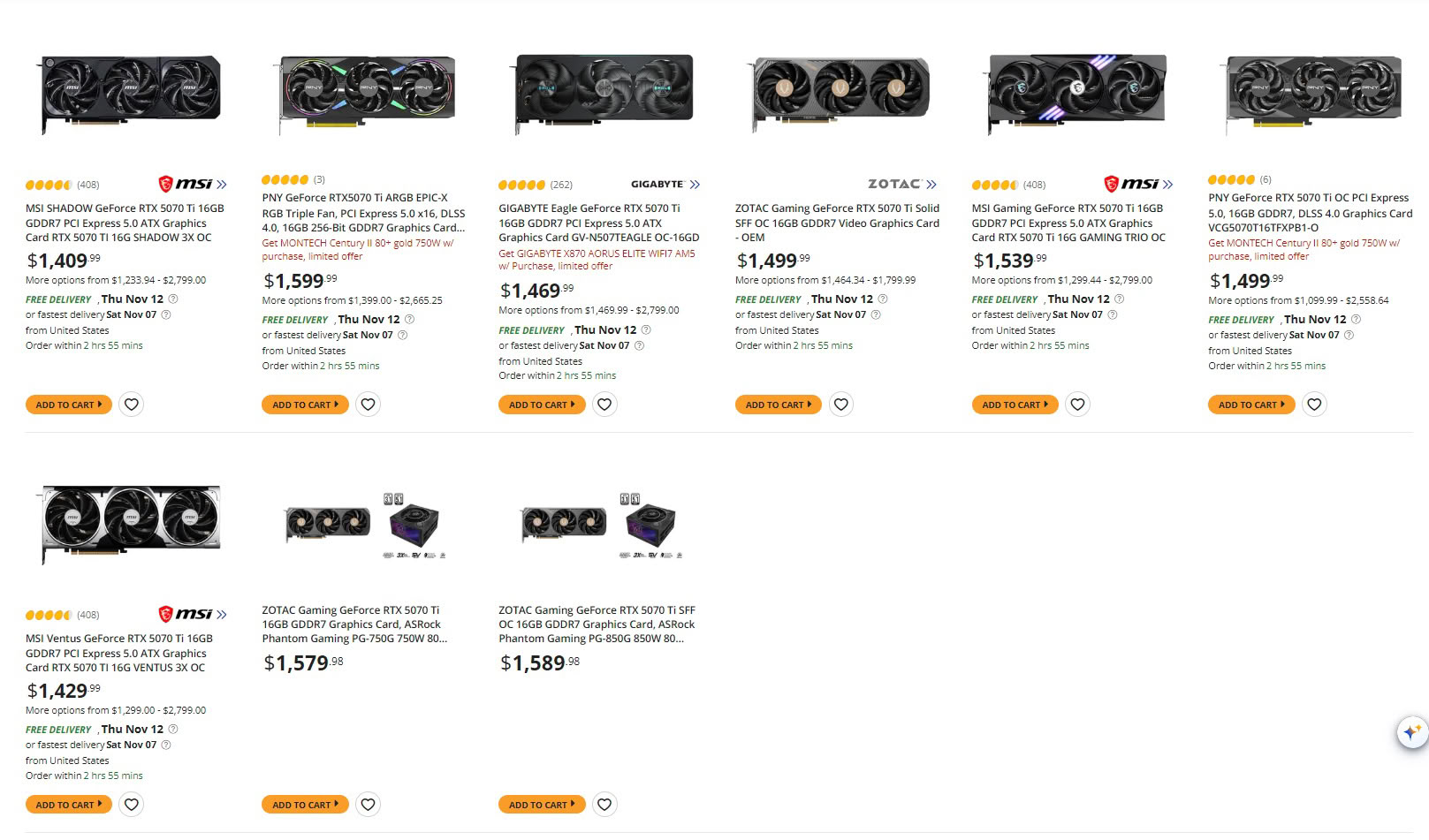
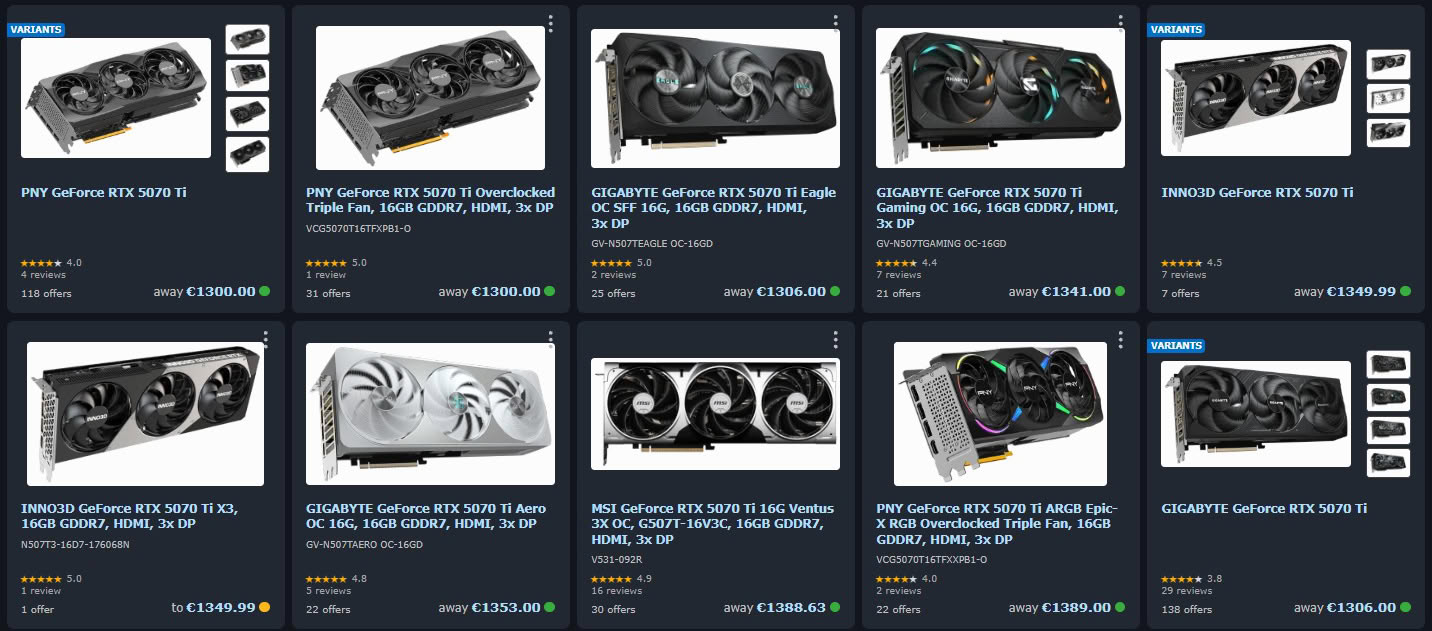
NVIDIA's GeForce RTX 5070 Ti is now close to double its $749 MSRP in the US. According to price tracking by VideoCardz, the cheapest RTX 5070 Ti at major US retailers was $1,339.99 on November 6, about 79% above MSRP, up from $1,179.99 on October 29. That's a $160 jump in just eight days. Some models have already crossed the 2x mark, like the ASUS TUF Gaming OC at $1,499.99 on B&H. Prices are also moving fast. At the time of writing, the cheapest RTX 5070 Ti sold by Newegg itself is an MSI SHADOW RTX 5070 Ti at $1,409.99. Things aren't much better in Germany, where the cheapest listing on Geizhals sits at €1,300 for a PNY model, roughly 48% above the €879 MSRP.

Things are probably going to get worse, too. NVIDIA's board partners in China are reportedly raising RTX 5070 Ti prices by around 1,000 RMB (about $150) this week, with retail prices expected to follow within a week or two. Unlike the RTX 5090 and 5080 16 GB, which have reportedly been discontinued, the RTX 5070 Ti is still officially in production. After reports of an end of production in January early this year, NVIDIA said it was still shipping all GeForce SKUs, and ASUS denied the card was end-of-life, while admitting that memory supply was hurting production and restocking. The card is still listed at major retailers, unlike the RTX 5080, which vanished from NVIDIA's US Marketplace two weeks after the RTX 5090 did the same. Anyone shopping for an RTX 5070 Ti should probably expect these prices to keep rising for a while.

GPU Prices Up Again in October, RTX 5090 Now Sells for 262% Over MSRP Worldwide

In a big surprise to no one, graphics card prices went up again in October. TechSpot's latest survey across 10 countries shows GPU prices rising 11% month over month, following a 15% jump in August and 7% in September, or roughly 35% over three months. On average, cards now sell for 44% above MSRP, climbing to 58% in the US and Canada. Keep in mind these numbers track the lowest in-stock price in each region, so most models cost even more. Moreover, there is another GeForce RTX 50-series price hike on the horizon, so these numbers will rise again pretty soon.

The GeForce RTX 5090 is in a league of its own. It got 32% pricier in a month, and its normalized global price of $7,240 sits a staggering 262% above its $1,999 MSRP, almost double the 136% figure from early September. In the US, the cheapest in-stock model now costs $9,400, or 370% over MSRP, and most models now sit above $11,000 comfortably. The RTX 5080 is following a similar path, up 22% in a month to $2,200 in the US, while Newegg had none of its own in stock when the data was collected. TechSpot argues the GDDR7 memory crisis can't explain a jump that big, and some retail sources apparently told them wholesale RTX 5080 costs have gone up recently too.

NVIDIA GeForce RTX 50-Series Scheduled for up to $500 Price Hike This Week

NVIDIA's GeForce RTX 50-Series "Blackwell" gaming graphics cards are expected to see significant price adjustments this week. According to Chinese ChannelGate, add-in card (AIC) partners have confirmed that price hikes are scheduled due to the ongoing demand for these GPUs outstripping supply. Some major AIC partners, like Colorful and Galax, have reportedly already started sharing information about these price increases. The most significant example is expected to be for SKUs based on NVIDIA's GeForce RTX 5090 DV2, which will see an increase of up to 3,300 RMB, translating to nearly $500. Even entry-level GPUs are not exempt, as the GeForce RTX 5060 is expected to see around a $30 price increase on existing models. These changes are anticipated to be implemented this week for retail partners, meaning that consumer prices might take a week or two to reflect the new listing prices.
Below is the list of price hikes in China, expected to be the norm.

Board Partners Reportedly Still Await NVIDIA GeForce RTX 5080 24 GB GPU Kits

NVIDIA's board partners reportedly still lack the supply of GeForce RTX 5080 24 GB design kits, making a nearby launch seemingly impossible. According to BenchLife, design kits have not yet been provided to NVIDIA's add-in card partners. These design kits typically include a GPU die and memory modules shipped directly from NVIDIA. NVIDIA negotiates GDDR7 module pricing and supply while also receiving GPU die shipments from TSMC. The company then packages these together and sends them to board partners for assembly on their custom PCBs and designs. Since this process takes time to validate and test new designs, board partners might be unable to meet the previously assumed launch in January.

Earlier rumors suggested that NVIDIA's GeForce RTX 5080 24 GB might arrive sooner than expected, with a post from Board Channels' ChannelGate account claiming NVIDIA is speeding up the launch, with availability now expected around January 2027. Apparently, NVIDIA has already cleared out its RTX 5080 16 GB GPU inventory, and the remaining stock should last around two months. However, since board partners aren't receiving those GPU kits yet, this timing might be impossible to meet, and the window would be around Q1 2027, but not in January.

RTX 5080 Vanishes From NVIDIA's US Marketplace Two Weeks After the RTX 5090

NVIDIA's US Marketplace no longer lists the GeForce RTX 5080. The GPU filter on the store's graphics card page now tops out at the RTX 5070 Ti, followed by the RTX 5070, RTX 5060 Ti, RTX 5060, and RTX 5050, with partner RTX 5080 models gone as well. The same thing happened to the RTX 5090 about two weeks ago and, barring a brief cameo at $5,599, the card still hasn't returned. NVIDIA has since denied that the RTX 5090 is discontinued, though it hasn't said anything about the RTX 5080 yet. Oddly enough, its RTX 5080 product page still says "Starting at $999."

The removal seems limited to the US for now. NVIDIA's UK Marketplace still has 13 RTX 5080 listings and two RTX 5090 cards. Of course, a missing listing could simply mean there's no stock left, since the RTX 5080 already costs close to $2,000 at US retailers, roughly double its MSRP. That leaves the RTX 5070 Ti as the fastest card on NVIDIA's US store, and it isn't cheap either. The seven listings there range from $1,269.99 to $1,499.99, well above its $749 launch price.

NVIDIA Reportedly Moves Up RTX 5080 24 GB Launch

NVIDIA's GeForce RTX 5080 24 GB might arrive sooner than expected. A new post from Board Channels' ChannelGate account claims NVIDIA is speeding up the launch, with availability now expected around January 2027 and December 2026 as the earliest option. Earlier this month, various sources relayed that the card was reportedly planned for Q1 2027. The same post says NVIDIA will stop supplying the RTX 5080 16 GB and the RTX 5090 D V2 to China, leaving the 24 GB RTX 5080 as the only flagship model in that market. The report only covers China, so there's no word yet on whether the 16 GB card is going away globally. If the January window pans out, a CES 2027 reveal seems likely, though NVIDIA hasn't confirmed anything.

Apparently, NVIDIA has already cleared out its RTX 5080 16 GB GPU inventory, and the remaining stock should last around two months. That roughly matches a leaker's claim that NVIDIA has January discontinuation dates set for the 16 GB card. The post is machine-translated, so some wording may be off. Specs are still unknown, though 24 GB on the same 256-bit bus would most likely mean 3 GB GDDR7 modules instead of 2 GB ones. Board Channels previously suggested the card could cost around 19,999 yuan (nearly $3,000) in China, while the 16 GB model already sells for close to $2,000 at U.S. retailers, double its $999 MSRP. With the memory shortage expected to get worse in 2027, it's reasonable to expect the 24 GB card to be both expensive and hard to find.

NVIDIA GeForce RTX 5080 Reaches Nearly $2,000 Across U.S. Retailers

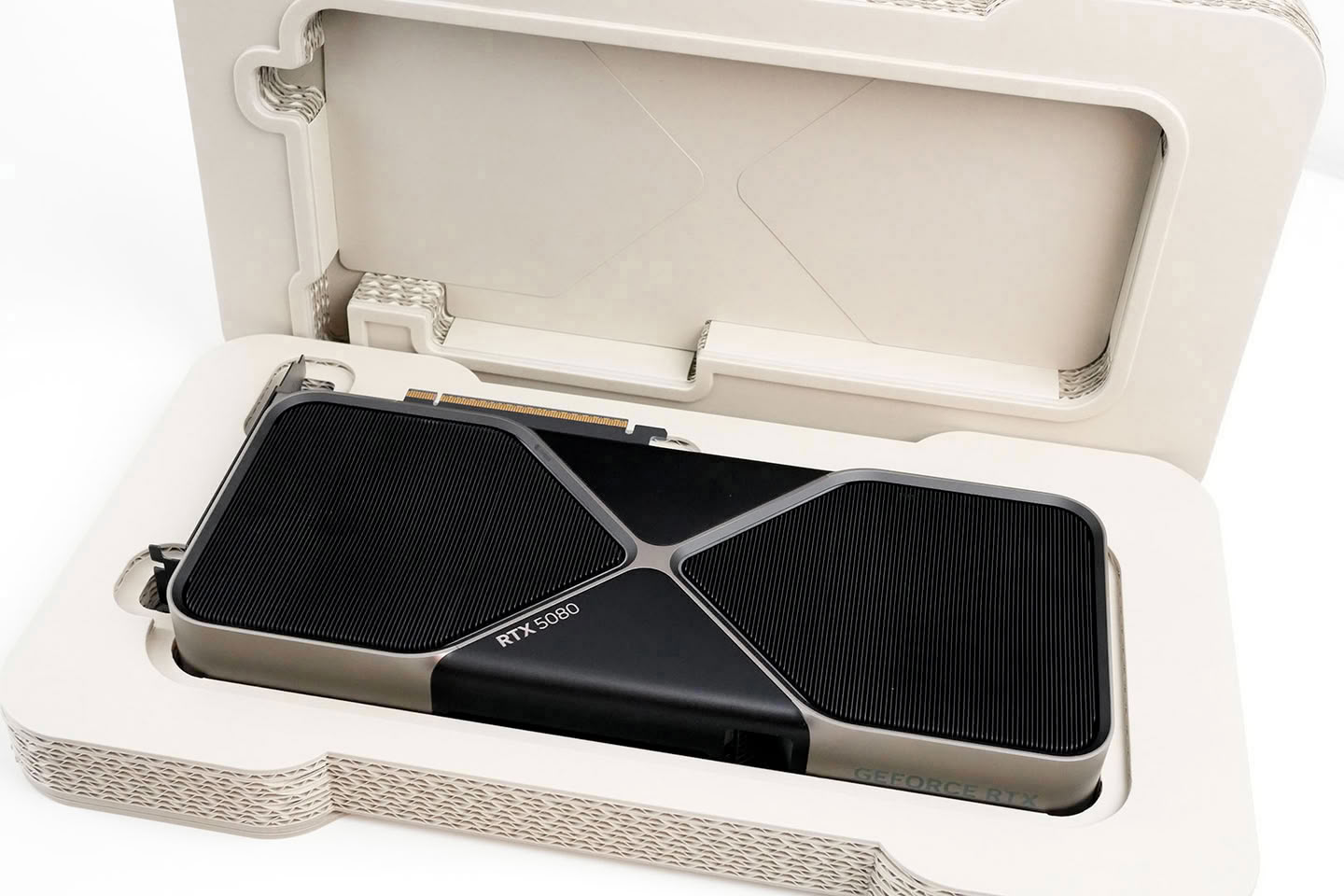
NVIDIA's GeForce RTX 5080 has seen a significant increase in its listed price over the past few weeks, with this high-end GPU now costing nearly $2,000. Due to price hikes throughout the supply chain and the GPU's 16 GB of GDDR7 memory, which is currently in short supply, the listing price has doubled its original MSRP. NVIDIA initially launched the GeForce RTX 5080 in early 2025 with an MSRP of $999. However, add-in card partners introduced custom solutions such as new PCBs, enhanced cooling, and other features that gradually increased the price. The pricing issue escalated when the memory supply became constrained, making the GDDR7 memory modules used in this GPU much more expensive.

Across U.S.-based retailers like Best Buy, Micro Center, Amazon, Newegg, B&H, and others, the listing price now starts at nearly $2,000. On B&H, older listings show better pricing but are marked as "Temporary out of stock." Only the in-stock listings are priced at $2,000 or more, indicating that new pricing adjustments have been made across all retailers. In just two months, the listings have jumped from $1,200 to $2,000, which is a dramatic increase in pricing.
Below are screenshots collected across U.S.-based retailers.

ASUS and Gigabyte Bump RTX 5080 Prices in China, RTX 5070 Ti Also Sees Wholesale Increase

Rumors of the RTX 5080 16 GB being discontinued are picking up steam, and the effects are starting to show. RTX 5080 16 GB wholesale prices in China have jumped by around 2,000 yuan (roughly $300), according to new information from Board Channels. The card previously traded at 12,700 to 13,500 yuan (~$1,900 to $2,020) and now sits at 14,500 to 15,000 yuan (~$2,170 to $2,240). Board Channels blames tighter upstream supply and the reported discontinuation of the 16 GB model. A leaker recently claimed that NVIDIA has set January discontinuation dates for the card, though NVIDIA hasn't confirmed anything.

Along with the RTX 5080 16 GB, the RTX 5070 Ti, which uses the same 16 GB of GDDR7, is also facing price hikes. It is now going for 9,650 to 9,850 yuan (~$1,440 to $1,470), compared to 9,000 to 9,150 yuan (~$1,350 to $1,370) before, a roughly $100 bump. Board partners are adjusting too. ASUS has reportedly added 1,000 yuan (~$150) to all of its RTX 5080 16 GB models and 200 yuan (~$30) to the RTX 5070 Ti, RTX 5070, and RTX 5060 Ti 16 GB cards. Gigabyte went further, with 1,200 yuan (~$180) on its RTX 5080 cards and 200 yuan (~$30) on the RTX 5070 Ti and RTX 5070. Cheaper RTX 5060-class cards from both brands saw smaller bumps of 200 yuan (~$30) or less, and ASUS reportedly raised prices on its Radeon cards as well, between $15 and $50.

GALAX GeForce RTX 5080 HOF Extreme Comes with Dual 12V-2x6 Power Connectors

GALAX has unveiled the specifications for its GeForce RTX 5080 Hall Of Fame Extreme edition graphics card, the only RTX 5080 model featuring two 12V-2x6 power connectors. Interestingly, the card has a TGP of 400 W, and the official GALAX announcement states that the two power connectors are not required for simultaneous use. Instead, they are offered as alternatives to suit different PC builds and cable management preferences, so even if both connections are used, only one will be active. One standard connector is located on the top of the GPU, in the usual spot. The second 12V-2x6 power cable is positioned at the bottom of the card, concealed behind a GPU shroud near the PCIe x16 connector. This serves as an alternative power supply, allowing system builders to hide visible cables for a cleaner look.

For the GPU itself, GALAX has implemented a 20-phase power delivery system for the GPU and a 4-phase power delivery design for the GDDR7 memory, along with a digital PWM controller, eFuse, and HOF-branded inductors. All of this is mounted on a customized white PCB with gold plating on key connections. In OC Mode, which raises the TGP to 400 W, the GPU clock speed reaches 2,805 MHz. In regular Gaming Mode, the TGP is reduced to NVIDIA's reference 360 W, with clock speeds at 2,655 MHz. Since the 12V-2x6 connector is sufficient for these TGP designs, a second power source is unnecessary. GDDR7 memory is running at 30 Gbps on a 256-bit memory bus for a total of 960 GB/s memory bandwidth.

NVIDIA Has January Discontinuation Dates Set for RTX 5090 and RTX 5080 16 GB, Claims Leaker

Earlier this month, leakers claimed NVIDIA had stopped allocating GB202 silicon to the GeForce RTX 5090, effectively discontinuing the Blackwell flagship. NVIDIA denied it a few days later, with SVP Jeff Fisher saying the RTX 5090 hasn't been discontinued and will keep shipping. Now, Moore's Law Is Dead (MLID) says the plans are still in place, and the RTX 5080 is part of them too. In the latest Broken Silicon episode, MLID read out a message from what he calls one of his oldest sources, apparently a major retailer, saying NVIDIA has set discontinuation dates for both cards in the first half of January 2027.

According to that source, the last RTX 5090 shipments arrived in September, while the final RTX 5080 batch should land by the end of October and sell through Thanksgiving. We recently reported that Micro Center has already marked its RTX 5090 listings as "Not Carried," which could be further evidence of the RTX 5090 leaving shelves. The retailer from MLID's video also says its system already has a placeholder SKU for an RTX 5080 24 GB, which aligns with BenchLife's earlier report of a Q1 2027 launch.

New Tools Let Users Edit and Load Modified VBIOS on GeForce RTX GPUs Without Flashing

A developer who goes by Panchovix has released three tools that let NVIDIA GeForce RTX 50, RTX 40, and RTX 30-series owners run a modified VBIOS without writing anything to the card's flash chip. The first is a VBIOS editor for Windows and Linux that can change power limits, voltage ceilings, current (OCP) limits, fan channels, and the core and memory offset ranges. Edited images keep NVIDIA's original signature, which no longer matches, so they can't be flashed with nvflash. Patched tools did break NVIDIA's BIOS signature lock for crossflashing back in 2023, but this approach skips flashing altogether. On Windows, the loader stores the edited image in the GPU's driver registry key, where the driver picks it up as an override every time the device starts, and it only needs a quick GPU restart. The Linux loader instead patches NVIDIA's open kernel modules so the GSP firmware starts with the custom image, with Fedora 43 being the only distro tested on real hardware so far.

The screenshots show how this works in practice. On what appears to be an RTX 5090 Founders Edition ROM, the board power ceiling went from 600 W to 700 W and the NVVDD and MSVDD voltage ceilings from 1,110 mV to 1,150 mV. An RTX 4090 ROM had its power ceiling raised from 666 W to 750 W and its core offset range doubled to +2,000 MHz, and nvidia-smi later confirmed that card's power limit going from 550 W to 671 W. Apparently, an RTX 5090 reached 800 W, an RTX 5080 went from 360 W to 500 W, and an RTX 5060 Ti from 185 W to 300 W in the developer's own testing. Laptop RTX 40 GPUs can't be edited yet, and memory timings can't be changed since the card reads them directly from the flash chip.

Official NVIDIA Marketplace Seemingly Removes GeForce RTX 5090

NVIDIA's official marketplace, where gamers across the United States, Europe, Australia, and Asia could purchase GeForce RTX cards through NVIDIA's official channels, is showing more signs that the GeForce RTX 5090 might indeed be nearing its end of life. There are officially no more GeForce RTX 5090 graphics cards on the NVIDIA Marketplace, which suggests that previous rumors of this GPU being phased out might be accurate. NVIDIA has reportedly stopped allocating GB202 silicon to the GeForce RTX 5090, as this will remain exclusive to the 96 GB RTX PRO 6000. While this theory seemed plausible a week ago, NVIDIA's official withdrawal from the marketplace might confirm that this decision is indefinite, and enthusiasts may no longer be able to get a brand new GeForce RTX 5090 from any source.

At the same time, the PC Games Hardware website issued their own report suggesting that NVIDIA is indeed no longer allocating new GB202 processors for the RTX 5090, according to their OEM and ODM sources. NVIDIA's add-in card partners can continue manufacturing these cards, but only as long as their GB202 stock lasts. Once the GB202 supply runs out, NVIDIA will reportedly not send any more GB202 kits with GDDR7 memory for RTX 5090 graphics cards. This also applies to the GeForce RTX 5090 D and RTX 5090 D V2 SKUs that were previously designed for the Chinese market, meaning that everyone is facing a cut-off in their GeForce RTX 5090 supply.

MSI Launches Limited MSI GeForce RTX 5080 16G COD MW4 EDITION OC Graphics Card Inspired by Call of Duty: Modern Warfare 4

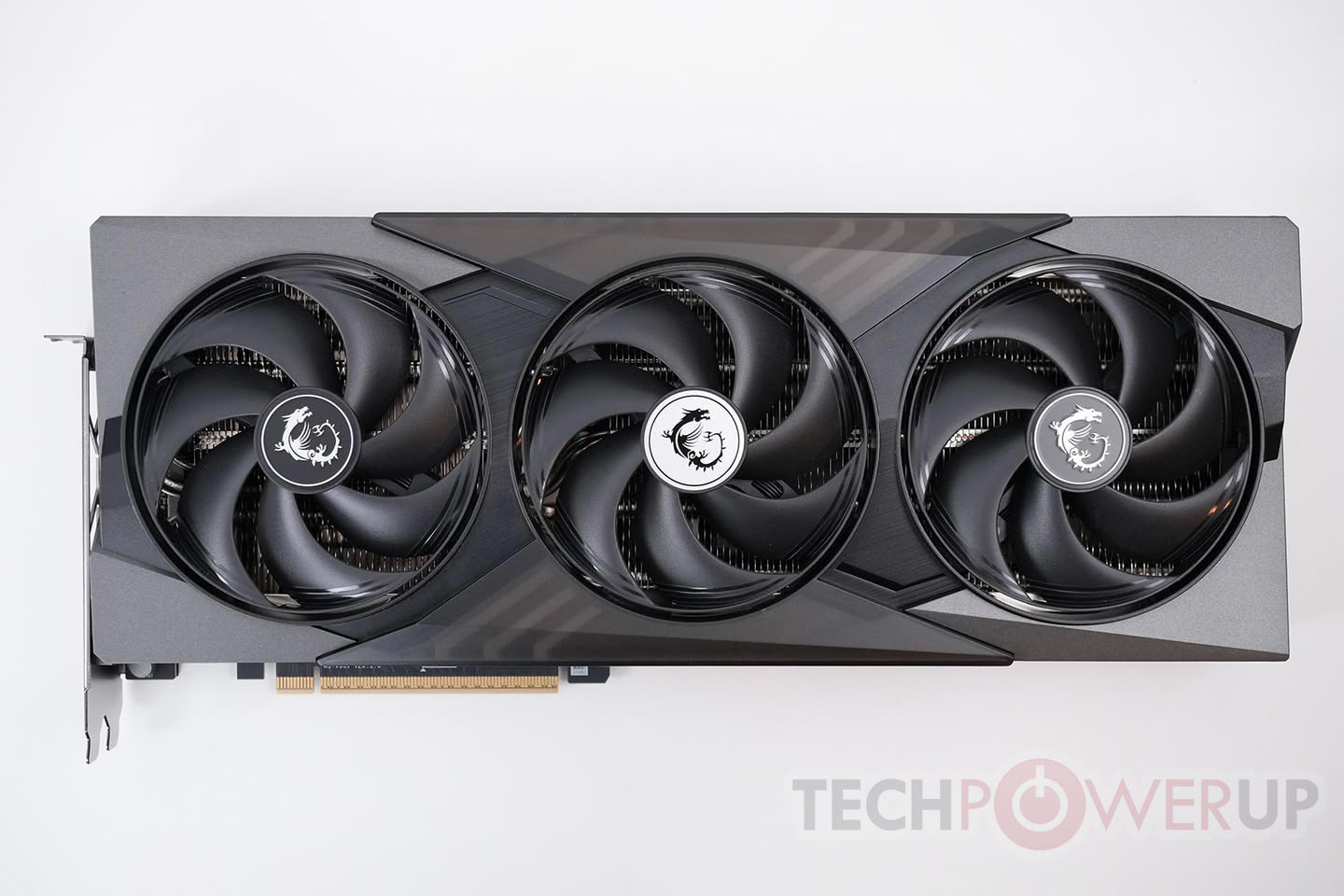
MSI proudly announces the launch of the limited MSI GeForce RTX 5080 16G COD MW4 EDITION OC Graphics Card, inspired by the intense action of Call of Duty: Modern Warfare 4. Developed in close collaboration with Activision, this exclusive edition brings together MSI's cutting-edge graphics technology and the unmistakable identity of the Call of Duty franchise.

Featuring a distinctive, custom-designed aesthetic created exclusively for this collaboration, the graphics card captures the spirit of Call of Duty: Modern Warfare 4 through a bold, military-inspired design that sets it apart from standard graphics cards. Combining high-performance gaming technology with a one-of-a-kind design, this limited edition is a collector-worthy centerpiece for gamers and Call of Duty fans.

NVIDIA RTX 5060 Ti 16 GB Price Hikes Put Entry-Level GPU Above $1,200 in Japan

On two separate occasions, in August and again in September, it was predicted that entry-level GPUs would see significant price increases in the second half of 2026, and it seems as though that prediction has come true, as showed in a recent Reddit post sharing updated retailer listing prices for NVIDIA GeForce RTX 50-series GPUs from Japan—one of the countries where PC hardware prices are often felt sooner than in international markets. According to the price list, the cheapest available RTX 5060 Ti 8 GB was ¥118,800 (~$750 converted), while RTX 5060 Ti 16 GB prices start at ¥139,800 (~$882 converted).

Meanwhile, the RTX 5070 12 GB starts at ¥145,800 (~$920 converted), 5070 Ti prices start at ¥230,800 (~$1,456 converted), and the RTX 5080 16 GB has climbed to a starting price of ¥295,801 (~$1,867 converted). Compared to MSRP, these new prices represent an increase of around 59% for the RTX 5060 Ti 8 GB, 66-144% for the 5060 Ti 16 GB, 32-82% for the 5070, and as much as 94% for the RTX 5080.

NVIDIA RTX 5080 24 GB Reportedly Planned For Q1 2027, but Board Partners Are Still in the Dark

Taiwanese outlet BenchLife has added more detail to last week's report that NVIDIA is pulling GB202 silicon away from the GeForce RTX 5090. According to BenchLife, board partners are no longer receiving GB202 chips for RTX 5090 production. The same applies to the China-specific RTX 5090 D and RTX 5090 D V2 variants. NVIDIA hasn't said anything officially yet. Apparently, the company doesn't see this as an end-of-life (EOL) move either, since the chips are simply being shifted to more profitable GB202-based RTX PRO cards like the RTX PRO 6000 and the recently unveiled RTX PRO 5500. In the meantime, any RTX 5090 cards still reaching shelves are built from chips partners already have. The card immediately sold out at Walmart for $4,299 last month, so buyers shouldn't expect prices to come down anytime soon.

The RTX 5080 part of the story is a bit more interesting. BenchLife says NVIDIA plans to launch an RTX 5080 with 24 GB of GDDR7 in the first quarter of 2027, replacing the current 16 GB model. However, board partners have yet to receive any development material for it. So far they've only been told verbally that it should arrive soon. That's odd, considering partners reportedly had RTX 50 SUPER silicon in hand back in July, before GDDR7 pricing put that launch on hold. We still don't know if the RTX 5080 24 GB and the long-rumored RTX 5080 SUPER are the same card. A Q1 2027 window would make CES in January a likely stage, though that's guesswork for now.

NVIDIA Reportedly Ending the RTX 5090, Reserves GB202 Silicon for Workstation GPUs

NVIDIA has reportedly stopped allocating GB202 silicon to the GeForce RTX 5090, according to leaker MEGAsizeGPU (@Zed__Wang) on X. "No more GB202 for 5090, confirmed," the leaker posted, adding in a follow-up that "all future GB202 supplies are RTX Pro exclusive." GB202 is the largest "Blackwell" graphics chip, and the RTX 5090 doesn't even max it out. The same chip powers the 96 GB RTX PRO 6000 with 24,064 CUDA cores, as well as the recently unveiled RTX PRO 5500, which pairs the RTX 5090's 21,760 CUDA cores with 84 GB of memory. Apparently, NVIDIA would rather put every GB202 it gets into those far pricier workstation cards. The company hasn't confirmed any of this as of the time of writing.

A second leaker, hongxing2020, posted "5090 EOL, 5080 24GB ready" alongside an apparent factory notice saying NVIDIA will no longer sell any RTX 5090 model, China-market D variants included. The same notice says an RTX 5080 24 GB will become the top GeForce card and the 16 GB version will be discontinued. That sounds a lot like the RTX 5080 SUPER, which was rumored with 24 GB of GDDR7 on the same GB203 chip, although it isn't clear if the two are the same card. SUPER cards reportedly reached board partners in July, only to be put on hold over GDDR7 pricing. As for the RTX 5090, I doubt NVIDIA would formally call this an end-of-life (EOL) move, since the chips are simply being redirected to a more profitable product line.

DLSS 5 Boosts RTX 5090 Connector Power Spikes to 647 W, Pushing Past 90°C

NVIDIA's DLSS 5 has been controversial ever since its announcement and eventual launch. Perhaps more concerning than the visual changes is its effect on the user's hardware. As reported by Videocardz, Korean outlet QuasarZone ran its own thermal tests on the RTX 5090's power connector with DLSS 5 enabled, to see if the technology really has a hand in recent reports of melting 12V-2x6 connectors. Testing an RTX 5090 Founders Edition in Cyberpunk 2077 at 4K with DLSS Quality and the Ultra preset over 20 minutes, the 12V-2x6 connector reached 91.7°C on the sense-pin side with DLSS 5 on, up from 80.9°C without it. The latch side climbed from 77.1°C to 83.4°C. An RTX 5080 FE tested the same way stayed far cooler, reaching just 48.6°C and 52.2°C at those two points with DLSS 5 enabled.

The increased heat aligned with a real jump in power draw. HWiNFO logged the RTX 5090's average power draw rising from 509.2 W to 575.1 W with DLSS 5 on, right at its 575 W limit. The RTX 5080 went from 298.2 W to 350.3 W, close to its own 360 W ceiling. External PCAT readings, which also catch short spikes, showed higher figures still: total board power rose from 527.3 W average and 582.5 W peak to 593.9 W average and 658.0 W peak. On the 16-pin 12V-2x6 connector alone, the RTX 5090 pulled 582.7 W on average and briefly spiked as high as 646.7 W. Of course, transient power spikes over 600 W are normal, and are not necessarily to blame for any melting connector issues. The increased power draw, however, lines up with Tom's Hardware's early DLSS 5 testing, which showed a noticeable jump in power draw with DLSS 5 enabled.

NVIDIA GeForce NOW Coming Soon to Googlebooks, Gets Nine New Games This Week

A warped Manhattan is waiting in the cloud this week. Remedy Entertainment's CONTROL Resonant brings Dylan Faden's extraordinary abilities and a paranatural crisis to GeForce NOW at launch. With the release comes the final days of the CONTROL Resonant Ultimate Membership Bundle. Purchase a 12-month GeForce NOW Ultimate membership through Sunday, Sept. 27, and receive CONTROL Resonant at no additional cost. GeForce NOW support is coming soon to Googlebooks, a new category of laptops bringing together the best of ChromeOS and Android. To top it off, DragonSword: Awakening leads nine new games this week, bringing an anime-style open world to supported devices.

Take Control on the Cloud
Explore a warped Manhattan on the brink of paranatural annihilation in Remedy Entertainment's CONTROL Resonant. Harness Dylan Faden's extraordinary abilities to battle the Hiss, the Mold and other reality-bending threats while searching for his sister, Federal Bureau of CONTROL Director Jesse Faden. Dylan must master his new powers and the ever-changing forms of the Aberrant, his paranatural melee weapon, to face a cosmic threat that has escaped the Oldest House and swept through the city.

CyberPowerPC Launches RTX Founders Edition Pre-Built PCs Starting at $1,549

NVIDIA's Founders Edition graphics cards are generally restricted to its own retail channels, but it seems as though CyberPowerPC has a limited run of RTX 50-series GPUs available in its pre-built gaming PCs for a GeForce Week event, which is slated to run until September 27. The CyberPowerPCs are currently available at Walmart with an NVIDIA GeForce RTX 5070 Founders Edition, RTX 5080 Founders Edition, or RTX 5090 Founders Edition, with CPU configs including both AMD and Intel variants.

There are two versions of the RTX 5070-powered gaming PCs at Walmart. Both feature 32 GB of DDR5-6000 RAM, 1 TB of PCIe 4.0 SSD storage, 360 mm closed-loop liquid coolers, and the aforementioned NVIDIA RTX 5070 Founders Edition GPUs inside a CyberPowerPC MA-01 case. The only difference between them is that the $1,599 variant comes with an AMD Ryzen 7 7800X3D, while the version featuring an Intel Core i7-14700KF comes in at $1,549.
Return to Keyword Browsing
Nov 28th, 2026 06:23 CST change timezone

New Forum Posts

Popular Reviews

TPU on YouTube

Controversial News Posts