News Posts matching #RX 9070 XT

Return to Keyword Browsing

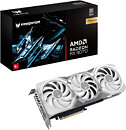
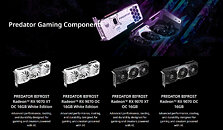
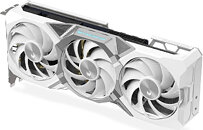
Acer Launches White Edition Predator BiFrost Radeon RX 9070 XT/9070 Cards

Acer introduced its opening salvo of Radeon RX 9070 XT 16 GB and RX 9070 non-XT 16 GB custom card designs back in March, almost alongside competing options produced by other AMD board partners. Oddly, the Taiwanese computer hardware manufacturer did not end up launching Navi 48 GPU-based products during that period—months later, retail stock started appearing in Japan. Fast-forward to the end of 2025, and Acer seems to be catching up with other AIBs, yet again. Last Friday (December 12), a Japanese press release signalled the arrival of White Edition Predator BiFrost options at retail outlets. The flagship spin-off SKU is available immediately, at 138,800 yen (tax included), converting to ~$896 USD.

A weekend investigation—prompted by GDM/hermitage akihabara's PR release—produced evidence of pale Predator BiFrost Radeon RX 9070 XT OC and RX 9070 OC stock reaching Europe. VideoCardz happened upon highly-detailed entries on the Geizhals price aggregation engine. In Germany, Acer's best RDNA 4 gaming card—now dressed in white—is (appropriately) cheapest at the "NBB - notebooksbilliger" Ebay store. An active voucher promo brings total cost of ownership down to €613.81 (~$722 USD). Alternatively, NBB and Nullprozentshop offer the joint-lowest non-XT White Edition listings: €539.00 (~$634 USD). Product renders show familiar packaging; already present on boxed standard black models. Oddly, the non-XT promotional shots show the deployment of three 8-pin power connectors (instead of the standard two). Normally this triple provision is reserved for top-level XT options, so Acer's graphics department could be using a generic image set for both overclocked models.
AMD Releases Adrenalin Edition 25.12.1 WHQL Drivers

AMD has released its latest AMD Software Adrenalin Edition 25.12.1 WHQL drivers, headlined by support for AMD FSR 4 "Redstone", the company's next-gen FidelityFX Super Resolution technology. The driver also adds product support for the Radeon AI PRO R9600D and Radeon AI PRO R9700S, alongside several fixes. These include Radeon Anti-Lag 2 not available in Counter-Strike 2 (DX11), crashes with some HDMI 2.1 displays during standby, intermittent Radeon Overlay freezes, and a crash in ARC Raiders on the Blue Gate map on RX 9000 series GPUs.

Known issues remain, including Cyberpunk 2077 path-tracing crashes, instability in Battlefield 6 on Ryzen AI 9 HX 370, Roblox Player crashes when task-switching on RX 7000 GPUs, Battlefield 6 texture flicker when using Record & Stream, and incorrect shadows in Call of Duty: Black Ops 7. AMD says fixes are in progress.

DOWNLOAD: AMD Software Adrenalin 25.12.1 WHQL
[Editor's note: Our in-depth review of the AMD FSR 4 Redstone is now live]

AMD Radeon Price Hike Confirmed at $10 per 8GB of VRAM, More Increases Expected in 2026

AMD's rumored price hike at the end of 2025 is becoming a reality, as confirmed by anonymous GPU distributors to Tom's Hardware. The increase is a more modest $10 per 8 GB of VRAM. This means a $10 increase for 8 GB models like the Radeon RX 9060 XT 8 GB, and a $20 increase for 16 GB models like the Radeon RX 9060 XT 16 GB and RX 9070 / 9070 XT. This adjustment is just half of what was anticipated based on an earlier report from Chinese Board Channels, which suggested AMD was considering a $20 increase for 8 GB models and a $40 increase for 16 GB models.

However, this is not the end of price hikes. AMD is expected to implement another increase in January 2026, though the specifics are currently unknown. Earlier information from Board Channels suggested that gamers might see a price increase of 300 RMB ($42) for 8 GB models and 600 RMB ($85) for 16 GB SKUs. As we approach the final weeks of 2025, these details remain unconfirmed. AMD's AIB partners will pass these increases to customer, who will absorb any additional cost of manufacturing.

12V-2×6 Power Connector Burns on Sapphire Radeon RX 9070 XT GPU

The story of the 12V-2x6 power connector overheating is almost as old as the original 12VHPWR connector itself, and the improved 12V-2x6 still faces issues common to the 12-pin GPU power connector family. Recently, another instance of a burning 12V-2x6 connector was reported, this time on a Sapphire Radeon RX 9070 XT GPU. A user named u/ProfessionalHost3913 shared images on the r/AMD subreddit showing his Sapphire Radeon RX 9070 XT with a burned connector end on the GPU. According to the user, the GPU was running at its default settings, with no overclocking or increased power limits, during gaming sessions of Battlefield 6, Cyberpunk 2077, Outerworlds, Minecraft, and others.

The issue appears to arise from powering the GPU with a regular PSU that lacks a native 12V-2x6 output. Instead, the GPU was connected using a 3x8-pin adaptor rather than directly to an ATX 3.1 PSU. These adaptors have been known to cause melted connectors. This problem was first observed in August, highlighting a recurring theme for new builders: to prevent this situation, avoid using last-generation PSUs and opt for an ATX 3.1 PSU design whenever possible to eliminate the need for adaptors. As more companies adopt the 12V-2x6 power source for their GPU designs, gamers might consider investing in ATX 3.1 PSUs to ensure their systems can power future generations of GPUs.

AMD Radeon RX 9070 and RX 9070 XT Finally Reach MSRP

AMD's Radeon RX 9070 and Radeon RX 9070 XT graphics cards have finally reached their MSRPs of $549 and $599, respectively. According to US retailer Newegg listing, these GPUs are now trading at the price AMD artificially set at the launch eight months ago. AMD's AIB partners have used this MSRP model as a general guide, but priced the cards historically higher to preserve margins. Since no reference Made by AMD (MBA) cards were shipped to the masses, AMD's MSRP had little influence over the pricing decision made by AIB partners. Consumers couldn't get MBA cards at their MSRPs, so they had to opt for custom PCB designs from third parties like ASUS, Sapphire, ASRock, XFX, and others. Since all of these were custom designs, AIBs have priced it higher to account for custom engineering going into their GPUs.

Thankfully, gamers can now get both the Radeon RX 9070 and Radeon RX 9070 XT at AMD-set MSRP at US retailers like Newegg. Below, you can check out the images from Newegg for PowerColor Reaper Radeon RX 9070 trading at $549 and ASRock Challenger Radeon RX 9070 XT trading at $599. As a reminder, AMD launched both the Radeon RX 9070 XT and RX 9070 on March 6th, 2025. Both cards are built on the 4 nm process using Navi 48 chips and come with 16 GB of GDDR6 memory and PCIe 5.0 x16 connectivity. The RX 9070 XT uses the Navi 48 XTX variant and features 4096 SPs, 64 ray tracing acceleration cores, and 128 tensor cores. It can boost up to 2970 MHz, and has a maximum power draw of 304 W. The RX 9070, meanwhile, uses the Navi 48 XT variant with some shaders disabled, resulting in 3584 SPs, 56 ray tracing acceleration cores, and 112 tensor cores. It boosts up to 2520 MHz and draws up to 220 W.

ASUS TUF Gaming Unveils Call of Duty: Black Ops 7 Edition AMD Radeon RX 9070 XT

ASUS today announced the Call of Duty: Black Ops 7 Special Edition of the TUF Gaming Radeon RX 9070 XT graphics card, created in collaboration with AMD and Call of Duty. This unique graphics card features the Call of Duty: Black Ops 7 insignia with orange accents in signature Black Ops style. First displayed at the Call of Duty NEXT press event in Las Vegas on September 30, this limited-edition card will be sold at select retailers around the world and bundled with a digital copy of the standard PC version of the game.

TUF Gaming Radeon RX 9070 XT cards feature the latest RDNA 4 architecture from AMD, 16 GB of VRAM, and AMD Software with the new ML-Powered AMD FSR 4 Upscaling Technology. This card offers next-level immersion with the latest AI-powered features from AMD, and improved gaming experiences with faster ray tracing. In addition, AMD Software can upgrade select FidelityFX Super Resolution 3.12 games to the latest ML-powered model, delivering an incredible balance of detailed imagery and fluid frame rates to over 85+ games. Plus, DisplayPort 2.1 outputs give users massive bandwidth for going big on resolution while supporting high-end refresh rate.

PowerColor Introduces New REVA GPU Series with Hellhound RX 9070 XT

PowerColor has officially introduced the Hellhound AMD Radeon RX 9070 XT 16 GB GDDR6 graphics card that will be a part of the new REVA Edition series and the first waifu graphics card from PowerColor. Based on the well-known Hellhound GPU series, the new PowerColor Hellhound REVA AMD Radeon RX 9070 XT 16 GB GDDR6 graphics card features a specific cooler design with black and white details, blue lighting at the top that can actually be disabled via a physical switch, a custom metal backplate, and plenty of other accessories.

Specification-wise, the Hellhound REVA Radeon RX 9070 XT features 4,096 stream processors and 16 GB of 20 Gbps GDDR6 memory on a 256-bit memory interface. It is an OC edition version, so it works at up to 2460 MHz Game and 3,010 MHz Boost GPU clocks in OC BIOS mode and up to 2,400 MHz in Game and 2,970 MHz in Boost GPU clocks in standard/silent BIOS mode. PowerColor paired up the Hellhound REVA Radeon RX 9070 XT graphics card with a large heatsink that features six nickel-plated copper heatpipes, a direct-contact nickel-plated copper base, and three fans.

Starforge Systems Launches Jujutsu Kaisen 0 PC Collection

Attention all Jujutsu Kaisen 0 fans! Starforge Systems is excited to announce the launch of their all-new Limited Edition PC collection celebrating the iconic anime film, Jujutsu Kaisen 0. Featuring powerful components and striking artwork that stars the movie's cast, this collection is a must have, no matter how obsessed you are with Gojo.

The Jujutsu Kaisen 0 PC bundle ($2399.99) brings the world of Jujutsu Kaisen to life, and fans can now channel their inner sorcerer with the PC, desk mat and wall art from Starforge Systems' collection.

ASRock Teams Up With Capcom for ASRock AMD Radeon RX 9070 XT MONSTER HUNTER WILDS EDITION

ASRock, the global leading manufacturer of motherboards, graphics cards, mini PCs, power supplies, and gaming monitors, today announced a collaboration with renowned game developer Capcom to launch the ASRock AMD Radeon RX 9070 XT MONSTER HUNTER WILDS EDITION 16 GB limited edition co-branded graphics card. Featuring a distinctive design combined with powerful performance, this graphics card brings the spirit of the hunt to life for players.

The graphics card combines the raw power of the ASRock AMD Radeon RX 9070 XT GPU with a striking aesthetic inspired by the "Arkveld" monster and the rugged new world of Monster Hunter Wilds. It combines striking aesthetics with the exclusive POLYCHROME SYNC Monster Hunter Edition RGB interface, fully capturing the essence of the game. From the shroud, RGB nameplate, and backplate to the fan hub sticker, every detail reflects the bold and dynamic lines of "Arkveld". Delivering top-tier performance alongside a cohesive visual identity, this graphics card embodies the monster's ferocity while offering a stunning and immersive design experience. For fans eager to immerse themselves in the hunting world, it stands as a truly unique piece to own.

Flashing XT BIOS on AMD Radeon RX 9070 Yields up to 25% Performance Boost

Flashing BIOS of a higher-end GPU onto a less powerful SKU from the same GPU family is not a novel concept. However, it can enable massive performance uplift thanks to the more relaxed approach to power and frequency. This is exactly what u/noVa_realiZe did and posted on r/Radeon subreddit. According to the post, the user flashed AMD Radeon RX 9070 XT BIOS onto his PowerColor RX 9070 non-XT SKU. This has yielded a considerable performance increase, driving the 3DMark Steel Nomad benchmark from 5,821 points at stock, non-flashed GPU to 6,461 points, which is approximately an 11% increase. With additional tweaks and settings, such as increasing the power limit with the XT BIOS and adjusting memory configurations, the user achieved a score of up to 7,277 points in the same benchmark. This represents a remarkable 25% increase over the base result, with the non-XT card achieving nearly a quarter of its performance improvement through a few tweaks.

In real-world gaming, the card only managed to gain roughly 8-12% uplift over the stock SKU, showing the decoupling from the synthetic tests. It is very likely that the longer-term thermal stress from the prolonged gaming sessions is causing this lower performance increase, sustaining lower clocks compared to the relatively short-term load from synthetic benchmarks. The entire cause of this FPS increase is the enhanced power limit, which increases the non-XT 220 W board power to as much as 300 W, representing a roughly 36% power increase on its own. No additional cores/ROPs/TMUs are unlocked by flashing the XT BIOS. In fact, the entire process is very inefficient when comparing the power/performance of the stock non-XT SKU. However, if you are looking to extract the maximum performance from your GPU, this may be a viable option, provided you consider all the risks associated with running your GPU at its non-default settings. Sustained higher power settings can result in GPU degradation over time, and BIOS flashing is always a risky endeavor.

ASUS Expands Its Radeon RX 9000 Series Lineup With Prime RX 9070 XT WHITE

ASUS is expanding its Radeon RX 9000 Series graphics card lineup with yet another model that will be a part of its Prime series, the ASUS Prime RX 9070 XT WHITE. The new version is the white color variant of the previously available Prime RX 9070 XT version. Surprisingly, ASUS still have no ROG Strix or ROG Matrix versions for the Radeon RX 9000 series.

As it was the case with the original ASUS Prime RX 9070 XT, the new WHITE version features the Navi 48 GPU with 4,096 Stream Processors and 16 GB of GDDR6 memory on a 256-bit memory interface. The GPU works at 2,460 MHz game clock and boost up to 3,010 MHz in default mode and 2,480 MHz game clock and 3,030 MHz boost clock in OC mode with GPU Tweak III. The ASUS Prime RX 9070 XT WHITE also uses the same 2.5-slot cooler with three Axial-tech fans, dual-ball bearings, and 0dB tech, and is NVIDIA SFF-Ready, which means it should fit in smaller cases.

Melting 12VHPWR Connector Claims its First AMD RX 9070 XT Victim

It appears as though AMD has also fallen prey to the melting 12VHPWR connector issues that plagued the NVIDIA RTX 4000 and 5000-series cards. Although very few AMD graphics card makers used the 12VHPWR connector for the Radeon RX 7000 series, adoption rates for the new connection standard increased with the release of the RX 9070 and 9070 XT. What appears to be first recorded instance of a melted 12VHPWR connector on an AMD Radeon RX 9070 XT has been posted to the r/Radeon subreddit by a user who goes by u/Savings_Opportunity3.

The issue only seems to have affected the cable on the GPU side, and the GPU seems to have survived for now, although the user remarks that one pin on the GPU power connector is darker than the rest, suggesting it has suffered spotty contact and increased heat. The GPU is an AsRock Taichi OC AMD Radeon RX 9070 XT, although many of the commenters suggest the PSU being used in the system was to blame for the melting connector. The GPU was also connected via a 3×8-pin adaptor, not straight to an ATX 3.1 PSU, and these sorts of adaptors have also been known to result in melted connectors. There have been no widespread issues with AMD GPUs and melting connectors, seemingly due to the lower power draw, but it clearly anything is possible, depending on the circumstances.

GravaStar and Yeston Unveil the Mercury Nova RX 9070 XT Graphics Card

GravaStar, a global leader in cyberpunk-inspired tech gear, today announced the official launch of its highly anticipated Mercury Nova RX 9070 XT graphics card, created in collaboration with renowned hardware brand Yeston. The card is now available worldwide starting July 17, 2025, at 8:00 AM EST.

Combining the latest AMD RDNA 4 architecture with GravaStar's iconic sci-fi design language, the Mercury Nova RX 9070 XT delivers extreme gaming performance in an unmistakable chassis. Designed for gamers, custom PC builders, and collectors who demand both power and personality, this GPU is a bold new entry in the high-performance graphics card category.

AMD Radeon RX 9070 XT Gains 9% Performance at 1440p with Latest Driver, Beats RTX 5070 Ti

In what could spell trouble for the upcoming GeForce RTX 5070 SUPER, Hardware Unboxed found that the latest Adrenalin drivers give the Radeon RX 9070 XT a 9% gain in raster performance at 1440p over review press drivers. This closes its performance gap with the current GeForce RTX 5070 Ti, which would make the card faster than any potential SKU NVIDIA intends to position between the RTX 5070 and RTX 5070 Ti. This testing is part of a feature by Hardware Unboxed where they compared current drivers to review press drivers for both the RX 9070 XT and RTX 5070 Ti.

When averaged across 16 games, the RX 9070 XT with latest drivers was found to gain 9% performance over review press drivers; whereas the RTX 5070 Ti with the latest drivers only gained 2.5% performance over its review press drivers. This 9% gain for the RX 9070 XT puts it ahead of the RTX 5070 Ti. Both the RTX 5070 Ti and RX 9070 XT are capable of gaming at 4K with some settings turned down. Here, averaged across the same 16 games, Hardware Unboxed found that the RTX 5070 Ti gained 3% performance, while the RX 9070 XT gained 4%, and the two GPUs were evenly matched. Helping AMD's average are specific game tests where the RX 9070 XT vastly improved its performance, with "Counter Strike 2" posting a 23% improvement, and "Spider-Man Remastered" posting a massive 27%. "Hogwarts Legacy" sees an 18% gain for AMD. There's more interesting findings and insights in the Hardware Unboxed video linked below.

ASUS TUF GPU Mix-Up Creates Rare Radeon-GeForce Hybrid

Sometimes GPU AIBs partners design a cooler and adapt it to more models, typically within a single GPU family or from the same manufacturer, such as AMD or NVIDIA. Today, we are witnessing what might appear to be the first crossover, with an ASUS TUF Gaming Radeon RX 9070 XT OC Edition featuring a GeForce RTX badge. Reddit user Fantastic-Ad8410 encountered persistent display artifacts on his Radeon RX 9070 XT OC Edition and returned it to Micro Center for an exchange. He expected an identical replacement, but upon unboxing at home he discovered a surprising anomaly. The card's backplate clearly reads "AMD Radeon RX 9070 XT" while the fan shroud prominently displays "GeForce RTX 5070 Ti." Both the Radeon RX 9070 XT and the GeForce RTX 5070 Ti employ very similar thermal solutions, with respective TDPs of 304 W and 300 W, so ASUS uses the same dual-fan cooler design on both models.

This is not an isolated incident. Approximately one month earlier, another Redditor, Blood-Wolfe, reported that an ASUS TUF Gaming GeForce RTX 5070 Ti OC Edition arrived bearing Radeon branding on its top panel. Given the nearly identical mounting points and the proximity of cooler assembly stations, a single misplaced component can lead to these hybrid graphics cards. A momentary mix-up on the production line allowed parts intended for one GPU to be fitted to another. In practical terms, the mixed-brand card performs exactly like a standard Radeon RX 9070 XT. The PCB, GPU silicon, and memory modules are all genuine AMD components, so gaming benchmarks and performance metrics match official specifications. Yet this unexpected blend of AMD and NVIDIA branding has sparked lively debate online. Whether Fantastic-Ad8410 opts to keep this one-of-a-kind GPU or seek another replacement remains to be seen, but this GPU is now definitely a collectible for some enthusiasts.

ASRock Intros Radeon AI PRO R9700 Creator Graphics Card

ASRock today introduced the Radeon AI PRO R9700 Creator graphics card. The card is based on the PRO R9700 GPU AMD launched earlier this week, which is targets both the edge AI acceleration and professional visualization markets. The R9700 is based on the 4 nm "Navi 48" silicon, which it maxes out, with all 64 CU being enabled for 4,096 stream processors, 128 AI accelerators, and 64 RT accelerators. A key difference between the RX 9070 XT gaming GPU and the PRO R9700 is memory, with the latter getting 32 GB of it—double the size. This should help with fairly large AI models. The card also uses PCI-Express Gen 5 memory pooling features in workstations with up to four of these.

To make the card capable of exactly this, ASRock designed its PRO R9700 Creator graphics card to have a strictly 2-slot form-factor, with a lateral blower-based cooling solution that has cutouts behind the blower, and clearance of the backplate toward the tail-end, to help with airflow to adjacent cards. The card also implements the 16-pin 12V-2x6 power connector. This is ASRock's second card from this generation to do so, the other being the Radeon RX 9070 XT Taichi. The connector is located at the tail-end of the card, and not the top. This is important, as the card becomes capable of 3U rackmount chassis installations, something not possible with top-oriented power inputs, particularly with the strict cable bending restrictions of 12V-2x6. The card is 27.1 cm long and 11.1 cm tall. Display outputs include four DisplayPort 2.1a.

AMD Formally Launches Ryzen Threadripper PRO 9000 and Radeon AI PRO 9000 Series

AMD today formally launched a slew of new hardware for workstations. These include the new Ryzen Threadripper PRO 9000 "Shimada Peak" line of high core-count processors, and the Radeon AI PRO 9000 line of graphics cards that cover a range of use-cases spanning from edge AI acceleration to professional visualization. The Threadripper 9000 series is based on the "Zen 5" microarchitecture, and "Shimada Peak" is a variant of the "Turin" MCM powering 5th Gen EPYC processors, which comes with workstation-relevant I/O. Meanwhile, the Radeon AI Pro 9000 series is based on the same RDNA 4 graphics architecture powering the Radeon RX 9000 series gaming graphics cards.

The Ryzen Threadripper 9000 series comes with CPU core counts of up to 96-core/192-thread, with an IPC uplift from the "Zen 5" microarchitecture over the previous Threadripper 7000 series "Storm Peak" processors powered by "Zen 4." More than IPC, workstation users should benefit greatly from the architecture's full 512-bit FPU data-path, offering significant increases in performance of applications that leverage the AVX-512 instruction set. AMD also fine-tuned the IOD (I/O die) to support increased memory speeds of DDR5-6400 (native), AMD EXPO profiles, and CKD. With these changes, and minor increases in clock speeds for certain SKUs, AMD is promising a 16% uplift in performance over the Threadripper 7000 series predecessors in workstation benchmarks, and a significant 25% increase in SPEC Workstation AI and ML benchmarks (comparing identical core-counts and frequency).

AMD Releases Adrenalin 25.6.2 Beta Drivers

AMD late Friday released the latest version of AMD Software Adrenalin drivers. Version 25.6.2 Beta comes with optimization for "The Alters" and "FBC: Firebreak." It also adds FSR 4 support for "The Alters," "Delta Force," "Dragonkin: The Banished," and "RoadCraft." The drivers fix a handful new issues. To begin with an issue that causes Oculus Rift S HMD to put out a green tint on Radeon RX 7000 series GPUs has been fixed. Stuttering and lower than expected performance noticed when using alt+tab to switch windows and streaming with Discord on machines with multiple monitors has been fixed.

An intermittent application crash or driver timeout observed when playing "Marvel's Spider-Man 2" with ray tracing enabled on Radeon RX 9060 XT has been fixed. An application crash observed when first launching "The Last of Us Part I" on RX 9060 XT has been fixed. Lower than expected performance when playing "Warhammer 40,000: Darktide" on RX 9070 series GPUs has been fixed. Grab the drivers from the link below.

DOWNLOAD: AMD Software Adrenalin 25.6.2 Beta

MSI Afterburner Dev Working on Support for Radeon RX 9000 Series GPUs

The popular MSI Afterburner overclocking and hardware monitoring program will be updated in the near future, with support for AMD RDNA 4 hardware. Despite the Taiwanese manufacturer's semi-recent shifting away from modern Team Red gaming desktop/discrete graphics solutions, the Afterburner suite's developer has committed to getting official support—at least for current flagships—up and running with the next version. Fortunately, MSI and AMD continue to collaborate on the making of various motherboard models and Radeon iGPU-powered devices.

Last week, Unwinder (aka Alexey Nicolaychuk) outlined early details on the Guru3D discussion board: "as you know, due to some unknown reason MSI decided to skip RDNA 4 and focus on manufacturing NVIDIA GPU-based solutions only this (time) round. Meaning that I get no MSI RDNA 4 hardware samples for development, so there is no RX 9070 XT support in MSI Afterburner, yet. But I decided to close this gap myself, and grabbed a third party hardware vendor's 9070 XT special to add unofficial support for it. So next beta with RDNA 4 support is around the corner, and MSI Afterburner (AB) is a bit PowerColor AB now." As seen in an attached photo, Unwinder has picked up a barebones Reaper Radeon RX 9070 XT 16 GB model.

AMD Radeon RX 9070 Non-XT Dips Below MSRP for the First Time

AMD Radeon RX 9070 graphics card has dipped below its MSRP for the first time since launch, according to a price tracker by ComputerBase. One of Germany's largest online retailers, Alternate, is offering the XFX Radeon RX 9070 Quicksilver OC for €613, undercutting AMD's MSRP target of €629. This marks the first time since launch that consumers can purchase the card at a sub-MSRP rate. When the Radeon RX 9070 and its faster sibling, the RX 9070 XT, debuted in early March, both models briefly sold at their intended MSRPs of €629 and €689, respectively. Soon after, retail prices surged, and the cheapest listings for non-XT SKU remained around €649, €20 above MSRP, for weeks.

The card features a factory OC, boosting the base clock by 8% to 1,440 MHz, the game clock by 7% to 2,210 MHz, and the boost clock by 7% to 2,700 MHz, while the memory clock runs at an effective 20.1 Gbps. A ComputerBase pricing bot dedicated to tracking Radeon RX 9000 series fluctuations finally displayed the offer after an earlier error had prevented listing. Meanwhile, the RX 9070 XT remains priced above €700, with no comparable sub-MSRP listings. Enthusiasts hoping for a similar price drop on the XT variant will need to wait and monitor whether other retailers follow Alternate's example or if further price adjustments occur in the coming weeks. If you see a good deal, it may not be there for long, so act swiftly!

PowerColor's RX 9070 XT Red Devil Special Edition Features Magnetic Swappable Backplates

PowerColor has introduced a new twist to its Red Devil lineup with the Radeon RX 9070 XT Special Edition, which features swappable magnetic backplates known as "Devil Skins." While the GPU itself remains identical in terms of specifications and cooling design to the existing Red Devil variants, this new edition focuses on user customization by allowing aesthetic changes without altering performance. Customers will receive the "Onyx Devil Skin" with the card, and although no additional skins have been confirmed, more options are likely to follow. Interestingly, these magnetic skins are expected to be compatible with other RX 9000-series Red Devil models, making it an easy and cost-effective upgrade for existing owners. Visually, the card maintains the sharp, angular look typical of the Red Devil line. However, PowerColor has moved toward a cleaner and more uniform finish compared to some of its past, more dramatic designs. Pricing and availability for the Special Edition have not been announced yet. The last picture shows the regular backplate on the Red Devil RX 9070 XT, so you can see the comparison between the two.

ASRock Showcased Radeon RX 9070 XT "Taichi White" OC Concept Card with Built-in LCD Panel

ASRock revealed its Radeon RX 9070 XT Taichi OC flagship card at CES 2025—at the time, TechPowerUp staffers quickly realized that this design was outfitted with a 12V-2x6 power connector. Up until early 2025, this connection standard was mostly associated with NVIDIA GeForce 40 and 50-series graphics cards. ASRock and Sapphire have taken the unusual step of deploying premium RDNA 4 GPU-based models that sport 12V-2x6 connectors; breaking away from a traditional usage of 8-pin power delivery channels. The Radeon RX 9070 XT Taichi OC SKU arrived with a new aesthetic; consisting of various gunmetal gray shades, gear graphics, and ARGB lighting zones. Visitors to the company's Computex 2025 booth were dazzled by plethora of new products—most notably: brand-new Radeon RX 9060 XT models.

Unfortunately, TPU's photographer did not notice a very special current-gen Taichi spin-off. Apparently, the Taiwanese manufacturer has absorbed some inspiration from a nearby rival's "Spectral White" line: PowerColor. ASRock's "Taichi White 16 GB OC Concept Card" seems to stick with existing overclocked Radeon RX 9070 XT specifications (including a 3.1 GHz boost clock), but the firm's engineering team has integrated an LCD information window. This built-in-display was not powered up—for obvious reasons—but industry watchdogs reckon that (speculative) finalized retail examples will demand higher prices of entry, due to this extra provision. Company representatives—in attendance at last week's Computex event—have disclosed only a bare minimum of details. Top brass could be weighing up Taichi White's future; with an escape beyond concept phases—maybe in limited edition form.

Bitspower at Computex 2025: RTX 50-series and RX 9000 Water Blocks, New Desktop and Workstation Blocks

Bitspower at the 2025 Computex shows off its latest DIY liquid cooling solutions. The water block expert began its showcase with full-coverage water blocks for the latest generation of NVIDIA GeForce RTX 50-series "Blackwell" and AMD Radeon RX 9000 RDNA 4 graphics cards. The Bitspower Nebula BPM-VG5090FE is designed for the GeForce RTX 5090 Founders Edition. There are additional custom-design vendor-specific full-coverage blocks under the Nebula series for other RTX 50-series GPUs.

For example, the Nebula BPM-VG5090ASA is designed for the ASUS ROG Astral RTX 5090. The BPM-VG5090ASF is for the ASUS TUF Gaming RTX 5090. The VG5080MT is designed for the MSI RTX 5080 Gaming Trio. The company also introduced water blocks for AMD Radeon RX 9070 XT custom-design graphics cards, such as the 2025 VGM-X9070XT for Radeon RX 9070 XT graphics cards designed close to the AMD reference design PCB; and the VGM-X9070X16 is designed for the XFX RX 9070 XT Mercury OC.

Sapphire at Computex 2025: Edge AI Mini PCs, NITRO+ PhantomLink Motherboard, RX 9060 XT

Sapphire brought unique new hardware to Computex 2025. We begin our tour with the new Sapphire Edge AI line of mini PCs. First up, is the Edge AI 370, a mini PC measuring 117 mm x 111 mm x 30 mm (WxDxH). It is powered by AMD Ryzen AI 9 HX 370 "Strix Point" mobile processor, with two DDR5 SO-DIMM slots supporting up to 96 GB of memory. Storage comes from a 1 TB Gen 4 NVMe SSD. The CPU is configured with 12 cores (4x Zen 5 + 8x Zen 5c), while the maxed out RDNA 3.5 iGPU has 16 CU. The XDNA 2 NPU is clocked for 50 AI TOPS, and meets Microsoft Copilot+ requirements.

Next up, is the Sapphire X870EA Wi-Fi PhantomLink Edition motherboard. This is Sapphire's first high-end motherboard in years. The Socket AM5 motherboard is based on the flagship AMD X870E chipset, and offers premium connectivity and I/O features. It's also designed to visually match the company's latest Radeon RX 9070 XT NITRO+ graphics card, but its most striking feature is PhantomLink. This is a backside power delivery feature similar to ASUS BTF. The main PCI-Express 5.0 x16 slot has a trailing power delivery slot that relays power from a 12V-2x6 power input located next to the 24-pin ATX connector on the motherboard. This may not be a complete backside I/O motherboard, but at least keeps the graphics card free from any power cables sticking out. To use PhantomLink, however, you need a compatible graphics card, and Sapphire showed us the Radeon RX 9070 XT NITRO+ PhantomLink Edition.

AMD Announces Radeon AI PRO R9700 Graphics Card

AMD at Computex 2025 announced the Radeon AI PRO R9700 graphics card. This card is being launched to cover a wide range of use-cases from professional visualization to AI acceleration at the edge. The card is a beefed up variant of the desktop Radeon RX 9070 XT, and maxes out the 4 nm "Navi 48" silicon, enabling all 64 compute units, for a total of 128 AI accelerators. It also gets 32 GB of 20 Gbps GDDR6 memory across the chip's 256-bit wide memory interface for 640 GB/s of memory bandwidth. The card is rated for a total board power of 300 W. At its given specs, AMD claims up to 96 TFLOPs of FP16 throughput, and up to 1,531 AI TOPS (INT4 sparse).

The 32 GB of memory should come in handy for larger AI models, AMD claims, as it illustrates its performance against an NVIDIA GeForce RTX 5080 with its 16 GB of memory—this could also hint at the target pricing of this card. The card supports driver-level scalability for up to 4 such GPUs, for a memory pool of 128 GB, leveraging the interface level features offered by PCIe Gen 5. The 128 GB memory pool should prove sufficient for Mistral Large Instruct (123 billion parameters with GPTQ4), and DeepSeek R1 Distill (Llama 70 billion parameters, FP8), both of which have memory footprints ranging between 112 GB to 116 GB. Much like the Ryzen Threadripper PRO 9000 "Shimada Peak" workstation processors being announced today, the AMD Radeon AI PRO R9700 should be available in July 2025.
Return to Keyword Browsing
Nov 26th, 2026 00:23 CST change timezone

New Forum Posts

Popular Reviews

TPU on YouTube

Controversial News Posts