News Posts matching #RX 9070 XT

Return to Keyword Browsing

AMD Launches Radeon RX 9070 GRE Worldwide at $550

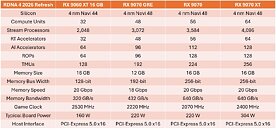
AMD today announced a global launch of the Radeon RX 9070 GRE graphics card. The card was debuted as a China-exclusive, and is seeing a wider launch to fill a key price-performance gap that exists between the RX 9060 XT 16 GB and the RX 9070. The new RX 9070 GRE carved out from the same 4 nm "Navi 48" silicon as the RX 9070 and RX 9070 XT. While the silicon physically has 64 compute units and a 256-bit wide memory bus, the RX 9070 GRE is configured with three quarters of it, featuring 48 compute units, and a 192-bit memory bus. In comparison, the RX 9060 XT and the "Navi 44" silicon it's based on, has exactly half the CU count and memory bus width.

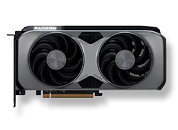
The Radeon RX 9070 GRE hence has 3,072 stream processors, 48 RT accelerators, 96 AI accelerators, 192 TMUs, and 96 ROPs. The card gets 12 GB of 18 Gbps GDDR6 memory across its 192-bit wide memory bus, for 437 GB/s of memory bandwidth. It's also configured with 48 MB of Infinity Cache memory, three quarters of the 64 MB physically present on "Navi 48." The card is configured with 2.20 GHz of Game clock, and 2.79 GHz of maximum boost frequency for the GPU engine clock domain, while the memory ticks at 18 Gbps (GDDR6-effective). The main competition for this card is NVIDIA's GeForce RTX 5060 Ti 16 GB, which is priced at $570. AMD, in its first-party performance tests claims a significant 22% performance gain over the RTX 5060 Ti 16 GB, and a 26% performance-price gain. While NVIDIA recommends the RTX 5060 Ti for 1080p gaming, AMD is confident in the RX 9070 GRE being a 1440p-class gaming GPU. The card will be available from today, June 1st, through AMD's various add-in board (AIB) partners, including Sapphire, PowerColor, ASRock, XFX, GIGABYTE, Acer, and ASUS.
AMD Radeon RX 9070 XT Drops Below MSRP in China

Chinese GPU distributors are now selling some AMD Radeon RX graphics cards below the MSRP set by AMD. According to Channel Gate, AMD graphics cards in China are currently being sold at a loss, with many channel distributors actually losing money on some Radeon models. For example, the entry-level Radeon RX 7650 GRE, which has an MSRP of 2,099 RMB ($308), is now being sold for about 1,740 RMB ($256), including sales tax. This represents a 17% decrease compared to the MSRP, making it an attractive price point for buyers, but not so much for sellers who have a stockpile of these graphics cards. Moving on to the more recent RDNA 4 generation, the Radeon RX 9060 XT 8 GB edition has an MSRP of 2,499 RMB ($367) but is now being sold at 2,250 RMB ($330). This is another drop of 10% compared to the MSRP, offering gamers a better deal.

The smallest difference is seen with AMD's top RDNA 4 GPU, the Radeon RX 9070 XT. This model has an MSRP of 4,999 RMB ($735) in China but is now trading at a slight discount of less than one percentage point at 4,950 RMB ($727). While this may not seem significant, it indicates that the card is finally trading at prices that AMD encouraged its board partners to adopt for the latest RDNA 4 family. However, these changes are only now starting to appear in China.

Sapphire Launches NITRO+ PhantomLink Polar Edition

SAPPHIRE Technology unveils the revolutionary PhantomLink connectivity feature in the distinctively special Polar edition on the SAPPHIRE NITRO+ AMD Radeon RX 9070 XT PhantomLink Edition Graphics Card and SAPPHIRE NITRO+ X870EA PhantomLink Edition Motherboard for the ultimate SAPPHIRE NITRO+ ecosystem in a glacial white-color themed pairing.

The SAPPHIRE NITRO+ AMD Radeon RX 9070 XT PhantomLink Polar Edition Graphics Card and the SAPPHIRE NITRO+ X870EA PhantomLink Polar Edition Motherboard were designed conjunctively to be used together for a premium SAPPHIRE NITRO+ ecosystem. For the first time, this ecosystem has been created in a silver-white aesthetic for powerful systems where innovative cooling meets enthusiast performance on an icy-metallic and elegant backdrop.

ASUS AMD Radeon RX 9070 XT Prices Jump by 17% in US Stores

It's no secret that prices for electronics are skyrocketing across the board, and shortly after it seemed as though there may be some hope on the horizon, it has been revealed by VideoCardz that the ASUS AMD Radeon RX 9070 XT GPUs have seen a significant price increase in US markets. All three ASUS RX 9070 XT models listed on PCPartPicker have seen a substantial price increase in recent days, with the average increase coming out to around 17%.

The ASUS Prime OC Radeon RX 9070 XT saw its price go from $819.99 to $959.95 at both B&H and ASUS's own online store. It currently retails for the same $959.95 at Amazon, too. Similarly, the black version of the Prime OC RX 9070 XT and the ASUS TUF Gaming OC Radeon RX9070 XT have increased from $799.99 to $939.99 and $849.99 to $989.99, respectively. Curiously, the ASUS Prime OC RX 9070 XT can still be had at Newegg and Amazon for its lower $799.99 price, suggesting that this is effectively a pricing change that was implemented by ASUS when new GPUs were sent out to retailers.

AMD Radeon RX 9070 and RX 9070 XT Fall Below MSRP in Germany

AMD's RDNA 4-based Radeon RX 9070 and RX 9070 XT graphics cards have finally reached reasonable pricing, as German retailers report that these GPUs are now selling below MSRP. In Germany, the European MSRP for Radeon RX 9070 cards is €629, including 19% VAT. For its bigger sibling, the Radeon RX 9070 XT, the European MSRP is listed at €689, also including the sales tax. However, according to multiple listings from German online retailers, both cards are trading below their European MSRP pricing, marking the first occurrence since the memory shortage fiasco began, which took a toll on the gaming community. The cheapest Radeon RX 9070 non-XT model is listed at €539.00 in the form of the ASUS Prime Radeon RX 9070 OC SKU, while the cheapest Radeon RX 9070 XT model is listed at €640 for the ASRock Radeon RX 9070 XT Challenger GPU. Do note that this is not the first time that these GPUs are priced below MSRP in Germany, but just the first time since the memory shortages started.

Interestingly, this price drop in Germany is not consistent with the markets in the United States, where GPU pricing for the Radeon RX 9070 and RX 9070 XT still ranges around $810-$820 for the non-XT SKU and about $880-$890 for the Radeon RX 9070 XT model. This represents a large premium in the U.S. market, considering that the Radeon RX 9070 and Radeon RX 9070 XT graphics cards have MSRPs of $549 and $599, respectively. Perhaps a fresh supply of GPUs has hit the German market, causing supply to overwhelm demand and significantly pushing prices down. In the U.S., that is not the case, where prices remain high and on an upward trajectory, according to PCPartPicker. In contrast, the German market is experiencing some of the lowest pricing in recent months, finally giving gamers a break.

MAINGEAR Drops Custom Crimson Desert Limited Edition PC

MAINGEAR, the leader in premium-quality, high-performance gaming PCs, today announced the official launch of its Rush Crimson Desert Limited Edition PC: a hand-built collector's collab aligned with today's launch of Crimson Desert, Pearl Abyss's open-world action-adventure set across the brutal continent of Pywel. Only 30 units will ever be produced. Orders close April 2, or when the 30th system is sold, whichever comes first.

Crimson Desert is one of the most anticipated open-world titles of 2026, and MAINGEAR crafted a system worthy of this moment. At the center of this collaboration is the Crimson Desert AMD Radeon RX 9070 XT, the Sapphire Nitro+ limited edition GPU featuring a design inspired by the game's visual identity, and the AMD Ryzen 7 9850X3D CPU, the world's fastest gaming processor, for a build that can handle everything Pywel throws at it: massive open landscapes, dynamic lighting, large-scale faction battles, and cinematic boss encounters, all without compromise.

System76 Introduces New Thelia Mira High Performance Desktop Series

System76 has refreshed its Thelio Mira desktop series with a focus on better thermals, easier serviceability, and a cleaner overall design, while it's still all built in-house at the company's facility in Denver. The new chassis mixes aluminium, steel, and a tempered glass front panel, with a vertical control bar consolidating the power button and front I/O into one clean strip. System76 uses steel fasteners throughout, and the panels are designed for quick access when you need to get inside for upgrades or maintenance. On the cooling side, System76 made improvements, the company claims up to 19% higher sustained CPU clock speeds and temperature drops of up to 13.5°C thanks to liquid cooling and revised airflow.

System76 also made changes to the specs as it is built around an ASRock X870 Pro RS WiFi motherboard. Processor options top out at the Ryzen 9 9950X or 9950X3D, memory goes up to 192 GB of DDR5, and storage can reach 28 TB spread across NVMe and SATA drives. As for the GPU, you can choose a single graphics card up to an RTX 5090 or Radeon RX 9070 XT over PCIe 5.0. Connectivity includes USB4, 2.5 GbE, and Wi-Fi 7, with a mix of front and rear USB ports. PSU requirements start at 750 W and go up to 1000 W for the beefier GPU configs. As with other System76 products, the Thelio Mira carries open-source firmware elements and is built with long-term usability in mind.

Mindfactory Reports AMD Radeon RX 9070 XT Still Tops Sales Charts but GPU Sales Plummet

German retailer Mindfactory indicates that AMD's Radeon RX 9070 XT is its top-selling GPU for weeks 9-11 of 2026 (meaning March 1-15), although it also indicated that there is a dramatic decrease in GPU sales during the same time period. According to the retailer data (shared by TechEpiphanyYT on X), AMD made up 55.6% of the outlet's sales for that time period, with the AMD Radeon RX 9070 XT in the lead as top seller with 25.6% market share and the RX 9060 XT following that up with 20.3%. The next five spots, though, are all NVIDIA GPUs—namely the RTX 5080 at 11.8%, the RTX 5070 Ti at 9%, the RTX 5060 and 5070 at 7% each, and the RTX 5090 at 5.3%.

The next-most-popular AMD GPU at Mindfactory was the Radeon RX 7600 in the eighth spot, with the RX 7900 XTX, 7900 XT, and 7700 XT following in 10th, 11th, and 12th place. Curious as it may seem to see AMD in the lead where NVIDIA usually dominates in most other markets, it follows trends set by previous Mindfactory reports. More concerning, GPU sales have also reportedly fallen to roughly a third of their usual numbers, likely as a result of stock shortages and skyrocketing hardware prices across the board. While recent reports indicate that GPU prices might be correcting slightly, at least on the AMD side, other component supply issues and the resulting high prices may be dissuading people from platform upgrades or fresh PC builds altogether.

Crimson Desert Gets Surprisingly Low-End Minimum Hardware Requirements for PC and Console

Crimson Desert, the upcoming open-world action-adventure game from indie studio, Pearl Abyss, is finally closing in on its March 19 launch date, and as part of the lead-up to the launch, Pearl Abyss has officially published the minimum hardware requirements for both PC and console, including a proper dedicated handheld spec sheet that should give owners of the ASUS ROG Ally and Xbox Ally handheld gaming PCs an idea of what to expect. On the Xbox Series X and the Sony PlayStation 5, players can choose between Performance, Balanced, and Quality graphics settings, all of which with their own framerate targets and render quality settings. Performance targets 1080p resolution with 60 FPS, VRR or VSync enabled and ray tracing set to low.

Balanced bumps up the resolution to 4K upscaled from 1280p with FSR 3 and targets 40 FPS with Vsync, while Quality scales 1440p to 4K with FSR 3 and targets 30 FPS with Vsync enabled. The PS5 Pro steps up all quality settings to 4K, with Performance and Balanced using Upgraded PSSR upscaling to upscale 1080p and 1440p with 60 FPS and 48+ FPS with VRR, respectively. Quality mode on the PS5 Pro goes straight for 4K native at 30 FPS with Vsync and ray tracing on ultra. For the Xbox Series S, there are only two quality settings: Performance, at 720p, 40 FPS with Vsync and RT off, or Quality, at 1080p, 30 FPS with RT off. The Xbox Series X, on the other hand, offers Performance, with 1080p at 60 FPS with VRR or Vsync and RT set to low; Balanced, with 4K upscaled from 1280p with FSR 3, at 40 FPS with RT on low; and Quality, which is 4K upscaled from 1440p with FSR 3, at 30 FPS with RT set to high.

Overclockers UK Announces the Brand New TechForge REVAlution Gaming PC

She travelled across space and time to fulfil the prophecy bestowed upon her. Now Reva takes her place amongst the legendary OcUK TechForge Gaming PC range with the brand new REVAlution Gaming PC. Built to travel the universe and facilitate high-performance gaming, the OcUK TechForge REVAlution harnesses the latest gaming hardware to delivered 4K AAA gaming with ease.

Hardware built to defy destiny
Reva's Shatterclaws aren't the only tech designed with performance and strength in mind, as under the hood the OcUK TechForge REVAlution houses the very best hardware. Powering the system is AMD's brand new Ryzen 7 9850X3D, the fastest gaming CPU on the market. With 32 GB of Patriot Viper RGB XTREME 5 DDR5 RAM and Kioxia's EXCERIA 2 TB SSD NVMe M.2, the OcUK TechForge REVAlution spared no expense on its journey across space and time.

Death Stranding 2: On the Beach PC Minimum Specifications Revealed Alongside Graphics Enhancements

Death Stranding 2: On the Beach is slated to launch on March 19 for PC after almost nine months as a PS5 exclusive, and Nixxes and Kojima Productions just revealed the minimum PC hardware requirements, as well as the supported upscaling and graphical enhancement options, in a PlayStation Blog post. According to the blog post, the absolute minimum spec, which gets you 30 FPS as 1080p with low settings, requires an AMD Ryzen 3 3100 or Intel Core i3-10100, 16 GB of RAM, and an NVIDIA GeForce GTX 1660 or AMD Radeon RX 5500 XT 8 GB. Medium, or 1080p with medium settings, requires an RTX 3060 12 GB or Radeon RX 6600, and an AMD Ryzen 5 5600 or Intel Core i5-11400. Stepping it up to High (or recommended specs), which gets you 1440p at 60 FPS with high settings, requires an AMD Radeon RX 6800 or NVIDIA GeForce RTX 3070 and an AMD Ryzen 7 5700X or Intel Core i7-11700. Very High, or 4K resolution at 60 FPS with very high settings, calls for an upgrade to an NVIDIA GeForce RTX 4080 or Radeon RX 9070 XT, while the CPU and memory specs remain the same as for the High tier. All spec tiers require 16 GB of memory, Windows 11 or Windows 10 1909 or up, and at least a 150 GB SSD.

Death Stranding 2: On the Beach will also offer PC players support for both 21:9 and 32:9 ultrawide aspect ratios, and players with 16:9 displays can simulate a cinematic experience by opting for a 21:9 aspect ratio with black bars on the top and bottom of the display—this option will also be introduced for PS5 at the same time as the PC release. PC players will also get support for upscaling tech from all three GPU manufacturers: NVIDIA DLSS 4, AMD FSR 4, and Intel XeSS 2, with both frame generation and upscaling options available. These upscaling options can be used in conjunction with Dynamic Resolution Scaling, and players will be able to adjust upscaling quality. The game will also see the debut of Pico—Progressive Image Compositor—on PC. This is the upscaling technology used by Death Stranding 2 on PS5 and developed by Guerrilla Games for the Decima engine, and it can also be used alongside all available frame generation options and on all available graphics card manufacturers. The game will also offer native AA options for those not interested in upscaling.

AMD GPU Prices Rebound Slightly As Demand Drops

It's no secret that GPU prices have skyrocketed lately as a result of increased AI data center demand. This has been especially true for any GPU featuring more than 8 GB of VRAM, like AMD's Radeon RX 9060 and 9070 series. However, while AMD GPUs were previously seen as a viable alternative when NVIDIA GPUs were unaffordable or unavailable, that increased demand resulted in price spikes of up to 40% by December 2025. This is based on Japanese data collected by Gaz:Log, who also found that, since that massive price hike, reduced demand has forced retailers to drop prices for both the RX 9070 XT and RX 9060 XT 16 GB GPUs by as much as 15% and 20% respectively.

Obviously, this is just one market, and it can't be guaranteed that events will play out similarly in other regions, but it is an indication that hardware pricing may be reaching a tipping point, after which we may see prices stabilize or fall slightly in response to reduced demand. It's also worth noting that AMD and NVIDIA have both been rumored to be planning to effectively increase MSRP in early 2026, which would result in price increases of at least 10% across the board. This is on top of a late 2025 price increase of $20-40 on both 8 and 16 GB GPUs.

ASRock Radeon RX 9070 XT Taichi White OC Model Appears in First Review

Over a month ago, ASRock fully presented its brand-new Radeon RX 9070 XT Taichi White OC 16 GB graphics card model. To some surprise, the Taiwanese PC hardware manufacturer has not released a simple pale redecoration of this generation's (RDNA 4) standard gray metallic Taichi SKU. Last week, a sponsored review was published by GDM Japan. So far, only Japanese PC enthusiasts have enjoyed public hands-on experience with the new flagship model. Despite claims of ASRock exhibiting a preview sample at CES 2026, TechPowerUp's ground team did not spot any demo units at the firm's Las Vegas graphics card showcase. The opening section of GDM's write-up mentions several recent domestic promo events, including one held in Tokyo's Akihabara Electric Town. The new model's unique selling point is an integrated 2-inch color LCD screen—officially dubbed "LCD Information Center." As expected, GDM dives deep into this fun feature. They managed to upload custom images and animated content (GIFs) via ASRock's Polychrome SYNC suite. Under normal modes, the small screen can inform users about GPU clocks, fan speeds, and operating temperatures.

The Radeon RX 9070 XT Taichi White OC candidate was hooked up to a test build based on Intel's Core Ultra 9 285K processor and ASRock's "ultra-high-end" Z890 Taichi AQUA motherboard. Performance-wise, the white variant seems to do just as well as its metallic gray sibling. GDM concludes that the latest model only distinguishes itself in terms of aesthetics; mainly through its "striking" white design and integrated screen gimmick. In their analysis of the Taichi White OC's debut review, VideoCardz has highlighted the test subject boosting well beyond the factory-set 3.1 GHz boost clock rating. Months into RDNA 4's lifecycle, only a handful of Team Red board partners had released custom designs overclocked to this level, with only ASRock and Sapphire choosing to implement the controversial 12V-2×6 power connector. Under load, GDM reported the "Navi 48 XTX" GPU boosting up to a maximum of 3296 MHz. Last March, TechPowerUp's W1zzard got his gray Taichi evaluation unit overclocked up to an average of 3213 MHz. We hope that upcoming non-sponsored reviews will provide a clearer picture of the Radeon RX 9070 XT Taichi White OC SKU's capabilities.

Sapphire NITRO+ Radeon RX 9070 XT OC Crimson Desert Edition Listed by EU Stores

After a short period of teasing a Crimson Desert collaboration product, Sapphire recently revealed a fantasy adventure themed spin-off of its RDNA 4 flagship NITRO+ Radeon RX 9070 XT 16 GB custom graphics card. The sudden appearance of this special edition model roughly coincided with the launch of an AMD Ryzen/Radeon hardware + Pearl Abyss software promotional campaign. So far, Sapphire's marketing campaign—of the NITRO+ RX 9070 XT OC Crimson Desert Edition SKU—has not set a firm release date or confirmed day one pricing, although a (February 10) VideoCardz report proposed a "within February" window. The freshly-introduced card's EAN code (4895106297623) and manufacturing number (11348-10-20G) turned up online not long ago, and web searches—as of today—involving this info leads to several fresh e-tail listings in Germany and Austria.

Surprisingly, a couple of these shops state that they have Sapphire's latest top-end product "in stock," although the remainder outline about a week's worth of lead time. According to a regional price aggregator, Alternate.de offers the best deal—€919.99 (including VAT and delivery), which converts to ~$1093 USD. The additional Crimson Desert livery—consisting of an elaborate backplate print and distinctive fan stickers—seems to demand a significant premium, when compared to the vanilla Nitro+ design. For reference, Alternate has the standard SKU stocked for a total of €842.99 (~$1002 USD). The least appealing Crimson Desert Edition price tag comes in at €1109.40, via Kaufland.de's marketplace. Alternate GmbH's eBay store advertises stock at €773.10 (per unit), but this initial figure is deceptive—VAT gets added on in the checkout process, aligning with the aforementioned "best" €919.99 price point.

AMD Launches Crimson Desert Promo Bundles for Qualifying Ryzen & Radeon Hardware

This season's AMD Rewards campaign started going live this morning, across several regions. Officially, this promotional period started today (February 10), at 9:00 a.m. ET, and is due to end on April 25. Participants have until May 23 (11:59:59 p.m. ET) to get/redeem "Crimson Desert with select AMD products." Hints of a Pearl Abyss—the game's South Korean development team—and Team Red collaboration appeared online last week; eventually leading to the reveal of Sapphire's Nitro+ Radeon RX 9070 XT OC Crimson Desert Edition graphics card model. In terms of qualifying desktop processor products, AMD has narrowed its selection down to current-gen 3D V-Cache-augmented gaming models, including the 16-core Ryzen 9 9950X3D, 12-core Ryzen 9 9900X3D, and 8-core Ryzen 7 9800X3D. The semi-recently launched Ryzen 7 9850X3D SKU gets some special treatment—according to the latest reward scheme's small print: "purchases of this product prior to the Campaign Period are eligible to receive a Coupon Code."

The Crimson Desert promotion also encompasses RDNA 4 generation graphics cards, although the Red Team has only deemed its upper echelon options worthy of this Pearl Abyss sponsorship. The Radeon RX 9070 XT and Radeon RX 9070 (both 16 GB models) are qualifiers in this category. Oddly, cheaper Radeon RX 9060 XT (16 GB and 8 GB) cards are not listed in freshly published material. Also absent is the Chinese market exclusive Radeon RX 9070 GRE 12 GB or 16 GB models. The less potent Radeon RX 9000-series products are very likely capable of running the Black Desert Online prequel to a satisfying degree—as noted by VideoCardz, Crimson Desert's minimum PC specification requirements hark back to pre-2020s processor and GPU hardware.

Sapphire Presents NITRO+ Radeon RX 9070 XT Crimson Desert Edition Card

A week ago, Sapphire Technology's social media account started to tease a forthcoming Crimson Desert collaborative product. A few days later, the Hong Kong-based computer hardware specialist unveiled an officially redecorated variant of its current flagship RDNA 4 graphics card—the NITRO+ Radeon RX 9070 XT 16 GB model. In the time gap between Sapphire's two preview posts, web sleuths managed to find early retail listings—pre-release info included the product code (11348-10-20G), GTIN/EAN number (4895106297623), and a full product name—Sapphire Nitro+ Radeon RX 9070 XT OC Crimson Desert. Across a smattering of prematurely published Austrian and German webstore pages, possible placeholder pricing seems to be hovering around €970 - 980. Currently, the PCO Computer Handels GmbH online shop is advertising "in stock" availability.

Surprisingly, Sapphire's recent release of TRIXX v11.0 contained patch notes that mentioned the "Crimson Desert Version" special edition, as well as the PhantomLink spin-off. Crimson Desert, a single-player open-world fantasy action-adventure, is due to launch on multiple platforms next month—specifically March 19. The AMD x Sapphire Nitro+ x Pearl Abyss collaboration could bear fruit in the run-up to the Black Desert Online prequel's international arrival. Sapphire's promotional render shows a fairly typical Nitro+ RX 9070 XT card design that sports Crimson Desert livery; mainly on the backplate. Additionally and subtly, the triple-fan array features a different set of stickers, when compared to the standard model. Semi-recently, TechPowerUp's W1zzard was impressed by the high quality print present on ASRock and Capcom's Radeon RX 9070 XT Monster Hunter Wilds Edition card—a more mid-range-type design. Hopefully, Sapphire has applied a similar—or superior—level of treatment onto its premium-tier creation.

AMD Radeon AIBs to Prioritize 8 GB GPU SKUs and Push 10% Price Hike

According to Chinese Board Channels, a reliable source of GPU news, AMD's add-in board (AIB) partners are preparing for another round of GPU price increases. They also seem to be shifting their product focus toward 8 GB Radeon models. After distributors implemented a 5-10% price adjustment in January, another increase is reportedly planned for February or March, though the exact percentage is not yet known. Board Channels also reports that AMD is expected to prioritize stocking 8 GB SKUs such as the Radeon RX 9060 XT 8 GB and the older RDNA 3-based RX 7650 GRE, rather than the 16 GB SKUs like the Radeon RX 9070 XT. This shift is due to a shortage of GDDR6 memory, which is reducing the profit margins for AIBs without a significant price increase.

Distributors reportedly stocked up after January's price increase, which could lead to uneven availability if resellers hold onto inventory in anticipation of another adjustment. With DRAM prices having risen sharply in recent months, manufacturers are reassessing which memory configurations to produce, favoring 8 GB variants because they are cheaper to manufacture. This shift might also cause some 16 GB parts to become more expensive, narrowing the price gap between AMD and NVIDIA in the midrange market. The earliest effects of these changes are expected to be seen in mainland China, where partners may allocate more volume to 8 GB cards and reduce the output of certain 16 GB GRE and non-GRE models. We are yet to see how it reflects on the Western stores and pricing imposed by retailers like Amazon, Newegg, and others.

AMD Reportedly Prioritizing Radeon RX 9070 XT Over Non-XT Version

AMD is reportedly shifting its production strategy to focus more on the Radeon RX 9070 XT graphics cards instead of the non-XT version. According to PROHARDVER, AMD is reallocating internal capacity towards the higher-end Radeon RX 9070 XT, which has a higher MSRP of $599. This decision is driven by the fact that the production costs for both GPUs are the same, as they both use the Navi 48 die and 16 GB of GDDR6 memory. With memory pricing being the main bottleneck, AMD aims to concentrate on a SKU that offers a better profit margin and justifies the engineering efforts invested in the series. Although both SKUs have the same memory configuration, the non-XT version uses a Navi 48 XT die, likely a lower-bin version of the Navi 48 XTX die. As a result, production costs are similar, but the Radeon RX 9070 XT has a slight 9% price premium over the non-XT model.
PROHARDVERThis does not make the Radeon RX 9070 a very good alternative for manufacturers, and according to our information, its production is not stopped, but the focus is largely on the Radeon RX 9070 XT, so they may produce more of this model in the future at the expense of its smaller brother. On paper, this could help minimize the need for price correction, since the fastest Radeon model is already more expensive, so it is less affected by the increase in memory prices.

ASRock Website Updated with Radeon RX 9070 XT Taichi White OC Model Page

In the run-up to Christmas, ASRock unveiled a pale spin-off of its readily available Radeon RX 9070 XT Taichi OC graphics card model. As of this week, gaming graphics card sleuths have noticed that the Taiwanese manufacturer has published a dedicated product page. A "RX9070XT TCW 16GO" code, detailed specifications, various product and feature set descriptions, and plenty of images are on full display on ASRock's main web presence. TechPowerUp's CES 2026 ground team did not spot a white Taichi demonstration sample during a past week ASRock suite visit. An official pre-event PR piece implied some form of early January trade show concurrent introduction.

Their latest update of the custom RDNA 4-based flagship manages to implement a new "LCD Information Center" feature—simply a dinky side-mounted 2-inch color LCD screen that can broadcast key diagnostic data and animations. Early promotional renders indicated that ASRock had bunged on a longer strip of ARGB lighting across the white Taichi variant's top-side. A full selection of shots show off this new zone, complete with an expansion of this Taichi generation's gear-themed aesthetic. The added extras have tacked on a little bit of extra weight (+67 g), relative to the metallically-dressed standard Taichi model—ASRock's specification sheet lists a slightly heavier net weight measurement of 1621 grams. The white RX 9070 XT Taichi OC variant is still a three-slot thick behemoth, with an additional 6 mm tacked onto its depth dimension (according to official specs).

ASRock at CES: Single-Slot, Passive, Arc Pro B60 24 GB and AMD Radeon GPUs

Even though this year CES show lacked major desktop-class GPU launches, ASRock featured several graphics cards. Among those, one interesting product on display was a single-slot, passively cooled workstation-class card, namely the Intel Arc Pro B60 Passive 24 GB. The card is designed for scalable multi-GPU systems and features (as said) a single-slot, passively cooled design, making it suitable for dense workstation or server deployments. It is based on Intel 5 nm BMG-G21 graphics processor with Xe2-HPG architecture and comes with 24 GB of GDDR6 memory on a 192-bit bus, PCIe 5.0 support, and four DisplayPort 2.1 outputs. ASRock noted that this passive model is intended for business and enterprise customers only and will not be sold through retail channels. For users looking for a retail option, ASRock also showed the Intel Arc Pro B60 Creator 24 GB, which uses a more conventional dual-slot blower-style cooler.

On the AMD side, the company presented the Radeon AI Pro R9700 Creator 32 GB, targeting similar professional and AI-focused workloads. ASRock booth also featured several consumer Radeon cards, including the Radeon RX 9060 XT Steel Legend 16 GB OC, RX 9060 XT Challenger 16 GB, and Radeon RX 9070 XT Monster Hunter Wilds Edition (our extended review here), developed in collaboration with Capcom.
More images follow.

ASRock to Announce Expanded PC Lineup and Debut AIO Liquid Cooler at CES 2026

ASRock, a global leader in motherboards, graphics cards, gaming monitors, small form factor PCs, power supply units, and AIO liquid coolers, is set to impress tech enthusiasts worldwide at CES 2026 with its latest product lineup innovations. This year, ASRock will unveil an expanded lineup featuring cutting-edge motherboards, graphics cards, gaming monitors, compact systems, power supply series, and the debut of its all-in-one (AIO) liquid cooler solution.

This comprehensive product showcase highlights ASRock's continuous commitment to high performance and precision engineering. By combining innovative technology, reliable quality, and industry-leading design aesthetics, ASRock continues to shape the future of PC hardware, driving the industry forward with innovation that leads the flow.

Sapphire AMD Radeon RX 9070 XT Nitro+ Melts Connector After "Almost a Year" in Use

It's no secret that NVIDIA GPUs have had a habit of burning up 12vHPWR and 12V-2x6 connectors, but increasingly, reports are emerging of the same thing happening to AMD's Radeon GPUs running the same connectors. The latest report of such burned connectors come from a user on r/Radeon on Reddit, where user u/divinethreshold posted an image of their burned Sapphire Nitro+ AMD Radeon RX 9070 XT GPU with a burned 12V-2x6 connector on the GPU cable side. According to the account, the GPU had been running in the same system for upwards of a year without issue before it started crashing mysteriously, prompting the redditor to disassemble the system and inspect for hardware issues.

[Editor's note: You can read our in-depth review of the Sapphire AMD Radeon RX 9070 XT Nitro+ graphics card here]

In the comments, the affected user explains that the burned cable was part of an included adaptor that connects the 12V-2x6 connector on the GPU to three 8-pin connectors on the PSU side. As commenters in the thread have also pointed out, these sorts of failures seem to be more common when similar adaptors are used, which makes sense, since most official sources attribute failures to overheating caused by improper contact across one or more pins. Increasing the number of potential failures also increases the likelihood of said failure.

Sapphire Intros NITRO+ Phantom Link Radeon RX 9070 XT and X870E Socket AM5 Motherboard

Sapphire launched its flagship graphics card and motherboard featuring PhantomLink discreet power delivery technology. The tech sees an ASUS BTF-like GC-HPWR power-delivery slot located along the plane of the main PCI-Express 5.0 x16 slot, which delivers power to the graphics card without you having to wrestle with a delicate 12V-2x6 cable on top of the card. But then there's a catch. The motherboard isn't designed on the philosophy of backside connectivity like ASUS BTF or MSI Project Zero or GIGABYTE Stealth, the connects are all still located along the obverse side of the PCB. There is a 600 W-capable 12V-2x6 input located next to the 24-pin ATX, which simply routes power to the GC-HPWR slot.

Launching today, are the Sapphire NITRO+ Radeon RX 9070 XT PhantomLink PE graphics card, and the NITRO+ X870EA PhantomLink Socket AM5 motherboard. Both products have an identical silver-white color scheme and NITRO+ design theme that pair well visually. The graphics card features an overclocked RX 9070 XT with similar specs to the regular NITRO+ RX 9070 XT from Sapphire. The motherboard comes in two color trims, white+silver and black+silver. It offers a premium CPU VRM solution, a heavy M.2 PCIe Gen 5 heatsink, reinforced PCI-Express 5.0 x16 slot, premium Wi-Fi 7 and onboard audio solutions, and USB4. Sapphire is expected to showcase this along with example builds at CES next week.

Vlogger Inspects Sapphire Radeon RX 9070 XT Nitro+ White Variant & Phantom Link Adapter

Sapphire has seemingly distributed special variants of its flagship Radeon RX 9070 XT Nitro+ graphics card model to Chinese press and influencer outlets. A Phantom Link edition received pre-launch video coverage earlier in the week, swiftly followed by the surprise appearance of a white spin-off. Yesterday, the Just Buy (if you like it) video channel showcased Sapphire's pale redecoration of the current-gen Nitro+ design—possibly the first of its kind. Normally, this premium card design—within the RDNA 4 generation—sports a luxurious champagne gold finish. The not-yet-released "Aurora Edition" veers closer to the Hong Kong-based manufacturer's upper-mid-range PURE product theme.

So far, previewers have not paired their card samples with Sapphire's X870EA Wi-Fi Phantom Link Edition motherboard. Instead, Just Buy settled on utilizing an ASUS TUF Gaming BTF-type mainboard; readily compatible with the Phantom Link system—merely Sapphire's rebranding of the modular GC-HPWR adapter. They freely swapped between the Sapphire card, and (what looks like) a TUF Gaming RTX 5070 Ti BTF White model. As mentioned by Uniko's Hardware, Tony Yu (aka Uncle Tony)—general manager of the ASUS China branch—has personally "endorsed" the Radeon RX 9070 XT Nitro+ Phantom Link design. Industry observers believe that the current seeding of press samples will build up hype before an official unveiling at CES 2026, potentially followed by a widespread retail release. At the time of writing, early hands-on demonstrations did not include any on-screen or benchmarking sessions.

ASRock Intros Radeon RX 9070 XT Taichi White with a Color Display of its Own

ASRock today introduced the Radeon RX 9070 XT Taichi White graphics card. The card is positioned a notch above the company's current RX 9070 XT Taichi OC. While the shape of its cooling solution resembles that of the original Taichi OC with its 3-tone black+gray+chrome trim, the shroud is now almost completely single-tone white, but with an acrylic ARGB diffuser along the top. There are additional ARGB LED elements along the front. The middle fan is clear, and comes with ARGB lighting. Perhaps the most striking element is its tiny 2-inch color LCD that can be programmed to display just about anything. By default, it puts out system monitoring specs pulled from the ASRock PolyChrome Sync app.

The card retains the meaty VRM setup of the original Taichi OC, and is among the few custom RX 9070 XT cards to come with a 16-pin 12V-2x6 power connector that's capable of 450 W input. The card comes with a factory OC of 2570 MHz Game clock, and 3100 MHz boost, compared to AMD reference speeds of 2400 MHz Game clock and 2970 MHz boost. Its cooling solution uses an impressive eight 6 mm-thick nickel-plated copper heatpipes that pull heat from the GPU and memory, pushing it through the heatsinks, which are ventilated by a trio of fans. ASRock did not confirm pricing, but this is sure to be pricier than the regular RX 9070 XT Taichi OC.

A marketing video by ASRock follows.
Return to Keyword Browsing
Nov 26th, 2026 00:23 CST change timezone

New Forum Posts

Popular Reviews

TPU on YouTube

Controversial News Posts