News Posts matching #RX 9070 XT

Return to Keyword Browsing

AMD Wants to Ray Trace Large, Dynamic Worlds with Reusable Parts

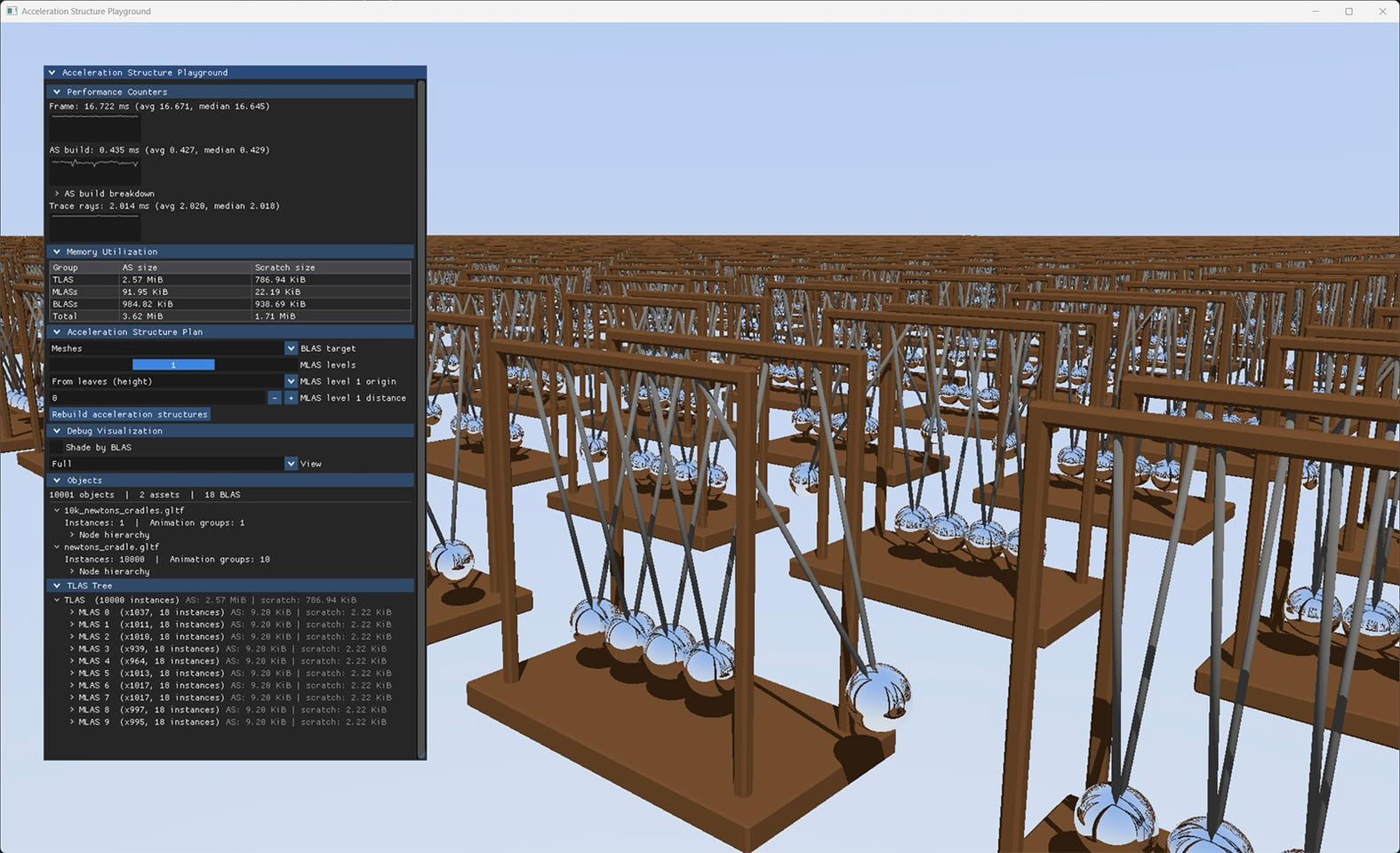
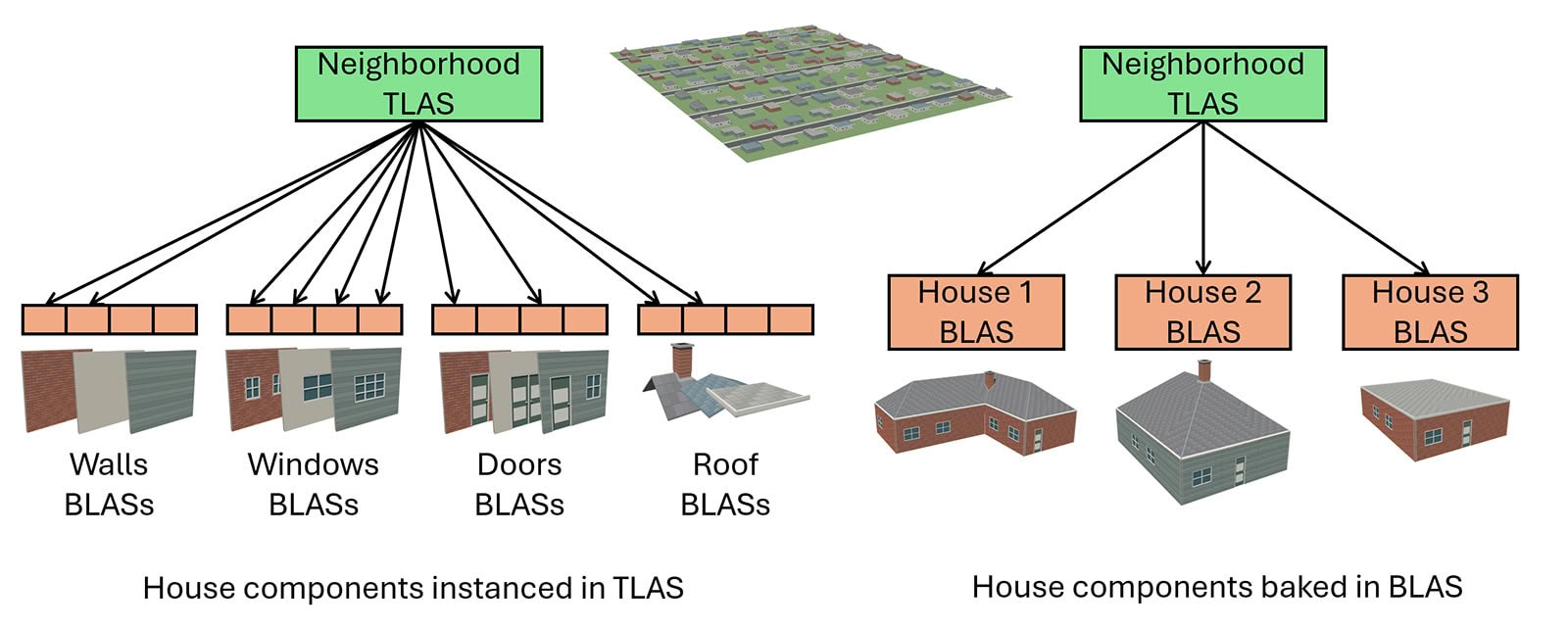
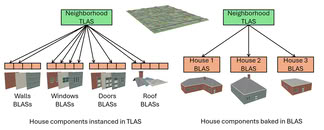
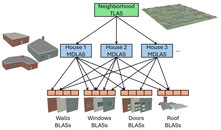
To scale large, open, dynamic worlds with ray tracing, AMD is developing a new approach to simplify the process. By extending traditional techniques, AMD introduces Ray Tracing Multi-Level Acceleration Structures (RT-MLAS). This technology adds additional levels of reusable acceleration structures within ray-traced objects, reducing both memory consumption and the time required to build and update them. Traditional ray tracing pipelines rely on two levels of acceleration structures: Bottom-Level Acceleration Structures (BLAS), which contain geometry, and a Top-Level Acceleration Structure (TLAS), which organizes instances of that geometry. However, large open worlds can have an enormous number of objects, making the TLAS increasingly expensive to rebuild as objects move or change their level of detail (LOD).

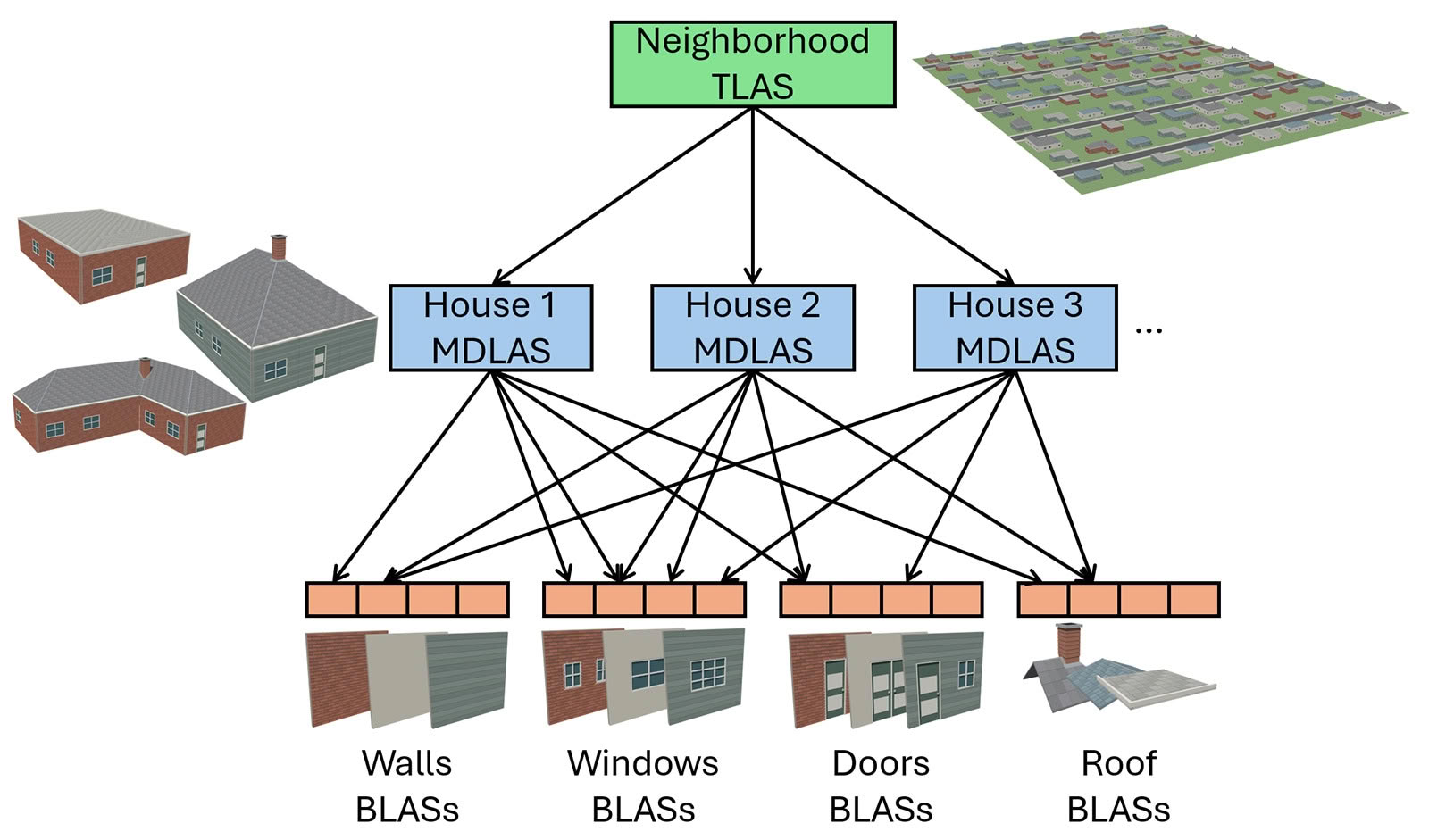
RT-MLAS addresses this challenge by introducing Mid-Level Acceleration Structures (MDLAS), allowing developers to organize objects into additional reusable hierarchies. AMD's implementation supports up to two additional levels, enabling repeated scene components to share acceleration structures rather than being individually duplicated or registered in an increasingly large TLAS. For example, an entire building can be represented by an MDLAS containing reusable walls, windows, doors, and roof components. This approach is particularly useful for open-world environments, where developers can organize different areas into independently manageable structures and rebuild only the sections that need updating. AMD's research also shows how the technology can benefit heavily animated environments, such as forests with tens of thousands of independently animated plants.
AMD's "We Love Gamers" Post Clashes With Its Own CEO's Comments

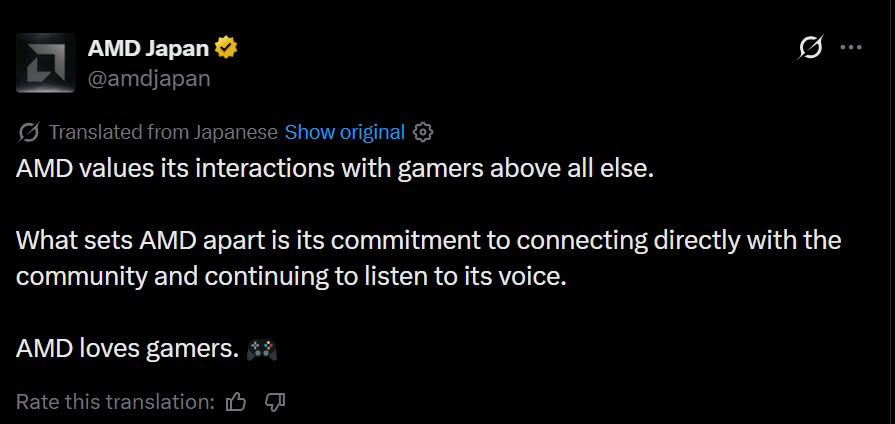
AMD Japan took to X today to say "AMD loves gamers," while also claiming that the company values its interactions with gamers above all else. The post was a quote tweet to coverage of CEO Dr. Lisa Su attending the opening of Micro Center's new Austin store. AMD handed out 300 swag bags and also raffled off a Radeon RX 9070 XT signed by Dr. Su at that event. However, that gesture was certainly not enough to undo Dr. Lisa Su's comments less than two weeks ago, where she called AMD a "data center first" company. The replies, and later a community note, were quick to remind AMD Japan of that contradiction.

In addition to its own CEO's comments, AMD's latest earnings also don't agree with its X post today. AMD posted record Q3 2026 revenue of $13.4 billion, up 45% year over year, and the Data Center segment did most of the heavy lifting. It brought in a record $8.5 billion, 64% of the total revenue, which was up 97% year over year. By comparison, the Client and Gaming segment fell 8% to $3.7 billion. This is the part that caters to gamers, and what's more interesting is that the Client revenue actually grew 7%, which means that the damage sits almost entirely in gaming. The latter dropped 40% to $773 million, under 6% of AMD's total revenue now. Not to mention, AMD expects data center sales to grow roughly 50% from Q3 to Q4, while there's nothing officially on the horizon for gamers except a CES 2027 teaser.

AMD Reportedly Cuts Gaming GPU Supply in China by Up to 50%

AMD has reportedly cut its gaming GPU supply in China by at least 20% to 50% since the start of the fourth quarter in October. According to a November 12 post on Board Channels spotted by Videocardz, AMD's shortage is now comparable to NVIDIA's, with very few gaming chips going to add-in board (AIB) partners. Their monthly allocations are apparently still shrinking, and the source expects supply to remain extremely tight until January.

The same source describes Radeon prices in China climbing every quarter, with smaller increases month to month within each quarter, and puts that down to rising memory and GPU costs. AMD is reportedly raising the price of its GPU and GDDR6 kits again this month, after an earlier increase in October. Things aren't much better on the green side either, with an NVIDIA partner saying in late October that it couldn't buy RTX 5090 GPU and GDDR7 kits anymore, while RTX 5090 and 5080 prices continue to skyrocket. Graphics cards were already selling 44% above MSRP on average in October, so a smaller pool of Radeon cards is unlikely to help matters.

DLSS 5 on Radeon Gets Faster With AMDLSS5 2.0, Up to 64% Performance Uplift

AMDLSS5, a free mod that runs NVIDIA's DLSS 5 Neural Rendering on AMD's Radeon RX 9070 and RX 9070 XT, has reached version 2.0 with an engine its developer, Wehaveall, built for the project. Earlier builds were based on Daniel Blanco's DLSS-NR-on-AMD, the tool that first got DLSS 5 working on Radeon cards back in September, but version 2.0 no longer needs files from any other mod. In a 60-second Resident Evil Requiem run at 4K with FSR on an RX 9070 XT, the new build averaged 101.2 FPS with 78.5 FPS 1% lows, up from 91.3 and 66.0 FPS on version 1.6.1. That is roughly 11% and 19% better, respectively.

The headline 64% figure comes from a comparison with unnamed "other mods," which managed 61.6 FPS in the same scene. These are the developer's own numbers from one game on one GPU, and there's no mod-off baseline showing what Neural Rendering costs. Game support now includes PRAGMATA, Nioh 3 and GTA 5 Enhanced, the latter only in offline Story Mode with BattlEye disabled. RX 9060 series cards should work but are untested, while RX 7000 support is an alpha that hasn't been tried on real hardware yet.

GPU Prices Up Again in October, RTX 5090 Now Sells for 262% Over MSRP Worldwide

In a big surprise to no one, graphics card prices went up again in October. TechSpot's latest survey across 10 countries shows GPU prices rising 11% month over month, following a 15% jump in August and 7% in September, or roughly 35% over three months. On average, cards now sell for 44% above MSRP, climbing to 58% in the US and Canada. Keep in mind these numbers track the lowest in-stock price in each region, so most models cost even more. Moreover, there is another GeForce RTX 50-series price hike on the horizon, so these numbers will rise again pretty soon.

The GeForce RTX 5090 is in a league of its own. It got 32% pricier in a month, and its normalized global price of $7,240 sits a staggering 262% above its $1,999 MSRP, almost double the 136% figure from early September. In the US, the cheapest in-stock model now costs $9,400, or 370% over MSRP, and most models now sit above $11,000 comfortably. The RTX 5080 is following a similar path, up 22% in a month to $2,200 in the US, while Newegg had none of its own in stock when the data was collected. TechSpot argues the GDDR7 memory crisis can't explain a jump that big, and some retail sources apparently told them wholesale RTX 5080 costs have gone up recently too.

AMD Reportedly Plans Another Radeon GPU and GDDR6 Kit Price Hike for November

AMD is reportedly getting ready to raise prices on its Radeon GPU and GDDR6 memory kits again in November. According to a new post from Board Channels, the increase would follow an earlier adjustment in October, when AMD apparently started charging its board partners more for GDDR6 from October 1. The exact scope of the November hike isn't known yet. The main reason seems to be memory, since GDDR6 prices reportedly went up by around 8 to 10% in the third quarter. Board Channels also claims AMD now reviews its kit pricing every quarter to keep up with rising GPU and memory costs. AMD sells its GPUs to add-in board partners bundled with memory, so any increase there usually ends up in the price of the finished card.

This would add to a long list of reported increases this year. A 10% hike on Radeon GPU kits was reported for July, another 10% increase across GPUs, chipsets, and possibly CPUs followed in September, and AMD's suggested Radeon prices in China went up in early October. Retail prices are already moving, too. According to Hardware Unboxed's latest pricing survey, cited by Videocardz, the RX 9060 XT 16 GB costs 17% more than it did in September, while the RX 9070 and RX 9070 XT are up 12%. Of course, AMD hasn't officially confirmed any of this. How much the November change affects store prices will depend on board partner pricing and existing inventory, so buyers who were already planning on a Radeon RX 9000 card might want to buy sooner rather than later.

ASUS Announces TUF Gaming Radeon RX 9070 XT Onimusha Special Edition

ASUS today announced the TUF Gaming Radeon RX 9070 XT Onimusha Special Edition graphics card, arriving alongside Onimusha: Way of the Sword, which releases on September 4, 2026. More than a performance powerhouse, this card is a collectible piece of artistry—bundled with the game, slashing onto the scene, and ready for action.

A masterpiece of dark artistry
The TUF Gaming Radeon RX 9070 XT Onimusha Special Edition pays visual tribute to the world of Onimusha: Way of the Sword. A dark fantasy set in Edo-period Kyoto, the game invites players to explore the historic Japanese capital on the edge of a blade, battling underworld monstrosities with shadow and steel.

AMD Radeon Owners Can Now Run Nearly Every DLSS Feature Through Fan-Made Mod

Daniel Blanco's DLSS-NR on AMD project has grown well past its original scope. The mod first got NVIDIA's DLSS 5 Neural Rendering running on Radeon cards back in September, and later pulled off a 74% performance jump in a single day. The new Alpha 0.8.0 release, published on October 17, now brings almost the whole DLSS stack to AMD GPUs. That includes DLSS 4.5 Super Resolution (Models M and L), Ray Reconstruction (Model F), and Frame Generation with up to 4x multi-frame generation (MFG) in games that expose DLSS FG inputs. FSR 4.1.1 is also bundled, so it no longer depends on the driver, and a new NeuralHub mod manager handles game detection and installation.

According to the developer, this is a ground-up reimplementation of the DLSS runtimes using custom HIP kernels rather than a translation layer, and users have to supply their own NVIDIA DLLs. RDNA 4 and RDNA 3 cards get the full feature set, while RDNA 2 support is still experimental and limited to Neural Rendering. The developer says DLSS 5 Neural Rendering now runs at roughly 90 to 100 FPS at 1080p on an RX 9070 XT, and the goal is to match an RTX 5070 Ti. Early results with Ray Reconstruction are mixed, however. One Reddit user reported no performance loss in Cyberpunk 2077 with path tracing at 1440p on an RX 9070 XT, while others saw drops of up to 25%. The mod only works in DirectX 12 games on Windows 11, and anti-cheat software blocks it, so readers are advised to stick to single-player titles.

Sapphire Officially Unveils NITRO+ AMD Radeon RX 9070 XT Valor Mortis Edition

SAPPHIRE Technology, in collaboration with AMD and One More Level S.A., the acclaimed developer of first-person action-platformer and hardcore slasher Ghostrunner, formally unveils the SAPPHIRE NITRO+ AMD Radeon RX 9070 XT Valor Mortis Edition graphics card.
Adrian Thompson, VP of Marketing, SAPPHIRE"The NITRO+ Valor Mortis Edition is exactly what our community asked us for; flagship Radeon performance with a design that means something. We wanted every detail, from the custom backplate to the artwork on the fans, to feel like it belongs in the world of Valor Mortis. Working with AMD and One More Level, we've built a card that performs at the highest level, comes with a coupon for the game in the box, and stands out as a true collector's piece."

AMD GPUs Get Price Hike in China with International Increases To Follow

As if GPU prices weren't high enough, thanks to the ongoing RAMpocalypse driving up BOM costs continuously for what seems like the last year, the trend is clear. According to recent reports, it now seems as though AMD GPUs are slated to get even more price hikes in the near future. As reported by VideoCardz, based on a source on Board Channels, AMD has increased GPU vendor pricing by as much as $104 in China.

Reportedly, the AMD Radeon RX 9070 XT and RX6500 XT pricing will remain unchanged, but the RX 9070 will get a price hike equivalent to $104, being the steepest price increase on the list, while the RX 9060 XT 8 GB will get the smallest price increase, at $45. It is said that these price hikes are motivated by higher memory prices and manufacturing costs, and that, while they are seemingly local to China for the time being, international board partners have also been informed of the upcoming changes.

AMD Shows Off Ray Tracing Tech That Slashes GPU Memory Use By 47x

AMD has detailed a new ray tracing technique called tetrahedral cages, and according to a blog post on the company's GPUOpen developer site, it can cut BVH memory use by roughly 47x while speeding up BVH updates by around 90x. AMD demoed the tech on a large scene with about 25,000 independently animated plants, running at 60+ FPS at 1080p on a Radeon RX 9070 XT. In a conventional setup, every uniquely animated object needs its own acceleration structure updated every frame, which gets expensive fast in dense scenes. AMD says the same demo would normally require up to 80 GB of GPU memory and over 300 ms per frame for BVH updates using standard methods. With tetrahedral cages, that dropped to about 1.7 GB of memory and roughly 3.3 ms per frame.

The trick is that instead of animating the dense mesh directly, AMD wraps it in a much simpler deformable cage. The dense geometry and its BVH stay static and reusable, and only the cage itself needs to be animated each frame, so update cost scales with the cage's complexity rather than the triangle count. The tradeoff is losing per-vertex animation control, which is why AMD is positioning it for grass, foliage, and other dense but not individually detailed objects. AMD says the technique can be combined with Microsoft's DirectX ray tracing too. Still, this is only a research showcase in its current state, and there's no word yet on when or if it might show up in games.

Sapphire Prepares Nitro+ Radeon RX 9070 XT OC Valor Mortis Edition GPU

Sapphire is preparing a Valor Mortis edition of its Nitro+ Radeon RX 9070 XT OC, a themed variant created in collaboration with dev studio One More Level and publisher Lyrical Games to coincide with the launch of their first-person Soulslike action game on October 13, 2026. This isn't Sapphire's first themed graphic card, the most recent was the Nitro+ RX 9070 XT OC Crimson Desert edition. The Valor Mortis variant follows the same path: a custom logo on the fans and a magnetic backplate decorated with game artwork. Even if not officially announced yet, the GPU, memory, cooling, and factory overclock likely won't change as the specs would match the Crimson Desert edition. This means the GPU will have up to 3060 MHz boost clock and 2520 MHz game clock, while the card will feature 16 GB of 256-bit GDDR6 at 20 Gbps.

A copy of the game comes bundled with the card, however, Sapphire did not mention which edition, standard or deluxe. Also, pricing or an exact release date has not been announced. We estimate that the Sapphire Nitro+ Radeon RX 9070 XT OC will be available around October 13 or shortly after, given the game's launch date. As a side note, Sapphire is celebrating its 25th anniversary this year. Founder and CEO KD Au said the milestone "belongs to our customers, our partners at AMD, and every member of the SAPPHIRE team," adding that the company started with the ambition of building the best graphics cards in the world, a goal he says still drives the company today.

AMD Radeon RX 9070 XT is AMD's Most Popular Discrete GPU on Steam Survey

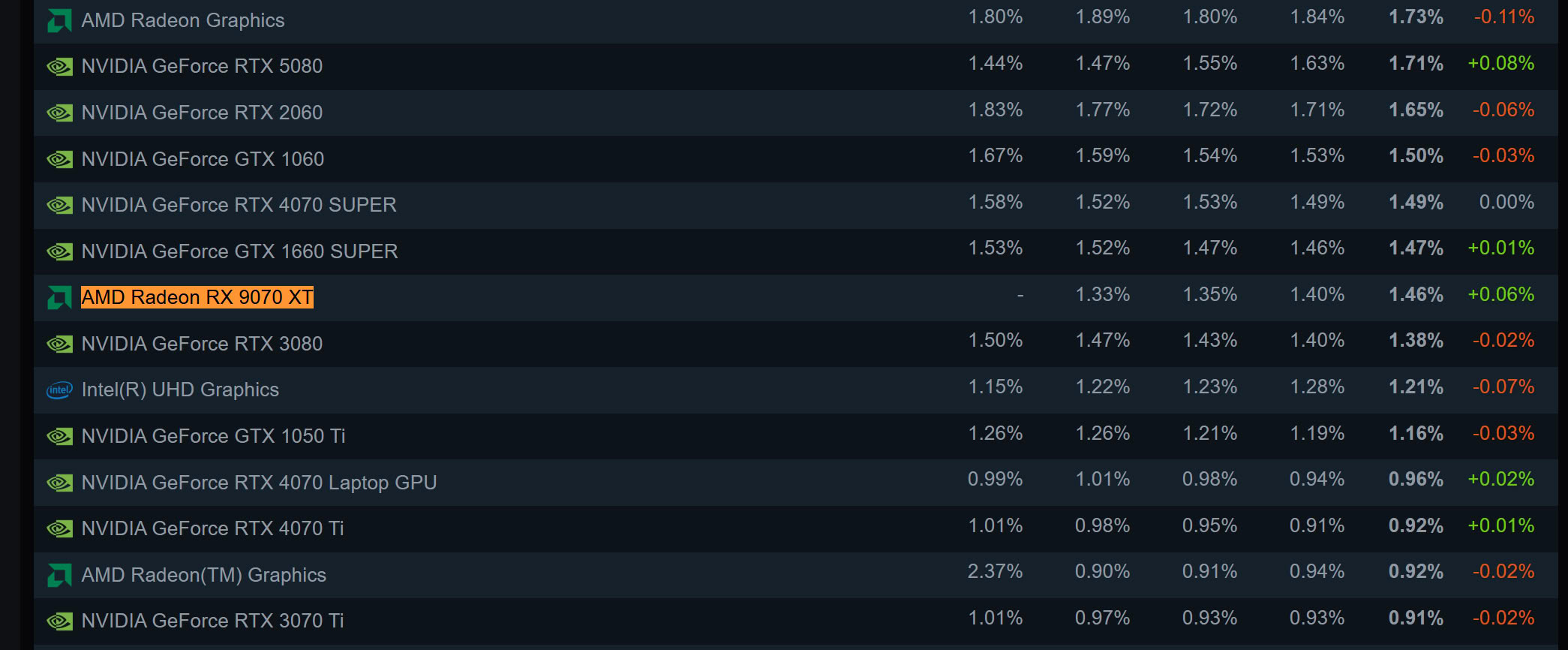
According to the latest Steam Hardware and Software Survey update, in August, AMD's Radeon RX 9070 XT, the flagship of the RDNA 4 family, became the company's most popular discrete graphics card. With a share of 1.46% among surveyed Steam gamers, the Radeon RX 9070 XT ranks 24th in the graphics card popularity and market share list. From an immeasurable market share in April, Steam is seeing growth to about 1.33% in May, 1.35% in June, 1.40% in July, and finally reaching 1.46% in August. Currently, this places AMD's top RDNA 4 card just above NVIDIA's GeForce RTX 3080 and below the GeForce GTX 1660 SUPER.

In comparison, NVIDIA's current GeForce RTX 50-Series "Blackwell" generation shows a strong presence, with the GeForce RTX 5070 ranking third on the list with a 3.77% share, the GeForce RTX 5060 at 3.16%, and the RTX 5060 Ti at 2.55% among gamers. NVIDIA's discrete GPUs appear to have significantly higher market penetration with the current "Blackwell" family, as even the high-end GeForce RTX 5080 holds a 1.71% share. It's worth noting that AMD still commands a large percentage of integrated graphics solutions, but when focusing on discrete GPUs, the second-best RDNA 4 share is the Radeon RX 9060 XT with a 0.80% share.

Modders Get DLSS 5 Working on AMD Graphics Cards, Though Performance is Rough

A modder has ported DLSS 5 Neural Rendering onto an AMD GPU for the first time, less than a week after the tech started spreading to older NVIDIA cards. Developer danielblnc released a tool called DLSS-NR for AMD, which allows AMD's RDNA 4 GPUs to run NVIDIA's neural rendering model in supported games. The setup works by dropping a small installer and NVIDIA's own nvngx_dlssnr.dll file into a game's bin folder, then toggling neural rendering through an FSR 3 or FSR 4 profile. It has been tested on Cyberpunk 2077 and GTA V: Enhanced so far, with older AMD GPUs reportedly not supported. Anti-cheat games will block the DLL entirely, so this is single-player territory only for now.

According to tests by YouTuber Ancient Gameplays, performance is still the bottleneck. Early builds tanked Cyberpunk 2077 from over 80 FPS down to around 11-12 FPS at 1080p on the Radeon RX 9070 XT. The modder's latest Alpha v0.2.7 update has clawed back roughly 12%, pushing it to about 30 FPS, still a steep cost for a card that handles native rendering well. The reason this works at all is quite straightforward. DLSS 5 runs on FP8 math, and AMD's RDNA 4 architecture, which powers the RX 9000 series, has native FP8 support, just like NVIDIA's RTX 50-series and 40-series cards.

AMD's RDNA 5 Reportedly Targets Clock Speeds of Up to 3.5 GHz

According to a well-known leaker, Kepler_L2, AMD is reportedly targeting clock speeds ranging from 3.1 GHz to 3.5 GHz for RDNA 5. The leaker claims to have gained access to AMD's internal materials. This suggests that AMD's new silicon will not only feature significant microarchitectural changes but also offer a raw frequency boost of approximately 4-14% over the factory-rated Radeon RX 9070 XT GPU. The current out-of-the-box boost frequency for this top RDNA 4 GPU SKU is 2.97 GHz, indicating that AMD is planning a substantial increase in clock speeds.

However, it is unclear whether these clock speeds are intended for integrated graphics, dedicated graphics, desktop, or mobile platforms, leaving some questions unanswered. Additionally, RDNA 5 does not appear to be launching soon, with a supposed release date likely in mid-to-late 2027. As of now, we are less than a year away from the launch, it seems. As the launch date approaches, more details will emerge, allowing us to form a clearer picture of what to expect.

Gigabyte Partners with AMD to Bring Onimusha: Way of the Sword Game Bundle to Gamers

Gigabyte, the world's leading computer brand, announced the Onimusha: Way of the Sword Game Bundle for eligible graphics cards and gaming desktops powered by the latest AMD technologies. Featuring select products equipped with AMD Radeon RX 9070 XT, RX 9070, or RX 9070 GRE graphics, the bundle brings together the AMD RDNA 4 architecture, advanced ray tracing, and AMD HYPR-RX technologies with Gigabyte's WINDFORCE cooling system and patented Hawk fan to deliver high-performance gaming for the highly anticipated action title.

The Gigabyte Radeon RX 9070 XT, RX 9070, and RX 9070 GRE series graphics cards harness the AMD RDNA 4 architecture to deliver enhanced gaming performance and advanced ray tracing for immersive visuals. AMD HYPR-RX further combines performance-enhancing technologies to deliver smoother, more responsive gameplay. Complementing GPU performance, Gigabyte's WINDFORCE cooling system incorporates the Hawk fan to increase air pressure by up to 53.6% and air volume by up to 12.5%, supporting stable performance during demanding gaming sessions.

Acer Nitro 30 PC Launches With Radeon RX 9070 XT and Ryzen 7 8700F for $3,700

Acer has officially launched the Nitro 30 PC in Japan, a 28 L gaming PC powered by the AMD Ryzen 7 8700F and the AMD Radeon RX 9070 XT, as the latest in its line-up of Nitro pre-built gaming desktops. The chassis features a semi-closed front panel with an edgy Nitro logo emblazoned on the front, and it has a tempered glass side panel to show off the internals. For now, it seems as though the Nitro 30 is exclusive to Japan, but a global launch may be planned for a later date, given the presence of the Nitro 85 and Nitro 60 in international markets.

The internals feature the aforementioned AMD Ryzen CPU, 32 GB of DDR5-5600 RAM in dual channel, a 1 TB PCIe Gen 4 NVMe SSD, and a built-in wireless card with Wi-Fi 7 and Bluetooth 5.4 connectivity. The compact desktop chassis comes with an 850 W 80 Plus Gold PSU and two pre-installed 120 mm RGB case fans and another 120 mm RGB fan on the top-flow CPU cooler. The front intake has space for another 120 mm fan, but it does not look like there is additional space for more intake or exhaust fans.

Stormcraft PC Launches Valkyrie Series Gaming Desktops

Stormcraft PC, a California gaming PC brand founded by gamers and engineers, today announced the launch and multi-channel availability of new Valkyrie Series gaming desktops through Amazon, Best Buy, Newegg and the official Stormcraft PC webstore. The expanded lineup features NVIDIA GeForce RTX 50 Series and AMD Radeon RX 9070 XT graphics, paired with AMD Ryzen 7 X3D and Intel Core Ultra 7 processors.

The four featured configurations span AMD Ryzen 7 7800X3D and Ryzen 7 9800X3D processors, the Intel Core Ultra 7 processor 270K Plus, AMD Radeon RX 9070 XT graphics, and NVIDIA GeForce RTX 5070 and RTX 5080 graphics. Each featured system includes DDR5 6000 MHz RGB memory, PCIe Gen 4 NVMe storage, a 360 mm liquid CPU cooler, an 850-watt 80 Plus Gold power supply and seven ARGB chassis fans.

Windows 11 vs Linux Gaming Test Reveals There's More to It Than FPS

It seems as though the launch of Valve's Steam Deck has resulted in an almost non-stop slew of comparisons between Linux and Windows as a gaming operating system. In one recent test, Meta PCs sought out to test the two operating systems head-to-head to get some hard numbers and potentially settle the debate, however, the results brought up an interesting debate about what makes one operating system better than another.

Benchmarks were conducted on an all-AMD system running an AMD Ryzen 7 9850X3D, an XFX Swift AMD Radeon RX 9070 XT 16 GB, and 16 GB of RAM, with the AMD Linux drivers effectively making this a best-case scenario for Linux. The benchmarks were run on the latest version of Windows 11 and Fedora Linux 44, games were tested at the same resolution, and results were an average across three runs. All games tested were also the Windows versions running via Valve's Proton compatibility layer.

AMD's FSR 4.1 Performance on RDNA 3 Notably Slower than FSR 3.1

AMD recently released FSR 4.1 for its RDNA 3 GPUs, which demonstrated a handy performance increase over native rendering on RDNA 3, but a recent comparison by German outlet, ComputerBase, has revealed that there are noticeable performance regressions when comparing FSR 4.1 to FSR 3.1 on RDNA 3 GPUs. The publication tested FSR 4.1 and FSR 3.1 on the AMD Radeon RX 7900 XTX, RX 7800 XT, and RX 7600, and FSR 4.1 on the Radeon RX 9070 XT. In geometric mean results of nine tested games, the 9070 XT scores an identical frame rate to the RX 7900 XTX in 4K native resolution, but the RDNA 3 flagship scores 52.6 FPS when using FSR 4.1 Quality settings, compared to 56.5 FPS on the 9070 XT—a 7% performance penalty. Looking at FSR 4.1 Performance, the gap grows, with the 7900 XTX serving 65.2 FPS in the test, while the 9070 XT scores 71.9 FPS, making the 7900 XTX 9% slower than the 9070 XT at FSR 4.1 compute.

The comparison between FSR 4.1 and FSR 3.1 on RDNA 3 is where it becomes even more interesting, with the geometric mean reflecting an 11% performance penalty for FSR 4.1 in Quality mode and a 14.5% regression in Performance mode. AMD previously explained in an interview with TechPowerUp that there were notable differences between the implementation of FSR 4.1 on RDNA 4 and RDNA 3, specifically that the older hardware uses 8-bit integer (INT8) data, while the RDNA 4 implementation uses the built-in FP8 support in the 2nd-generation AI accelerators in RDNA 4 GPUs. Despite this, AMD claims that it aimed for quality parity across different RDNA generations, which may partially explain the bigger performance penalty on RDNA 3 GPUs. FSR 4.1 support has yet to make it to RDNA 2 GPUs, with official support for the RX 6000-series graphics cards planned for early 2027, so we have yet to see what sort of performance penalty will be incurred there, however, AMD also commented that supporting that older hardware is even more complex, since there are no dedicated AI accelerators. This means RX 6000 GPUs will need to rely on Stream Processors to compute FSR 4.1 upscaling.

AMD Threadripper Unlocks Massive 215% HandBrake Performance Boost

AMD has fixed a couple of threading bottlenecks in HandBrake that were holding back transcoding performance on high-core-count systems, and the fixes have been included in HandBrake 1.11.0. AMD found that the issues came down to two things. HandBrake wasn't built to efficiently manage systems with more than 64 logical processors, so on chips like Threadripper, available compute was sitting idle instead of being put to work. Separately, some workloads were chopped into jobs that were too small, creating scheduling overhead that affected the actual transcoding time, particularly noticeable at 720p. AMD found cases where performance actually dropped by up to 60% rather than scaling as more cores were assigned. The fix improves thread management and job scheduling so HandBrake can split work more effectively across high core counts, keeping more cores busy with actual transcoding instead of coordination overhead.

According to an AMD blog post, a Threadripper 7980X (64 cores, 128 threads) CPU with 128 GB of DDR5-5600 paired with a Radeon RX 9070 XT measured gains up to 215% in Perfume H.264 720p, 203% in LG_8K HEVC 8-bit 4320p and 105% in LG 8K 60 FPS HEVC 10-bit 4320p. Across all the tested workloads, improvements ranged from 16% to 215%. In HEVC, a Threadripper PRO 9995WX (96 cores, 192 threads) with the same RX 9070 XT achieved gains of up to 181%, depending on the workload. The biggest gains were up to 181% in Perfume H.264 720p, 151% in Perfume HEVC 10-bit 2160p and 149% in LG_8K HEVC 8-bit 4320p.

Steam Survey: Increased Windows 11 Adoption, AMD GPU Detection Fix Live

Despite having launched in 2021, adoption of Windows 11 has been somewhat slow-going, with Microsoft's latest desktop OS only overtaking Windows 10 nearly four years after launch and only reaching 1 billion users in 2026. If Valve's Steam Hardware and Software survey is anything to go by, it looks as though Windows 11 adoption has continued to grow in recent months. The survey results for May 2026 point to a 2.02% increase in the number of PC gamers on Windows 11, with Windows 10 losing 1.64% and Linux losing 0.53%, despite Valve's ongoing work on SteamOS and the never-ending proclamations of "the year of the Linux desktop."

Overall, however, these changes have barely moved the needle, with Windows gaining 0.38% of Steam's user share, and macOS gaining 0.15%. It's worth noting that English-language users are somewhat overrepresented in this particular Steam Survey, with 2.71% more English users than in the previous survey. These sorts of biases have previously skewed results, as certain groups may have status quo biases that play into their choice of operating system and hardware. The rest of the Steam Hardware and Software Survey results are more or less business as usual, with 16 GB of RAM and 1080p monitor resolution continuing to be the standard, although the latter has lost a negligible amount of market share. The same is true for GPUs, where the NVIDIA GeForce RTX 3060 continues to be the most popular GPU on Steam. It appears as though the fix for Steam's recent faulty detection of Radeon GPUs has been released out of beta, though, as the survey reports that the AMD Radeon RX 9070 XT has gained 1.24%.

Cougar's New Mid-Tower Gaming PC Cases Hide Airflow in Aesthetic Cutouts

Alongside its new AI workstation-oriented NU-series cases, Cougar has also debuted new additions to its line-up of airflow-focused gaming PC cases at Computex 2026. The new CVF220 and Duoair RGB cases feature large cutouts and overhangs that not only serve to generate visual interest, but are also meant to increase airflow and cooling capacity, because they separate the PSU from the main system components and create more room for fresh air intake. The new Cougar CVF220 RGB case is a slightly more compact version of the existing CVF235, and it moves the PSU to the front of the case and has a fan intake cutout between the PSU and the rear of the case. Both CVF cases feature fan intakes on the bottom panel, right above the intake cutouts, in order to bring in fresh air from the outside of the case via that cutout. The older CFV235 has three fan mounts on the top and bottom intake panels, along with a pre-installed Cougar Unity 240 PWM fan kit (dual 120 mm fans in one frame), next to the motherboard. The CVF220, on the other hand, keeps the space in front of the motherboard completely clear, with tempered glass on all three sides of the case until the motherboard tray, instead relying only on two bottom intakes that draw air in via the cutout in front of the PSU compartment and three top fan mounts, where it can mount up to a 360 mm radiator.

The Duoair takes a more conservative approach with the chamber separation, but it makes up for that with two 140 mm intake fans behind a mesh front panel, as opposed to the motherboard-adjacent option. That mesh front panel can also be replaced with a tempered glass front panel for those more concerned with aesthetics. There are still two fan mounts above an empty space behind the PSU compartment in the front portion of the case, where the case fans can still draw in fresh air from the outside of the case to feed the GPU directly. The Duoair supports GPUs up to 410 mm long, while the CVF220 can fit longer 420 mm GPUs. Both the CFV220 and Duoair will also receive their own pre-built PC options. The Duoair A1 will feature up to an Intel Core i7-14700F, 16 GB of G.Skill Ripjaw DDR4-3200 memory, and an NVIDIA GeForce RTX 5060 GPU, with a mix of 2× 140 mm ARGB and 3x 120 mm non-RGB PWM fans handling airflow. Meanwhile the CVF220 will be powered by an AMD Ryzen 7 9800X3D, 32 GB of G.Skill Ripjaw DDR5 memory, and an AMD Radeon RX 9070 XT GPU. The Duoair X1 will launch at $1,499, while the CVF220 X1 will launch at $2,599.

ASRock Showcases Radeon RX 9070 XT Phantom Gaming with 12V-2x6 Power Input

When ASRock debuted its Radeon RX 9070 series graphics cards, the Phantom Gaming brand was conspicuously absent—you had cards from the Taichi, Steel Legend, and Challenger brands, but not Phantom Gaming. It looks like ASRock is close to fixing this. At Computex 2026, the company showcased a build with a "prototype" graphics card that very clearly has Phantom Gaming branding. This card is very different in design to the Radeon RX 7900 XT Phantom Gaming series from the previous generation. For one, it features a 12V-2x6 power input, and not the triple 8-pin setup.

The cooler shroud has a significantly updated design, with elements and motifs from the company's latest Phantom Gaming motherboards based on Intel 800-series and AMD 800-series chipsets. An ARGB LED diffuser runs along the edge of the cooler shroud, while two metal streaks cross the central fan frame. The three fans ventilate a dual aluminium fin-stack heatsink. Cutouts in the backplate push out most of the airflow from the third fan. ASRock's graphics card range also included its recently announced Arc Pro B60 and B70 graphics cards based on the maxed out "Battlemage" silicon. These cards are squarely targeted at creators.

PowerColor Showcases Graphics Cards with Groovy UV-reactive Art

PowerColor in its Computex 2026 booth showcased some new prototype custom AMD Radeon RX 9000 series graphics cards. These are variants of its existing RX 9070 XT Red Devil, RX 9070 XT HellHound, and Reaper series graphics cards, but come with groovy new UV-reactive artwork on their backplates. The first prototype had a UV-reactive branches of a cherry tree in blossom. The next one, titled "She Wears Red," showcases an abstract monstrosity on the Red Devil.

The most striking of these prototypes, titled "Relics that Still Burn," depicts Egyptian hieroglyphs that are physically etched into the backplate, and have UV-reactive paint within the etchings for a phenomenal look under UV light. The next one, titled "The Architecture," is based on the RX 9070 XT HellHound Spectral White, and uses a print of the bare PCB underneath, which comes to life under UV light. Our 2023 PowerColor factory tour shows you how bare PCBs come in, are inspected, and then turned over to a pick-and-place machine. Tell us which one you liked the most in the comments.
Return to Keyword Browsing
Nov 26th, 2026 00:33 CST change timezone

New Forum Posts

Popular Reviews

TPU on YouTube

Controversial News Posts