News Posts matching #inference

Return to Keyword Browsing

Stronger North American Demand to Keep Enterprise SSD Prices on an Upward Trend in 4Q26

U.S. CSPs have recently upgraded their enterprise SSD demand forecasts over the past two weeks, according to TrendForce's research. This shift is mainly driven by major CSPs speeding up deployments and expanding enterprise SSD use across more applications. Notably, this demand increase isn't confined to high-performance TLC products; QLC products, known for their superior cost efficiency and capacity, have become a significant growth catalyst.

Recent procurement momentum suggests that total enterprise SSD orders in the fourth quarter could surpass the already elevated levels seen in 3Q26, maintaining a strong upward trajectory. This has given NAND Flash suppliers greater control over capacity allocation and pricing in the enterprise segment, while further supporting continued increases in enterprise SSD prices.
Axelera Launches Europa AI Processing Unit (AIPU) With Up to 629 TOPS

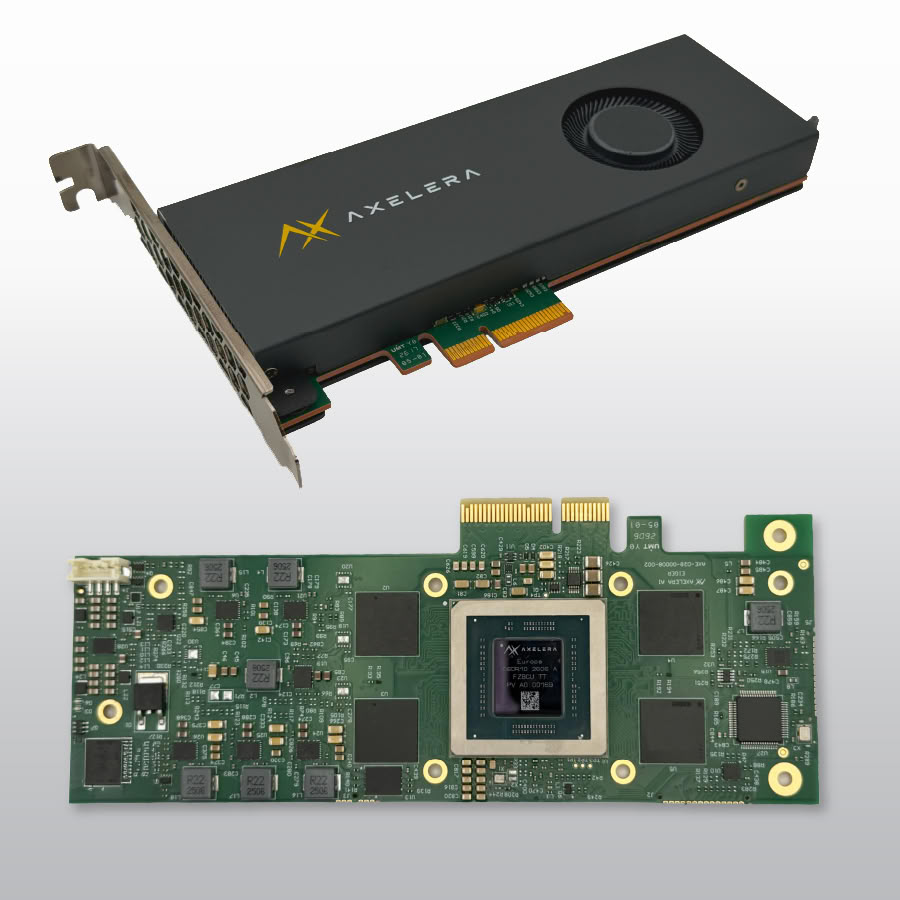
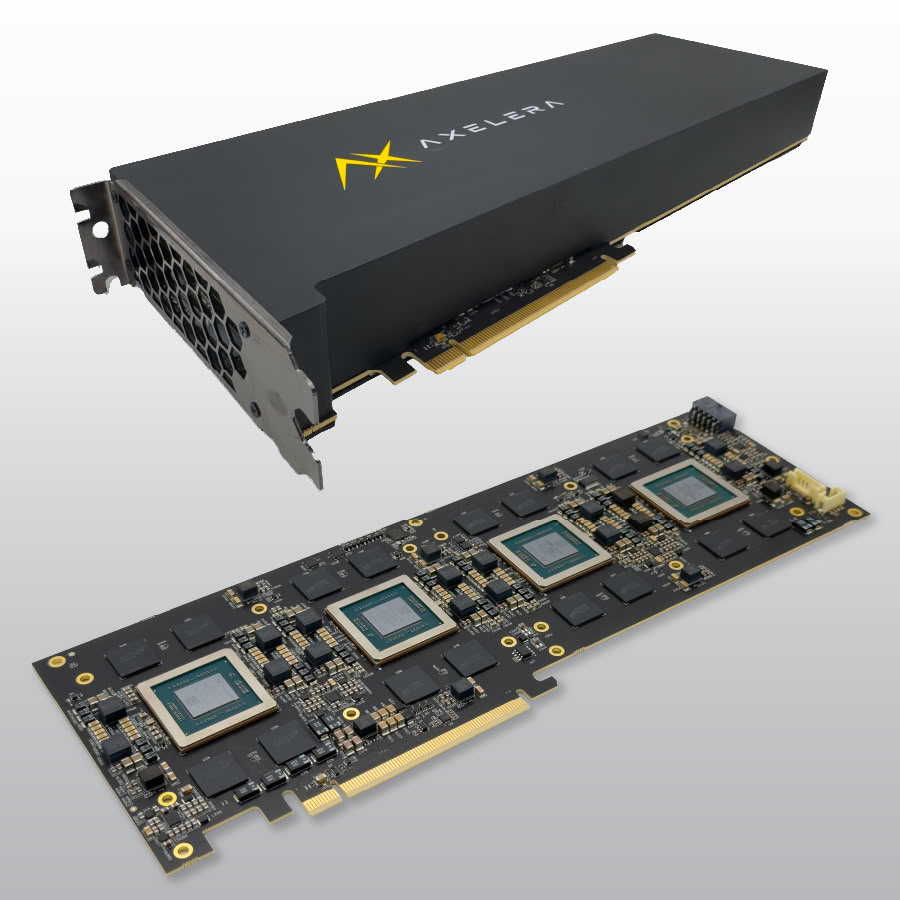
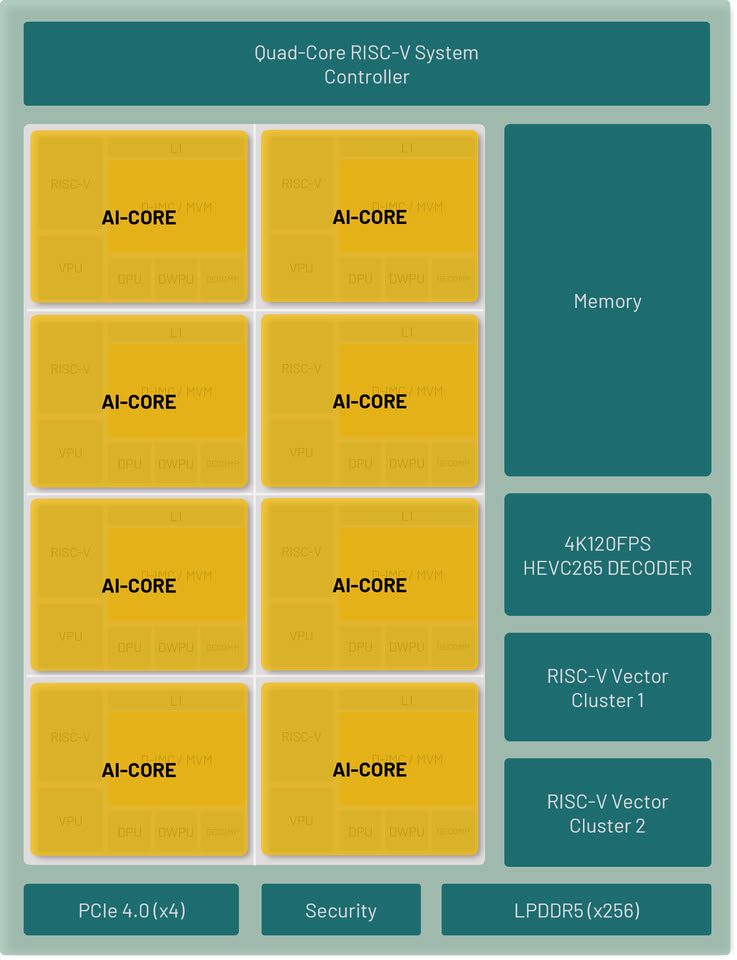
Axelera AI has formally launched Europa, its new AI Processing Unit architecture first announced back in October last year. The chip is now available in three form factors: as a chip for custom board designs, a half-height, half-length PCIe card (Edge 232p), and a full-height full-length PCIe card (Server 250p). The Europa AIPU has eight second-generation AI processing cores, 16 RISC-V vector processing cores, 128 MB of L2 SRAM, 200 GB/s DRAM bandwidth, PCIe 4.0 x4 interface and an onboard video decoder. The chip can reach 629 TOPS at a 45 W TDP, with INT4, INT8, and INT16 precision support. The Europa architecture targets inference workloads including agentic systems, vision-language models, generative AI, and computer vision and is the direct successor of Axelera Metis.

The Edge 232p is a single-chip HHHL card with up to 629 TOPS, reaching 83.4 tokens per second on Qwen 30B. It's available in validated configurations inside a Dell XE5 and a Supermicro 111AD. The Server 250p steps up to four Europa AIPUs for over 2,500 TOPS combined, delivering up to 4,205 tokens per second on Qwen3 8B at up to 32.1 tokens per second per watt. In a press release, Axelera says it has a sales pipeline that exceeds $1.5 billion and more than 600 customers across the globe. The company is now working on its first chiplet, the Titania, targeting rack-mount servers and supercomputers.

Apple Weighs Return to Server Market with NVIDIA Networking Technology

Apple is reportedly considering a return to the server market, where the company was once active with its Xserve rack technology. According to The Information, Apple is developing AI-focused M-series chips, which could incorporate several NVIDIA components, including the NVLink Fusion portfolio of technologies and IP. This includes the possibility of interconnecting two or four Apple M8 Ultra chips using NVIDIA NVLink for socket-to-socket communication, while NVIDIA NVLink-C2C manages die-to-die interconnection. Currently planned for launch in 2029, this product would mark Apple's first entry into the server space since debuting Xserve in 2002 and discontinuing it in 2011. Nearly two decades later, Apple's server offering might be making a comeback, building on the success that the Mac mini and Mac Studio are experiencing among AI developers.

For instance, Apple's Mac lineup achieved a record $10.4 billion in sales last quarter, with strong demand from the AI community. Enterprises are even constructing custom racks, mounting multiple Mac Studios to set up local AI inferencing efforts. For the new server design, Apple would delegate every interconnect question to NVIDIA NVLink Fusion, while it focuses on the actual system-on-chip as before. The new rack design would target enterprises and governments, who may already be running Mac clusters locally.

HP Announces the ZBook Ultra G3a Laptops With AMD Ryzen AI Max+ PRO

HP Inc. today announced the HP ZBook Ultra G3a, a new mobile workstation designed from the ground up to serve as a personal AI factory for professionals. Powered by AMD and enhanced by Perplexity, the HP ZBook Ultra G3a 16" combines workstation-class performance, local AI capabilities, and intelligent workflow experiences for demanding professional environments.

As organizations move from AI experimentation to production, professionals still face fragmented tools, disconnected applications, and complex setup requirements. HP is addressing that gap by bringing together AMD-powered local performance, Perplexity Computer to complete end-to-end work, and Autodesk application support in one mobile workstation built for professional use.

Huawei Prepares 160,000 Ascend 950DT Accelerators for DeepSeek Data Center

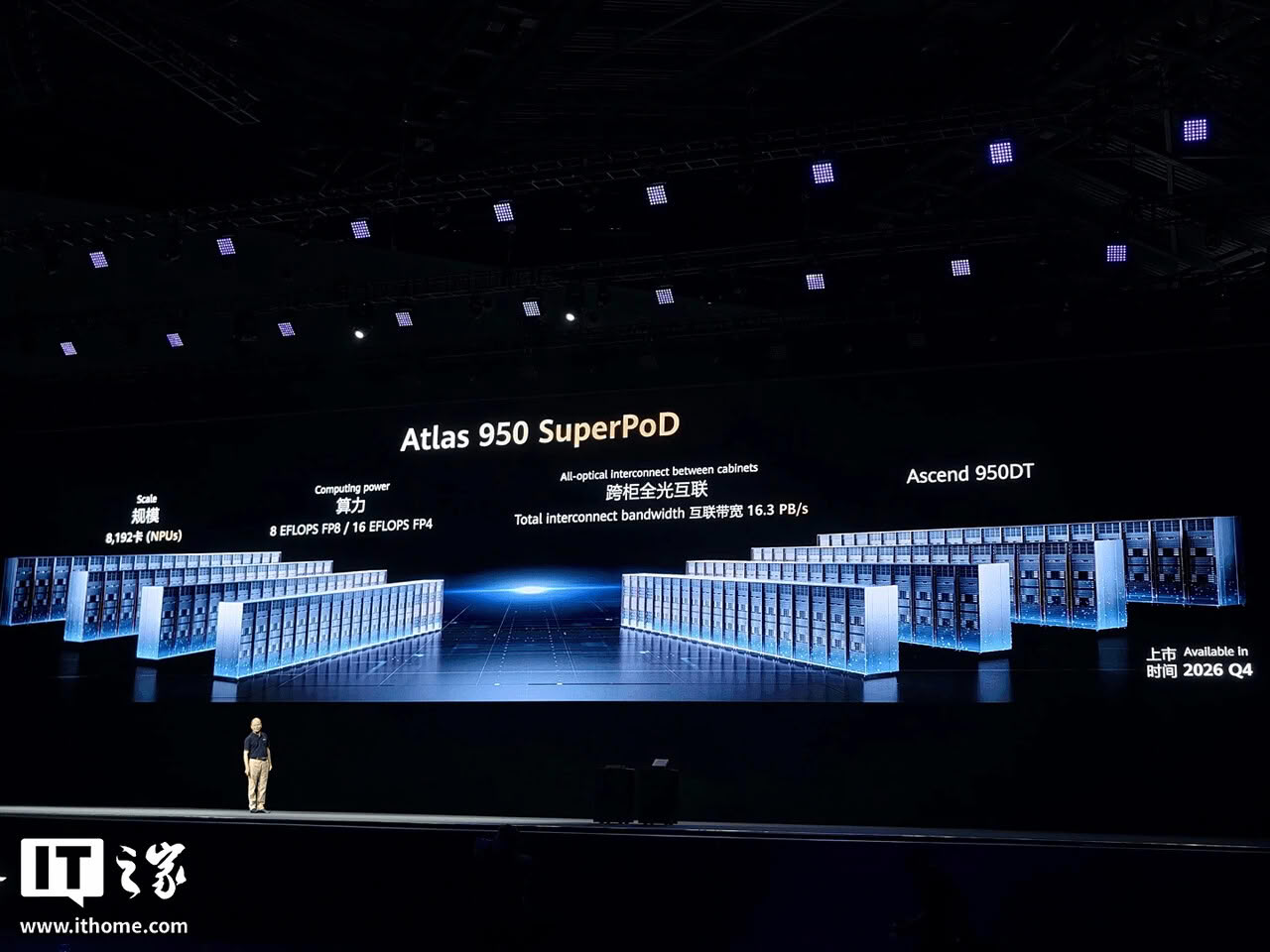
Chinese AI labs are increasingly ordering domestic AI accelerators, and one of the leading AI labs, DeepSeek, has reportedly placed an order for 160,000 Huawei Ascend 950DT chips. Late last year, Huawei revealed that the company is preparing a series of chips and rack-scale solutions to meet domestic AI demand, and now we are seeing large orders starting to materialize. For reference, the Huawei Ascend 950DT AI accelerator has a memory capacity of 144 GB, built on Huawei's own HBM memory design. This in-house solution delivers a bandwidth of nearly 4 TB/s, aligning perfectly with Huawei's vision. The chip can achieve about one PetaFLOP of FP8 peak compute, or about two PetaFLOPS of FP4.

DeepSeek, one of the leading Chinese AI labs, will use Huawei's Ascend 950DT chips for large-scale inference operations and will deploy them in a single data center located in Inner Mongolia. The overall system will deliver a peak of 160 ExaFLOPS at FP8 or about 320 ExaFLOPS at FP4 precision. The system will also have about 23 PB of total HBM memory, meaning that the large-scale inferencing operations will be able to serve thousands of customers concurrently without any issues.

GEEKOM's A9 Mega Mini PCs Form Local Inference Cluster at IFA 2026

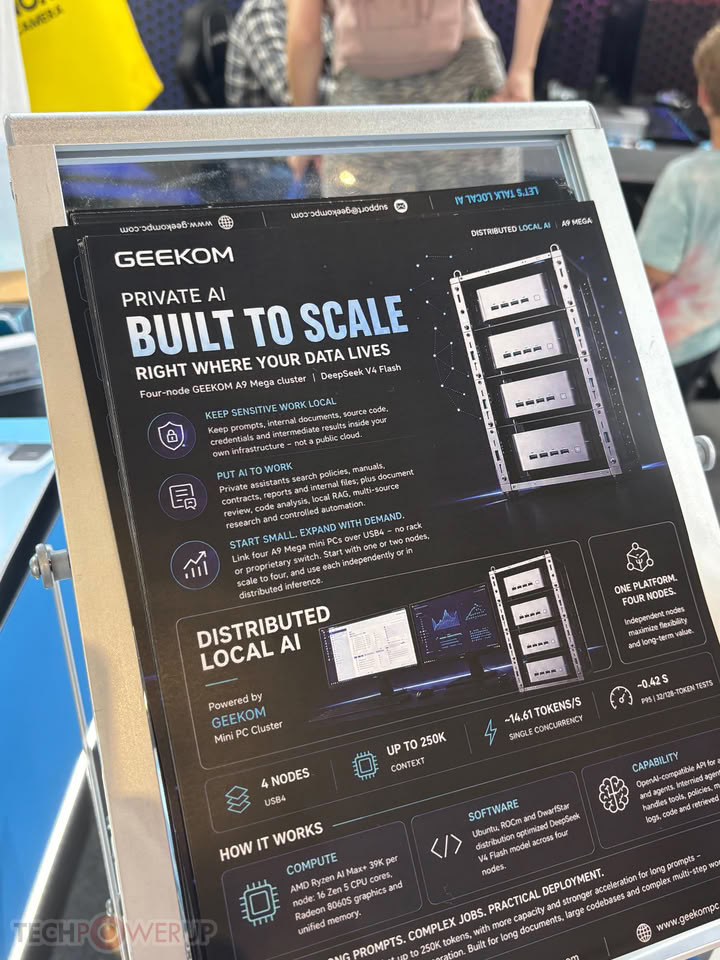
At IFA 2026, GEEKOM revealed that the company has successfully interconnected multiple miniature PCs into a single local supercomputer capable of running inference with ease. At the company booth, GEEKOM demonstrated how it linked four of its A9 Mega mini PCs into a local inference cluster. The GEEKOM Private AI setup uses USB4 to connect these four mini PCs directly, eliminating the need for a dedicated rack or proprietary networking hardware. The result is essentially a miniature supercomputer that can sit on a desk, keeping AI workloads and data entirely local.

Each node is based on AMD's Ryzen AI Max+ 395, featuring 16 "Zen 5" CPU cores with integrated Radeon 8060S graphics and up to 128 GB of unified LPDDR5X memory running at 8,000 MT/s. Storage is provided by two PCIe 4.0 x4 M.2 slots, supporting drives up to 4 TB. The compact 171 x 171.1 x 70.1 mm system also includes dual 2.5 GbE, Wi-Fi 7, Bluetooth 5.4, USB4, and HDMI 2.1 connectivity. The processor has a 140 W TDP and an NPU rated at up to 50 TOPS, which means the total mini rack system will draw less than 1,000 W at peak load, making this setup extremely power efficient.

NVIDIA Introduces Jetson Orin Nano 2 Robotics Computer

NVIDIA today announced NVIDIA Jetson Orin Nano 2, a new robotics computer set to redefine entry-level edge AI—putting frontier-class generative AI performance in the hands of millions of developers.

As AI models grow smaller and more efficient, more edge devices can become autonomous systems that understand context, interpret language and images, and act in real time. To bring these capabilities into physical machines like robots, delivery and inspection drones, and vision AI systems, developers need compact, energy-efficient robotics computers built for edge AI.

IBM Unveils Next Generation Dual-Architecture Processor for IBM Z and LinuxONE

At the annual Hot Chips conference, IBM (NYSE: IBM) today is announcing the first dual-architecture mainframe processor, which is being designed to enable enterprises to run operating systems and applications on both the IBM and Arm compute platforms in future IBM Z and LinuxONE systems. This marks the first processor milestone to emerge from the IBM and Arm collaboration established in April 2026, and represents a significant advance in enterprise computing. The new processor is being developed to allow organizations to run Arm-native Linux environments simultaneously with z/OS and Linux on IBM Z, while benefiting from IBM's established security, reliability, and scale.

With more than 22 million developers worldwide, the Arm software ecosystem supports a broad and growing range of applications from cloud to edge, including the cloud-native and AI software increasingly shaping modern infrastructure. This new processor will bring that ecosystem to the IBM platforms known globally for transaction processing and data-intensive operations. Arm workloads will benefit from IBM's enterprise-grade capabilities, including enhanced reliability, hardware-level fault detection and recovery, advanced encryption, secure key management, and AI acceleration.

NVIDIA's Six-Years-Old A100 "Ampere" GPU to Remain in Use Until 2029

With the expansion of AI, every bit of available computing power is being utilized, and even NVIDIA's six-year-old A100 "Ampere" accelerator is being fully utilized at CoreWeave. According to CoreWeave, and confirmed by NVIDIA's CEO Jensen Huang, the company has signed an agreement with a customer to rent chips released more than half a decade ago for several more years, specifically through 2029. This demonstrates that NVIDIA's platforms remain in high demand, with chips released in 2020 expected to have a usable lifespan extending nearly to the end of the decade. CoreWeave customers have rented these chips through 2029 for AI training and inference. In late 2020, NVIDIA introduced a GA100 GPU SKU for the A100, featuring 6,912 CUDA cores and up to 80 GB of HBM2E memory. By today's standards, the core count may not match modern solutions, but in an era where memory shortages affect everyone, even older HBM2E is acceptable when there is 80 GB of it per card.

Despite the later-introduced "Hopper," "Blackwell," and modern "Rubin" generations offering significant, multifold improvements in efficiency, performance, and memory capacity, every available computing resource is currently being utilized. CoreWeave confirmed that a customer is renting this six-year-old GPU through 2029, indicating that it still holds value for someone. This GPU likely costs much less to access per hour than modern solutions, but it probably performs well enough that customers are still willing to pay for it. On his social media feed, NVIDIA CEO Jensen Huang posted the following message.

MSI Extends XpertStation WS300 and EdgeXpert Platforms with Support for NVIDIA Nemotron 3.5 Lightning and NeMo Switchyard

MSI today announced that its XpertStation WS300 and EdgeXpert platforms now support NVIDIA Nemotron 3.5 Lightning, a lightweight open model purpose-built for agentic AI and NeMo Switchyard, an open-source model routing library. Switchyard supports systems of models by routing each workflow step to the best-suited model, such as frontier-scale models for complex reasoning, lightweight models like Nemotron 3.5 Lightning for high-volume specialized tasks, improving accuracy, latency, and cost. With this support, XpertStation WS300, based on the NVIDIA DGX Station platform, serves as a deskside AI supercomputer for local AI development, fine-tuning, and multimodel agent workflows, while EdgeXpert, powered by NVIDIA DGX Spark, applies the same routing intelligence in a compact system for always-on AI agents.

"No single system fits every stage of an AI agent's lifecycle," said Sam Chern, MSI Vice President of Marketing. "By supporting NVIDIA's latest routing and model technologies across both XpertStation WS300 and EdgeXpert, we're giving customers a complete path, from model training and fine-tuning to continuous agent deployment, without switching vendors or ecosystems."

XCENA Unveils MX1 Production Lineup to Accelerate Push Into Hyperscale AI Infrastructure

XCENA, providing memory-centric computing solutions for AI infrastructure, today introduced MX1, its production memory lineup built to break through the capacity, utilization and data-movement now limiting AI inference at scale. The company is showcasing MX1 at FMS 2026: The Future of Memory and Storage, being held Aug. 4-6 at the Santa Clara Convention Center.

As generative AI drives larger models, longer context windows and rapidly growing KV cache footprints, memory is emerging as the defining constraint on AI infrastructure. High-bandwidth memory remains costly and capacity-limited, and scaling out with additional servers creates stranded DRAM and rising total cost of ownership. XCENA developed the CXL-based MX1 lineup to give operators a different path - scaling memory as efficiently as they scale compute. Together with Intel Xeon 6 platforms, MX1 solutions showcase how CXL-based memory can help address memory-intensive AI workloads.

MSI Launches the PRO MAX EDGE AI+, Ushering in a New Era of On-Device AI Computing

MSI today announced the launch of the PRO MAX EDGE AI+, a next-generation AI desktop purpose-built for on-device AI computing. Designed to accelerate AI innovation, the PRO MAX EDGE AI+ delivers exceptional AI performance while keeping sensitive data local for enhanced privacy and security. Built to handle demanding AI inference workloads, it combines high-performance computing with enterprise-grade privacy and security, empowering users to unlock the full potential of local AI.

The Heart of Edge AI: Powered by the AMD Ryzen AI Max+ Platform
The PRO MAX EDGE AI+ is powered by the AMD Ryzen AI Max+ 300 Series Processors, with configurations available up to the AMD Ryzen AI Max+ 395. Delivering up to 126 TOPS of total AI performance, the platform integrates up to 96 GB of Variable Graphics Memory, integrated AMD RDNA 3.5 graphics with up to 40 Compute Units, and an AMD XDNA 2 NPU capable of delivering up to 50 TOPS of dedicated AI performance.

AMD and Anthropic Announce Strategic Partnership to Deploy 2 GW of Instinct MI450 Chips

AMD and Anthropic today announced a strategic partnership to deploy up to 2 gigawatts of AMD Instinct MI450 Series GPUs in AMD Helios rackscale solutions, with deployment of the first gigawatt beginning in the first half of 2027. The extraordinary pace of AI adoption is driving rapid growth in demand for training and inference capacity. Anthropic is scaling its compute infrastructure to serve strong and growing demand for Claude, and its adoption of AMD Helios at gigawatt scale represents a major expansion of AMD's position at the center of the global AI infrastructure buildout.

Anthropic will deploy AMD Helios rackscale solutions featuring AMD Instinct MI455X GPUs, part of the AMD Instinct MI450 Series, together with AMD EPYC "Venice" CPUs, AMD Pensando networking and AMD ROCm software. Purpose-built for next-generation AI training and inference, Helios delivers the performance, efficiency and scale required for the most demanding AI workloads. This deployment builds on Anthropic's existing use of AMD Instinct MI355X GPUs.

ASRock Industrial Integrates Axelera Metis AIPU Cards Into Its Edge AI Platforms

ASRock Industrial today announced a strategic collaboration with Axelera AI to deliver high-performance, power-efficient, and cost-effective AI inference solutions for edge computing. The collaboration integrates Axelera Metis AIPU cards into ASRock Industrial's edge AI platforms, delivering a compact, scalable AI inference solution optimized for real-world edge environments. The solution enables parallel AI processing by extending the system's native AI computing capabilities with up to 214 TOPS of additional inference through the Metis M.2 or PCIe AI acceleration cards. Powered by Metis AIPU, it delivers superior performance while significantly lowering power consumption and total cost of ownership (TCO) compared with conventional GPU-based architectures. Designed for edge AI applications including LLM, machine vision inspection, robotics, smart retail and city environments, the solution enables organizations to deploy advanced AI workloads where data is generated while minimizing the system footprint, power requirements, and infrastructure costs.

Validated Edge AI Platforms Accelerate Deployment
These validated configurations provide customers with a scalable path to deploying advanced AI capabilities on compact edge systems. On ASRock Industrial's expandable Edge AIoT platforms, including the iEPF-11000S, iEPF-10000S, iEPF-9500S, iEPF-9040S, and iEPF-9040VS series, the Axelera Metis PCIe card enables scalable, industrial-grade AI processing for demanding edge applications. For compact edge systems such as the AI BOX-A395, NUC BOX-358H, NUC BOX-255H, and NUC BOX-155H, the Axelera Metis M.2 card delivers high-performance AI inference in a compact, power-efficient form factor. Supporting multiple AI workloads running in parallel, these solutions enable real-time analysis for machine vision, robotics, retail and hospitality, warehouse automation, smart surveillance, and intelligent transportation.

Bosgame Demonstrates Scalable Private AI with 7-Node AI MAX+ 395 Cluster

Bosgame, a technology-based electronic product brand, has demonstrated distributed inference of the DeepSeek-V3.1 671B-parameter model on its AI MAX+ 395 7-Node Cluster. Built from seven Bosgame M5 AI Mini PCs connected through USB4 Direct Connection, the system presents a scalable approach to private AI deployment and local large language model (LLM) inference.

As AI models continue to expand in parameter size and complexity, a single AI PC may lack the memory and computing resources required for advanced workloads. While traditional AI servers can provide the necessary computing power, their high deployment costs and infrastructure complexity can limit adoption. Enterprises and developers are therefore exploring scale-out architectures that support larger models while providing greater flexibility than conventional AI server deployments.

Qualcomm Unveils Data Center Roadmap with New Dragonfly Portfolio

Qualcomm Technologies, Inc. (NASDAQ: QCOM) today announced at its Investor Day, new data center solutions, including the Qualcomm Dragonfly C1000 CPU, Qualcomm High Bandwidth Compute (HBC), Qualcomm Dragonfly AI300 inference accelerator, and connectivity products, together with custom silicon solutions, all engineered to maximize performance per watt and token throughput at lower total cost of ownership. The new platforms highlight Qualcomm Technologies' growing role in building full-stack data center infrastructure optimized for AI, spanning agentic and data-center-class CPUs, AI inference accelerators, high-performance connectivity, and at scale custom silicon solutions. The Qualcomm Dragonfly AI300 joins the previously announced Qualcomm Dragonfly AI200 and AI250 in its data center solutions portfolio with an annual cadence AI accelerator roadmap.

"Agentic AI is driving a significant increase in demand for AI inference in the data center. As these become the dominant workloads, infrastructure has to deliver much higher performance at lower power and cost," said Cristiano Amon, President and CEO, Qualcomm Incorporated. "That plays directly to Qualcomm's strengths, and we're well positioned for this shift. With Qualcomm Dragonfly, we're bringing our high-performance, low-power computing into the data center, with multi-year, multi-generation agreements with leading customers."

Micron and Anthropic Announce Strategic Agreement to Scale Next-Generation AI Infrastructure

Micron Technology, Inc. (Nasdaq: MU) today announced a strategic agreement with Anthropic that spans memory and storage AI architecture design, supply and demand, enterprise adoption of Claude across Micron and a strategic investment in Anthropic's Series H funding round. The agreement directly links the demands of frontier AI models to how infrastructure is designed, supplied, and deployed at scale.
"The AI revolution has permanently elevated the role of memory and storage solutions from the data center to the edge," said Sumit Sadana, executive vice president and chief business officer, Micron. "Micron's strategic collaboration with Anthropic brings together the industry-leading capabilities of both companies to innovate and scale next-generation AI infrastructure."

Gigabyte AORUS GeForce RTX 50 Series AI BOX Brings Desktop-Class Computing Power to Laptops

Gigabyte, the world's leading computer brand, showcased the AORUS GeForce RTX 50 Series AI BOX powered by NVIDIA Blackwell architecture, delivering desktop-class performance for ultrabook laptops at COMPUTEX 2026. Designed to bring game-changing capabilities, the lineup includes the flagship AORUS GeForce RTX 5090 AI BOX and the compact AORUS GeForce RTX 5060 Ti AI BOX, catering to gamers, creators, and AI explorers. Complementing the hardware, the AI BOX GPU Selector software further enhances flexibility by simplifying workload distribution for optimized performance.

The flagship AORUS GeForce RTX 5090 AI BOX delivers over 3,000 AI TOPS of FP4 computing power with 32 GB VRAM, supporting large language models, generative AI, inference, and demanding creative workloads. Meanwhile, the compact AORUS GeForce RTX 5060 Ti AI BOX offers an accessible solution for ultrabooks with a lightweight design. It enables 1080p to 2K gaming, smooth local image generation, 3D rendering, and everyday AI tasks with 16 GB VRAM.

Longsys Launches AIDIMM & AILPBGA at Computex 2026

From June 2 to 5, COMPUTEX 2026 in Taipei runs under the theme "AI Together." Longsys showcases its full-stack edge AI storage portfolio under "Edge AI Storage - Integrated Implementation," together with its high-end consumer storage brand Lexar, to optimize local LLM performance and accelerate AI ecosystem collaboration.

Global Launch: AIDIMM & AILPBGA for Edge AI Inference
AIDIMM delivers up to 128 GB capacity, 256-bit bus, and 307.2 GB/s bandwidth in a compact form factor. It resolves memory, thermal, and upgrade pain points of AI agent hosts—a single module reliably and stably runs edge LLMs with over 70 billion parameters. Dynamic voltage scaling (0.9 V-1.05 V) and FDVFS power tuning enable high-performance, low-power mass deployment.

Agentic AI Drives Structural Expansion in Memory Demand, Global Memory Market Projected to Reach US$1.28 Trillion by 2027

The shift in AI development from large-scale model training toward inference-centric Agentic AI applications is driving a structural expansion in memory demand, according to TrendForce's latest findings on the memory industry. With the resulting supply deficit unlikely to be resolved in the short term, prices are set to rise further.

TrendForce has therefore significantly raised its global memory market forecasts, increasing its 2026 estimate from US$551.6 billion in the previous report to $889.3 billion. Meanwhile, the 2027 forecast has been revised upward from $842.7 billion to more than $1.28 trillion, representing annual growth of approximately 44%.

Dell Technologies Introduces Dell Deskside Agentic AI Series

Dell Technologies (NYSE: DELL) introduces Dell Deskside Agentic AI, a new addition to the Dell AI Factory with NVIDIA that gives workgroups the ability to deploy and scale agentic AI workflows locally without the cost, latency and data sovereignty constraints of cloud-only approaches. With the NVIDIA OpenShell runtime now supported across the entire Dell AI Factory with NVIDIA, enterprises benefit from a single security and policy enforcement layer from deskside workstations to Dell PowerEdge XE servers.

Why it matters
As AI workflows shift toward agentic architectures, token usage compounds at an accelerating rate, driving cloud costs that can quickly become unsustainable despite falling token prices. Cloud-only strategies fall short on what matters at scale: economics, security and data sovereignty. Organizations running agentic AI need infrastructure that addresses all three and scales with workloads without requiring a rebuild every time they mature.

SiFive Launches RISC-V Performance P550 and P570 Gen 3 IP

SiFive, Inc., the gold standard for RISC-V computing, today announced the launch of the SiFive Performance P570 Gen 3, the most powerful and efficient out-of-order processor core in its class. Purpose-built for demanding edge AI, high-end consumer, and commercial IoT applications, the P570 Gen 3 delivers a large leap in performance compared to the popular P550 Gen 1, and also provides the most modern RVA23 ISA profile support.

This versatile IP can be used as the control processor in embedded IoT devices, running a full networking stack, or can be used as the main applications processor in consumer devices, running rich OSs, such as Android or enterprise-grade Linux. The high-performance vector unit supports running AI models and inference on edge devices.

SK Group Chairman Warns That Customers Will Use Less Memory Unless DRAM Supply Grows

Memory makers like Samsung, SK hynix, and Micron are currently striving to find the delicate balance between supplying the world with enough DRAM and expanding their production capacity by placing large new orders for the semiconductor fabs used to produce the memory. According to SK Group chairman Chey Tae-won, who also oversees SK hynix, if companies like SK hynix do not increase their memory supply, customers will find ways to use less memory by optimizing their infrastructure and software for much lower utilization. At present, hyperscalers and AI accelerator makers such as AMD, NVIDIA, and others are securing as much memory as possible. This is part of AI data center expansion, which requires more GPU and CPU DRAM to support large training runs and maintain massive model inference, now reaching tens of trillions of parameters and needing hundreds of gigabytes of system memory to host a single model for just a few users.

This demand has created a supply chain issue where memory makers are selling all of their available DRAM months in advance but are hesitant to significantly expand manufacturing capacity, despite recognizing the increase in demand years ago. Memory makers are the first to notice rising demand, and their reluctance to increase manufacturing capacity is contributing to the current memory shortage. However, they are also wary of expanding production capacity as it takes years to build new memory fabs, just as projected demand is expected to stabilize. SK hynix has ordered about 20 Low-NA EUV machines from ASML for their expansion plans, which will also support future storage production once the tools are operational. However, all of this added capacity is still years away, and we will remain in a tight situation for a little while longer.

AMD Launches Instinct MI350P PCIe GPUs

As organizations adopt AI, many discover that their infrastructure struggles to keep up. Running AI in the cloud is an option, but the cloud can introduce privacy concerns and unpredictable costs. Upgrading on-prem infrastructure is another option, but supporting large GPU-accelerator platforms can require expensive redesigns in data center power and cooling. Our new AMD Instinct MI350 PCIe cards give your enterprise a third option: Leadership AI performance designed to fit the data center infrastructure you already own.

Performance That Drops into Your Existing Racks
Designed to help you prepare for the agentic AI era, AMD Instinct MI350P PCIe cards are dual-slot drop-in cards for standard air-cooled servers. They are built to deploy inference on premises within your current data center's power, cooling and rack infrastructure. AMD Instinct GPUs in cost-effective PCIe cards round out the AMD AI compute portfolio, providing a range of options for your enterprise as it navigates its unique AI adoption curve.

AMD to Expand EPYC Lineup With Specialized CPUs for AI, HPC, and Cloud

AMD's CPU offerings will soon expand into more categories, specializing in different tasks and use cases. During the latest Q1 earnings call, AMD CEO Dr. Lisa Su confirmed that customers are increasingly interested in specialized EPYC solutions and that future CPU generations will cater to different customer needs. This means that agentic AI will receive a dedicated EPYC CPU SKU, HPC workloads will have their own EPYC CPU SKU, AI training and inference will get a separate EPYC SKU, and cloud workloads will have a distinct SKU. This expansion of task-specialized CPU designs will go beyond the "Venice" CPU platform, which is expected to be released this year. At CES 2026, AMD confirmed that EPYC "Venice" will be a highly dense CPU package with up to 256 cores and 512 threads of "Zen 6c" cores, while the regular "Zen 6" configuration will have a maximum of 96 cores and 192 threads.

With this generation of EPYC CPUs based on the "Zen 6" core IP, AMD will promote "Venice" CPUs broadly, while the "Venice" CPU generation will be complemented by the "Verano" CPUs. These appear to use the same "Zen 6" microarchitecture but have optimizations specifically designed for AI infrastructure. Contrary to previous assumptions that "Verano" would be a "Zen 7" IP, it is now confirmed to be part of the 6th-generation EPYC CPU family. This indicates that AMD is starting its CPU customization for different workloads as early as this year. As the server CPU market is projected to reach $120 billion by the end of this decade, less than 3.5 years away in 2030, it makes sense to have different CPU SKUs for each task and capture a significant portion of that revenue. Server CPUs are also expected to grow at a 35% compound annual growth rate, which is impressive for a relatively mature market.
Return to Keyword Browsing
Nov 28th, 2026 07:23 CST change timezone

New Forum Posts

Popular Reviews

TPU on YouTube

Controversial News Posts