Friday, September 9th 2016

AMD GPUs See Lesser Performance Drop on "Deus Ex: Mankind Divided" DirectX 12
Deus Ex: Mankind Divided is the latest AAA title to support DirectX 12, with its developer Eidos deploying a DirectX 12 renderer weeks after its release, through a patch. Guru3D put the DirectX 12 version of the game through five GPU architectures, AMD "Polaris," GCN 1.1, GCN 1.2, NVIDIA "Pascal," and NVIDIA "Maxwell," through Radeon RX 480, Radeon R9 Fury X, Radeon R9 390X, GeForce GTX 1080, GeForce GTX 1060, and GeForce GTX 980. The AMD GPUs were driven by RSCE 16.9.1 drivers, and NVIDIA by GeForce 372.70.
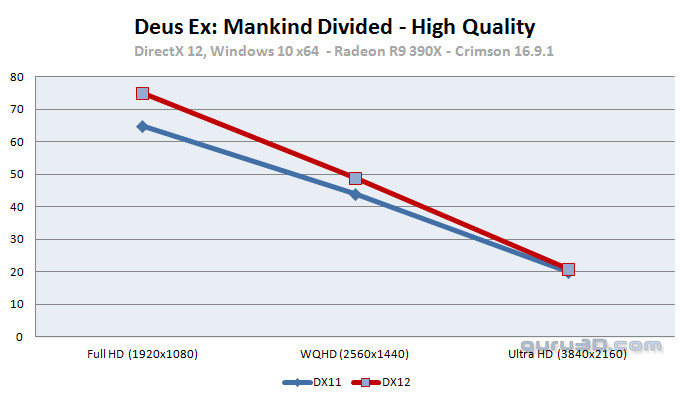
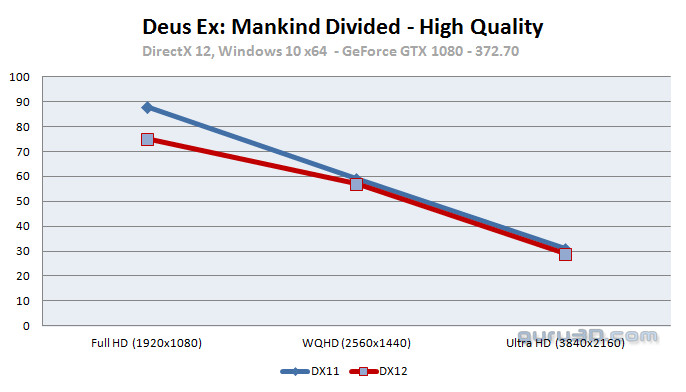
Looking at the graphs, switching from DirectX 11 to DirectX 12 mode, AMD GPUs not only don't lose frame-rates, but in some cases, even gain frame-rates. NVIDIA GPUs, on the other hand, significantly lose frame-rates. AMD GPUs tend to hold on to their frame-rates at 4K Ultra HD, marginally gain frame-rates at 2560 x 1440, and further gain frame-rates at 1080p. NVIDIA GPUs either barely hold on to their frame-rates, or significantly lose them. AMD has on multiple occasions claimed that its Graphics CoreNext architecture, combined with its purist approach to asynchronous compute make Radeon GPUs a better choice for DirectX 12 and Vulkan. Find more fascinating findings by Guru3D here.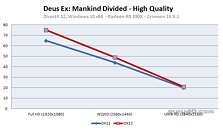
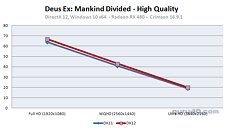
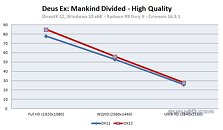
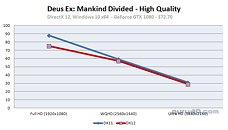 More graphs follow.
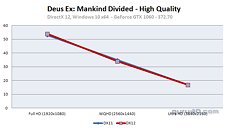
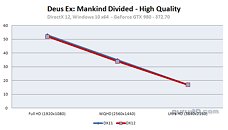
Looking at the graphs, switching from DirectX 11 to DirectX 12 mode, AMD GPUs not only don't lose frame-rates, but in some cases, even gain frame-rates. NVIDIA GPUs, on the other hand, significantly lose frame-rates. AMD GPUs tend to hold on to their frame-rates at 4K Ultra HD, marginally gain frame-rates at 2560 x 1440, and further gain frame-rates at 1080p. NVIDIA GPUs either barely hold on to their frame-rates, or significantly lose them. AMD has on multiple occasions claimed that its Graphics CoreNext architecture, combined with its purist approach to asynchronous compute make Radeon GPUs a better choice for DirectX 12 and Vulkan. Find more fascinating findings by Guru3D here.




114 Comments on AMD GPUs See Lesser Performance Drop on "Deus Ex: Mankind Divided" DirectX 12
On DX11 the driver does farm off asynchronous tasks to driver worker threads where possible.
Under DX11, NVIDIA driver has asynchronous tasks and multiple threads where possible.
https://developer.nvidia.com/unlocking-gpu-intrinsics-hlsl
None of the intrinsics are possible in standard DirectX or OpenGL. But they have been supported and well-documented in CUDA for years. A mechanism to support them in DirectX has been available for a while but not widely documented. I happen to have an old NVAPI version 343 on my system from October 2014 and the intrinsics are supported in DirectX by that version and probably earlier versions. This blog explains the mechanism for using them in DirectX.
Unlike OpenGL or Vulkan, DirectX unfortunately doesn't have a native mechanism for vendor-specific extensions. But there is still a way to make all this functionality available in DirectX 11 or 12 through custom intrinsics. That mechanism is implemented in our graphics driver and accessible through the NVAPI library.
NVIDIA already has hit-the-metal intrinsics and Direct3D API kitbashing along time ago while AMD gains similar feature with Doom Vulkan.
GameGPU, Techreport, Computerbase showed completely different results from Guru3D and they are wrong not Guru3D.
Can we maybe rather wait until a non-AMD and non-NVIDIA-affiliated company actually writes a game that uses DX12 from the ground up, and then compare performance? Because every DX12 renderer until this point has been a half-assed second thought at best and terrible at worst.
Mankind Divided is a particularly poor example: a beta DX11 renderer port of a console port. Like, seriously.
Consoles have had close to metal programming for a long time.
PC's have had massive amounts of processing power (compared to consoles) for a long time
The irony is that PC gaming doesn't NEED DX12 to progress, the consoles need it. VR and mobile need it. Systems with weak, low-power CPU's need it. And on the top end, PC gaming needs it to keep surpassing everything else. I suppose that last little bit is what you're looking for but let's face it, we won't see another Crysis in years.
You know how those high end GPUs are sold today? With inferior technology that really has no merit in real gaming, like VR, like 4K on crappy panels, like HDR with high latencies. These techs are all about moving hardware, not about a great experience, and they're all cash cows right now. None of them are mature.
In the end, the only thing that truly carries a platform and technological progress is an honest investment in stuff we can do with it. That doesn't mean more hardware, it means good, lovingly crafted software. Apple and Blizzard are some of the very few companies that understood this. MS has a love-hate relationship with it. A few smaller game developers also have it.
I also agree with the pushing of "immature" tech and selling overpriced cards to try to "brute force" through them, sadly it's still selling the hardware...
How is Gaining performance = Seeing lesser performance drop ?
you have to switch to a beta branch to get dx12 enabled... proper dx12 is in next weeks patch on 19th september-ish ?
TFLOPS are way too rough an indicator to be of any use in these kinds of comparisons. They're an indicator, nothing else, and I don't see how they are ever relevant in any GPU discussion. It's a shortcut to avoid getting into details, that is all.
Just because something appears on a marketing slide, doesn't make it informative.