Thursday, September 15th 2016

Intel "Coffee Lake" Architecture by Q2-2018, 7 nm Process By 2022?
Intel's silicon fabrication has evidently hit a huge roadblock. It turns out that not just "Kaby Lake," but its two successors "Cannon Lake" and "Coffee Lake" could also be built on the 14 nm node, at best with a few process-level improvements. "Coffee Lake" is the company's 9th generation Core architecture, which is two steps ahead of even the "Kaby Lake" architecture, which is due later this year. "Kaby Lake" makes its way to the 45W mobile (H-segment) and 15W mobile (U-segment), in Q4-2016 and Q3-2016, respectively. The 15W U-segment will be augmented by "Cannon Lake" (8th generation Core) in Q4-2017. By mid-2018, Intel plans to launch "Coffee Lake" across both H- and U-segments.
According to a "Hot Hardware" report, based on a job listing for a systems engineer at the company, Intel could be staring at the scary prospect of holding out on 14 nm for the next three years, only to be relieved by the stopgap 10 nm node, which makes its debut with the 10th generation Core "Tiger Lake" architecture, due for 2019. "Tiger Lake," its succeeding "Ice Lake," and one other architecture could be launched on 10 nm, before finally deploying 7 nm around 2022.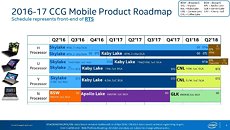
Sources:
HotHardware, AnandTech Forums
According to a "Hot Hardware" report, based on a job listing for a systems engineer at the company, Intel could be staring at the scary prospect of holding out on 14 nm for the next three years, only to be relieved by the stopgap 10 nm node, which makes its debut with the 10th generation Core "Tiger Lake" architecture, due for 2019. "Tiger Lake," its succeeding "Ice Lake," and one other architecture could be launched on 10 nm, before finally deploying 7 nm around 2022.
40 Comments on Intel "Coffee Lake" Architecture by Q2-2018, 7 nm Process By 2022?
sorry had to try to be differently Funny
"My brain hurts now"
Then you factor in hyperthreading, instruction improvements, other architectural improvements, memory bandwidth,chipset improvements, and etc.
The difference could be higher than 500% in certain areas like video encoding, compression, etc. and that's just 2007- 2016 much less what will be out in 2020.
262 CB points for a stock QX6700, there are mobile 3rd gen mobile i7 quads showing 100% scaling per clock
:roll:
Now let's move on.
This is horrifying for tech. Without continually improved process tech, not only will the processor industry stagnant, but all subsequent industries that rely on better, cheaper processors will too.
The original understanding of 10nm Cannonlake very much aligns with PROCESS - ARCHITECTURE - OPTIMIZATION that has been introduced with Kaby. I thought Icelake and Tigerlake were to eventually round out the PAO approach, all being on 10nm (though the HotHardware article gives the three CPU families different fancy names, at the end of the day 10nm 10nm+ and 10nm++++++++ are all 10nm).
And thus as the 'lakes round out 10nm, that should bring us to 2021/2022 with 7nm. Was this not how is was expected before?
I don't think some people understand the difference between the physical difficulties of going under 10nm and the "milking" that Intel is doing in the absence of AMD's competition. These major fabs don't adopt the exact same process, and I wouldn't be surprised that assuming GloFo actually delivers on its 7nm process (GloFo hasn't the greatest reputation of delivering what is agreed), it would be something like how "20nm" HPM in the ARM space wasn't exactly "20nm" in all respects because of the nature of the process.
Could they (Intel) lower prices? Yes, they could. But thinking about doubling performance in the next few years or some other crazy sh!t like that is wishful thinking at best, without some new exotic material at the very least. Let's face it, silicon is nearing the end-of-life as a product. It has served us all well for the past decades, but the time will come that it has to be put to rest (and that time is closer than most people think). Hopefully the smart guys can crack this bastard with a new type of material before we get stuck, technologically speaking.