Tuesday, February 14th 2017

AMD Ryzen Benchmarks Leaked - Amazing Multi-core and Single-core Performance
Benchmarks have leaked on AMD's upcoming Ryzen CPUs, and if accurate, these are the ones that will change the name of the game from "Hype Train" to "Reality Check". Part of a verified Passmark entry, the test system consisted of an AMD Ryzen 8-core, 16-thread ES clocked at 3.4 GHz (which puts it closely on the Ryzen 7 1700X territory, though it isn't known whether Turbo to its rated 3.8 GHz was active or not), seated on an entry-level MSI A320 AM4 motherboard (absent of overclocking functionality) and 16GB of 2400MHz DDR4 memory.
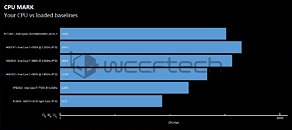
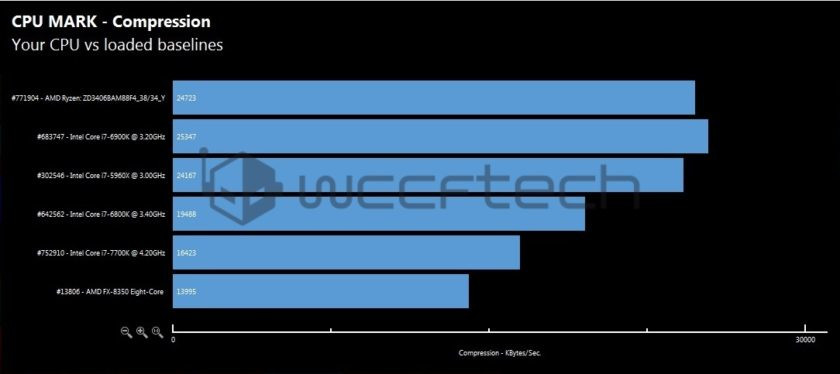
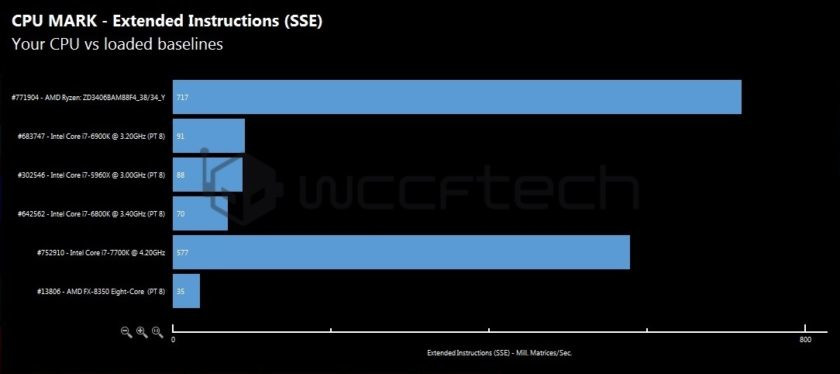
The tests include integer math, floating point performance, prime numbers, encryption, compression, sorting, SSE performance and physics. The AMD Ryzen 7 1700X outperformed every other CPU in 5 out of the 8 tests, including Intel's fastest 8-core chip, the $1099 Broadwell-E i7 6900K. When put side by side against Intel's slightly less expensive $999 8 core extreme edition Haswell-E i7 5960X, Ryzen was faster in 6 out of the 8 tests. The 1700X showed particularly good performance in integer math and encryption, workloads typically associated with server workloads (and where the bulk of the profit is).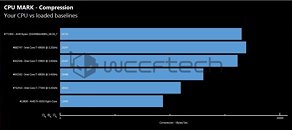
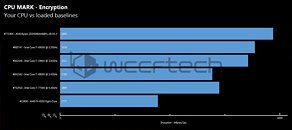
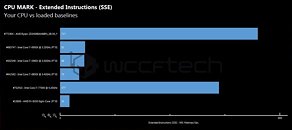
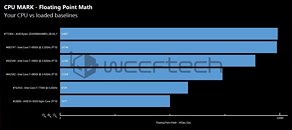
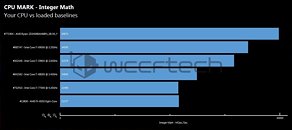
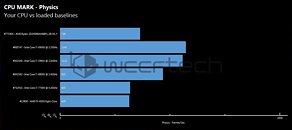
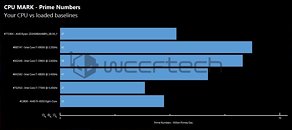
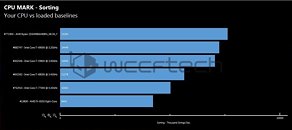 The average aggregate core Coming in at roughly 4% behind the i7-5960X and 9% behind the i7-6900K - both of which retail for more than double the pre-order price for the 1700X of $389. Consider that this isn't even the highest-clocked Ryzen CPUs about to hit retail, and things look rather good for AMD.
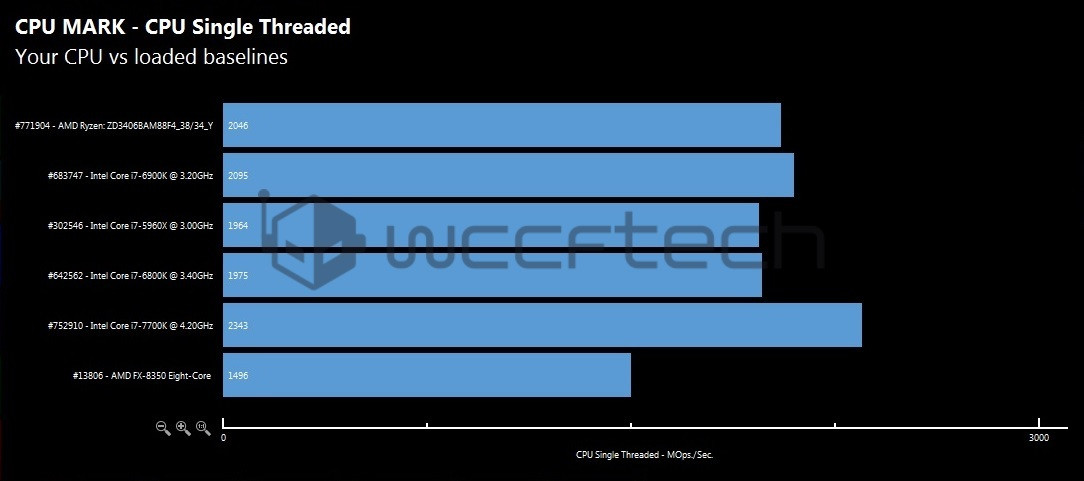
 Moving on from the multi-threaded benchmarks, Passmark's single-threaded performance test is probably the most interesting one, due to AMD's recent inability to go toe to toe against Intel in single-core performance. This here was definitely the uphill battle for the company, and it would actually seem that Jim Keller and company have managed to do what might seem impossible, simply by looking at AMD's R&D budget deficit compared to its Goliath of an adversary in Intel. Whether or not the sample is running at stock 3.4 GHz sans Turbo (mightily impressive), or at the retail 1700 X's 3.8 GHz Turbo speed (still very impressive), the sample manages to successfully edge out the 5960X and the 6800K, falling behind the 6900K by no more than 3%. That's a very impressive feat, especially when one considers that Intel's i7-6900K and i7-6800K can Turbo up to 4.0GHz and 3.8GHz respectively in single-threaded mode, thanks to Broadwell-E's Turbo Boost 3.0 feature. This means that even if the Ryzen engineering sample was in fact running at 3.8GHz Turbo frequency, it would still be outperforming Broadwell-E clock for clock ever so slightly.
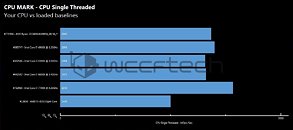 Only Intel's i7-7700K Kaby Lake with its 4.5 GHz Turbo manages to distance itself from the 1700X - a 91W 4-core going up against an 8-core chip, rated at only 4 watts higher at 95 W (rated; the jury is still out on real-world testing). And the power efficiency equation gets even more interesting (just not to Intel) when you consider that this Ryzen chip manages to come in at less 45 W TDP than Intel's 140 W i7-6900K. It would appear that AMD really did strike gold with the balance of features and power consumption, as well as multi and single-core performance.
If these benchmarks are real, the hype train has actually just vanished in smoke. Now it's called the Ryzen line, and it most likely represents a much-awaited supply train for AMD's pockets.
Source:
WCCFTech
The tests include integer math, floating point performance, prime numbers, encryption, compression, sorting, SSE performance and physics. The AMD Ryzen 7 1700X outperformed every other CPU in 5 out of the 8 tests, including Intel's fastest 8-core chip, the $1099 Broadwell-E i7 6900K. When put side by side against Intel's slightly less expensive $999 8 core extreme edition Haswell-E i7 5960X, Ryzen was faster in 6 out of the 8 tests. The 1700X showed particularly good performance in integer math and encryption, workloads typically associated with server workloads (and where the bulk of the profit is).



If these benchmarks are real, the hype train has actually just vanished in smoke. Now it's called the Ryzen line, and it most likely represents a much-awaited supply train for AMD's pockets.
79 Comments on AMD Ryzen Benchmarks Leaked - Amazing Multi-core and Single-core Performance
500 $ for the best processor on the market is a good slap in the face to Intel.
Now i and you can buy X processor that is worthy of the mark X. The first quadro EQ6700X cost me 1,000€ and it seemed to be too expensive . Bravo AMD !:rockout::peace:.
I am an AMD hopeful though, I'm ready to go pure Red again like the pre-C2D days... (Blue/Green has been a bit expensive over the years)
/sigh
*Under EKWB's custom 3x120mm/360XE-based liquid cooling kit.
Damn near $1k Intel for under $400 and still complain.
-------------------------------------
Looks like a 1700x/1800x is just what I need, along with an ENTHUSIAST CLASS iTX MoBo - Hear that Asrock/MSi/Gigabyte?
I would've went with an 8320 or similar last go 'round but there wasn't much IF any options for enthusiast iTX so I went with Intel.
I can wait, but only just barely.
This is getting to be an exciting build-up for Ryzen. It appears to be excellent news at this stage of the game.
I've always continued to buy AMD products (even after the Bulldozer debacle) because they are necessary for these markets. But my best systems are all better-performing Intel-based boxes, mainly because I'm a performance whore.
Also, I think that Intel has had free rein for far too long, and they're arrogant. I'm ready to see them stimulated into releasing some of the magic shit that they're probably sitting on. Either way, It's a good time to be a consumer.
Other than a main rig ( which if it will be built on Ryzen it will be the highest-end one ), I'm also thinking about a small mini-itx server ( NAS + Plex ) which might reach near ~8000 passmark to handle 3-4 fHD streams... I still don't know which CPU this will be, it might not be a CPU also, it might be Ryzen based APU ( eg. Raven Ridge ) which means 4C/8T APU, I know this can easily reach that mark as even stock i5-3570K can reach 7000+, so I guess even Ryzen 3 ( 4C/4T ) can get over 8000 easily, but I'll be looking for lower TDP also and low cost.
And, yeah, a lot of the syns (more like sins) are tuned for Intel. Where you think the money is coming from? Lol. (Ever see how many Intel logos are on cinebench ads?)
I'm wish AMD the best and we need competition, but lets not jump the gun here.
@Mescalamba, PhysX is physics for the GPU to compute for the CPU. When you don't play a game that doesn't use PhysX, again, by default, your CPU computes all physic for a game. It doesn't matter if you are using an NVidia or AMD Graphic Card to offload frame-rendering to the GPU. If for rendering, and the program uses PhysX, it helps to simulate particles, voxels and physics simulations in the aide of rendering. The hit that the CPU has to do for Physics is minor at best for games. Usually because there isn't a lot of physic calculations going on. So having the CPU compute physics, or having PhysX compute it doesn't really improve much as far as framerates.
*edit made to second reply. Guru obviously doesn't ONLY use AMD's tests for their results.