Thursday, May 4th 2017
AMD Works on At Least Three Radeon RX Vega SKUs, Slowest Faster than GTX 1070?
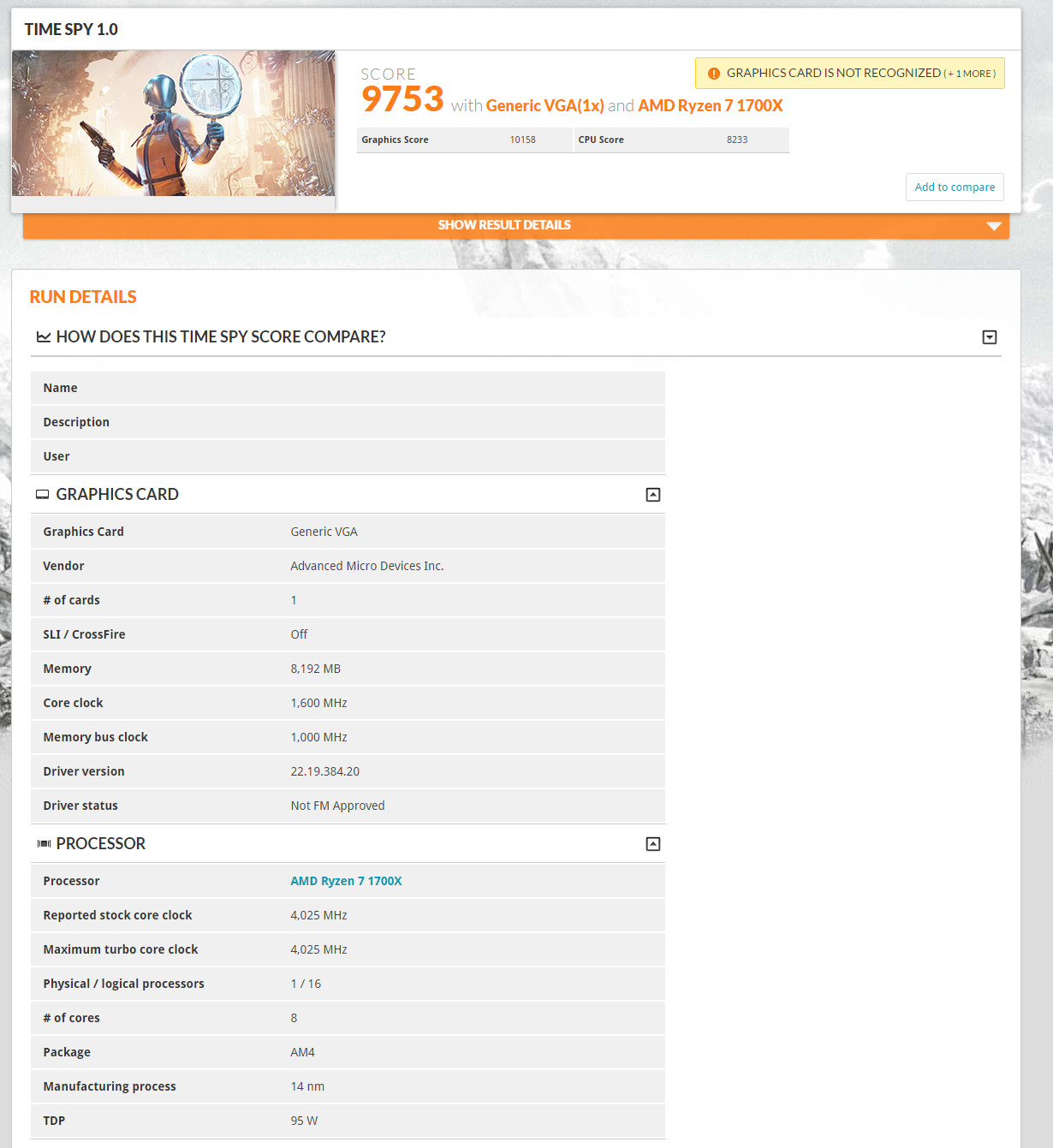
AMD could be working on at least three SKUs based on its upcoming "Vega 10" silicon to make up its Radeon RX Vega series. Leaked 3DMark validations point to a device ID that's third in a series of possible device IDs of graphics cards based on the "Vega 10" silicon, the 687F:C1, 687F:C2, and 687F:C3. All three SKUs feature 8 GB of HBM2 memory, and according to leaked 3DMark TimeSpy scores, the "slowest" SKU is faster than NVIDIA GeForce GTX 1070. The fastest SKU is in the same league as the GTX 1080 Ti.
The three SKUs could differ with core-configuration and clock speeds. AMD carved four SKUs out of its "Fiji" silicon, the liquid-cooled R9 Fury X, the air-cooled R9 Fury (with 12.5% fewer shaders), the SFF-friendly R9 Nano (full core-config, but aggressive power-management), and the halo dual-GPU Radeon Pro Duo (1st gen). AMD could take a similar approach with "Vega 10." AMD is expected to launch its Radeon RX Vega series within Q2-2017.

Source:
Guru3D Forums
The three SKUs could differ with core-configuration and clock speeds. AMD carved four SKUs out of its "Fiji" silicon, the liquid-cooled R9 Fury X, the air-cooled R9 Fury (with 12.5% fewer shaders), the SFF-friendly R9 Nano (full core-config, but aggressive power-management), and the halo dual-GPU Radeon Pro Duo (1st gen). AMD could take a similar approach with "Vega 10." AMD is expected to launch its Radeon RX Vega series within Q2-2017.

81 Comments on AMD Works on At Least Three Radeon RX Vega SKUs, Slowest Faster than GTX 1070?
You have multiple dependencies here, which has to be resolved sequentially. Each dependency has to wait for the instruction to be completely executed, meaning the length of the pipeline will affect the length of the stall. CPUs have since the 90s tried to work around this by out-of-order execution, and longer pipelines also means the dependencies has to be executed even earlier to prevent stalls. But eventually this means that branching is going to become a even larger problem, since each misprediction causes all calculations to be discarded. So if there are dependencies after the branching, you'll not only get a larger stall because of the flushing, but also because you'll then have to execute multiple dependencies without any benefit of out-of-order execution. This is why the penalties of long pipelines and mispredictions multiply.
Skylake does in fact have better branch prediction than Ryzen, even old Sandy-Bridge does it better. But branch prediction can only help a bit, since it's basically just statistics about which conditionals usually evaluates to true and which does not. If a conditional is 99% true and 1% false, it will start guessing 99% correct after a few iterations. But if a conditional is ~50% true and ~50% false, the CPU will only guess half of them correctly, and that is in fact the theoretical maximum. If you want to improve performance beyond this, you're left with trying to reduce the penalty costs, or rewriting the software :p
And one final note; the branch predictor (and prefetcher in general) were much better in Prescott than Athlon64, but the severe penalties of the super-long pipeline outweighed the benefits of a better prefetcher. There are limits to what a good prefetcher can do, so even with the best prefetcher Intel was crushed by a much more simple design.
After that Intel dropped netburst architecture.
Intel has been doing the very same thing for many years, Over Pricing it's CPU's because Bulldozer wasn't competitive.
Look what Ryzen did to those Over Priced Intel Processors. Intel is in damage control. Has been since ZEN.
Nvidia has absolutely no measure in how to price it's High end GPU's. AMD's GPU Line Up RX480/580 aren't competitive enough. Don't confuse a company ripping people off with over prices to actual economics.
If you disagree, then we will agree to disagree.