Thursday, May 4th 2017
AMD Works on At Least Three Radeon RX Vega SKUs, Slowest Faster than GTX 1070?
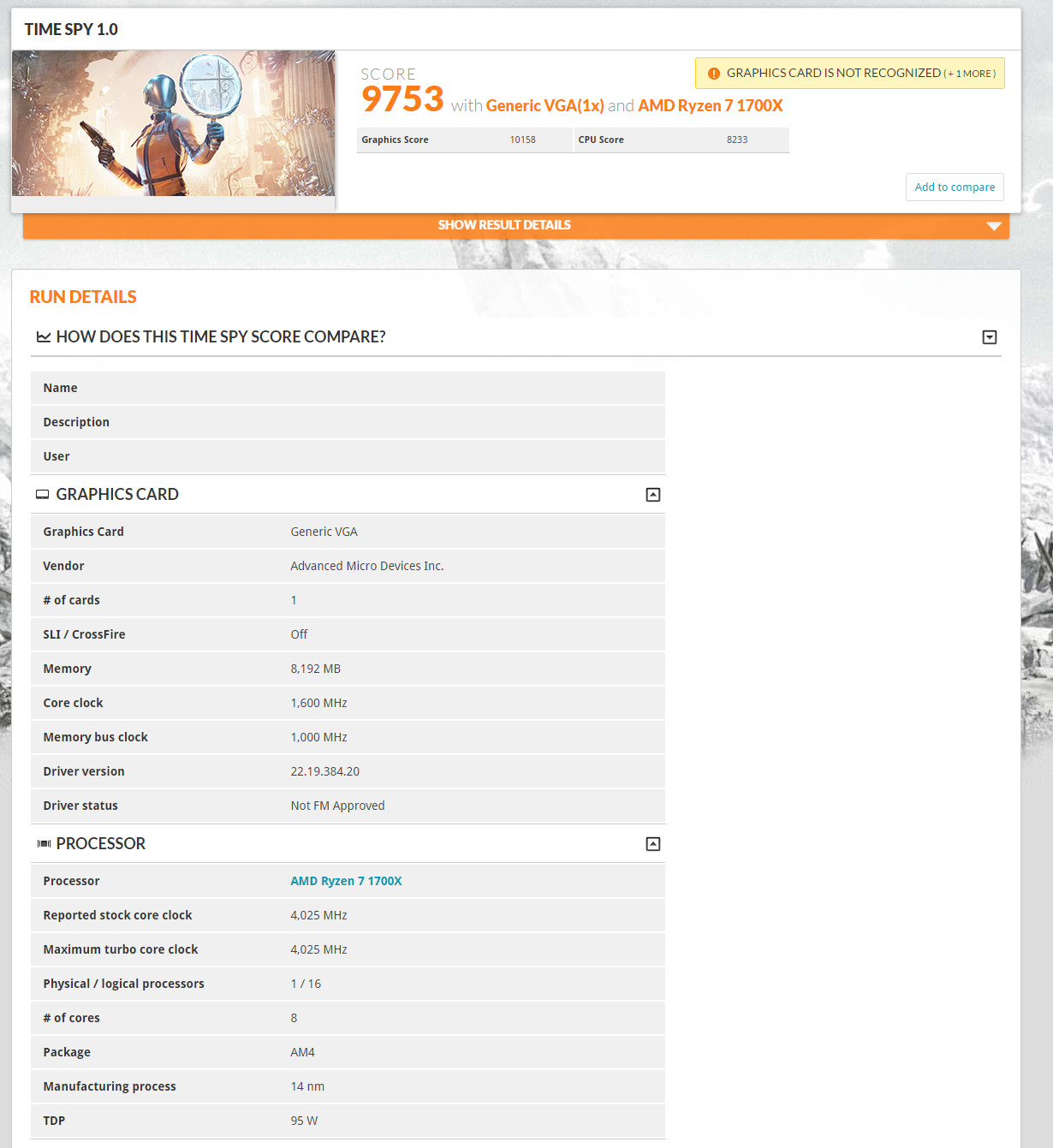
AMD could be working on at least three SKUs based on its upcoming "Vega 10" silicon to make up its Radeon RX Vega series. Leaked 3DMark validations point to a device ID that's third in a series of possible device IDs of graphics cards based on the "Vega 10" silicon, the 687F:C1, 687F:C2, and 687F:C3. All three SKUs feature 8 GB of HBM2 memory, and according to leaked 3DMark TimeSpy scores, the "slowest" SKU is faster than NVIDIA GeForce GTX 1070. The fastest SKU is in the same league as the GTX 1080 Ti.
The three SKUs could differ with core-configuration and clock speeds. AMD carved four SKUs out of its "Fiji" silicon, the liquid-cooled R9 Fury X, the air-cooled R9 Fury (with 12.5% fewer shaders), the SFF-friendly R9 Nano (full core-config, but aggressive power-management), and the halo dual-GPU Radeon Pro Duo (1st gen). AMD could take a similar approach with "Vega 10." AMD is expected to launch its Radeon RX Vega series within Q2-2017.

Source:
Guru3D Forums
The three SKUs could differ with core-configuration and clock speeds. AMD carved four SKUs out of its "Fiji" silicon, the liquid-cooled R9 Fury X, the air-cooled R9 Fury (with 12.5% fewer shaders), the SFF-friendly R9 Nano (full core-config, but aggressive power-management), and the halo dual-GPU Radeon Pro Duo (1st gen). AMD could take a similar approach with "Vega 10." AMD is expected to launch its Radeon RX Vega series within Q2-2017.

81 Comments on AMD Works on At Least Three Radeon RX Vega SKUs, Slowest Faster than GTX 1070?
Are they over-priced? Not at all.
So long as people keep buying them at their current prices the market will allow for Nvidia to charge more and more with each new generation.
If they were not selling and stores were left with stock on the shelves and in their warehouses, THEN they would be over-priced. That's just how free-markets work. If you don't like it, speak with your money and hope others follow suit.
The whole over-priced argument is laughable.
Overpricing is a common tactic. When you are the de facto only player in a particular market you can dictate the price of your product. You can rise prices only so much BTW, because there is that sweet spot where you are stealing the maximum amount of money from the consumer without him noticing. This sweet spot is waaaaaaaaaay over the real "fair" price of your product in a competitive situation.
So, the product IS, in fact, overpriced.
Being competition what it is, if Vega delivers, you will see the prices where they should have been.
Do you know for example how much it was costing the fastest video card in, let's say, 2009?? yeah, 350$. That's because back then there was still a competition going on for high-end.
Now since nVidia is owning everything the price just got doubled.
And you are saying is not overpriced?? :))))))))
But that was a refresh dropping the price of GTX 280 at $649 (~$735today).
Back in 2006 8800 GTX costed $600 (~$725 today).
So no, it's not overpriced. Get some knowledge instead of spreading misinformation.
Keep in mind that, overall, production cost have been halved in the meantime. Producing a chip in 2000 cost much more than producing it today. Memory has fluctuated though, due to availability.
Ever heard of ATI HD 5870 cards? They smoked out of the water any overpriced nVidia cards released back then:
www.techpowerup.com/102342/radeon-hd-5870-aggressively-priced-report
en.wikipedia.org/wiki/Radeon_HD_5000_Series#Desktop_products
www.anandtech.com/show/2841
Prices are in line, and that is without any competition for what seems like donkeys years.
Holly Cow, didn't realize the pics were so large. There's many more, but here is a few.
It has nothing to do with whether I have too much money and can afford to waste. Notice I don't have Nvidia's latest and greatest, and only bought an EOL 980Ti when 1080 was released. So it's not personal preferences or desire to waste money. But I understand economics, and can thus objectively state that if people were not buying all that Nvidia can sell at current prices, then said prices would drop.
en.wikipedia.org/wiki/GeForce_600_series
Nvidia's top end 600 series card was the 680 for only $500. Nvidia created two new GPU tiers in the Ti (first in the 700 series) cards and the Titan cards and charged significantly more for their full die than previous generations. You are straight up paying much more than you used to.
So if you are following GPU pricing, it's plain to see that Nvidia is milking it's customers due to lack of competition.
That 680 was NVIDIA's MID-LEVEL Kepler chip. So, $500 almost 4 years ago.....yep, about right where it is now.
From his 680 review:
"Technically GK104, as its name reveals is an upper mid-range GPU, not a pure high-end part. Following NVIDIA's naming convention such a chip would be called GK100. This subtle difference makes the GeForce GTX 680 even more impressive. Technically we'd have to compare it to GTX 560 Ti, not GTX 580.."
www.techpowerup.com/reviews/NVIDIA/GeForce_GTX_680/32.html
They got away with the $500 price because the 680 was a bit faster than the 7970 at $550 which was AMD's high end card at the time.
They didn't create a new tier with the 780 Ti. That was simply the Kepler high end like the 580 was the Fermi high end. They just didn't have a lot of motivation due to lack of competition to release it and the Kepler Titan was "selling like hotcakes" according to Mr. Huang.
www.anandtech.com/show/5699/nvidia-geforce-gtx-680-review
"What you won’t find today however – and in a significant departure from NVIDIA’s previous launches – is Big Kepler. Since the days of the G80, NVIDIA has always produced a large 500mm2+ GPU to serve both as a flagship GPU for their consumer lines and the fundamental GPU for their Quadro and Tesla lines, and have always launched with that big GPU first. At 294mm2 GK104 is not Big Kepler, and while NVIDIA doesn’t comment on unannounced products, somewhere in the bowels of NVIDIA Big Kepler certainly lives, waiting for its day in the sun. As such this is the first NVIDIA launch where we’re not in a position to talk about the ramifications for Tesla or Quadro, or really for that matter what NVIDIA’s peak performance for this generation might be."
Underlining and bolding by me, for emphasis.
Remember, long pipelines require higher clockspeeds to get the same performance out of short pipelines at lower clockspeeds because there's more steps (each step requiring a clock to complete) to render a frame.