Monday, February 24th 2020

Microsoft Confirms Xbox Series X Specs - 12 TFLOPs, Custom APU With Zen 2, RDNA 2, H/W Accelerated Raytracing
Microsoft has confirmed the official specs for the Xbox Series X games console, due Holiday 2020 (think November). The new specs announcement confirms the powerhouse of a console this will be, with its peak 12 TFLOPs compute being 8 times that of the original Xbox One, and twice that of the Xbox One X, which already quite capable of powering true 4K experiences. This 12 TFLOPs figure is a mighty impressive one - just consider that AMD's current highest-performance graphics card, Radeon VII, features a peak 13.4 TFLOPs of computing power - and that's a graphics card that was launched just a year ago.
The confirmation also mentions support for Hardware-Accelerated raytracing, something that all but confirms the feature being built into AMD's RDNA 2 microarchitecture (of which we are expecting news anytime now). this, alongside Variable Rate Shading (VRS) support, brings AMD to feature parity with NVIDIA's Turing, and should allow developers to optimize their performance and graphical targets without any discernible quality loss. Another very important metric, however, is still unknown: pricing. But with the new system featuring so many pieces of top-of-the-line technology, including SSD storage, this won't be a cheap endeavor. With Sony also keeping its cards close to its chest in regards to PS5 pricing (and the company even canceling their appearances at PAX East and GDC), we'll have to wait and see how interesting these systems really are from a value standpoint.
However, I have to throw my two cents in here: Microsoft's alleged approach towards releasing a top-tier (and top pricing) console in the Xbox Series X alongside a cheaper, more nimble system does paint the next-gen scenario as more positive for Microsoft than Sony, should the Japanese company choose to release a single, premium system (which some are saying hardware parts costs are set at $450).
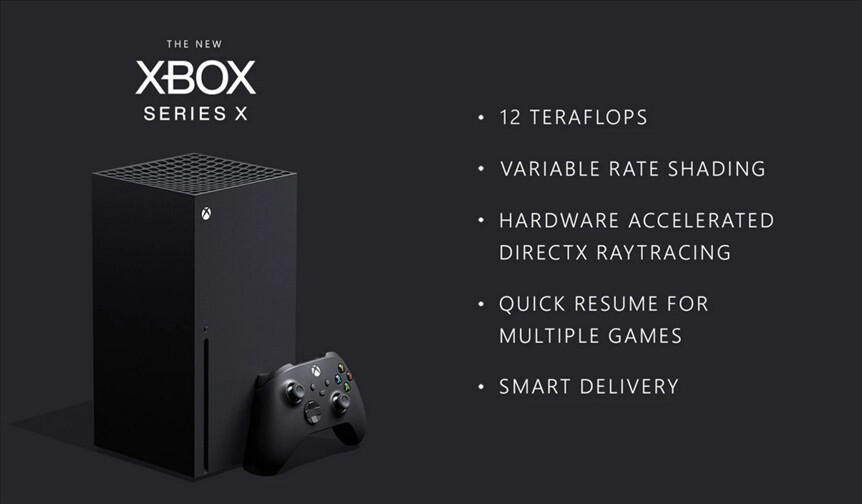
Features of XBOX Series X:
Source:
Microsoft
The confirmation also mentions support for Hardware-Accelerated raytracing, something that all but confirms the feature being built into AMD's RDNA 2 microarchitecture (of which we are expecting news anytime now). this, alongside Variable Rate Shading (VRS) support, brings AMD to feature parity with NVIDIA's Turing, and should allow developers to optimize their performance and graphical targets without any discernible quality loss.
However, I have to throw my two cents in here: Microsoft's alleged approach towards releasing a top-tier (and top pricing) console in the Xbox Series X alongside a cheaper, more nimble system does paint the next-gen scenario as more positive for Microsoft than Sony, should the Japanese company choose to release a single, premium system (which some are saying hardware parts costs are set at $450).
Features of XBOX Series X:
- Next Generation Custom Processor: Xbox Series X is our most powerful console ever powered by our custom designed processor leveraging AMD's latest Zen 2 and RDNA 2 architectures. Delivering four times the processing power of an Xbox One and enabling developers to leverage 12 TFLOPS of GPU (Graphics Processing Unit) performance - twice that of an Xbox One X and more than eight times the original Xbox One. Xbox Series X delivers a true generational leap in processing and graphics power with cutting edge techniques resulting in higher framerates, larger, more sophisticated game worlds, and an immersive experience unlike anything seen in console gaming.
- Variable Rate Shading (VRS): Our patented form of VRS empowers developers to more efficiently utilize the full power of the Xbox Series X. Rather than spending GPU cycles uniformly to every single pixel on the screen, they can prioritize individual effects on specific game characters or important environmental objects. This technique results in more stable frame rates and higher resolution, with no impact on the final image quality.
- Hardware-accelerated DirectX Raytracing: You can expect more dynamic and realistic environments powered by hardware-accelerated DirectX Raytracing - a first for console gaming. This means true-to-life lighting, accurate reflections and realistic acoustics in real time as you explore the game world.
- SSD Storage: With our next-generation SSD, nearly every aspect of playing games is improved. Game worlds are larger, more dynamic and load in a flash and fast travel is just that - fast.
- Quick Resume: The new Quick Resume feature lets you continue multiple games from a suspended state almost instantly, returning you to where you were and what you were doing, without waiting through long loading screens.
- Dynamic Latency Input (DLI): We're optimizing latency in the player-to-console pipeline starting with our Xbox Wireless Controller, which leverages our high bandwidth, proprietary wireless communication protocol when connected to the console. With Dynamic Latency Input (DLI), a new feature which synchronizes input immediately with what is displayed, controls are even more precise and responsive.
- HDMI 2.1 Innovation: We've partnered with the HDMI forum and TV manufacturers to enable the best gaming experience through features such as Auto Low Latency Mode (ALLM) and Variable Refresh Rate (VRR). ALLM allows Xbox One and Xbox Series X to automatically set the connected display to its lowest latency mode. VRR synchronizes the display's refresh rate to the game's frame rate, maintaining smooth visuals without tearing. Ensuring minimal lag and the most responsive gaming experience.
- 120 fps Support: With support for up to 120 fps, Xbox Series X allows developers to exceed standard 60 fps output in favor of heightened realism or fast-paced action.
139 Comments on Microsoft Confirms Xbox Series X Specs - 12 TFLOPs, Custom APU With Zen 2, RDNA 2, H/W Accelerated Raytracing
www.guru3d.com/articles-pages/aorus-radeon-rx-5700-xt-8g-review,20.html
You can find 2060s beating 5700xt more often than 5700xt matching 2070s.
Full testing suite,4k,aib vs aib,only proper way of looking.
The general feeling is that these consoles will be too expensive and hard to sell.
Which means a cheaper "on-premise" model is likely to appear soon after the flagship.
Early rumors suggested we would get one "on-premise" console and one suitable just for streaming (like Nvidia Shield).
It's designed to be immediately shrunk to 5nm and then to 3nm once the processes are available for mass production.
And then its chips will become much smaller and cheaper.
If this is 2080 stock indeed then 3060 may match it as soon as it arrives
On the console, you will be easily able to get 4K@120, while the PC will struggle at 4K@60.
Hope is that you get the point.
Does polaris in PS4 pro perform better than rx580?
No,its worse quality with worse performance in many cases.
Rdna1 to 2 is confirmed rt and vrs plus duv to euv.
There's nothing certain about rdna2 and hyping up amd products apparently never failed miserably before.
Ipc improvement may be single digit.
And my assessment was wrong but not because od that.
Aftet corrections it points to 2080fe performance,like @medi01 said,not 2070s.
RDNA 1.0 is hybrid between RDNA 2.0 and GCN 5.0.
RDNA 2.0 will be the true new micro-architecture.
You can't buy/build a cheaper alternative. And you can't buy an older/used model to play new games on low settings. Basically, the MSRP becomes the cost of entry if you want to try modern titles.
$600 (maybe more) for next gen will be unacceptable for many consumers who are used to the levels we've seen earlier ($300-500).
The argument about price/performance ratio may only be relevant for gamers who are willing to choose between console and PC.
There have been suggestions that games made for Xbox Series X will run on Xbox One ("forward compatible"), but AFAIK there was no official statement if that includes One S or just One X.
Either way, if true, that means Xbox side already has a ~$250-300 budget model.
A lot less is known about Sony's plans.
Get ready for prices rise.
Apple iPhone 11 Pro 512 GB costs up to $1349.
A much more powerful and expensive and advanced console should cost a lot, too.
$300 is a joke asking price.
I wouldn't buy a next-gen console for $300 because it's dirty cheap.Why does RDR2 run only at 1080p60 max on RTX 2080 Ti?
Your elitist opinions won't change how the world works. :)
Apple can ask $1300 for a smartphone because they aren't interested in the low-end.
There are smartphones priced between $50 and $1500 (likely even wider).
MS and Sony are interested in the low-end. If they ask $600 for the cheapest console, a lot of people will move to PCs. So this will not happen. New games will either work on older consoles (which would remain in production) or we'll see new entry-level models.
high end console is not a thing.
jensen already made references to console gpus (2080maxq matching new consoles),though I don't think the maxq can really do that.desktop 2080fe - we'll see,but most likely.
they're same as rx580/590 and at their price they were already too expensive for many.
now ask 2200pln for a console and see ppl line up when 1600pln buys them a new 3060 and 1400 a used 1080Ti