Monday, February 24th 2020

Microsoft Confirms Xbox Series X Specs - 12 TFLOPs, Custom APU With Zen 2, RDNA 2, H/W Accelerated Raytracing
Microsoft has confirmed the official specs for the Xbox Series X games console, due Holiday 2020 (think November). The new specs announcement confirms the powerhouse of a console this will be, with its peak 12 TFLOPs compute being 8 times that of the original Xbox One, and twice that of the Xbox One X, which already quite capable of powering true 4K experiences. This 12 TFLOPs figure is a mighty impressive one - just consider that AMD's current highest-performance graphics card, Radeon VII, features a peak 13.4 TFLOPs of computing power - and that's a graphics card that was launched just a year ago.
The confirmation also mentions support for Hardware-Accelerated raytracing, something that all but confirms the feature being built into AMD's RDNA 2 microarchitecture (of which we are expecting news anytime now). this, alongside Variable Rate Shading (VRS) support, brings AMD to feature parity with NVIDIA's Turing, and should allow developers to optimize their performance and graphical targets without any discernible quality loss. Another very important metric, however, is still unknown: pricing. But with the new system featuring so many pieces of top-of-the-line technology, including SSD storage, this won't be a cheap endeavor. With Sony also keeping its cards close to its chest in regards to PS5 pricing (and the company even canceling their appearances at PAX East and GDC), we'll have to wait and see how interesting these systems really are from a value standpoint.
However, I have to throw my two cents in here: Microsoft's alleged approach towards releasing a top-tier (and top pricing) console in the Xbox Series X alongside a cheaper, more nimble system does paint the next-gen scenario as more positive for Microsoft than Sony, should the Japanese company choose to release a single, premium system (which some are saying hardware parts costs are set at $450).
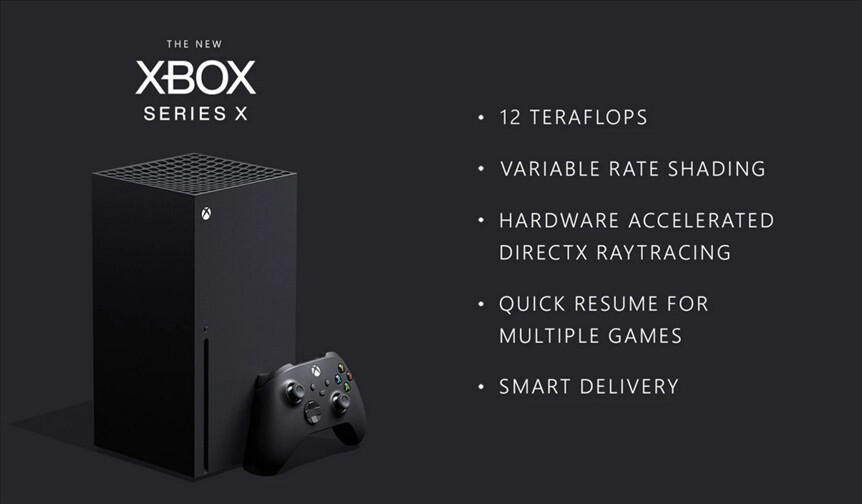
Features of XBOX Series X:
Source:
Microsoft
The confirmation also mentions support for Hardware-Accelerated raytracing, something that all but confirms the feature being built into AMD's RDNA 2 microarchitecture (of which we are expecting news anytime now). this, alongside Variable Rate Shading (VRS) support, brings AMD to feature parity with NVIDIA's Turing, and should allow developers to optimize their performance and graphical targets without any discernible quality loss.
However, I have to throw my two cents in here: Microsoft's alleged approach towards releasing a top-tier (and top pricing) console in the Xbox Series X alongside a cheaper, more nimble system does paint the next-gen scenario as more positive for Microsoft than Sony, should the Japanese company choose to release a single, premium system (which some are saying hardware parts costs are set at $450).
Features of XBOX Series X:
- Next Generation Custom Processor: Xbox Series X is our most powerful console ever powered by our custom designed processor leveraging AMD's latest Zen 2 and RDNA 2 architectures. Delivering four times the processing power of an Xbox One and enabling developers to leverage 12 TFLOPS of GPU (Graphics Processing Unit) performance - twice that of an Xbox One X and more than eight times the original Xbox One. Xbox Series X delivers a true generational leap in processing and graphics power with cutting edge techniques resulting in higher framerates, larger, more sophisticated game worlds, and an immersive experience unlike anything seen in console gaming.
- Variable Rate Shading (VRS): Our patented form of VRS empowers developers to more efficiently utilize the full power of the Xbox Series X. Rather than spending GPU cycles uniformly to every single pixel on the screen, they can prioritize individual effects on specific game characters or important environmental objects. This technique results in more stable frame rates and higher resolution, with no impact on the final image quality.
- Hardware-accelerated DirectX Raytracing: You can expect more dynamic and realistic environments powered by hardware-accelerated DirectX Raytracing - a first for console gaming. This means true-to-life lighting, accurate reflections and realistic acoustics in real time as you explore the game world.
- SSD Storage: With our next-generation SSD, nearly every aspect of playing games is improved. Game worlds are larger, more dynamic and load in a flash and fast travel is just that - fast.
- Quick Resume: The new Quick Resume feature lets you continue multiple games from a suspended state almost instantly, returning you to where you were and what you were doing, without waiting through long loading screens.
- Dynamic Latency Input (DLI): We're optimizing latency in the player-to-console pipeline starting with our Xbox Wireless Controller, which leverages our high bandwidth, proprietary wireless communication protocol when connected to the console. With Dynamic Latency Input (DLI), a new feature which synchronizes input immediately with what is displayed, controls are even more precise and responsive.
- HDMI 2.1 Innovation: We've partnered with the HDMI forum and TV manufacturers to enable the best gaming experience through features such as Auto Low Latency Mode (ALLM) and Variable Refresh Rate (VRR). ALLM allows Xbox One and Xbox Series X to automatically set the connected display to its lowest latency mode. VRR synchronizes the display's refresh rate to the game's frame rate, maintaining smooth visuals without tearing. Ensuring minimal lag and the most responsive gaming experience.
- 120 fps Support: With support for up to 120 fps, Xbox Series X allows developers to exceed standard 60 fps output in favor of heightened realism or fast-paced action.
139 Comments on Microsoft Confirms Xbox Series X Specs - 12 TFLOPs, Custom APU With Zen 2, RDNA 2, H/W Accelerated Raytracing
It is not a perfectly viable business model because AMD is under threat of going under.
You remember how Intel was fined $1.3B for damaging AMD's sales and profits?!
Why do we need these consoles specs 8-9 MONTHS before the actual launch, while we don't have any confirmation of real RDNA 2.0 videocards? Which are about to debut much, much earlier?!
At least some benchmarks with performance results from the Navi 21?!
NO?!
- $250 SoC
- $100 SSD
- $30 BD drive
- $20 PSU
- $40 motherboard (including chipset, network controllers, WiFi, etc.)
- $20 case
- $10 assembly
- $?? software development (ongoing cost, so hard to include, but it's definitely there)
- $?? long-term support, RMA handling, etc.
- $?? marketing
- $?? developer support
So, here we have a theoretical console at $470 BOM cost, plus significant support and development costs, yet it's sold at $500 - a figure that also needs to include distributor and retailer profit margins - in other words, the console maker is not getting $500 for this, the number is likely below $450. This is the console maker's loss alone. That theoretical $250 SoC? The price obviously includes all costs to the SoC maker as well as their profit margins. That $250 price likely includes 20-30% profit margins for AMD, even after amortized R&D costs. Selling a console at a loss does not in any way imply that the parts suppliers are selling their parts at a loss - why would they? Wouldn't they then rather refuse the contract? Your thinking here makes no sense at all. The same obviously applies to the third-party OEMs making the flash and controller for the SSD, the PSU, the BD drive, etc., etc. - they are all making a profit. Only the console maker, the one assembling all the parts and selling them as a finished product, is losing anything. This is a calculated risk on their part - they might go bust by doing this after all - but they aim to make back any losses (and then some!) through the licensing costs for selling games for their platform, which is paid by game distributors per copy of any licensed game sold. Game license fees are typically $10, so at a $470 BOM and $450 price to distributors, MS can break even at two games sold per console (not counting what is required to finance development, marketing and support costs), with anything more being profit to them. But the important part is that regardless of whether the console maker makes or loses money, all their parts suppliers are getting paid, including profit margins - barring, of course, the console maker defaulting on their debt as part of going bankrupt. Which isn't likely to happen with any of the current ones.
The Semi-custom department at AMD, which is responsible for console SoCs, has been one of their most profitable departments over the past decade, and a significant reason for their survival through times when both CPU and GPU departments have had significant losses.
Tl;dr: your point here is complete nonsense and doesn't apply to this situation whatsoever. A console maker selling a console at a loss does not mean that parts suppliers are selling parts at a loss.These products operate in entirely different markets with very different competitive landscapes. AMD is the only major high-performance player in consoles, as such they don't have to worry about competitors one-upping them by revealing features and broad specifications early. This also lets them give console makers some freedom in talking about specs for upcoming consoles to drum up interest for an upcoming generation - also a necessity given the long lifespans of consoles (5+ years) compared to PC GPUs (2-3 years) and the general unwillingness for most console gamers to upgrade (compared to the frenzied hardware fetishization in the PC gaming space).
On the other hand, in the PC space AMD is the perennial underdog, competing against a much larger and wealthier competitor that also has a performance and feature advantage currently. This means that tipping their hand too early is just feeding information to the competition, allowing them to adjust their product stack to compete at time of launch, minimizing any advantage AMD might gain from a new launch. Why would they give Nvidia early information so that they can adjust, rather than launch as "unexpectedly" as possible? AMD has zero to gain from leaking specs for upcoming GPUs early - they risk hurting sales of their current products while also giving Nvidia time to either adjust pricing of current produtcs or adjust specs/pricing/marketing of their upcoming products to better compete with what AMD is launching. The current timing would be especially terrible for this considering that Nvidia is expected to present consumer Ampere within a month - why not wait at least until Nvidia makes a public presentation so that AMD is then the one who can adjust?
You also didn't add the RAM cost which if HBM will be pretty high as well.
And I don't believe that Nvidia has no information about AMD's future products. If anyone knows best, it is exactly Nvidia.
They don't do anything because it's in their interest to sell the RTX lines at overinflated prices.
And how does Navi 21 interfere with the much lower specced and lower performance Navi 10!
Those are cards for completely different market segments.
Navi 10 is bad, while Navi 21 is expected to fix its problems.There is no Ampere launch within a month. The chips were cancelled and new ones haven't been taped out yet,
Ampere is a 2021 thing if released ever.
Should I list even more?
- Noisy in gaming
- Overclocking is complicated
- Driver bugs
- High temperatures
- No support for raytracing acceleration
- No idle fan stop
- High multi-monitor power draw
- CrossFire no longer supported
www.techpowerup.com/review/amd-radeon-rx-5700-xt/35.html- Large increase in power consumption, power efficiency lost
- Memory overclocking limited by adjustment range
- Memory not overclocked
- No hardware-accelerated raytracing
www.techpowerup.com/review/xfx-radeon-rx-5700-xt-thicc-iii-ultra/36.html- High price
- Large increase in power consumption, power efficiency lost
- No hardware-accelerated raytracing
www.techpowerup.com/review/sapphire-radeon-rx-5700-xt-nitro-special-edition/35.html- Price seems a bit high
- Large increase in power consumption, power efficiency lost
- Memory overclocking limited by adjustment range
- Memory not overclocked
- No hardware-accelerated raytracing
www.techpowerup.com/review/asrock-radeon-rx-5700-xt-taichi-oc-plus/34.htmlAsus blames AMD for overheating ROG Strix RX 5700 Series cards
www.notebookcheck.net/Asus-blames-AMD-for-overheating-ROG-Strix-RX-5700-Series-cards.454185.0.html
Gamers are ditching Radeon graphics cards over driver issues
www.techspot.com/news/84005-gamers-ditching-radeon-graphics-cards-over-driver-issues.html
AMD is Investigating Black Screen Driver Issues on Radeon Cards
www.extremetech.com/extreme/306175-amd-is-investigating-black-screen-driver-issues-on-radeon-cards
That being said, there is no chance in hell that next-gen consoles are getting HBM. Zero. Zilch. Nada. Never going to happen. HBM is way too expensive for consoles, and two of its main advantages (space savings and power savings) don't matter much in that scenario. A 250W console can afford to spend 20W more than "necessary" on memory, and has a large motherboard capable of fitting heaps of GDDR6 channels.Who cares? Believing that Nvidia likely has well-placed sources (even if this runs the risk of industrial espionage if taken far enough, which is rather illegal) does not in any way make for an argument that AMD (or whoever who is competing with whoever else, really) should go around divulging information of not-yet-ready-for-market products ahead of time. Period. Seriously, what do they stand to gain from this? Nothing at all.Not necessarily. Do you think AMD will only be launching a single RDNA2 GPU this year? I think there will be a fuller stack this year than last year. And a lot of people considering buying an RX 5700XT might consider holding off and saving up another $100-200 to get the next tier up if they know it's coming, which is a loss to AMD today with only the potential (not sure in any way) of future profits to show for it. Your logic here is very poor....no. Navi 10 is a significant improvement from GCN in any guise. It's far more efficient (even beyond the node change - a 210W 5700 XT matches a 295W Radeon VII on the same 7nm node, after all, and with 20 fewer CUs to boot - they have driven GPU prices down (I'd like more, but we're moving in the right direction at least). They haven't caught up to Nvidia, true, but expecting that to happen in a single generation (particularly when Nvidia has many times the R&D budget of AMD) is entirely unrealistic. RDNA (1) is a very good architecture, and hopefully RDNA2 will improve upon this again.Source?
wccftech.com/igors-lab-no-nvidias-ampere-gpus-are-not-launching-in-march/
www.personal-view.com/talks/discussion/22993/nvidia-ampere-gpus-coming
- You're complaining that cards that AMD's partners (not AMD themselves) have overclocked are less efficient than stock. I shouldn't have to tell you, this is how overclocking works, and it's exactly the same for Nvidia cards. If this bothers you, don't buy an overclocked card.
- You're complaining that a bog-standard blower design is hot and loud. Okay, sure, the reference design is less than ideal (even if the reasoning behind using a blower is acceptable it's less and less relevant to real-world uses). Get a better ventilated open air card with better thermals then (and not an OC version if that bothers you).
- "High temperatures" is not something that can be leveled as a general complaint of a GPU. Get a card with a good cooling solution then. Same goes for noise. Turing blower designs are also hot and loud.
- Driver bugs - largely overstated, and a lot of what was bad at launch was fixed within a few weeks of launch. Still some stuff there, true, and some persistent issues that should have been dealt with long ago, but it's nowhere near as bad as the media would like it to be. Media want sensations to drive traffic, and love to overstate problems as this is a major source of said traffic.
- You're complaining that a blower card doesn't have idle fan stop. No blower cards do, as they lack the access to open air to allow for passive heat dissipation.
- No support for ray tracing ... well, there's something to that, though one could respond by saying the competition at a similar (or even higher) price isn't delivering useable RT either (at least not without DLSS upscaling). It's a missing feature, but that doesn't detract from the card's overall performance or efficiency, and the games that might have made use of said feature number in the low, low double digits. Anyhow, catching up on a new and revolutionary feature in one generation is rather decent, no?
- Nvidia has a similar high multi monitor power draw bug.
- CrossFire no longer supported - so what? Games don't support CF or SLI any more, as there are no people using setups like that, and the technology is inherently problematic. Nvidia only supports SLI on its highest tier SKUs.
There's nothing wrong with Navi 10. Yes, overclocking and general tuning in Radeon Software needs serious improvement, including fan controls. And no, AMD didn't catch up with Nvidia entirely, but it's a damn sight better than what they had before, and they're making major architectural improvements. You don't seem to have a very good grasp on reality if you're expecting more than that.Check your sources. The Igor's lab article WCCFTech "bases" their wild speculations on says nothing of Ampere being a 2021 product, but rather speculates whether Gamescom (late August) would be a more logical expectation. It even explicitly states that "even if AMD takes the crown with Big Navi [at Computex], it might only last for two months".Same here - I considered replacing my Fury X with a 5700XT, but I've held off as I want my next GPU to last as long as this one (nearly five years now!), so I want a higher performance tier. For that kind of longevity, I also want RT - I don't see it as a necessity today or even next year, but when the new consoles arrive with RT, it's going to start being a necessary feature, and waiting until 2025 for my PC to keep up feature-wise with my consoles isn't an option. So I've held off, but Big Navi is 99% sure going into my PC this year. Hopefully in a relatively short form factor card (hoping for HBM!) and obviously with a water block. Can't go back once I went custom loop - never seeing a 275W GPU exceed 55C is rather amazing.And now with the upcoming Variable Rate Shading, I think 4K experiences will be the main headline.
After all, with Nvidia SLI, users do game at 8K Battlefield V: