Saturday, August 22nd 2020

NVIDIA GeForce RTX 3090 Founders Edition Potentially Pictured: 3-slot Behemoth!
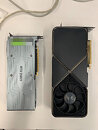
The rumor mill has no weekend break, and it churned out photos of what appears to be an NVIDIA Founders Edition version of the upcoming GeForce RTX 3090 next to the equivalent FE RTX 2080, with the latter looking like a toy compared to the massive triple slotter. The cooler comprises of the same design we discussed in detail in June, with the unique obverse dual-fan + aluminium heatsink seen in the images below. We also covered alleged PCB photos, in case you missed them before, and all lines up with the most recent leaks. The only difference here is that pricing for the RTX 3090 FE is claimed to be $1400, a far cry from the $2000 mark we saw for certain aftermarket offerings in the makings, and yet significantly higher from the previous generation- a worrying trend that we eagerly await to see justified with performance, before we even get into case compatibility concerns with the increased length here. Either way, if the images below are accurate, we are equally curious about the cooling capability and how it affects partner solutions and pricing.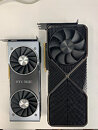
Source:
Twitter user @GarnetSunset


183 Comments on NVIDIA GeForce RTX 3090 Founders Edition Potentially Pictured: 3-slot Behemoth!
Just saying :)
AMD has a hell of a leap to catch up and be competitive. I think they'll do it.. but they'll be on the outside looking in by at least 10-15%. It will be slower, cheaper and use less power...AMD's motto on the GPU side.
Having said that, You probably wouldn't want to do it as a 5700XT will bottleneck like mad in a T3500 (even with a 3.8GHz 6c12t CPU) so this GPU would be choked to death.Isn't that exactly what the GTX580 was, it beat the GTX480 in both, hell some AIB 580s were sucking over 100w more than the 480 lol
As for the 5700 being stretched in efficiency somehow proving they're further behind: obviously not, which you yourself mention. The 5700 XT is a comparatively small die, which AMD chose to push the clocks of to make it compete at a higher level than it was likely designed for originally. The 2080 Ti on the other hand is a classic wide-and-(relatively-)slow big die GPU, which gives it plenty of OC headroom if the cooling is there, but also makes it operate in a more efficient DVFS range. AMD could in other words compete better simply by building a wider chip and clocking it lower. Given just how much more efficient the 5700 non-XT is (166W average gaming power! With the 5700 XT just winning by ~14%!) we know even RDNA 1 can get a lot more efficient than the 5700 XT (not to mention the 5600 XT, of course, which beats any Nvidia GPU out there for perf/W). And the 2080 Ti still can't get 2x the performance of the 5700 non-XT (+54-76% depending on resolution). Which tells us that AMD could in theory build a slightly downclocked double 5700 non-XT and clean the 2080 Ti's clock at the same power, as long as the memory subsystem keeps up. Of course they never built such a GPU, and it's entirely possible there are architectural bottlenecks that would have prevented this scaling from working out, but the efficiency of the architecture and node is there. And RDNA 2 GPUs promise to improve that both architecturally and from the node. We also know that they can clock to >2.1GHz even in a console (which means limited power delivery and cooling), so there's definitely improvements to be found in RDNA 2.
The point being: if AMD is finally going to compete in the high end again, they aren't likely to go "hey, let's clock the snot out of this relatively small GPU" once again, but rather design as wide a GPU as is reasonable within their cost/yield/balancing/marketability constraints. Then they might go higher on clocks if it looks like Nvidia are pulling out all the stops, but I would be downright shocked if the biggest big Navi die had less than 80 CUs (all might not be active for the highest consumer SKU of course). They might still end up releasing a >350W clocked-to-the-rafters DIY lava pool kit, but if so that would be a reactive move rather than one due to design constraints (read: a much smaller die/core count than the competition) as in previous generations (RX 590, Vega 64, VII, 5700 XT).
I don't think anyone will mind a 250W Big Navi being more than 20% behind Ampere if said Ampere is 350W or more. On the other hand, if it was more than 20% Ampere at the same power? That would be a mess indeed - but it's looking highly unlikely at this point. If Nvidia decided to go bonkers with power for their high end card, that's on them.
You're going a lot further down the wormhole than I ever want to go. Time will tell... but I dont see big navi within 15%. That said, we'll all take that as a win im sure (depending on price).
10.5" long
4.6" high
1.4" wide
My 980Ti AMP! Omega (and the Extreme version) is:
12.9" long
5.25" high
??? wide - can't find specific width dimensions listed, but it takes up just shy of 3 slots (by "just shy" I mean about 1/4" of an inch, if that)
My guess is the pictured (supposedly) 3090 is similar in size as my 980Ti AMP Omega card.Only problem you run into if you keep a card for a very long period of time is they will eventually drop support. I had some GTX 280 in SLI for about 3.5 years. About a year after I stopped using them I gifted one to my younger brother and he used it for about 3 years. This put the age of card just over 7 years old of the release date (originally released June 2008). Nvidia stopped driver support for that series of cards in 2014, if I remember correctly.
He used that card until the release of Dying Light (which was 2015), but the driver support was gone for his 280 and Dying Light literally wouldn't work because the driver was too old. The game would tell him his card/driver was not supported.
My point is, sure, you can use a card for a good amount of time, but unfortunately it will stop getting support and new games won't run.
This does look like it would need a support inside the case, because I can already imagine cards breaking the PCIe slots/their own connectors...
With the premium series being capped in performance, Nvidia will need to artificially gimp their GTX series to avoid cannibalizing the sales of RTX series. The same should be expected with the upcoming 3xxx series as I am sure Nvidia will double down on the likes of RT and DLSS. In addition, I am not sure what sorts of bespoke tech will Nvidia introduce at the hardware level since they tend to do this with every new generation.I don't agree. While I am not fan of giant graphic card/ cooler, the reality is that with every few passing generations, we are observing a jump in size. When I started on my first PC, the graphic card I used relies on passive cooling with a small heatsink. Then active cooling started creeping in after a few years. The active coolers grew in size over the years but maintained as a single slot. Then 2 slots cooler appeared, 2x fans. Fast forward to the recent 3 to 4 years, it is not uncommon to see coolers with 3x fan, taking up 3 slots, and also taller than the graphic card. As technology improve, the graphic card makers get more aggressive with adding hardware and features, pushing the boundaries and also power consumption.
Once more, all I can say is... credibility... LOWIs that Jerry? Lol. I can sort of hear his soothing voice :twitch:Big Navi might gain 30, best case 40% over RDNA2. Best case. Or AMD has gone similarly mental and this whole 3090 BS is true and they do both sport 400+W cards that I won't ever buy :p In that case I'm staying far away from any res higher than 1440p for the foreseeable future and keep rolling with sensible pieces of kit... but then I might do that anyway.Perhaps the far more interesting question is what AMD is going to offer across the stack below their top end RDNA part. Because it was AMD itself that once told us when they were gonna do RT, it would be from midrange on up. Where is it? .... Its starting to smell a lot like late to the party again.
1) 505mm2 (a rumor, however from a source with good track record) and 80CUs (over 5700XTs 40CUs), all sounds reasonable
2) PS5 being able to push GPU to 2.1Ghz (with some power consumption reservations)
3) RDNA2 should be a bit faster, not slower, than RDNA1
Optimistically, next gen, improved fab node, twice 5700XT with faster RAM could be about 100% faster.
Taking 2080Ti as being 45% faster than 5700Xt, we get:
RDNA2 505mm2 thing with 80CUs = 2/1.45 =38% faster than 2080Ti, or somewhat lower (it would, of course, be drastically different in different games, but note how optimizing for RDNA2 becomes unavoidable, given AMD's dominance in console market)
They did form an good card in a package with best ever cooler system, this does not happen every day.
www.ittsb.eu/forum/index.php?topic=1598.0
I also believe if big navi does that, it will be at least a 225W GPU... more likely 250W.
Any more would have me very surprised.
So far AMD has not shown us a major perf/w jump on anything GCN-based ever, but now they call it RDNA# and they suddenly can? Please. Tonga was a failure and that is all they wrote. Then came Polaris - more of the same. Now we have RDNA2 and already they've been clocking the 5700XT out of its comfort zone to get the needed performance. And to top it off they felt the need to release vague 14Gbps BIOS updates that nobody really understood, post/during launch. You don't do that if you've got a nicely rounded, future proof product here.
I'm not seeing the upside here, and I don't think we can credit AMD with trustworthy communication surrounding their GPU department. It is 90% left to the masses and the remaining 10% is utterly vague until it hits shelves. 'Up to 50%'... that sounds like Intel's 'Up to' Gigahurtz boost and to me it reads 'you're full of shit'.
Do you see Nvidia market 'up to'? Nope. Not a single time. They give you a base clock and say a boost is not guaranteed... and then we get a slew of GPUs every gen that ALL hit beyond their rated boost speeds. That instills faith. Its just that simple. So far, AMD has not released a single GPU that was free of trickery - either with timed scarcity (and shitty excuses to cover it up, I didn't forget their Vega marketing for a second, it was straight up dishonest in an attempt to feed hype), cherry picked benches (and a horde of fans echoing benchmarks for games nobody plays), supposed OC potential (Fury X) that never materialized, supposed huge benefits from HBM (Fury X again, it fell off faster than GDDR5 driven 980ti which is still relevant with 6GB), the list is virtually endless.
Even in the shitrange they managed to make an oopsie with the 560D. 'Oops'. Wasn't that their core target market? Way to treat your customer base. Of course we both know they don't care at all. Their revenue is in the consoles now. We get whatever falls off the dev train going on there.
Nah, sorry. AMD's GPU division has lost the last sliver of faith a few generations back, over here. I don't see how or why they would suddenly provide us with a paradigm shift. So far, they're still late with RDNA as they always have been - be it version 1, 2 or 3. They still haven't shown us a speck of RT capability, only tech slides. The GPUs they have out lack feature set beyond RT. Etc etc ad infinitum. They've relegated themselves to followers and not leaders. There is absolutely no reason to expect them to leap ahead. Even DX12 Ultimate apparently caught them by surprise... hello? Weren't you best friends with MS for doing their Xboxes? Dafuq happened?
On top of that, they still haven't managed to create a decent stock cooler to save their lives, and they still haven't got the AIBs in line like they should. What could possibly go wrong eh
//end of AMD roast ;) Sorry for the ninja edits.
Beyond that, most of what you describe is during the tenure of Koduri, and while it is obviously wrong to place the blame for this (solely) at his feet, he famously fought tooth and nail for near total autonomy for RTG, with him taking the helm for the products produced and deciding the direction taken with them. He obviously wasn't at fault for the 64 CU architectural limit of GCN, which crippled AMD's GPU progress from the Fury X and onwards, but he was responsible for how the products made both then and since were specified and marketed. And he's no longer around, after all. All signs point towards there having been some serious talking-tos handed out around AMD HQ in the past few years.
But beyond the near-constant game of musical chairs that is tech executive positions, the main change is AMD's fortunes. In 2015 they were near bankrupt, and definitely couldn't afford to splurge on GPU R&D. In 2020, they are riding higher than ever, with Ryzen carrying them to record revenues and profits. In the meantime they've shown with RDNA that even on a relatively slim budget (RDNA development must have started around 2016 or so, picking up speed around 2018 at the latest) they could improve things signifcantly, and now they're suddenly flush with cash, including infusions from both major high performance console manufacturers. The last time they had that last part was pre-2013, when they were already struggling financially, and both console makers went (very) conservative in cost and power draw for their designs. That is by no means the case this time around. They can suddenly afford to build as powerful a GPU as they want to within the constraints of their architecture, node and fab capacity.
And as I mentioned, RDNA has shown that AMD has found a way out of the GCN quagmire - while 7nm has obviously been enormously beneficial in allowing them to get close to (5700 XT), match (5700, 5500 XT) or even beat (5600 XT) Nvidia's perf/W, it is by no means the main reason for this, as is easily seen by comparing the efficiency of the Radeon VII vs. even the 5700 XT. And with RDNA being a new architecture with a lot of new designs, it stands to reason that there are more major improvements to be made to it in its second generation than there were to GCN 1.whatever.
As for the Fury X falling behind the 980 Ti: not by much. Sure, the 980 Ti is faster, and by a noticeable percentage (and a higher percentage than at launch), but they're still firmly in the same performance class. The 980 Ti has "aged" better, but by a few percent at best.
So while I'm all for advocating pessimism - you'll find plenty of my posts here doing that, including on this very subject - in this case I think you're being too pessimistic. I'm not saying I think AMD will beat or even necessarily match Ampere either in absolute performance or perf/W, but there are reasons to believe AMD has something good coming, just based on firm facts: We know the XSX can deliver a 52CU, 12TF GPU and an 8c16t 3.6GHz Zen2 CPU in a console package, and while we don't know its power draw, I'll be shocked if that SoC consumes more than 300W - console power delivery and cooling, even in the nifty form factor of the XSX, won't be up for that. We also know the XSX runs at a relatively low clock speed with its 52 CUs thanks to the PS5 demonstrating that RDNA 2 can sustain 2.1 GHz even in a more traditional (if enormous) console form factor. We also know that even RDNA 1 can clearly beat Nvidia in perf/W if clocked reasonably (hello, 5600 XT!). What can we ascertain from this? That RDNA 2 at ~1.8GHz is quite efficient; that RDNA 2 is capable of notably higher clock speeds than RDNA 1, and that AMD is entirely capable of building a wider die than the RX 5700 - even for a cost-sensitive console.