Wednesday, September 23rd 2020

GALAX Confirms GeForce RTX 3080 20GB and RTX 3060, RTX 3060 Matches RTX 2080
An alleged event by GALAX targeted at distributors in China revealed up to three upcoming SKUs in NVIDIA's RTX 30-series. This comes as yet another confirmation from a major NVIDIA AIC partner about the 20 GB variant of the GeForce RTX 3080. The RTX 3080 originally launched with 10 GB memory earlier this month, and it is widely expected that NVIDIA fills the price-performance gap between this $700 SKU and its $1,500 sibling. The RTX 3080 uses twenty 8 Gbit GDDR6X memory chips (two chips per 32-bit data-path), much like how the RTX 3090 achieves its 24 GB memory amount.
Elsewhere we see GALAX mention the RTX 3060, a performance-segment SKU positioned under the RTX 3070. You'll notice that the product-stack graph by GALAX suggests performance comparisons to previous-generation SKUs. The RTX 3080 and RTX 3090 are faster than everything from the previous generation, while the RTX 3070, which is coming next month, is shown trading blows with both the RTX 2080 Ti and the RTX 2080 Super. In this same graph, the RTX 3060 is shown matching up to the RTX 2080 (non-Super), a card NVIDIA originally launched at $700.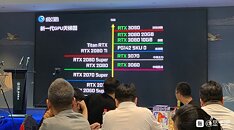 There's an unnamed SKU slotted between the RTX 3070 and the RTX 3080 10 GB, which is codenamed "PG142 SKU 0." Some AICs/OEMs are referring to this as the "RTX 3070 Ti," and others the "RTX 3070 Super." Given that the Super brand extension has been used by NVIDIA to denote a mid-life refresh for an existing product stack, it's very likely that this SKU is simply the RTX 3070 16 GB (RTX 3070 with 16 GB of GDDR6 memory, and perhaps bolstering in other areas). This SKU is shown trading blows with the RTX 2080 Ti and the TITAN RTX.
Source:
Overclocking.com
Elsewhere we see GALAX mention the RTX 3060, a performance-segment SKU positioned under the RTX 3070. You'll notice that the product-stack graph by GALAX suggests performance comparisons to previous-generation SKUs. The RTX 3080 and RTX 3090 are faster than everything from the previous generation, while the RTX 3070, which is coming next month, is shown trading blows with both the RTX 2080 Ti and the RTX 2080 Super. In this same graph, the RTX 3060 is shown matching up to the RTX 2080 (non-Super), a card NVIDIA originally launched at $700.

81 Comments on GALAX Confirms GeForce RTX 3080 20GB and RTX 3060, RTX 3060 Matches RTX 2080
Here you have a 2070 Super at 4k ultra with DXR playing Battlefield V, on a 9600K. Mem usage 7GB. Well the game runs around 45FPS but it is just a 2070 and that one has 8GB which is still enough. If you go down from any setting in the game, you wouldn't do it because of the Vram deficiency but to bump FPS. Maybe if the CPU was OC'ed to 5Ghz (in game shows 4.5-4.6), the game would run faster.
They (tried to) buy the 3080 because of the hype surrounding it, to go slot into their Ryzen 3300x system, DVI-linked to a 60hz 1080p HP monitor they bought on Black Friday at Walmart.
More is always better so more VRAM definitely is better, right? At least this way they might release the current 3080s into the used market.
(I would like to believe that) Nvidia isn't stupid. They made the current cards with the current VRAM size because they devised that it would be more than enough for more than 90% of users buying a 3080.
This size of VRAM is a commodity, where you either have special use cases (i.e. planning for 4K, 8K texture mods on EVERYTHING for 2077 with custom meshes including 2B ass port) or you buy for future proofing (which is gamble within itself as it heavily depends on game developers utilizing what Nvidia gives them. SLI was a good example of FOMO, now that its officially dead for the average consumer. MAAAAAYBEEE it might help DLSS3.0 but tin foil hat theory with the premises that they have to use the extra VRAM for something.).
Currently, the real bottleneck that no one talks about is the audio/video interface. Idk if its possible to get around it by forcing multiple links (as seen on some monitors), though 8K 60fps "HDR+" (no compression) is already impossible with a single HDMI2.1/DP2.0 (the marketing numbers they give you up front are the maximum resolution with compression without HDR+ and at or lower than 60fps). So you gain all this processing power that your monitor can't even fully display because of a physical bandwidth limit of the interface. This is the reason the marketing shifted to 8K gaming, now that the 4k high refresh rate (120+) HDR gaming is a reality, the new "1440p," so they want you to lust for the next unobtainable.
Over the years, very few of my "early adopter" experiences have panned out. Most of them were simply victims of early adopter tax. It's why it's called a tax.
If you wait for just a month or two, you can usually get a better version of that product for less money with more stable drivers and better all-round experience.
For an early adopter, it's all about getting the latest hardware, as soon as it is available. Not getting the best deal and teething problems go with the territory. Otherwise we'd all be early adopters.
You said yourself, - not getting the best deal and teething problems, for the sake of impatience. If you don't call that a sucker, what do you call a sucker?
I had a GTX1080 and have been waiting since Turing, watched reviews and knew what I wanted. To an extent I even enjoy the 'experimental' type features that don't have wide support and being on that bleeding edge. Hec even that GTX1080 was purchased launch week and I enjoyed over 4 years of amazing performance from it, including Nvidia allowing Freesync to work and enabling RTX for the lols, and even today it performs admirably.
To me, the only ways the RTX3080 10gb doesn't 'pan out' for me is if the card outright dies or has some widespread hardware issue it needs to be RMA'd for (even then it's manageable), or more likely a new product releases soon that reduces the RTX3080 10gb value by worsening the price/performance ratio compared to then new products.
Regardless of your doubts because of past history, when two or more companies release new products within a month of each other, it's common sense to see what both have on offer...
Before, it was RDNA. Big words, ok performance but nothing game changing, much driver issues.
Before that, it was Vega and so on and so forth...
5700XT didn't have RTRT either, but it came for like $100 less.