Wednesday, February 23rd 2022

Intel's Global CPU Market Share is on the Rise, AMD Starts the Downfall
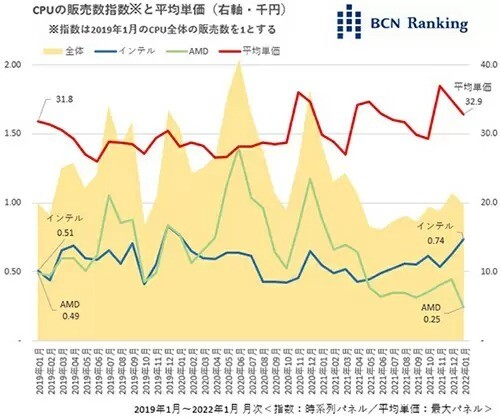
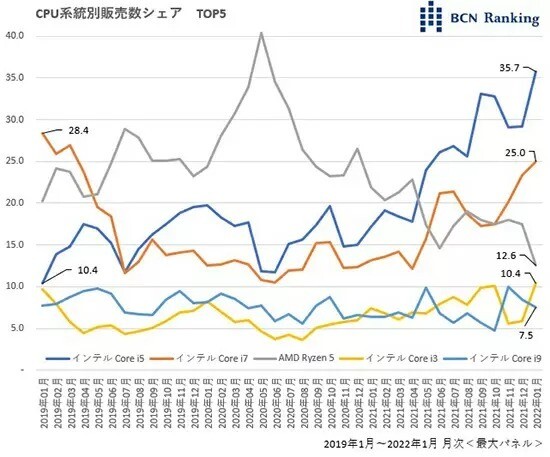
Since the launch of AMD's Ryzen processors, the CPU market share has been reshaped in AMD's favor. Intel's offerings were matched by team red, and AMD quickly broke into the consumer market. However, according to the latest round of reports, it seems like that is no longer the case. As per the Japanese DIY market analysis from BCNR, sales of Intel processors started rising in mid-2021, and the company is managing to grab some market share from AMD. After nearly two years of dominance in the Japanese market, AMD is now behind Intel in sales, and team blue is getting back to its older setting.
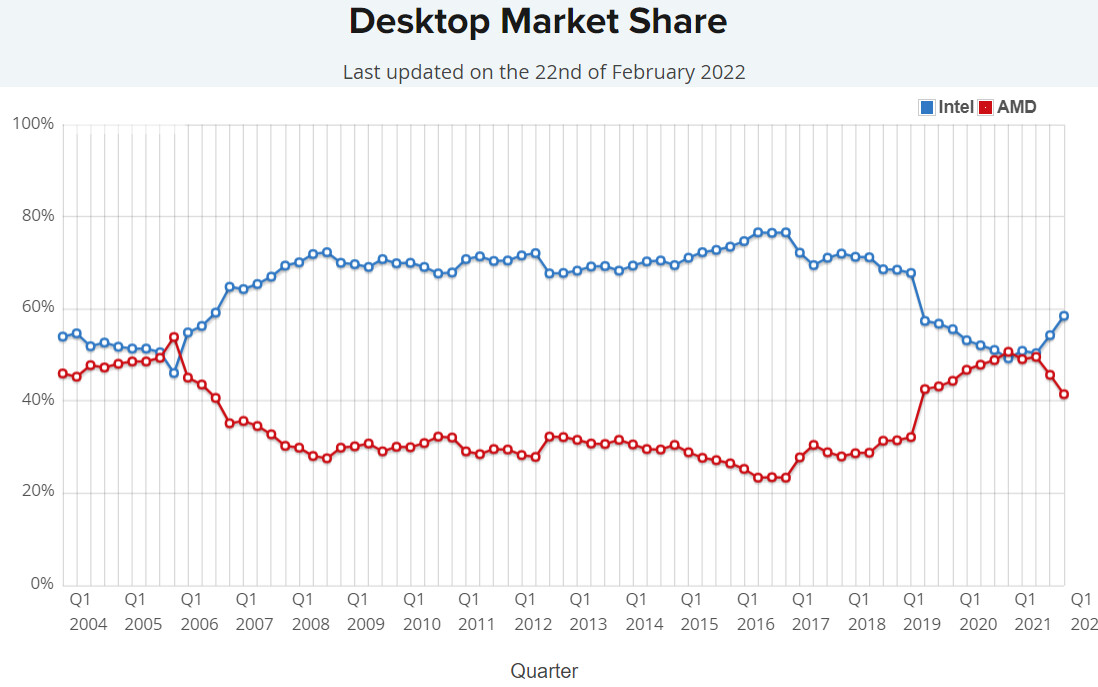
Another source that is generally a pretty good indicator of the market share of Intel and AMD processor is PassMark. As users submit their benchmark runs, the PassMark software developer has updated the CPU market share statistics chart, mainly showing the desktop segment. It also concludes the same thing as BCRN: Intel is again gaining share in the CPU market. As it always goes hand-in-hand, AMD is losing the CPU marker share naturally. This is due to many reasons, and it seems like Intel's marketing and supply tactics are paying off. Intel now sits at 60% share, while AMD is set at 40%.


Source:
via VideoCardz
Another source that is generally a pretty good indicator of the market share of Intel and AMD processor is PassMark. As users submit their benchmark runs, the PassMark software developer has updated the CPU market share statistics chart, mainly showing the desktop segment. It also concludes the same thing as BCRN: Intel is again gaining share in the CPU market. As it always goes hand-in-hand, AMD is losing the CPU marker share naturally. This is due to many reasons, and it seems like Intel's marketing and supply tactics are paying off. Intel now sits at 60% share, while AMD is set at 40%.
112 Comments on Intel's Global CPU Market Share is on the Rise, AMD Starts the Downfall
Let's face both AMD and Intel both only care about the markets that make them money. My strategy, buy who ever is better at the time I build.
wccftech.com/amd-ryzen-5000-desktop-cpu-major-price-cuts-5950x-599-5900x-449-5800x-299-5600x-229/
5600X becomes a better deal than 12400F with these prices since B660 MBs are more expensive than B450/B550.
5600X(230usd)+B550(80usd)=310usd
12400F(180usd)+B660(120usd)=300usd
5600X is slightly faster stock and 5-10% faster with max tuning.
5800X is a bit more attractive now.
5800X(300usd)+B550(80usd)=380usd
12600KF(270usd)+Z690(200usd)=470usd
12600KF is about 10% faster stock, up to 15% tuned, maybe worth 90usd more.
590X and 5950X is only worth it for productivity even with these prices.
Keep trying.
No matter how you look at it margins are better in datacenter and HPC parts. Not only are the margins better, once you win one datacenter contract thats good for at least five years minimum as platforms are expanded and upgraded, and replicated across sites so that one initial win is pretty much guaranteed to provide future sales for years down the road.IDK, if you had limited supply who would you rather say "no" to. DellEMC, and HPE or a bunch of fickle gamers?Its fair to criticize them for the priority decisions they made but I would say the made the right business priorities. Ideally I'm sure they'd go after all of the markets including entry-level to mid-range markets that would be served by a 4 core Zen3 but I don't think they have the resources to pursue all that at the same time. Zen3 chiplets are already pretty small (compared to Alder Lake anyway) and yields are really good so while you'd get more by making a smaller chiplet and slightly better yields there is less money in each chip so there isn't much incentive to do it when your 8 core chiplet is yeidling great and selling out. Also, nobody really buys server CPUs in less than 10 core per socket configurations so a 4 core chiplet would be pretty much useless for Epyc.
You're also missing the point when talking about yields - the point of a smaller die wouldn't be better yields (those are already great), but simply increasing the die per wafer count. Heck, if anything, the good yields from TSMC 7nm is a disincentive towards producing low-end chips from an 8c CCX, as there simply aren't enough defective chips for this. That's why I brought up a smaller die to begin with. A thought experiment (which is obviously very simplistic, but still useful): the Zen3 CCD is reportedly 11.27x7.43mm. Putting that into a die per wafer calculator alongside TSMC's (old, likely superseded) 0.09/cm² defect density, gives us 692 complete dice per wafer, with ~50 defects. So, ~642 fully functioning dice, with 50 that might be salvaged with a lower core or CU count or cache size (though they may also be unsalvageable). AMD has essentially no reason to sell lower core count chips unless they just can't meet power or clock targets. So, let's assume a 4c CCX would just have the bottom four cores lopped off (it would likely entail more of a reconfiguration of the layout, but the area would still be similar). That would make it ~11.27x4.2. Plugging that back into the calculator gives us 1228 total dice with 51 defects or 1177 fully enabled dice per wafer. That's not quite a doubling, but it's still a massive increase in output per wafer. And these dice would of course be equally usable across their entire product range, from consumer desktop to OEM desktop to low core count/high RAM bandwidth/high PCIe lane count servers. And, of course, you could still make a 32c EPYC with these if you wanted to, though it would have slightly higher latencies than 4x8 core equivalents. Designing the new die would be a significant cost, but it would give them a product portfolio much better suited to addressing a diverse market, while drastically increasing the actual numbers of chips produced. And allocating even 10% of the wafers used for producing 8c CCDs would have given them a pretty significant amount of 4c CCDs.
Of course, there are more factors than just CCDs in this, and there have been reported shortages of CPU packaging and substrate materials, hold-ups with downstream processing plants, and it's not given that they have sufficient IOD supplies for this either. They also likely banked on their single Zen3 die to hold them over till Zen4 alongside the new APUs, but this has clearly failed in light of the shortages.
But most of that is unknown and unknowable, and doesn't change the fact that I simply think AMD made the wrong judgements here, and reacted poorly to the shortages. They tried to ride things out and keep prices high while investing minimally, which is backfiring significantly against a resurgent Intel that competes across a much broader range of products. They've left the low end essentially barren for two product generations and multiple years, which is undermining the public support that allowed them to gain their current position in the first place. This might be a passable plan if you're in an entrenched position of power, but AMD isn't. They're still highly vulnerable to the much larger and wealthier Intel. And especially in light of that, but also in light of their responsibility to produce actually useful and somewhat attainable products for their customers, I think they've missed the mark.
They just don't have the resources to fill every product market segment and what they do have is addressing the most valuable segment so while I'd personally really like a 4 core Ryzen for my HTPC and to be able to recommend a Ryzen 3 or 5 as entry level CPU to someone I find it really hard to find fault in their product road maps.
Yeah B660 is pricier but good entry have against the B550 2x M2 with PCIE 4.0,
B550 offers only 1x 4.0.
B550 is between H610 and B660.
Ram oc is shit in gear 1 on B660 on locked CPUs, best you can expect is 3400-3600 vs 3800+ on B550. Also you can overclock CPU on B550.
If you plan on getting Raptor lake B660 can be viable, also Asus B660 strix F and G D5 can overclock locked CPUs.