Monday, January 20th 2025

NVIDIA's Frame Generation Technology Could Come to GeForce RTX 30 Series
NVIDIA's deep learning super sampling (DLSS) has undergone many iterations to the current version 4 with the transformer model, delivering new technologies such as DLSS Multi Frame Generation, predicting multiple frames in advance to generate the upcoming frame, and increasing the frame output per second. However, not every NVIDIA GPU generation supports these more modern DLSS technologies. In an interview with Digital Foundry, Bryan Catanzaro, VP of Applied Deep Learning Research at NVIDIA, commented on trickling down some DLSS technologies to older GPU generations. For example, DLSS Ray Reconstruction, Super Resolution, and Deep Learning Anti-Aliasing (DLAA) work on NVIDIA GeForce RTX 20/30/40/50 series GPUs. However, the RTX 40 series carries an exclusive DLSS Frame Generation, and the newest RTX 50 series carries the DLSS Multi Frame Generation as an exclusive feature.
However, there is hope for older hardware. "I think this is primarily a question of optimization and also engineering and then the ultimate user experience. We're launching this Frame Generation, the best Multi Frame Generation technology, with the 50 Series, and we'll see what we're able to squeeze out of older hardware in the future." So, frame generation will most likely arrive on the older RTX 30 series, with even a slight possibility of the RTX 20 series getting the DLSS frame generation. Due to compute budget constraints, the multi-frame generation will most likely stay an RTX 50 series exclusive as it has more raw computing power to handle this technology.
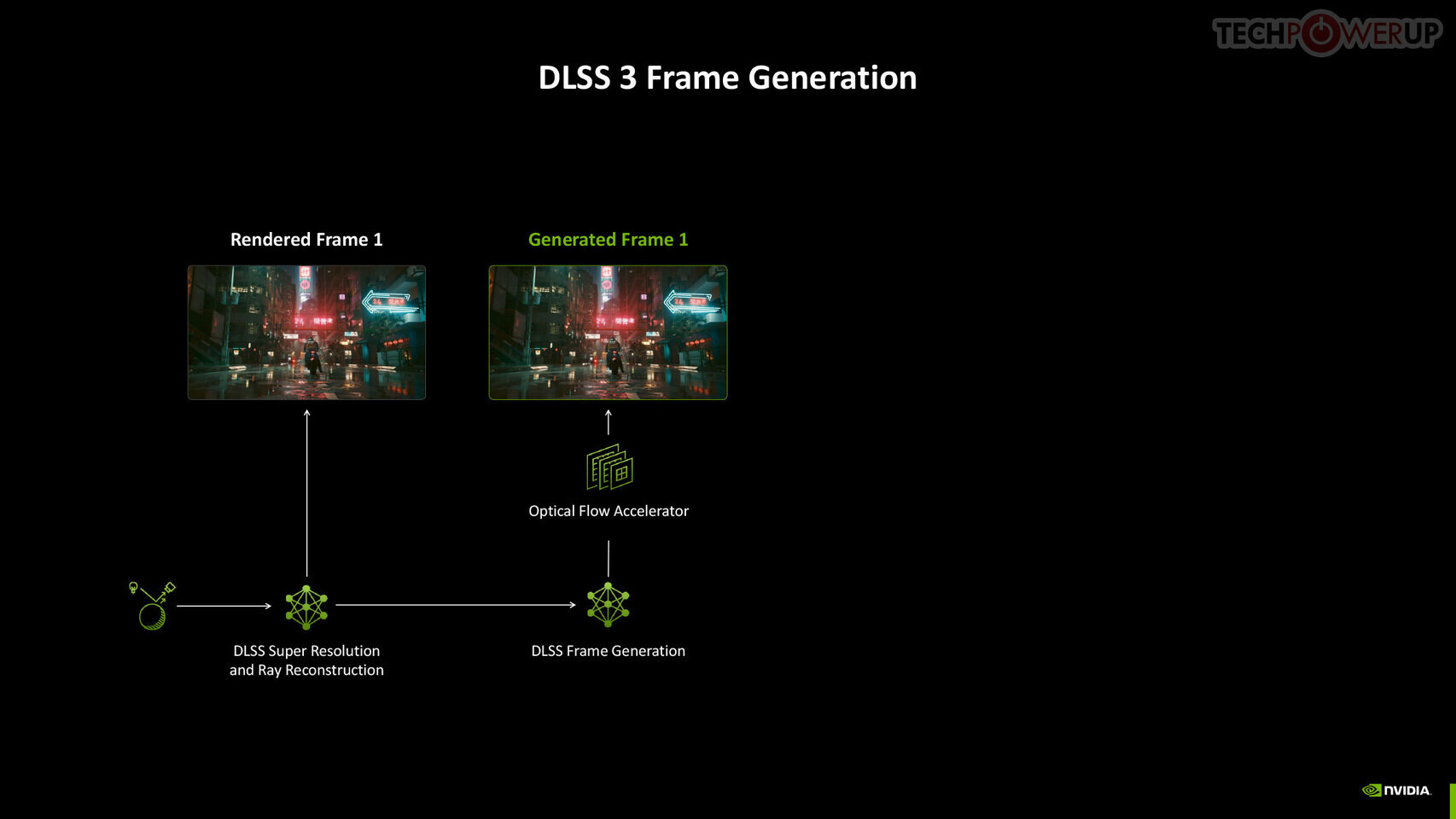
 Bryan Catanzaro also shared some notes about the DLSS development. "When we built NVIDIA DLSS 3 Frame Generation, we absolutely needed hardware acceleration to compute Optical Flow. We didn't have enough Tensor Cores and we didn't have an Optical Flow algorithm that was good enough. We hadn't developed a real-time Optical Flow algorithm that ran on Tensor Cores that could fit our compute budget. We had the Optical Flow accelerator, which NVIDIA had been building for years as an evolution of our video encoder technology, and it's also been a part of our automotive computer vision acceleration for self-driving cars.
It made sense for us to use that for NVIDIA DLSS 3 Frame Generation. But the difficult part about any sort of hardware implementation of an algorithm like Optical Flow is that it's really difficult to improve it. It is kind of what it is and the failures that arose from that hardware Optical Flow, we couldn't undo them with a smarter neural network until we decided to just replace it and go with a fully AI-based solution, so that's what we've done for Frame Generation in DLSS 4."
Sources:
Digital Foundry, via VideoCardz
However, there is hope for older hardware. "I think this is primarily a question of optimization and also engineering and then the ultimate user experience. We're launching this Frame Generation, the best Multi Frame Generation technology, with the 50 Series, and we'll see what we're able to squeeze out of older hardware in the future." So, frame generation will most likely arrive on the older RTX 30 series, with even a slight possibility of the RTX 20 series getting the DLSS frame generation. Due to compute budget constraints, the multi-frame generation will most likely stay an RTX 50 series exclusive as it has more raw computing power to handle this technology.

It made sense for us to use that for NVIDIA DLSS 3 Frame Generation. But the difficult part about any sort of hardware implementation of an algorithm like Optical Flow is that it's really difficult to improve it. It is kind of what it is and the failures that arose from that hardware Optical Flow, we couldn't undo them with a smarter neural network until we decided to just replace it and go with a fully AI-based solution, so that's what we've done for Frame Generation in DLSS 4."
64 Comments on NVIDIA's Frame Generation Technology Could Come to GeForce RTX 30 Series
especially if the raw performance gains of the new 50xx series is not that impressive
They did the same with DLSS with older cards. Same will go with DLSS Frame generation. I'm disappointed Nvidia didn't make any serious hardware improvements or advancements with the 50serious.
Skip---> click here.
Here's hoping the next Gen will be next Gen.
A bit after they acquired PhysX, they disabled hardware acceleration if the drivers detected a Radeon card in your system. So even if you bought and paid for an Nvidia card to use for PhysX acceleration you got screwed over.
One of the more useful situations for frame generation are for games that have a 60 (or 30) fps cap and can't unlock the framerate. Most likely in these titles the GPU will have computational power to spare for frame generation.
At this point I wouldn't be surprised to find out that Tensor cores actually do nothing in a game and locking DLSS is just an artificial driver limitation.
...yeah, for some reason, I remembered a ~20 year old scenario when they brought a feature from the newer gen to the older gen since it was practically artificially limited. :laugh:
Nvidia has a LOT of highly educated well paid engineers on this. Pathfinding takes time and research - it’s literally why it’s called pathfinding.
I know enough about science to know that blindly trusting a company (primary source) whose main goal is to sell you stuff without any info from independent sources is dumb.
I mean in this very thread i've read about how fine FSR FG is running, so obviously it doesn't need all the nvidia tech to run FG. No mention of loss of detail here. If you go a thread about RT, oh boy, FG is so bad and the loss of image quality is insane.
Like even if it was an artificial limit, who cares honestly. There was no FG when youbought the card, you thought it was a good deal without FG and that's why you bought it, why do you expect someone to do something for free is beyond me honestly.
This is not an AMD vs Nvidia fight, so please don't make it so. This is a fight for our rights to be informed consumers regardless of the colour of the box. The "you must love everything about Nvidia, otherwise you're an AMD fan and can't have an opinion" bullshit is getting very tiresome.
If AMD limits FSR 4 to RDNA 4 because of its AI cores, I'll question it just the same, considering that RDNA 3 has AI cores, too. I want details, not excuses.Do you think it's unimaginable that someone swapped a 30-series card for a 40-series one specifically for FG? Then why is FG such a huge part of Nvidia's marketing?
You keep acting like you are unbiased and how dare I state otherwise but your posts.. I mean you posted the other day how the gpu market is crap but you had to add in that one manafacturer is mostly to blame. You keep adding that poisonous bias into your posts. It is what it is.
2. Wider game adoption.
3. Even if it doesn't work properly, it's at least a demo for your future purchase, just like RT on a 1660 Ti was.
4. If spending resources on it doesn't make sense, then why did they decide to do it now? Why not just leave it?