Monday, January 20th 2025

NVIDIA's Frame Generation Technology Could Come to GeForce RTX 30 Series
NVIDIA's deep learning super sampling (DLSS) has undergone many iterations to the current version 4 with the transformer model, delivering new technologies such as DLSS Multi Frame Generation, predicting multiple frames in advance to generate the upcoming frame, and increasing the frame output per second. However, not every NVIDIA GPU generation supports these more modern DLSS technologies. In an interview with Digital Foundry, Bryan Catanzaro, VP of Applied Deep Learning Research at NVIDIA, commented on trickling down some DLSS technologies to older GPU generations. For example, DLSS Ray Reconstruction, Super Resolution, and Deep Learning Anti-Aliasing (DLAA) work on NVIDIA GeForce RTX 20/30/40/50 series GPUs. However, the RTX 40 series carries an exclusive DLSS Frame Generation, and the newest RTX 50 series carries the DLSS Multi Frame Generation as an exclusive feature.
However, there is hope for older hardware. "I think this is primarily a question of optimization and also engineering and then the ultimate user experience. We're launching this Frame Generation, the best Multi Frame Generation technology, with the 50 Series, and we'll see what we're able to squeeze out of older hardware in the future." So, frame generation will most likely arrive on the older RTX 30 series, with even a slight possibility of the RTX 20 series getting the DLSS frame generation. Due to compute budget constraints, the multi-frame generation will most likely stay an RTX 50 series exclusive as it has more raw computing power to handle this technology.
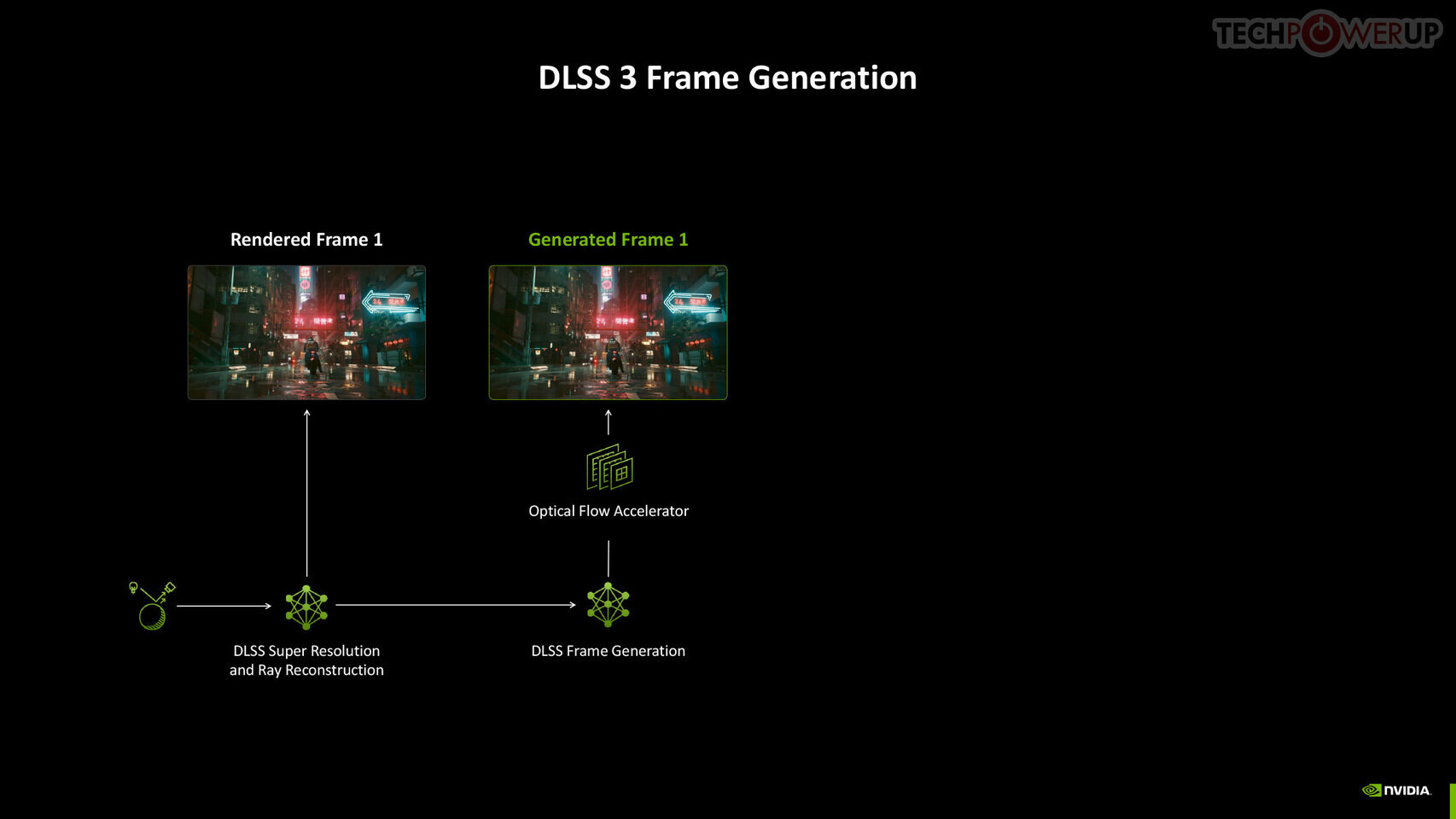
 Bryan Catanzaro also shared some notes about the DLSS development. "When we built NVIDIA DLSS 3 Frame Generation, we absolutely needed hardware acceleration to compute Optical Flow. We didn't have enough Tensor Cores and we didn't have an Optical Flow algorithm that was good enough. We hadn't developed a real-time Optical Flow algorithm that ran on Tensor Cores that could fit our compute budget. We had the Optical Flow accelerator, which NVIDIA had been building for years as an evolution of our video encoder technology, and it's also been a part of our automotive computer vision acceleration for self-driving cars.
It made sense for us to use that for NVIDIA DLSS 3 Frame Generation. But the difficult part about any sort of hardware implementation of an algorithm like Optical Flow is that it's really difficult to improve it. It is kind of what it is and the failures that arose from that hardware Optical Flow, we couldn't undo them with a smarter neural network until we decided to just replace it and go with a fully AI-based solution, so that's what we've done for Frame Generation in DLSS 4."
Sources:
Digital Foundry, via VideoCardz
However, there is hope for older hardware. "I think this is primarily a question of optimization and also engineering and then the ultimate user experience. We're launching this Frame Generation, the best Multi Frame Generation technology, with the 50 Series, and we'll see what we're able to squeeze out of older hardware in the future." So, frame generation will most likely arrive on the older RTX 30 series, with even a slight possibility of the RTX 20 series getting the DLSS frame generation. Due to compute budget constraints, the multi-frame generation will most likely stay an RTX 50 series exclusive as it has more raw computing power to handle this technology.

It made sense for us to use that for NVIDIA DLSS 3 Frame Generation. But the difficult part about any sort of hardware implementation of an algorithm like Optical Flow is that it's really difficult to improve it. It is kind of what it is and the failures that arose from that hardware Optical Flow, we couldn't undo them with a smarter neural network until we decided to just replace it and go with a fully AI-based solution, so that's what we've done for Frame Generation in DLSS 4."
64 Comments on NVIDIA's Frame Generation Technology Could Come to GeForce RTX 30 Series
It's not the first time they changed it btw, dlss 1 was completely different to dlss 2 as well.
NVIDIA-Turing-Architecture-Whitepaper.pdf
NVIDIA A100 Tensor Core GPU: Performance and Innovation | IEEE Journals & Magazine | IEEE Xplore
nvidia-ampere-architecture-whitepaper.pdf
nvidia-ada-gpu-science.pdf
1803.04014
(is)was required for Nvidia's FG, and why it isn't for AMD's is awkwardly missing.The TPU review of the 4090 for example said that the optical flow thingy is required for FG, that's why the feature is missing in Ampere and Turing. Then an article came sometime later stating that the OFA has always been part of Ampere as well as Turing, it just... ehm... (*nvidia PR person searching through notes*)... isn't fast enough.
That wouldn't be the first time that something like that happens in tech. Like how AMD can make smaller CPU cores that are better than Intel big CPU cores. Or how nvidia managed to develop some kind of compression algorhitm and tile rendering with maxwell that allowed that arch to do more with less. This time around AMD was the one who found a way to make optical flow more efficient.
www.techspot.com/article/2747-amd-fsr-3-tech/
gpuopen.com/fidelityfx-super-resolution-3/
gpuopen.com/manuals/fidelityfx_sdk/fidelityfx_sdk-page_techniques_optical-flow/
Intel themselves is looking at another approach that won't introduce additional latency.
www.intel.com/content/www/us/en/developer/articles/technical/gffe-g-buffer-free-frame-extrapolation.html
ReBAR is also not some super new AI tech that requires dedicated hardware. It has been in the PCIe spec for a long time.
AMD on the other hand supports ReBAR on their older cards too.
AMD's FG works flawlessly on my RTX 3080, with minimum VRAM usage and latency, so you're telling me nVidia cannot do better? Hilarious.
MFG on 40 series
FG on 20 and 30 series
I reckon this will come out in about 2 months