Monday, August 4th 2025

AMD Readies 16-Core Ryzen 9000X3D CPU with 192 MB L3 Cache and 200 W TDP
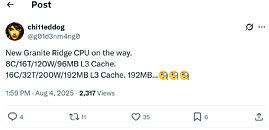
AMD is reportedly gearing up to expand its Ryzen 9000 "Granite Ridge" lineup with two all-new Zen 5 CPUs that push the limits of power draw and cache capacity. Leaker chi11eddog, who has cultivated ties with motherboard vendors, claims that AMD will introduce an 8-core/16-thread model rated at 120 W TDP, featuring a substantial 96 MB of L3 cache. This mirrors the cache density of the existing Ryzen 7 9800X3D, but could represent a distinct SKU. More striking is the rumored 16-core/32-thread part, a 200 W processor boasting 192 MB of L3 cache, surpassing the Ryzen 9 9950X3D's 128 MB. According to the leak, this chip features a dual-CCD design, with each chiplet pairing 32 MB of on-die cache with 64 MB of stacked 3D V-Cache, marking the first time AMD may ship a desktop CPU with 3D V-Cache on both dies.
If these claims prove accurate, AMD may finally have solved the economic puzzle of dual-X3D production. Until now, the company's top-end 16-core models have paired a single 3D V-Cache chiplet with a standard CCD. The new dual-stacked design removes that compromise and promises consistently high cache bandwidth across multithreaded workloads. If launched, these chips would reinforce AMD's gaming performance crown and finally bring true dual-X3D dies to the mainstream desktop arena.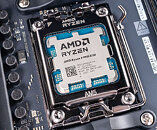
Sources:
chi11eddog on X, via VideoCardz
If these claims prove accurate, AMD may finally have solved the economic puzzle of dual-X3D production. Until now, the company's top-end 16-core models have paired a single 3D V-Cache chiplet with a standard CCD. The new dual-stacked design removes that compromise and promises consistently high cache bandwidth across multithreaded workloads. If launched, these chips would reinforce AMD's gaming performance crown and finally bring true dual-X3D dies to the mainstream desktop arena.


355 Comments on AMD Readies 16-Core Ryzen 9000X3D CPU with 192 MB L3 Cache and 200 W TDP
chipsandcheese.com/p/amds-strix-halo-under-the-hood
This was the answer I was referring to:
"That's a sea of wires. We use fan out, we're for level fan out in order to connect the two dies. So you get the lower latency, the lower power, it's stateless. So we're able to just connect the data fabric through that connect interface into the CCD. So the first big change between a Granite Ridge or a 9950X3D and this Strix Halo is the die-to-die interconnect. Low-power, same high bandwidth, 32 bytes per cycle in both directions, lower latency. So everything - and almost instant on-and-off stateless - because it's just a sea of wires going across. So it's a little [bit of a tradeoff] of course, the fabrication technology is more expensive than the one over there [points to a 9950X3D, but it meets the needs of the customer and the fact that it has to be a low power that can actually connect."
It seems that they've prioritized power instead but fanouts would technically allow them much lower latencies.
But it's an Intel optimized game so maybe something is going on, although HW Unboxed CPU benchmarks shows the 9800X3D being much faster than a 265K.
Some games may have some kind of dynamic LoD though, so any comparisons needs to make sure they are actually comparing apples to apples.
- 1st quadrant is CCD0's cores talking to one another in the same CCD
- 2nd quadrant is CCD0's cores talking with CCD1's cores
- 3rd quadrant is CCD1's cores talking to one another in the same CCD
- 4th quadrant is CCD1's cores talking with CCD0's cores
And yes, BT6 will be a heavy game, as it is probably poorly written and will need to be further optimized, but it is still in beta, so we'll see.
And yes, I know there are a few games where the code is too heavy or poorly written, and having more cores will make it run faster, thus achieving a higher FPS.
Or maybe having more cores is just better instead of buying a 1 trick pony 8 core cpu
And yes, as I mentioned earlier, there are a few games where more cores mean more FPS. I have no problem with BT6 being one of them, I just prefer to wait for more results.
But that's it because the engine need more cores, and this is different.
medium.com/codex/fixing-intel-compilers-unfair-cpu-dispatcher-part-1-2-4a4a367c8919
First of all, (compiled) applications, games, drivers and OS' are in >99% of cases compiled with either gcc, msvc or llvm, none of which are from Intel (for Windows software the biggest one is msvc).
Secondly, this is not about compiling code more optimized for Intel over AMD. Whoever wrote this nonsense article keep mixing in feature detection in math libraries, which is completely irrelevant when compiling code, and his argument hinges on guesses about what the assembly code does (which he isn't even sure about), and he doesn't even understand how the CPUID instruction works. This has no relevance for how games work.
wccftech.com/amd-ryzen-cpu-with-dual-x3d-chiplets-is-reportedly-fake-and-doesnt-exist/
www.agner.org/optimize/blog/read.php?i=49#49
Intel's compiler is still relevant in some math libraries, but nowadays it's just a fork of LLVM with their patches that haven't made to upstream on top, similar to AMD's AOCC (a fork of LLVM as well).I agree that this has nothing to do with how games work, but they never mentioned this to be the case, their focus was on math libraries and fortran code.
The compiler is relevant because it's using Intel's stdlib impl, with their own intrinsics, which are done in compile-time.
There's both a runtime and a build time aspect of that post, and it did lead to difference in benchmarks they run.
Chip one, gotta be a 9700X3D or a 9850X3D with perhaps a higher boost clock up to the 9700X clock speeds but I am guessing its going to be the former. 9800X3D is already a very decent offering and I dont see 1-200mhz making business sense. 9800X3D are flying off the shelves at current pricing etc. The market could very well do with a 5700X3D esque boost to the lower cost area of the platform say 90% of the 9800X3D for 80% of the cost etc.
Chip Two its one of three things