Monday, August 4th 2025

AMD Readies 16-Core Ryzen 9000X3D CPU with 192 MB L3 Cache and 200 W TDP
AMD is reportedly gearing up to expand its Ryzen 9000 "Granite Ridge" lineup with two all-new Zen 5 CPUs that push the limits of power draw and cache capacity. Leaker chi11eddog, who has cultivated ties with motherboard vendors, claims that AMD will introduce an 8-core/16-thread model rated at 120 W TDP, featuring a substantial 96 MB of L3 cache. This mirrors the cache density of the existing Ryzen 7 9800X3D, but could represent a distinct SKU. More striking is the rumored 16-core/32-thread part, a 200 W processor boasting 192 MB of L3 cache, surpassing the Ryzen 9 9950X3D's 128 MB. According to the leak, this chip features a dual-CCD design, with each chiplet pairing 32 MB of on-die cache with 64 MB of stacked 3D V-Cache, marking the first time AMD may ship a desktop CPU with 3D V-Cache on both dies.
If these claims prove accurate, AMD may finally have solved the economic puzzle of dual-X3D production. Until now, the company's top-end 16-core models have paired a single 3D V-Cache chiplet with a standard CCD. The new dual-stacked design removes that compromise and promises consistently high cache bandwidth across multithreaded workloads. If launched, these chips would reinforce AMD's gaming performance crown and finally bring true dual-X3D dies to the mainstream desktop arena.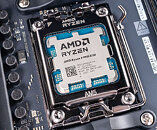

Sources:
chi11eddog on X, via VideoCardz
If these claims prove accurate, AMD may finally have solved the economic puzzle of dual-X3D production. Until now, the company's top-end 16-core models have paired a single 3D V-Cache chiplet with a standard CCD. The new dual-stacked design removes that compromise and promises consistently high cache bandwidth across multithreaded workloads. If launched, these chips would reinforce AMD's gaming performance crown and finally bring true dual-X3D dies to the mainstream desktop arena.


355 Comments on AMD Readies 16-Core Ryzen 9000X3D CPU with 192 MB L3 Cache and 200 W TDP
With that said, this should be all properly in place since ADL became a thing, so it's indeed a DICE issue.
The game has plenty of other issues, CPU optimization is a rather moot point compared to serious things like cheaters, team balancing, and terrible weapon balance.
As a disclaimer, I have no idea what that game is like nor how it behaves, I was just pointing out that the thread director is not that transparent, but is not likely the culprit of any issue (if there's any).
A better example of such driver to read the counters can be seen with Intel's HFI driver for Linux.Instead of just being arrogant and not bringing anything of relevance, why don't you provide further clarifications to your point instead?
it's already posted in this thread.Why didn't I have scheduling issues?
Intel chips consume a huge amount of energy in this game, but the game is light = so there is a serious problem with the huge internal data transfer. And since the game runs well on 6-8 cores, this just confirms the same thing.Yes, this will be the best solution.
Below a 9950x 3d consuming more (150-160w) than my 12900k...
A 9950x3D is quite a bit faster than a 12900k, and personally I would rather trust the tpu charts.
www.techpowerup.com/review/amd-ryzen-9-9950x3d/19.html
HW unboxed also tested the 9800X3D to be faster in BF6 than a 14900K at half the power draw.
HUB severely throttled the 14900k for whatever reason btw, look at his clocks :D
Ryzen V-caches simply skips a lot of data transfer because it reads from the cache.
And as it seems, BF6 has a problem with moving threads from one core to another.
Although the 9800X3D beats the pants off of the 9950X3D and the 285K, while being cheaper and you can run the X3D on a B850 motherboard.
And you brought up 12th gen, comparing vs 14th gen was fair enough, now you bring up the 285K, keep those goalposts moving lol. HUB claims they're running both at stock, stock vs stock is what I'd trust for CPU benchmarking.