Monday, August 4th 2025

AMD Readies 16-Core Ryzen 9000X3D CPU with 192 MB L3 Cache and 200 W TDP

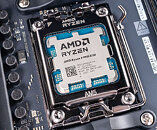
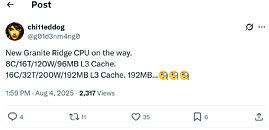
AMD is reportedly gearing up to expand its Ryzen 9000 "Granite Ridge" lineup with two all-new Zen 5 CPUs that push the limits of power draw and cache capacity. Leaker chi11eddog, who has cultivated ties with motherboard vendors, claims that AMD will introduce an 8-core/16-thread model rated at 120 W TDP, featuring a substantial 96 MB of L3 cache. This mirrors the cache density of the existing Ryzen 7 9800X3D, but could represent a distinct SKU. More striking is the rumored 16-core/32-thread part, a 200 W processor boasting 192 MB of L3 cache, surpassing the Ryzen 9 9950X3D's 128 MB. According to the leak, this chip features a dual-CCD design, with each chiplet pairing 32 MB of on-die cache with 64 MB of stacked 3D V-Cache, marking the first time AMD may ship a desktop CPU with 3D V-Cache on both dies.

If these claims prove accurate, AMD may finally have solved the economic puzzle of dual-X3D production. Until now, the company's top-end 16-core models have paired a single 3D V-Cache chiplet with a standard CCD. The new dual-stacked design removes that compromise and promises consistently high cache bandwidth across multithreaded workloads. If launched, these chips would reinforce AMD's gaming performance crown and finally bring true dual-X3D dies to the mainstream desktop arena.
Sources: chi11eddog on X, via VideoCardz
Add your own comment

355 Comments on AMD Readies 16-Core Ryzen 9000X3D CPU with 192 MB L3 Cache and 200 W TDP

#2
user556
I wonder if they'll come with a new I/O die? AMD have previously acknowledge there being a performance issue with dual chiplet V-cache stacking. Maybe it can be overcome with an improved I/O die.
Posted on Reply
#4
kondamin
that 128MB 3dl3 is about time.

I'm not getting one, but I'm certain they will move a lot of those
Posted on Reply
#5
Geofrancis
They must have finally met demand of EPIC processors with 3d cache that they have enough to start adding more to the desktop.


I wonder if it will be launched as a 9000 series Ryzen or a AM5 EPIC.
Posted on Reply
#6
billeman
I don't see this doing miracles, not for gaming or standard windows use. Some Linux applications might react well to this.
Posted on Reply
#7
Auxityne
Please don't give it a stupid name like the 9955X3D. Call it... I don't know, the 9950 Ultimate. Distinguish it from the single-stack 3D chips in order to try and justify what I'm sure would be a $899 or $999 price tag.
Posted on Reply
#8
GhostRyder
I will be curious about the dual 3D V-cache design. If they solved the problems and can make this work, would be pretty cool to see performance numbers all around.
Posted on Reply
#9
Tigerfox
9800X3D already has 120W TDP, so that's nothing new. It could be 9700X3D with slightly lower boost clock or 9850X3D/9800XT3D with slightly higher clock - 5.2GHz is quite low compared to 5.4/5.5/5.6/5.7GHz of 96/7/9/00X/950X or even 9950X3D.

Does 16 cores with 2x X3D really need 200W TDP? I thought 9950X3D was quite efficient.
Posted on Reply
#10
overclockedamd
user556I wonder if they'll come with a new I/O die? AMD have previously acknowledge there being a performance issue with dual chiplet V-cache stacking. Maybe it can be overcome with an improved I/O die.
If AMD truly broke new ground with an updated I/O die and advanced 3D V-Cache stacking, that could justify a refresh of the 8-core, 16-thread, 96MB L3, 120W CPU. Otherwise, it would be hard to see the point of revisiting a config that already exists with the 9800X3D.

Did they actually manage to push the Infinity Fabric and memory controller far enough to enable a new level of 1:1 sync? A 9800X3D-class chip running 8000MT/s at 1:1 would be an absolute game-changer for latency-sensitive workloads, especially in gaming.

Maybe I'm dreaming a bit here—but even if it's not about raw memory speed, perhaps we're looking at a more efficient I/O die with better power gating and internal bandwidth, allowing higher sustained clocks within the same thermal envelope. Either way, I'm genuinely excited to see what's behind the curtain.
Posted on Reply
#11
Macro Device
AuxitynePlease don't give it a stupid name like the 9955X3D. Call it... I don't know, the 9950 Ultimate. Distinguish it from the single-stack 3D chips in order to try and justify what I'm sure would be a $899 or $999 price tag.
AMD Ryzen 9 It's Over Nine Thousand Edition.
Posted on Reply
#12
Dr. Dro
Dual X3D chip is an instant buy for me. Very happy to part with a stack for it. $999 - fair price for the 16-core version.
Posted on Reply
#13
A Computer Guy
AuxitynePlease don't give it a stupid name like the 9955X3D. Call it... I don't know, the 9950 Ultimate. Distinguish it from the single-stack 3D chips in order to try and justify what I'm sure would be a $899 or $999 price tag.
9950X3DD
Dr. DroDual X3D chip is an instant buy for me. Very happy to part with a stack for it. $999 - fair price for the 16-core version.
I'm looking forward to trying this but I'm hoping we don't have a repeat of exploding chips again. 3 of 3 launch safety fails would be bad outcome for AMD. If this ends up being a $900 chip I might consider a 9945WX instead considering I'll wait a couple years for them to workout the early adopter issues either way.
Posted on Reply
#14
Pets4Ever
Dual 8 core CCDs with X3D cache would be nice, but a 12 core CCD with X3D cache is probably better for gaming if I had to bet. Any more word on those rumors?
Posted on Reply
#15
AusWolf
I don't see the point of a dual X3D CPU, but I want one! :D
I just hope the TDP can be adjusted down, I mean, way down, before my HN-U9S bursts into flames.
kondaminthat 128MB 3dl3 is about time.

I'm not getting one, but I'm certain they will move a lot of those
It's not 128 MB, though. The 9950X3D has 96 MB on CCD1 + 32 MB on CCD 2. That's not 128 MB because it's split into 96+32 MB.
Posted on Reply
#16
rv8000
Relatively pointless if loads are going to be crossing ccds. If there’s no improved software scheduling or an actual hardware scheduler, you’re tossing out 400-500mhz on cores that aren’t going to be utilized in games. Minor benefit in cache sensitive highly threaded workloads, but if that’s what you’re after and or make money from you should be looking at threadripper. Questionable product if true…
Posted on Reply
#17
AusWolf
rv8000Relatively pointless if loads are going to be crossing ccds. If there’s no improved software scheduling or an actual hardware scheduler, you’re tossing out 400-500mhz on cores that aren’t going to be utilized in games. Minor benefit in cache sensitive highly threaded workloads, but if that’s what you’re after and or make money from you should be looking at threadripper. Questionable product if true…
It's probably not intended for sensible people, but for the "bragging rights" segment.
Posted on Reply
#18
windwhirl
AusWolfI just hope the TDP can be adjusted down, I mean, way down, before my HN-U9S bursts into flames.
You could probably do that with just custom TDP limits anyway, since that's supported as part of PBO IIRC. Plus, most likely it will come with its own "ECO" setting that adjusts TDP down.

Though, if you have money for whatever this is gonna cost, you should probably throw a few bucks at a cooling solution that's up to the task as well.
Posted on Reply
#19
overclockedamd
rv8000Relatively pointless if loads are going to be crossing ccds. If there’s no improved software scheduling or an actual hardware scheduler, you’re tossing out 400-500mhz on cores that aren’t going to be utilized in games. Minor benefit in cache sensitive highly threaded workloads, but if that’s what you’re after and or make money from you should be looking at threadripper. Questionable product if true…
The 9950X3D still uses one V-Cache CCD and one standard CCD, just like the 7950X3D. During gaming, it relies on AMD’s drivers and Windows to schedule threads onto the cached CCD while mostly parking the other. That helps latency, but you're only really using half the chip in games.

If this rumored 192MB part has both CCDs stacked with V-Cache, that solves the whole issue—no asymmetric scheduling, no parked cores, and full access to all 16 cores and cache for gaming or multithreaded workloads. That’s a pretty big deal if true.
Posted on Reply
#20
igormp
LabRat 891and 9970X3D?
9970X is already taken by the Threadripper lineup.

Let's now start betting on bad names for this new rumored CPU:
Auxityne9955X3D. Call it... I don't know, the 9950 Ultimate.
Macro DeviceAMD Ryzen 9 It's Over Nine Thousand Edition.
A Computer Guy9950X3DD
9955X3D was going to be my first guess. 9950X3D² would be hella funny.
They could also go with the awful laptop branding, wouldn't you love a Ryzen AI MAX+ X3D 495?
Posted on Reply
#22
windwhirl
overclockedamdthat solves the whole issue
No it doesn't unless the 16 cores are one whole CCD or the operating system never lets any program distribute processes through different CCDs without very good reason (the reason being that 8 cores are not enough for that program). Remember, going out of the CCD is costly.
Posted on Reply
#23
hsew
Could just use an “X4D” moniker. Bigger question is, will the dual 3D caches be treated as a single coherent pool or 2 separate pools?
Posted on Reply
#24
overclockedamd
windwhirlNo it doesn't unless the 16 cores are one whole CCD or the operating system never lets any program distribute processes through different CCDs without very good reason (the reason being that 8 cores are not enough for that program). Remember, going out of the CCD is costly.
Yes, it does solve the scheduler issue. It doesn’t eliminate the latency from crossing the Infinity Fabric—but that’s a separate matter. The key point is that it resolves the asymmetrical scheduling problem caused by only one CCD having V-Cache, which was the real limitation in chips like the 9950X3D.


Scheduler ≠ Infinity Fabric.
Posted on Reply
#25
rv8000
overclockedamdThe 9950X3D still uses one V-Cache CCD and one standard CCD, just like the 7950X3D. During gaming, it relies on AMD’s drivers and Windows to schedule threads onto the cached CCD while mostly parking the other. That helps latency, but you're only really using half the chip in games.

If this rumored 192MB part has both CCDs stacked with V-Cache, that solves the whole issue—no asymmetric scheduling, no parked cores, and full access to all 16 cores and cache for gaming or multithreaded workloads. That’s a pretty big deal if true.
No. Crossing CCDs has a performance penalty, without a better/faster I/O die or a 16c CCD this solves nothing but making a product more expensive to be plain. If anything crosses that ccd while using 8 threads or less, this will be slower than a 9800X3D when it comes to gaming.
Posted on Reply
Add your own comment
Nov 28th, 2026 11:18 CST change timezone

New Forum Posts

Popular Reviews

TPU on YouTube

Controversial News Posts