Tuesday, August 12th 2025

Samsung Launches World First Micro RGB TV
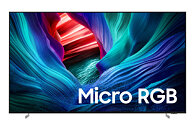
Samsung Electronics America today announced the official launch of its Micro RGB TV, the world's first display to feature a micro-scale RGB LED backlight behind a super big and fully immersive 115-inch screen. This breakthrough display delivers brilliant brightness and hyper-realistic hues, allowing you to indulge in color like never before.
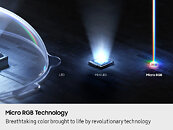
The category-defining TV is built with Samsung proprietary Micro RGB Technology, which arranges individually controlled red, green and blue micro LEDs—each less than 100 µm in size—in an ultra-fine pattern behind the panel. Unlike most conventional backlighting, the architecture enables precision control over each red, green and blue LED—resulting in an industry-first 100% color coverage of BT.2020, an international standard for color accuracy established by the International Telecommunication Union (ITU).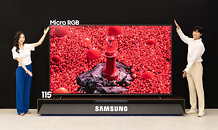
 "Micro RGB achieves unprecedented precision in the control of micrometer-sized RGB LEDs, raising the bar for color accuracy and contrast in consumer displays," said Taeyong Son, Executive Vice President and Head of the R&D Team of the Visual Display (VD) Business at Samsung Electronics. "With this launch, we're setting the standard in the large-sized, ultra-premium TV market and reinforcing our commitment to next-generation display innovation."
Powered by the Samsung Micro RGB AI engine, this new innovation uses AI processing to finely control the red, green and blue backlight for next-level color expression, as well as optimized picture and sound. This advanced technology analyzes each frame in real time and automatically optimizes color output for a more lifelike and immersive picture. With AI, Micro RGB Color Booster Pro recognizes scenes with dull color tones to intelligently enhance colors across all content for a more vivid and immersive viewing experience.
Plus, the display features Micro RGB Precision Color, which lends a new level of intense immersion to your movie night. The technology finely and precisely controls colors, adding depth and dimension for a level of detail nearly indistinguishable from real life. Samsung Micro RGB TV also received 'Micro RGB Precision Color' certification from the Verband der Elektrotechnik (VDE), a leading German electrical engineering certification institute.
Samsung Micro RGB TV is designed with our most advanced Glare Free technology to minimize reflections, even in bright lighting conditions for a more comfortable and focused viewing experience. Apart from providing next-generation performance, the Micro RGB TV's super slim metal design achieves a sleek, minimalistic profile to compliment any interior.
With Samsung Vision AI integrated, the display offers a smarter viewing experience, enabling features like an upgraded Click to Search, powered by Samsung Bixby. Viewers can ask Bixby contextual questions about the content on screen and receive natural language answers, as well as access actor bios, related content and real-time recommendations without ever leaving the screen.
Samsung Micro RGB TV is also secured by Samsung Knox, the industry-leading security solution designed to protect your sensitive personal data, and supports the Samsung 7-year free Tizen OS Upgrade program, which ensures ongoing software enhancements and long-term upgrades.
Samsung Micro RGB TV will be available in the U.S. for an MSRP of $29,999. It's also available in Korea, with future plans for a global rollout featuring a variety of sizes to meet customer needs.
Source:
Samsung
The category-defining TV is built with Samsung proprietary Micro RGB Technology, which arranges individually controlled red, green and blue micro LEDs—each less than 100 µm in size—in an ultra-fine pattern behind the panel. Unlike most conventional backlighting, the architecture enables precision control over each red, green and blue LED—resulting in an industry-first 100% color coverage of BT.2020, an international standard for color accuracy established by the International Telecommunication Union (ITU).


Powered by the Samsung Micro RGB AI engine, this new innovation uses AI processing to finely control the red, green and blue backlight for next-level color expression, as well as optimized picture and sound. This advanced technology analyzes each frame in real time and automatically optimizes color output for a more lifelike and immersive picture. With AI, Micro RGB Color Booster Pro recognizes scenes with dull color tones to intelligently enhance colors across all content for a more vivid and immersive viewing experience.
Plus, the display features Micro RGB Precision Color, which lends a new level of intense immersion to your movie night. The technology finely and precisely controls colors, adding depth and dimension for a level of detail nearly indistinguishable from real life. Samsung Micro RGB TV also received 'Micro RGB Precision Color' certification from the Verband der Elektrotechnik (VDE), a leading German electrical engineering certification institute.
Samsung Micro RGB TV is designed with our most advanced Glare Free technology to minimize reflections, even in bright lighting conditions for a more comfortable and focused viewing experience. Apart from providing next-generation performance, the Micro RGB TV's super slim metal design achieves a sleek, minimalistic profile to compliment any interior.
With Samsung Vision AI integrated, the display offers a smarter viewing experience, enabling features like an upgraded Click to Search, powered by Samsung Bixby. Viewers can ask Bixby contextual questions about the content on screen and receive natural language answers, as well as access actor bios, related content and real-time recommendations without ever leaving the screen.
Samsung Micro RGB TV is also secured by Samsung Knox, the industry-leading security solution designed to protect your sensitive personal data, and supports the Samsung 7-year free Tizen OS Upgrade program, which ensures ongoing software enhancements and long-term upgrades.
Samsung Micro RGB TV will be available in the U.S. for an MSRP of $29,999. It's also available in Korea, with future plans for a global rollout featuring a variety of sizes to meet customer needs.
75 Comments on Samsung Launches World First Micro RGB TV
Micro-led is the most amazing tech: oled-like constrast, insane response time, very high max brightness reachable and, more importantly, NO burn-in, it’s not organic and decaying like oled
Issue is: price, heat, scalability seem very hard to master, Apple was supposed to invest massively in micro-led before backtracking to next-gen OLED like tandem
I hope in a future not too far we’ll have micro-led like we have oled today in monitor, TV and even phones/consoles
Or, from an Arstechnica summary:
"...Currently, though, researchers are still working on ensuring that blue and green quantum dot materials can last long enough to make a viable consumer gadget without using cadmium. As it stands, QDEL displays would become noticeably dimmer more quickly than today's OLED displays...."
arstechnica.com/gadgets/2024/04/meet-qdel-the-backlight-less-display-tech-that-could-replace-oled-in-premium-tvs/
Samsung's claim of 100% color coverage of BT.2020 (something that even OLEDs cannot claim, lacking the high enough brightness), if true, should mean it is the real "like oled, but without organic bit".Welp, for what it is worth.
My first OLED was LG signature 65". Paid 5k for it, MSRP was double that sum.
MSRP of the bigger version (mm.... 77" but could have been 85") was 20k, actual price 12k.
Assuming it is a real microLED with individual pixels (I don't see how they could getto 100% of BT.2020 otherwise), 30k MSRP is... not that expensive.
I know it might sound like splitting hairs at first but it is not :)
Burn-in is about residual permanent image retained on the screen -> unwanted image appearing.
Burn-out is when the displayed image is faded -> wanted image not appearing.
Anyhow, just semantics I guess :toast:
Thus, the primary modes of pixel burn-out can also generate burn-in.
Those miniaturized semiconductor LEDs have to be manufactured separately and then transferred to display backplane as separate manufacturing stage.
Even if you test every LED separately before transfer, there's always chance for something to go wrong during transfer.
And for 4K panel that's 25M LEDs to move.
No one ever looks at a black screen, so the "perfect black" argument is moot, but games and TV programs come with permanent elements that burn into the panel. No thanks.
When we talk about lifespan we dont talk about that as that is usually just misusing a product, with lifespawn we talk about (with TV's in particular) how long it takes before it emits only half the light intensity it did when bought through normal wear&tear usage.
So with Qdel it seems they are talking about lifetime durability and not being sensitive to burn in or not, some tech is just not susceptible to that, where CRT screens were, LCD's are not.
and I use it for everything, especially gaming.
I mean sure you have the UI that is usually static but yeah if you do a lot of work on it, like programs that are static all around with only the middle bit being interacted with like Word or Excell or some Cad program, those really can cause some burn in.
But LG has stuff like local dimming and pixel shift stuff to help out.
For reference, the standard size of a mouse cursor in windows at 100% is 32x32 = 1024pixels - just 100k zones are more than enough to say goodbye to mouse trailing and almost all blooming.
Current FALD solutions are already not terrible with just 1k zones (1 led per ~8300pixels), it's the same old pareto principle, 20% of the effort will get you 80% of the result. The idea of per pixel control is nice but it's not necessary, you'll have a very nice experience with much much less.
While still having all the costs of LCD panel...
And its drawbacks in resposne times and viewing angles.
No average or even nonrich prosumer is buying microled.
Also, the tech here (the RGB one) is more miniled than microled, despite what Samsung marketing says. Not in the same ballpark as Microled.
Which is why i opted for a monitor as who knows when others will do this bs.
These days it is very important for banking your data and other things to have an up to date phone. My samsung tablet which is much newer is also months behind hte security updates.
--
I want an update cycle similar to www-client/vivaldi or www-client/google-chrome for a very long time period.I do not buy any smart products, gaming consoles or rent games or moving picture materials.
I have 3 LCD tvs lying around which i repaired 3 years ago. Ready to replace those which are in use. These are much older as those 7 years. Satellite material is low resolution anyway.I quoted the marketing. Feel free to check out spare parts from televisions or how they are build 15 years ago. They compare it to how they are build 15 years ago.
I think comparing 15 year old television tech of this marketing by this company deserves my comment.