Thursday, August 14th 2025

Intel "Lunar Lake" Updated PL2 Setting Can Yield Up to 30% Higher Gaming Performance
We recently published our MSI Claw 8 AI+ A2VM review, which is the only handheld gaming device to utilize the Intel Core Ultra 7 258V "Lunar Lake" CPU, featuring four E-cores and four P-cores, paired with the Intel Arc 140V Xe2 GPU. During our testing, we manually set different TDP values via the Manual power profile slider to see what the results are in gaming and how it compares to other, mostly AMD-based, handhelds. However, Intel notified us about performance levels used in testing, and that the official specification for Lunar Lake states that PL2 should always be at least 1 W higher than PL1, or always set at 37 W (the maximum TDP value for Lunar Lake chips). This means that whenever a CPU can extract an additional boost, it will, yielding up to 30% more performance, as we have seen in our own testing.
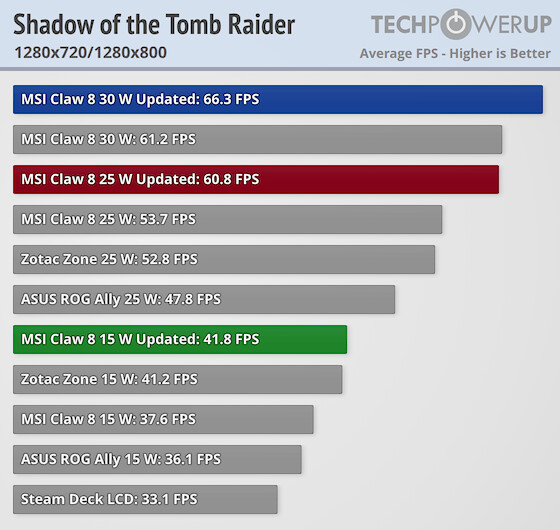
Initially, we used the Manual power profile, which had allowed owners to match PL2 to PL1. However, Intel noted that when PL2 is set to at least a single W higher than PL1, there is an expected 10% performance increase across the suite of games, but depending on the scenario, it can lead to a 30% increase in some instances. An update has arrived for the MSI Center M app, which locks PL2 to always be at least 1 W higher than PL1. As a result, you can no longer match the two. It was only possible before the update. In our retest, Cyberpunk 2077 and Space Marine 2 achieved nearly a 30% performance uplift with this setting. The Lunar Lake-based MSI Claw AI+ A2VM handheld is the highest-performing device we have tested across the board, even surpassing AMD-based devices in our testing suite. In other games, baseline improvement is set at 10%, just as Intel had notified. Our testing confirmed that Lunar Lake is now the most powerful gaming CPU for handheld devices that we own and have tested.
15:57 UTC: We updated some of the claims to better reflect the PL2 setting and that we manually set TDP values, too.
 Below you can find the updated performance graphs.
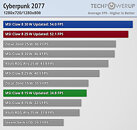
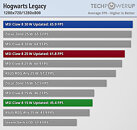
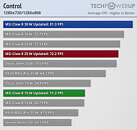
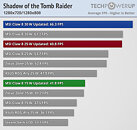 For more details, 1080p testing, and 1% lows, check out the MSI Claw 8 AI+ A2VM review.
Initially, we used the Manual power profile, which had allowed owners to match PL2 to PL1. However, Intel noted that when PL2 is set to at least a single W higher than PL1, there is an expected 10% performance increase across the suite of games, but depending on the scenario, it can lead to a 30% increase in some instances. An update has arrived for the MSI Center M app, which locks PL2 to always be at least 1 W higher than PL1. As a result, you can no longer match the two. It was only possible before the update. In our retest, Cyberpunk 2077 and Space Marine 2 achieved nearly a 30% performance uplift with this setting. The Lunar Lake-based MSI Claw AI+ A2VM handheld is the highest-performing device we have tested across the board, even surpassing AMD-based devices in our testing suite. In other games, baseline improvement is set at 10%, just as Intel had notified. Our testing confirmed that Lunar Lake is now the most powerful gaming CPU for handheld devices that we own and have tested.
15:57 UTC: We updated some of the claims to better reflect the PL2 setting and that we manually set TDP values, too.


38 Comments on Intel "Lunar Lake" Updated PL2 Setting Can Yield Up to 30% Higher Gaming Performance
Why can't people act like normal human being in intel / nvidia threads? What the actual hell..
Coincides with my testing.This is true, but the reason why you want PL1 and PL2 set properly is for errant apps that request for more power even though it doesn't need it. An example of this is Fallout 3 where you can absolute run it at 60 FPS at 13W TDP with no frame drops (except for the usual engine jank) and it will only use 16W total system draw, but if you have PL1/PL2 set to the max 30W-37W, it will absolutely keep using more power even though it doesn't need despite locking frame rate to 60 FPS.This is also a test I wish to try as I'm waiting for the MSI Claw A8 to be available here US-side. I can only simulate the Z2 Extreme for now with my HX 370 devices, which is not going to as accurate as I would like.
The Z2 Extreme is 3C+5c/16T/16CU so it should be match-for-match with Lunar Lake in core configuration and it should be able to beat the 258V in multi-thread performance (16T vs 8T, duh), but is beaten in single-thread performance because the IPC is technically better. I have confirmed this with multiple HX 370 devices and the two Lunar Lake devices (258V and 288V) I have access to, but they are close to each other in performance.
iGPU performance trade blows with each other closely in various games. For example Elden Ring runs faster on the 890M by 10 FPS but Apex Legends runs 12 FPS faster on the 140V, both devices at 1200p, same game settings, and locked to PL1/SPL 17W.
READ this time and actually try to understand. Mobiles CANNOT have infinite PL2 timer. PL2 is temporary.
The power management of modern computers are FAR more advanced than you think they are. We're not in 2002 where Battery = 800MHz and Plug = 1GHz and stayed there forever.
Lunar Lake is an impressive chip from Intel for sure, but I think we cannot directly compare it with the likes of the current gen of Ryzen chip because they are built on different TSMC node. Lunar Lake has an advantage being on 3nm instead of 5nm (even in name it’s called 4nm) on the AMD chips. So while LL power draw includes memory, it’s already having an advantage from a node perspective.
Also, N3B on Lunarlake is a minor advancement on the power level over N4P on Ryzen. Something like 6-8%. Also, AMD chose not to use N3. As a customer you are buying a black box.
In particular, the RAM is on the SOC so included in the 25W for intel, and not for AMD (should be 1-2W, i.e. 8% difference)
Again, I hope we can have actual consumption of the plateform Claw AMD vs Claw Lunar Lake (time / battery), not just relying on what different manufacturer claim.
same screen, same almost everything, but the SOC (and the southbridge).memory is not lower power, it is just included in the SOC package of intel.
It requests excess voltage margin that it doesn't use, changes the clock frequency too much, and downclocks in big jumps.
Efficiency would probably be even better with PL1 and PL2 maxed out so they're never hit, plus a userspace program controlling clock frequency to maintain constant FPS measured with presentmon.
But at wattages that are still very low for what Lion coves can exploit. It's the same architecture used in the +200W desktop chips. Mobile chips are just made with high-quality silicon that can use a lower voltage to be more efficient. And tuned for efficiency. That means lower power limits, shorter bursts of turbo boost, resulting in lower sustained performance.
Overvolting is only necessary when you push the silicon to/beyond its limits. That lunarlake chip is running at fairly low clocks, compared to what lion cove can achieve, there's no need to overvolt. If an overvoltage were necessary, that would have been the worst grade of silicon ever, and would have been a defect. If you read the reviews, you can see that this chip stays below 3Ghz in sustained load, and even under 2Ghz in gaming. Why would you need to overvolt to reach those clocks??? Again, it's the same arch used in the desktop chips, just tuned for low power.
www.notebookcheck.net/HP-OmniBook-X-Flip-16-convertible-review-Luxury-features-for-a-midrange-price.1049258.0.html#c13736824