Tuesday, August 19th 2025

ASUS ROG MATRIX RTX 5090 PCB Pictured, Cooler Disassembled
Here are some of the first pictures of the ASUS ROG MATRIX GeForce RTX 5090 flagship graphics card taken apart, courtesy of der8auer. The card was launched earlier today at the company's Gamescom 2025 showcase. The ROG MATRIX uses a spruced-up version of the ROG Astral RTX 5090 BTF PCB. While we haven't had a chance to take apart the BTF ROG Astral, we've tested both the ROG Astral Liquid RTX 5090 and its air-cooled sibling, which share a common PCB design. You can compare that with the ROG MATRIX RTX 5090 PCB (pictured below) and spot some obvious differences.
To begin with, the ROG MATRIX appears to have the same VRM configuration as the ROG Astral, with 24+7 phases. These are laid out in an identical arrangement to the ROG Astral. We can't make out the DrMOS chips, but it's possible that ASUS is using higher current DrMOS chips than the 80 A ones used in the ROG Astral. It's the only area where ASUS can one-up the Astral on the MATRIX. The other visible difference is the detachable BTF (GC-HPWR) gold-finger. It's detachable so you can use it on non-BTF motherboards by connecting the 12V-2x6 connector that's concealed by a small metal cover on the cooler shroud. It's also interesting to see the two 4-pin PWM case fan headers next to the 12V-2x6 being shrouded, but this is probably just a factory concealment. The display I/O is identical to that of the ROG Astral, which is a missed opportunity to throw in something like USB-C with DisplayPort passthrough, which ASUS implemented on its RTX 5080 ProArt. Next up, we have the cooler.

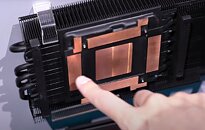
 The ROG MATRIX RTX 5090 cooler is built on essentially the same design principle as the air-cooled ROG Astral RTX 5090, with three fans pushing air onto the heatsink, and a fourth fan pulling the airflow out the backplate; however, the ROG MATRIX cooler appears heavier, with more heatpipes, a denser fin-stack, and a vapor-chamber baseplate with exposed copper contact surfaces replacing nickel-plated copper ones on the ROG Astral.
ASUS will likely implement a more premium thermal interface material. Although the company has invented a method to ship graphics cards and gaming notebooks with liquid metal TIM, the bare copper surfaces rule out the possibility of liquid metal with this product.
Source:
der8auer (YouTube)
To begin with, the ROG MATRIX appears to have the same VRM configuration as the ROG Astral, with 24+7 phases. These are laid out in an identical arrangement to the ROG Astral. We can't make out the DrMOS chips, but it's possible that ASUS is using higher current DrMOS chips than the 80 A ones used in the ROG Astral. It's the only area where ASUS can one-up the Astral on the MATRIX. The other visible difference is the detachable BTF (GC-HPWR) gold-finger. It's detachable so you can use it on non-BTF motherboards by connecting the 12V-2x6 connector that's concealed by a small metal cover on the cooler shroud. It's also interesting to see the two 4-pin PWM case fan headers next to the 12V-2x6 being shrouded, but this is probably just a factory concealment. The display I/O is identical to that of the ROG Astral, which is a missed opportunity to throw in something like USB-C with DisplayPort passthrough, which ASUS implemented on its RTX 5080 ProArt. Next up, we have the cooler.


ASUS will likely implement a more premium thermal interface material. Although the company has invented a method to ship graphics cards and gaming notebooks with liquid metal TIM, the bare copper surfaces rule out the possibility of liquid metal with this product.
19 Comments on ASUS ROG MATRIX RTX 5090 PCB Pictured, Cooler Disassembled
Anus has some heavy mental issues if they thinks to sell this shit at such price.
No comment.
The rest of this ~$1600 build took me 15 seconds — not “perfectly optimized,” just a straight AI-generated parts list that gets the job done:
- CPU: AMD Ryzen 7 9800X3D – ~$480
- Mobo: ASUS ROG Strix X870E-F Gaming WiFi – ~$370
- RAM: 32GB (2×16) DDR5-6000 CL30 – ~$170
- SSD: 2TB NVMe Gen4 (WD Black SN850X / Samsung 990 Pro) – ~$160
- Cooler: Arctic Liquid Freezer III 360 AIO – ~$120
- Case: Fractal Design North XL / Meshify 2 – ~$150
- PSU: Seasonic Prime TX-1000 (1000W, Titanium) – ~$270
- Extras: Fans/cables – ~$50
Build total: ~$1,600System total w/ RTX 5090 ($2399.99): ~$3,999.99
Two separate “news posts” for a XOC limited ed Halo product? Come on guys, TPU is better than that.
B2T: Not a water cooled card with an 800W bios? Machined copper surfaces with liquid metal on the core? For 4-5k? Man, I don't know. :wtf:
If Anus Rog has solved the issue with burning connectors by using this new HPSU by Bellwether, then - Why Nvidia them self are not yet switching to a such solution - or they just don't care?