Monday, August 25th 2025

ASRock Adds Overheating Protection to Its L-Shaped 12V-2x6 GPU Cable
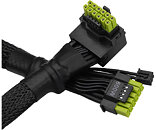
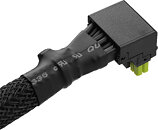
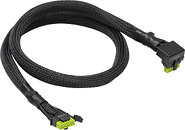
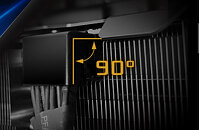
ASRock announced a right-angled 12V-2×6 cable designed to make tight builds neater and to avoid stressing the cable bend radius. The lead is 700 mm long, sleeved in black, and finished with ASRock Classic Green tips so you can quickly check insertion. It meets ATX 3.1 and PCIe 5.1 standards, utilizes 16 AWG conductors, is rated for up to 600 W, and is designed for systems with power supplies of 750 W or greater. ASRock bundles stickers for Taichi, Phantom Gaming, and Steel Legend builds and offers a two-year warranty. The cable also features a built-in NTC temperature sensor that detects rising temperatures by measuring resistance changes, enabling over-temperature protection when used with compatible Taichi and Phantom Gaming PSUs. ASRock reminds users to follow their GPU maker's power recommendations, to fully seat connectors until they click, and to avoid bending or stressing the cable near the plug. Priced at around $40 (5,980 yen including tax in Japan), it is definitely on the pricey side.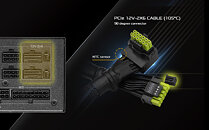
Sources:
ASRock, GDM Japan, via VideoCardz


48 Comments on ASRock Adds Overheating Protection to Its L-Shaped 12V-2x6 GPU Cable
And these marketing bullshit products prove we need to stick with 8-Pin, which was never an issue to begin with. Let the business server market do all they want, but hardware for the average joe should be safe.
That, and there is a simple fact that the connector just works with the hand it has been dealt - which is itself shit. The PCI-E AIB form-factor has NEVER been intended for 600W guzzling boards. It's an issue which basically is impossible to solve at this point - if we want to continue with ever increasing power budgets, then a new standard for GPUs specifically would have to be drafted. This is unsustainable.
I don't understand why you feel the need to glaze a multi-billion dollar company that has clearly made a mistake and refuses to admit it.
At least ASRock is helping the situation somewhat, but I think ASUS's BTF in my opinion is the better solution. A 12v-2x6 connector doesn't have to be the pass through on the back or front of the motherboard, it could be 8pins/6pin connectors.
It doesn't take much of a genius to figure it out, the moment anything goes wrong, current follows the path of least resistance.
I'll shut up if you give me a valid source that says power supplies really are the issue, not just "trust me bro."
Either have load balancing on the card on each lead or/and have proper voltage monitoring via the sense pins to the PSU, these are the most prominent current solutions.
600+ Wattage by itself doesn't matter that much. Connectors also melted on 4070 Ti SUPERs (300W), 4080s (350W), 4080 SUPERs (375W), even on a 9070XT (350W) just recently.
As long as a fault leads to a single wire running the whole load, stuff will get hot. :(
Let me say it again: a coloured connector is neither a safety measure nor a solution to the problem.
--
Nice marketing. People will buy.
--
Where is the temperature limit set?
How frequently is it polled?
Is the power cut from the graphic card when triggered?
What happens when the power is cut - do we get a blue screen of death or an X-server lockup?
What is the recommended course of action when this temperature feature triggers multiple times a day?
How is the user notified?
How will the user know the blue screen of death was caused by the temperature sensor in the cable?
So many questions and so few answers in this thread.
The problem goes far beyond just this connector: draws are way to too high for the form factor and it remains this is a singular point of failure situation.Agree, personally I like ASUS' BTF, I'd actually be on board if they opened the standard and shared it with the rest of the industry. It's solid and remained cool even with 1000W+ draws.
Why should a wattage rating of a power supply cause the issue?
I assume we talk about this gpu:www.asrock.com/Graphics-Card/AMD/Radeon%20RX%209070%20XT%20Taichi%2016GB%20OC/#Specification
850 Watt recommendation. I read quite often that the graphic card makes power supply recommendation is always far bigger as needed when "using" a "quality" power supply unit.
Are you implying the power supply in question delivered too much Voltage and current to that graphic card with the underrated 700 Watts rating?
Help me understand your point, please.
But given the nature for this cable, I'd only be comfortable with ample headroom and perfect mechanical connection on both ends.
Is the resistor reporting temps back to the PSU?
At what temp does it trigger a shutdown on the 12v cable?
BTW, yes this is on Nvdia, as Nvidia and Dell Technologies are the main contributors to the 12hpwr specification.
Only way for PSU to protect this badly designed 12VHPWR/12V-2×6 connector would be by limiting whole 12V output to something like little over 10A.PSU doesn't push any current, it will only provide/supply current when something in other end of wire draws/pulls that current.
And if PSU is undersized and load draws too much current/power for the PSU, in that case PSU's protections activate and it shuts down.
Or if voltage becomes too unstable, then it's pretty much guaranteed crashing of GPU/something else...
So basically that too weak PSU would be safer for this connector than beefy high quality PSU capable to actually providing some amount more over numbers in sticker.
PSU doesn't care (and can't even know) where the current goes for as long as it stays inside its total maximum output.
Just like your power company doesn't know and couldn't care less about how your home consumes that power, being only interested that you don't try to melt their power line to your house/stay inside limits of connection you're paying for... And if your own in house electric appliances burn your house, that's in no way their fault.
And even if PSU is bad and lacks working overcurrent/power protections, laws of the physics still apply and it can't push more current out than that drawn by connected device.
Unless it's the cable of PSU which is shorting, which hasn't been the case in any of these melting connectors.It would be safe if used inside its actual capabilities, which are significantly weaker per pin than for old 8pin PCIe power connector instead of higher!
But Nvidia Stockton Rushed their own MIASS specs for it, basically removing all proper safety margins and then not even mandating any current balancing.
How on Earth does a power supply have nothing to do with how power is delivered and distributed? :confused:
I get it, arguing against an established standard like the (6+2) 8-pin PCIe connector from a reliability standpoint is an exercise in futility, it's an established, time proven standard after all. That's pretty much irrefutable, but it doesn't mean the new cable is evil incarnate either.
A quick look at an octopus adapter cable with 4 of those dangling around a RTX 5090 justifies it if you ask of me.
Just saw your edit: Bruh. Of course the GPU is drawing the power, except there isn't a single safety anywhere to cut this draw off in case of a malfunction on either side. That much should have been clear.
12V-2x6 connector is not designed to be immune to resistance differences on pins and VGA cards do not have any load balancing detection capabilities between pins.
Old 8-pin connector is almost immune to resistance differences on pins because of multiple pins with very little (relatively) current flowing through any of that pins (when any of that pins could safely take full current of the connector!) and VGA boards have load balancing detection between sockets.
It is ont he device to manage its own power draw. This is the case with most electronics. The card makers need to be putting power resistors on the cards to force equal loading on all 6 pins. This was normal with multiple 8 pin connectors, but now card makers are cheapening the designs.
That is an nvidia, and AMD, and asrock, and asus, ece issue. It is not on the PSU. Card makers need to fix this.Apparently it does, since the internet still incorrectly labels this is a connector or PSU issue when debauer already debunked this as being a load balancing issue.It isnt immune. There were plenty of instances of 8 pins melting too, but since that wasnt pushed by nVidia, nobody cared.