Wednesday, August 27th 2025

NVIDIA Dissects GB10 Superchip SoC with 20 CPU Cores and 6,144 CUDA GPU Cores
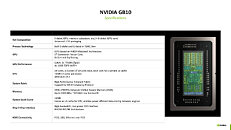
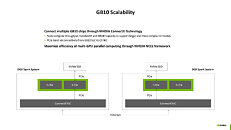
At Hot Chips 2025, NVIDIA offered a detailed look at the GB10 "Grace Blackwell" superchip, presenting a compact multi-die design meant to bring datacenter capabilities to a desktop-sized workstation. The chip pairs a MediaTek-sourced Arm CPU die with a Blackwell GPU die in a 2.5D package built on TSMC's 3 nm process. The CPU side implements 20 Arm v9.2 cores split into two clusters of ten, each cluster backed by a 16 MB shared L3 (32 MB total) while each core retains private L2 storage. The memory subsystem is a unified LPDDR5X-9400 fabric on a 256-bit bus, supporting up to 128 GB and delivering roughly 301 GB/s of raw bandwidth to the package. High-speed I/O is concentrated on the CPU die, while NVMe storage and peripherals ride PCIe lanes there, and a ConnectX-7 NIC is attached via a PCIe Gen 5 x8 link to enable multi-unit networking.
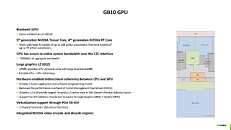
NVIDIA described the GPU die as a scaled Blackwell configuration tuned for low-power, small-form-factor operation. The quoted peak throughput is approximately 31 TeraFLOPS for FP32 and around 1,000 TOPS when using NVIDIA's NVFP4 reduced-precision format. The GPU carries a large 24 MB L2 that can act as a higher-level cache visible to the CPU, creating a coherent cache hierarchy across the two dies. NVIDIA states that the inter-die C2C link offers aggregate bandwidth on the order of 600 GB/s, enabling low-latency sharing without requiring heavy software-managed copying. The package is rated at approximately 140 W TDP and exposes multi-display outputs (DisplayPort alt-mode plus HDMI 2.1a options) alongside security and virtualization features intended for professional workloads.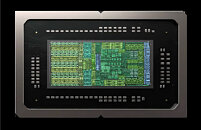


 NVIDIA has framed DGX Spark as a "gateway" workstation that runs DGX Base OS and the company's AI stack locally, then scales workloads to larger DGX systems or cloud hosts as needed; the vendor lists a reference price of $3,999. What is interesting is that GB10 SoC is setting the stage for consumer-grade N1/N1x SoC, which will reportedly use a similar GPU and CPU configuration. The computing power of the GB10 SoC superchip is more than enough for a consumer laptop, so we are waiting to see what NVIDIA plans for N1/N1x chips.
Sources:
NVIDIA at Hot Chips 2025, via ServeTheHome
NVIDIA described the GPU die as a scaled Blackwell configuration tuned for low-power, small-form-factor operation. The quoted peak throughput is approximately 31 TeraFLOPS for FP32 and around 1,000 TOPS when using NVIDIA's NVFP4 reduced-precision format. The GPU carries a large 24 MB L2 that can act as a higher-level cache visible to the CPU, creating a coherent cache hierarchy across the two dies. NVIDIA states that the inter-die C2C link offers aggregate bandwidth on the order of 600 GB/s, enabling low-latency sharing without requiring heavy software-managed copying. The package is rated at approximately 140 W TDP and exposes multi-display outputs (DisplayPort alt-mode plus HDMI 2.1a options) alongside security and virtualization features intended for professional workloads.


31 Comments on NVIDIA Dissects GB10 Superchip SoC with 20 CPU Cores and 6,144 CUDA GPU Cores
Also, comparing even a 5090 to this Gb10 is kinda moot. Sure, the 5090 is going to be way faster for any model that fits within its VRAM, but then it's almost useless for bigger models, and we have tons of bigger models nowadays.
4060 Ti = Memory Bandwidth 288 GB/s
GB10 = Memory Bandwidth: 300 GB/s
4060 Ti = Cores: 4352
GB10 = Cores: 6144
GB10 has more of both, GB10 will do better than "barely reach the performance of something like a 5060/4060ti." And on a smaller node, it will make up some/most core clock speed on the 5070 at the same power use, though with lower bandwidth it'll never catch it.