Friday, September 19th 2025

ASUS Proposes Reinforced PCIe Slot to Deliver 250 W of Power From the Motherboard
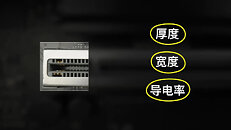
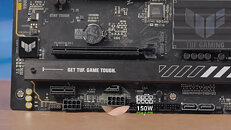
ASUS unveiled a prototype this week with a new method for graphics cards to draw power from the motherboard's PCIe expansion slot, proposing a solution that could eliminate the need for card-mounted power cables for many entry-level and mid-range GPUs. The concept focuses on beefing up the physical PCIe power path: ASUS engineers widened and thickened the contact pads at the front edge of the card's PCIe interface, enlarged the copper area inside the corresponding slot, and fused several 12-volt lanes into larger, lower-resistance conductors. To share the load, the traditional 8-pin connector is relocated onto the motherboard, allowing the slot and onboard connector to work together. Higher-conductivity materials and a larger terminal cross-section are used to increase the continuous current capacity without modifying the card's external form factor.
This idea could be a good match for GPUs in the 180-220 W range, where customers might appreciate a cable-free card. Examples could include RTX 5060 Ti-class parts or comparable AMD models. The company has not released full schematics, continuous current ratings, thermal validation, or long-term endurance data, and the headline 250 W claim leaves some questions unresolved. A conventional slot plus a motherboard auxiliary connector typically totals 225 W, where the 8-pin supplies 150 W and the PCIe connector gives 75 W. ASUS is already known for experimenting with alternative power delivery, with an example being the Graphics Card High-Power (GC-HPWR) connector. This is a higher-power design, rivaling NVIDIA's 12V-2x6V connector.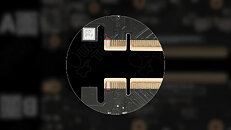
Sources:
IT Home, via ComputerBase
This idea could be a good match for GPUs in the 180-220 W range, where customers might appreciate a cable-free card. Examples could include RTX 5060 Ti-class parts or comparable AMD models. The company has not released full schematics, continuous current ratings, thermal validation, or long-term endurance data, and the headline 250 W claim leaves some questions unresolved. A conventional slot plus a motherboard auxiliary connector typically totals 225 W, where the 8-pin supplies 150 W and the PCIe connector gives 75 W. ASUS is already known for experimenting with alternative power delivery, with an example being the Graphics Card High-Power (GC-HPWR) connector. This is a higher-power design, rivaling NVIDIA's 12V-2x6V connector.


95 Comments on ASUS Proposes Reinforced PCIe Slot to Deliver 250 W of Power From the Motherboard
Now you also need to dedicate additional (expensive) PCB layers and throw a lot more copper traces (expensive) at it too. It's just a glorified extension cable that adds another connector to the equation. Why go from the PSU directly to the GPU when you can now do it with extra steps!! (/s)
Cable still required, but now you need a new motherboard, too....
Why? Because cables are evil, apparently and this fits the dumb BTF form factor that's all about form over function, for people with infinite wallets.
ASUS is for sure not going to add this to cheap motherboards and instead add it to already quite expensive motherboards.
Who's going to combine such an expensive motherboard with a <=225W GPU?
If they're serious I'm expecting them to make variants of their ROG series with this feature that are priced a bit higher.
Also not a single word on how is this even negotiated. I only hope it is, because standard motherboards/slots will just melt or straight up burn if you try to do this...
Apparently that's the trend to keep up with the "You'll own nothing and be happy" motto of stream everything, throwaway everything, get in debt all the time mentality.
Up to 200 Watts is less than a No Radeon 6600xt, 6800 non xt or 7800xt. I just named a few grpahic cards i bought and used myself in windows 10 or 11 pro.
the 200 watt days are over. This is not even enough for a cpu.
I do not know who I want to give the worst Mainboard brand sticker. Asrock or ASUS or Gigabyte.... A hard competition during the year.
I don't see what this is supposed to do other than make the power connector more complicated than it really needs to be, and it will raise motherboard prices even higher.
They didn't lift a finger to implement ATX12VO which actually brings some advantages but are now pushing a stupid change that bring no technical advantage whatsoever - it's just looks of components closed in a box that's under a desk hidden.
The scary part is if Dell/Lenovo/HP get on board with something like this because it could make desktop assembly cheaper and repairs more difficult.
My 3070Ti has the same cooler as the 3080 so it is a pig too.
If they want to put more power on/in the slot, extend the slot towards the I/O bracket w/ Power and Ground pins (ala ATX20+4 or AGPpro).
That way there's 100% backwards compatibility and a usable wattage capacity on the board.
Still, requires re-laying out the PCB, and still requires EPS and/or +12VHPWR/+12V-2x6 aux inputs on the board.
The only 'plus' would be the board could actively balance the per-conductor load; requiring more power circuitry on the mainboard... :rolleyes:
NtM, the +12V and GND 'high current plane' would probably go through the PCB space where most boards isolate their onboard sound. (that'd be great for sound quality :laugh:)
Also IIRC wasnt one of the main reason nearly every card has moved the majority if not all the load onto dedicated feeds from the PSU is due to both noise concerns in power delivery and the instability it may cause to other devices inadvertantly?
Alas in the 2020s, who'd ever let a silly thing like logic or physics get in the way of consumer product engineering? :laugh:
Better to have PSU > GPU than PSU > Board > GPU.
Vendors trying to solve an issue that doesnt need solving, 8 pin cables are fine.
End result not just an added failure point but yet another price bump on boards.