Friday, September 19th 2025

ASUS Proposes Reinforced PCIe Slot to Deliver 250 W of Power From the Motherboard

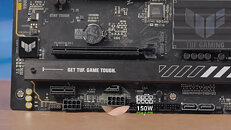
ASUS unveiled a prototype this week with a new method for graphics cards to draw power from the motherboard's PCIe expansion slot, proposing a solution that could eliminate the need for card-mounted power cables for many entry-level and mid-range GPUs. The concept focuses on beefing up the physical PCIe power path: ASUS engineers widened and thickened the contact pads at the front edge of the card's PCIe interface, enlarged the copper area inside the corresponding slot, and fused several 12-volt lanes into larger, lower-resistance conductors. To share the load, the traditional 8-pin connector is relocated onto the motherboard, allowing the slot and onboard connector to work together. Higher-conductivity materials and a larger terminal cross-section are used to increase the continuous current capacity without modifying the card's external form factor.

This idea could be a good match for GPUs in the 180-220 W range, where customers might appreciate a cable-free card. Examples could include RTX 5060 Ti-class parts or comparable AMD models. The company has not released full schematics, continuous current ratings, thermal validation, or long-term endurance data, and the headline 250 W claim leaves some questions unresolved. A conventional slot plus a motherboard auxiliary connector typically totals 225 W, where the 8-pin supplies 150 W and the PCIe connector gives 75 W. ASUS is already known for experimenting with alternative power delivery, with an example being the Graphics Card High-Power (GC-HPWR) connector. This is a higher-power design, rivaling NVIDIA's 12V-2x6V connector.


Sources: IT Home, via ComputerBase
Add your own comment

95 Comments on ASUS Proposes Reinforced PCIe Slot to Deliver 250 W of Power From the Motherboard

#26
LabRat 891
ymdhisI propose we put IEC C14 plugs on the graphics cards. Boom, now you can deliver up to 3800 watts to them. Problem solved.
They'd have to have a whole APFC SMPS onboard...
That'd be about as 'simple' of a solution as merely increasing voltage on the aux power input. I mean... 24VDC isn't uncommon, and 48VDC is quite common in Enterprise and Telecomm :laugh:

Actually, I think it'd be 'simpler' to up the DC voltage. The onboard power phases on a given card would just need to be 'wide range' for backwards compatibility.
First 'transitional' generation(s) would have implicitly monsterous power phases to support 50+Amps @ 12VDC but, once well-adopted could be as little as 12.5Amps@48VDC.
Posted on Reply
#27
Hecate91
Panther_SeraphinSame Designer from 12vhpwr infiltrated PCI-SIG by the looks of things if this gets signed off


Also IIRC wasnt one of the main reason nearly every card has moved the majority if not all the load onto dedicated feeds from the PSU is due to both noise concerns in power delivery and the instability it may cause to other devices inadvertantly?
Dell and Nvidia, it definitely seems that way, PCI-SIG passing 12VHPWR was bad enough.
Dell can use this on prebuilt systems to lower costs while making replacing the GPU with a standard card more difficult, and Nvidia can increase the power consumption of their cards to 800W.
And yeah, I recall there being issues with PSU's being tripped from too much noise on PCI-e slot power.
Posted on Reply
#28
Pepamami
the more its fire hazard the better!
Posted on Reply
#29
Panther_Seraphin
LabRat 891Actually, I think it'd be 'simpler' to up the DC voltage. The onboard power phases on a given card would just need to be 'wide range' for backwards compatibility.
First 'transitional' generation(s) would have implicitly monsterous power phases to support 50+Amps @ 12VDC but, once well-adopted could be as little as 12.5Amps@48VDC.
I have suggested this before, a lot of Server space stuff is going to 48V PURELY for this reason as accelerators on things like SXM. Hell a lot of the Fets on consumer stuff is already rated for 24volts in their spec sheets btu then its the PSU mafia that will resist such a change.

Especially while trying to keep backwards compatability with stuff.
Posted on Reply
#30
Rowsol
More expensive motherboards is exactly what the world needs.
Posted on Reply
#31
N3utro
_roman_the 200 watt days are over. This is not even enough for a cpu.
Nonsense. Steam surveys show that the majority of gamers use cards in the low end range. The most popular one is the 4060 right now, a 115W card.

Which means 200W would probably cover 50% or more of all gamers gpu users.

Asus is not investing money on these experiments for fun, they do it because they know it can potentially be attractive to a majority of their buyer's base.

Not everybody has a 600W 5090.
Posted on Reply
#32
x4it3n
75W in 2025 is not much anymore, 150W should be the minimum now, so 250W would be great to use GPUs without the need of any 8-pin or 16-pin cable! I'm all for it! (even if iGPUs become more and more powerful and efficient) 😎
Posted on Reply
#33
windwhirl
sudothelinuxwizardIs it just me or does pushing 225W through less then 10 microscopically thin copper traces sound like a fire hazard?
Well, we do have thick-ish cables for sending 75/150W per PCIE power conector for safety reasons...
x4it3n75W in 2025 is not much anymore, 150W should be the minimum now, so 250W would be great to use GPUs without the need of any 8-pin or 16-pin cable! I'm all for it! (even if iGPUs become more and more powerful and efficient) 😎
Personally I don't think it makes sense to add the motherboard to the power circuit. Motherboards already are complex enough routing power for onboard components + the basic 75W PCIE slot power suply + CPU, and all of that added to the data traces, which increased motherboard complexity with PCIE 4.0/5.0 and most likely will increase again when they decide to put PCIE 6.0 on consumer motherboards (there seems to be only one or two PCIE 6.0 devices so far, and they're not consumer-class, but most likely it's just a matter of time before PCIE 6.0 in general makes its way to consumers, even if it's stupid)

GPUs can already get enough power and cleaner of disturbances/noise straight from the power supply.
Posted on Reply
#34
Darmok N Jalad
Not sure if this is the answer, but at least they are looking at solutions. I still think that there are better ways to serve power to the GPU over the existing solutions.

I know it's old and dated now, but have a look at how the cylinder Mac Pro delivered power to its 2 GPUs, Apple used 2 wide, flat copper rails that were held to the GPU boards by screws at the power contact point. Very secure, with big enough conductors to handle the load. Considering we already have our screwdrivers out in order to install our GPUs, I wonder why something like that hasn't become a consideration over the plastic clip?
Posted on Reply
#35
_roman_
windwhirlPersonally I don't think it makes sense to add the motherboard to the power circuit.
The extra connector for the USB 4, fake Thunderbolt Connector, is already very stupid. they are unable to route measly 60 Watts over the board to USB. 60 Watts is not much. A full connector extra only for one PEG extra slot or one extra USB-C port. Stupid - It shows the lack of knowledge of the mainboard layouters. 25 years ago most of the stuff the autorouter did. Still i placed 30% myself. I am not sure if the autorouter does 100% these days. Asus defintelly lack the knowledge or the personal for proper boards. Feel free to buy boards which are mechanically in the lowest class with the firmware having bugs in the lowest class.

Bend connectors on asus mainboard articles for mainboard experiments speak a clear language for myself. Back to the future = BTF had too many bend FAN header pins. The lack of capability to not bend them back on a press booth or having at least 20 spare boards lying around for press pictures. Srcape PEG sockets which ruin the core functionality of plug in cards. A few examples for the lack of expertise in the mainboard segment. a 2000€ mainboard maybe feels like luxuary. I talk about the press pictures, tech press articles and generic impressions of the equivalent of hte hp microtowers and asus prime mainboards.
Posted on Reply
#36
Onasi
N3utroNonsense. Steam surveys show that the majority of gamers use cards in the low end range. The most popular one is the 4060 right now, a 115W card.

Which means 200W would probably cover 50% or more of all gamers gpu users.

Asus is not investing money on these experiments for fun, they do it because they know it can potentially be attractive to a majority of their buyer's base.

Not everybody has a 600W 5090.
To add to that, even high end GPUs are over-specced in the power department and don’t actually need to be THIS power hungry. In the recent thread, @wolf ran tests with limiitng and tweaking his 5080 and running a heavy GPU load and the consensus was that the 5080 can easily be a 250-280W card. The extra power does nigh on nothing.
Posted on Reply
#37
Knight47
x4it3n75W in 2025 is not much anymore, 150W should be the minimum now, so 250W would be great to use GPUs without the need of any 8-pin or 16-pin cable! I'm all for it! (even if iGPUs become more and more powerful and efficient) 😎
They dont even use 75W from the slot. They would need to go back to the drawing board 😎
Posted on Reply
#38
ypsylon
Much simpler idea would be to simply add power lines in form of longer PCIe slot.

Most people remember old PCI, but in servers you had PCI-X everywhere. In this case it was to support 32/64b, but there is nothing which stands in the way to add extra powerlines inside PCI-e spec/slot at the very end.

It just requires the will for a change. Let's say from 2030 PCI-SIG will put HP-PCIe (HighPower) standard into practice. No need to worry for old GPUs as standard will be backward compatible for older hardware. Yes, SSI-EEB will be the new ATX in 2 years at the top end.

It's not really feasible long term to deliver a lot of power for future GPUs, without more power coming from the motherboard through slots. CPUs are already there - bigger and bigger and enormous sockets are purely for power delivery to handle 1kW+ of power. 75W through PCIe was fine with GTS8800 in 2008 or GTX580 in 2010. Time to admit we're at the wall what current PCIe slot can do for modern GPUs.

Oh and when they are at the prototyping stage let them fix 12HPWR-whatever power delivery standard to be actually safe. It's ridiculous that nGreedia doesn't allow partners to fix obvious faults with 12HPWR connector by splitting the load, proper fusing and current balancing.
Posted on Reply
#39
EsaT
NostrasEEs typically know what they're doing. Since you can't really mess the connection up I'd argue this is least concern.
What engineers?
Engineering management is near extinct.
Nowadays most corporations are run purely by MBA/marketing scammers and other psychopaths.
And this proposition is just another thing out of their anus just like that grossly overspecced 12VHPWR/what ever the name of the day for turd.
ypsylonMuch simpler idea would be to simply add power lines in form of longer PCIe slot.
Nothing simple in that.
It would need rerouting lots of stuff on mobo and where would you put things displaced by it?
Mobos are already running out of real estate courtesy of misfit for desk PC M.2 slots originally designed for slim, limited expandability mobile devices.

Simplest thing is delivering power directly as close as possible to where it's consumed.
That has also the least things which can be failure points.

Servers are again entirely different animal because their hardware is purposely designed for specific needs/functionality.
Posted on Reply
#40
Chrispy_
r00tczThis is way worse bodge than BTF or what is it called. This connector was never meant to be used for 250W, even with some magical golden contacts, this is 12V-HP disaster waiting to happen at over 3x the current.
Also not a single word on how is this even negotiated. I only hope it is, because standard motherboards/slots will just melt or straight up burn if you try to do this...
If it's done properly it's fine. I have 1000W rackmount servers where the PSU just has a slot on the end like this:


They go up to 1800W to the best of my knowledge, maybe more? As you can imagine though, it needs a lot of copper in a nice, thick, expensive PCB trace - so not something you're going to see on cheap motherboards.
TPUniqueYes it does. It improves compatibility in tight SFF cases, where the power cable protruding on the GPU's side leads to a waste of space in order to accommodate it.
Maybe it does in a few scenarios but most GPUs recess the power connector, and if there's no room to fit the power connector, I've been using things like this for at least a decade:


There are plenty of solutions to this problem already, and Asus' idea is another solution that seems to have just as many downsides as it does benefits. For an ultra-cramped mITX motherboard, it means you've got to sacrifice precious real estate on the board for some space-inefficient fat power traces. No through-hole components can be used in any of the PCB layers these power traces take up, and the PCIe slot location on the very edge of an mITX board is likely to be so close to where the 8-pin power cable for it plugs in that the cable-avoidance savings are likely to be minimal, if not entirely pointless.

As for compatbility with PCIe riser cables that so many SFF cases rely on? Just LOL. I'm sure Asus will make and sell a 250W PCIe 5.0 riser for you, for $150 or something offensive like that!

On ATX and mATX boards where there's some decent distance between the PCIe slot and the edge of the board where the 8-pin power plugs in, you'd need those long, heavy-duty PCB traces, and if you're struggling to squeeze a power cable into a case big enough for an mATX or ATX board, something's gone very wrong already.

Nah, this is about vanity IMO. Pure, premium, glass-cased, show builds, to be sold at a vast premium for the deep-pocketed people who would rather spend $500 on ARGB than more performance or more silence.
Posted on Reply
#41
agent_x007
x4it3n75W in 2025 is not much anymore, 150W should be the minimum now, so 250W would be great to use GPUs without the need of any 8-pin or 16-pin cable! I'm all for it! (even if iGPUs become more and more powerful and efficient) 😎
75W is perfectly fine on MB, AMD and NV should just make cards with smaller power requirements (performance be damned).

Pulling 150W through PCIe x16 would require either going full 12VO or redesign of ATX power plugs.
Alternative is simply plug a second 8-pin EPS 12V just for PCI-e power.
In this case, one 8-pin EPS could only power three-four PCI-e x16 150W slots.
RIP WS boards with 6+ PCIe slots : Two EPS 8-pin for CPUs, and another two for PCIe slots, and what, like... 3-4 12VHP/12V2x6 for actual GPUs ?
Problem only get's worse if you want to scale power on PCIe ports even higher.
Posted on Reply
#42
Chrispy_
Panther_SeraphinI have suggested this before, a lot of Server space stuff is going to 48V PURELY for this reason as accelerators on things like SXM. Hell a lot of the Fets on consumer stuff is already rated for 24volts in their spec sheets btu then its the PSU mafia that will resist such a change.

Especially while trying to keep backwards compatability with stuff.
48V desktop sure would solve some problems. Laptops have been running power around their PCBs at ~20V since lithium chemistry; more voltage lets you design thinner, lighter traces and cables.
N3utroNonsense. Steam surveys show that the majority of gamers use cards in the low end range. The most popular one is the 4060 right now, a 115W card.

Which means 200W would probably cover 50% or more of all gamers gpu users.
250W covers a lot of the market right now. 4070S, 5070, 9070. People with faster GPUs than that are in the top 10% of the enthusiast niche.

Those of us with more potent GPUs often choose to tune them for efficiency by undervolting them too, I run my 5070Ti at 250W, my 9070XT at 250W, and I ran my 7800XT and 4070S at 200W, all without really losing any performance.
Posted on Reply
#43
Aleksandar_038
x4it3n75W in 2025 is not much anymore, 150W should be the minimum now, so 250W would be great to use GPUs without the need of any 8-pin or 16-pin cable! I'm all for it! (even if iGPUs become more and more powerful and efficient) 😎
And that exactly is the issue.

You are talking about more efficient, yet all efficiency comes from drastically increased power consumption.

Efficiency would be having 150W GPU performing well...

Not having 800W GPU which requires 3 kg of aluminum inside chassis in order to work decently...
Posted on Reply
#44
Chomiq


Mr Meeseeks was tasked with this.
Posted on Reply
#45
TPUnique
Hecate91Graphics cards that aren't 3 slot bricks would better solve compatibility with ITX SFF cases.
No, this won't solve the cable location problem. At all.
Posted on Reply
#46
jaggerwild
I can smell the burnt traces now, how glorious it will be!! Melted board and GPU…….
Posted on Reply
#47
ymdhis
LabRat 891They'd have to have a whole APFC SMPS onboard...
That'd be about as 'simple' of a solution as merely increasing voltage on the aux power input. I mean... 24VDC isn't uncommon, and 48VDC is quite common in Enterprise and Telecomm :laugh:

Actually, I think it'd be 'simpler' to up the DC voltage. The onboard power phases on a given card would just need to be 'wide range' for backwards compatibility.
First 'transitional' generation(s) would have implicitly monsterous power phases to support 50+Amps @ 12VDC but, once well-adopted could be as little as 12.5Amps@48VDC.
So? It's not as if there's no space on the thing, with cards becoming 4 slot in size. And then we wouldn't have to worry about the 12VHPWR connectors burning up, and we don't have to worry about PCIE slots burning up because they can't handle the proposed 200W load, or for that matter PCIE extenders not supporting it either. It also solves the problem of the power cable not fitting (for SFF cases), or not being able to hide it (for glass cases where you want to hide all cables). And you don't need to get 1600W power supplies for $500 because the GPU has the power connector.

Additional bonus: it would make external GPUs (oculink, etc) simpler.
Posted on Reply
#48
Wirko
Panther_SeraphinI have suggested this before, a lot of Server space stuff is going to 48V PURELY for this reason as accelerators on things like SXM. Hell a lot of the Fets on consumer stuff is already rated for 24volts in their spec sheets btu then its the PSU mafia that will resist such a change.

Especially while trying to keep backwards compatability with stuff.
Now think of the copper wire mafia!

Yes, full backward compatibility could be achieved at a low marginal cost. Proof: USB PD exists and works. But a few companies would have to invest some engineering talent and time in it. Certainly more than was invested in (all attempts at making) the 2x6+4 connector.
Posted on Reply
#49
AsRock
TPU addict
N3utroNonsense. Steam surveys show that the majority of gamers use cards in the low end range. The most popular one is the 4060 right now, a 115W card.

Which means 200W would probably cover 50% or more of all gamers gpu users.

Asus is not investing money on these experiments for fun, they do it because they know it can potentially be attractive to a majority of their buyer's base.

Not everybody has a 600W 5090.
Yeah but i don't want to be on the end were they know it's fcked up but have to make some of the money back from part failure.

And maybe just maybe there is a reason or 2 why 75 though the PCI-e slot, interference be one i would of thought.
Posted on Reply
#50
Tek-Check
Not sure why it is a big deal to oppose this solution. Let them release a few retail boards to experiment with uptake, and whoever wants to buy it, be my guest. It's about having choices. By introducing a few boards with this solution, users can still connect PSU directly to appropriate GPU, or via motherboard too. If someone wants to pay more for a board with such option to improve aesthetics of their build and hide cables, it's their choice.
Posted on Reply
Add your own comment
Nov 11th, 2026 03:18 CST change timezone

New Forum Posts

Popular Reviews

TPU on YouTube

Controversial News Posts