Wednesday, October 15th 2025

Apple Vision Pro Upgraded With the New M5 Chip and Comfortable Dual Knit Band
Apple today introduced Apple Vision Pro with the powerful M5 chip that delivers a leap forward in performance, improved display rendering, faster AI-powered workflows, and extended battery life. The upgraded Vision Pro also comes with the soft, cushioned Dual Knit Band to help users achieve an even more comfortable fit, and visionOS 26, which unlocks innovative spatial experiences, including widgets, new Personas, an interactive Jupiter Environment, and new Apple Intelligence features with support for additional languages. There are over 1 million apps and thousands of games on the App Store, hundreds of 3D movies on the Apple TV app, and all-new series and films in Apple Immersive with a selection of live NBA games coming soon. Vision Pro with M5 and the Dual Knit Band is now available to pre-order on apple.com. Customers can book a demo at Apple Store locations today and it will be available nationwide beginning Wednesday, October 22.
"With the breakthrough performance of M5, the latest Apple Vision Pro delivers faster performance, sharper details throughout the system, and even more battery life, setting a new standard for what's possible in spatial computing," said Bob Borchers, Apple's vice president of Worldwide Product Marketing. "Paired with the comfortable Dual Knit Band, innovative features in visionOS 26, and all-new Apple Immersive experiences spanning adventure, documentary, music, and sports, spatial computing is even more capable, entertaining, and magical with the new Vision Pro."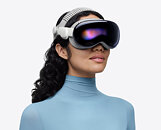
 A Leap Forward in Performance with M5
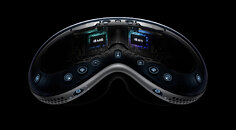
M5 provides an even faster, smoother, and more responsive experience for Apple Vision Pro users, while introducing new opportunities for developers to create more advanced spatial and immersive experiences. Built using third-generation 3-nanometer technology, M5 on Vision Pro features an advanced 10-core CPU that delivers higher multithreaded performance, resulting in faster experiences throughout the system, including faster load times for apps and widgets and more responsive web browsing. The next-generation 10-core GPU architecture brings support for hardware-accelerated ray tracing and mesh shading, enabling developers to add remarkable detail to lighting, shadows, and reflections in games like Control.
With M5, Apple Vision Pro renders 10 percent more pixels on the custom micro-OLED displays compared to the previous generation, resulting in a sharper image with crisper text and more detailed visuals. Vision Pro can also increase the refresh rate up to 120 Hz for reduced motion blur when users look at their physical surroundings, and an even smoother experience when using Mac Virtual Display. Vision Pro with M5 works alongside the purpose-built R1 chip, which processes input from 12 cameras, five sensors, and six microphones, and streams new images to the displays within 12 milliseconds to create a real-time view of the world. The high-performance battery now supports up to two and a half hours of general use, and up to three hours of video playback, all on a single charge. And it's easy to use Vision Pro for longer periods at home, at an office, or while commuting by connecting the battery to power.
The 16-core Neural Engine makes AI-powered features run up to 50 percent faster for system experiences—like capturing a Persona or transforming photos into spatial scenes—and up to 2x faster for third-party apps compared to the previous generation. With M5, developers such as JigSpace are pioneering new use cases for enterprises that combine spatial computing with on-device AI. Using Apple's Foundation Models framework, the new JigSpace app for Vision Pro taps into the on-device model at the core of Apple Intelligence to make complex information easier to understand. Users can parse through complex datasets with natural language and learn about sophisticated objects, like wind turbines, using interactive 3D models.
The New Dual Knit Band Offers a More Comfortable Fit
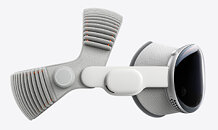
The Dual Knit Band delivers an even more comfortable fit for users. It features upper and lower straps that are 3D-knitted as a single piece to create a unique dual-rib structure that provides cushioning, breathability, and stretch. The lower strap features flexible fabric ribs embedded with tungsten inserts that provide a counterweight for additional comfort, balance, and stability. And the intuitive dual-function Fit Dial allows users to make fine-tuned adjustments to achieve their ideal fit. The new Dual Knit Band comes in small, medium, and large sizes; is available to purchase separately; and is compatible with the previous-generation Apple Vision Pro. Customers can easily find the size that is right for them using the Apple Store app for iPhone.
Powerful Spatial Experiences with visionOS 26
visionOS 26 brings a set of powerful spatial experiences to Apple Vision Pro. Widgets seamlessly integrate into a user's space and reappear every time they put Vision Pro on, making it easy to check the time or weather, play music or podcasts, decorate their space with photos, or access ChatGPT. Striking enhancements to Persona make communicating in apps like FaceTime feel even more natural and familiar. Spatial scenes, which use generative AI to add lifelike depth to photos, make memories come to life. Users can play back 180-degree, 360-degree, and wide field-of-view video from popular action cameras, so they can enjoy their footage the way it was meant to be seen, and creators can publish videos in these formats to apps like Safari and Vimeo. With iPadOS 26.1, available later this fall, the Apple Vision Pro app comes to iPad, offering users another great way to discover new content, queue apps and games to download, find tips, and quickly access information about their Vision Pro.
New Apps, Content, and Games to Explore
There are over 1 million apps available for Apple Vision Pro, including more than 3,000 apps built for visionOS. Users can design their dream home with HomeByMe and Lowe's Style Studio, outfit their closet with Balenciaga, and browse stunning artwork with Christie's Select and Art Authority Museum. They can explore extraordinary locations around the world with Epic Earth and Explore POV, transform their physical space into a planetarium with Space Vision, or travel back in time with D-Day: The Camera Soldier.
Apple Vision Pro remains the ultimate entertainment device. With the new Vision Pro, users can experience concerts like never before with Amplium; tune into their favorite teams with apps from major sports leagues; or enjoy a personal theater with apps from popular streaming services on a screen that appears up to 100 feet wide. Apple Immersive continues to redefine what is possible in storytelling, and Vision Pro users can enjoy new series and films on the Apple TV app. Later this season, users in the Lakers' broadcast territory will be able to watch select live games in Apple Immersive, and new titles from the Audi F1 Project, the BBC, HYBE, and Red Bull will launch in Apple Immersive in the coming months. The Apple TV app is also home to one of the largest digital collections of 3D movies available, featuring recent blockbusters like Superman, Jurassic World Rebirth, How to Train Your Dragon, and Wicked.
Gaming on Apple Vision Pro is next level with its ultra-high-resolution displays, advanced Spatial Audio system, low latency, and responsive controls across a variety of input methods, including popular game controllers like Sony DualSense, which now supports multidevice pairing. Players will be able to enjoy iPad games like Where Winds Meet, POOLS, and Sniper Elite 4, fun spatial games like Porta Nubi and Glassbreakers: Champions of Moss, and the latest titles on consoles and PCs with apps like Portal and Steam Link. And with support for the PlayStation VR2 Sense controller, players get a new class of immersive games with high-performance motion tracking in six degrees of freedom, finger touch detection, and vibration support. Elu Legend, Pickle Pro, Ping Pong Club, and Spatial Rifts are some of the first games available with support for the PlayStation VR2 controller.
Enhanced Capabilities for Pro Users and Enterprises
With Apple Vision Pro, users can supercharge their workflows and discover new ways to realize their creative visions. Artists can design new works using apps like Crayon and Da Vinci Eye. Photographers can edit images with color accuracy from any location and in any lighting condition using Pixelmator on MacBook Pro with Mac Virtual Display. Filmmakers can scout locations from anywhere by viewing spatial media—including panoramas and spatial videos shot on iPhone—on a large wraparound display. And pro users can assemble and rehearse their presentations while in a seat-for-seat replica of the Steve Jobs Theater at Apple Park using Keynote. With Logitech Muse—a digital pencil built for Vision Pro—users can create and collaborate with a new level of precision. Apps like Crayon, doppl by Interaptix, Sketch Pro, and Spatial Analogue are adding support for Muse over the coming weeks.
Businesses around the world are harnessing the power of spatial computing on Apple Vision Pro every day to invent new solutions and streamline operations across design, education, healthcare, sales, and more. CAE, the multinational technology company that specializes in simulation and instruction solutions, uses Vision Pro to help pilots complete training activities outside of specialized centers, featuring true-to-life flight deck environments and scenarios. At Porsche, drivers can visualize and personalize new vehicles in select showrooms before taking delivery. And by seamlessly blending digital content with the physical world, Visage provides high-quality, three-dimensional medical imaging, helping hospitals like UC San Diego Health improve patient care.
Apple Vision Pro and the Environment
Apple 2030 is the company's ambitious plan to be carbon neutral across its entire footprint by the end of this decade by reducing product emissions from their three biggest sources: materials, electricity, and transportation. Apple Vision Pro is made with 100 percent recycled aluminium in the frame and battery enclosure, 100 percent recycled rare earth elements in all magnets, and 100 percent recycled cobalt in the battery. Vision Pro is designed to last and meets Apple's high standards for energy efficiency and safe chemistry. The paper packaging is 100 percent fiber-based and can be easily recycled.
Pricing and Availability
Source:
Apple
"With the breakthrough performance of M5, the latest Apple Vision Pro delivers faster performance, sharper details throughout the system, and even more battery life, setting a new standard for what's possible in spatial computing," said Bob Borchers, Apple's vice president of Worldwide Product Marketing. "Paired with the comfortable Dual Knit Band, innovative features in visionOS 26, and all-new Apple Immersive experiences spanning adventure, documentary, music, and sports, spatial computing is even more capable, entertaining, and magical with the new Vision Pro."


M5 provides an even faster, smoother, and more responsive experience for Apple Vision Pro users, while introducing new opportunities for developers to create more advanced spatial and immersive experiences. Built using third-generation 3-nanometer technology, M5 on Vision Pro features an advanced 10-core CPU that delivers higher multithreaded performance, resulting in faster experiences throughout the system, including faster load times for apps and widgets and more responsive web browsing. The next-generation 10-core GPU architecture brings support for hardware-accelerated ray tracing and mesh shading, enabling developers to add remarkable detail to lighting, shadows, and reflections in games like Control.
With M5, Apple Vision Pro renders 10 percent more pixels on the custom micro-OLED displays compared to the previous generation, resulting in a sharper image with crisper text and more detailed visuals. Vision Pro can also increase the refresh rate up to 120 Hz for reduced motion blur when users look at their physical surroundings, and an even smoother experience when using Mac Virtual Display. Vision Pro with M5 works alongside the purpose-built R1 chip, which processes input from 12 cameras, five sensors, and six microphones, and streams new images to the displays within 12 milliseconds to create a real-time view of the world. The high-performance battery now supports up to two and a half hours of general use, and up to three hours of video playback, all on a single charge. And it's easy to use Vision Pro for longer periods at home, at an office, or while commuting by connecting the battery to power.
The 16-core Neural Engine makes AI-powered features run up to 50 percent faster for system experiences—like capturing a Persona or transforming photos into spatial scenes—and up to 2x faster for third-party apps compared to the previous generation. With M5, developers such as JigSpace are pioneering new use cases for enterprises that combine spatial computing with on-device AI. Using Apple's Foundation Models framework, the new JigSpace app for Vision Pro taps into the on-device model at the core of Apple Intelligence to make complex information easier to understand. Users can parse through complex datasets with natural language and learn about sophisticated objects, like wind turbines, using interactive 3D models.
The New Dual Knit Band Offers a More Comfortable Fit
The Dual Knit Band delivers an even more comfortable fit for users. It features upper and lower straps that are 3D-knitted as a single piece to create a unique dual-rib structure that provides cushioning, breathability, and stretch. The lower strap features flexible fabric ribs embedded with tungsten inserts that provide a counterweight for additional comfort, balance, and stability. And the intuitive dual-function Fit Dial allows users to make fine-tuned adjustments to achieve their ideal fit. The new Dual Knit Band comes in small, medium, and large sizes; is available to purchase separately; and is compatible with the previous-generation Apple Vision Pro. Customers can easily find the size that is right for them using the Apple Store app for iPhone.
Powerful Spatial Experiences with visionOS 26
visionOS 26 brings a set of powerful spatial experiences to Apple Vision Pro. Widgets seamlessly integrate into a user's space and reappear every time they put Vision Pro on, making it easy to check the time or weather, play music or podcasts, decorate their space with photos, or access ChatGPT. Striking enhancements to Persona make communicating in apps like FaceTime feel even more natural and familiar. Spatial scenes, which use generative AI to add lifelike depth to photos, make memories come to life. Users can play back 180-degree, 360-degree, and wide field-of-view video from popular action cameras, so they can enjoy their footage the way it was meant to be seen, and creators can publish videos in these formats to apps like Safari and Vimeo. With iPadOS 26.1, available later this fall, the Apple Vision Pro app comes to iPad, offering users another great way to discover new content, queue apps and games to download, find tips, and quickly access information about their Vision Pro.
New Apps, Content, and Games to Explore
There are over 1 million apps available for Apple Vision Pro, including more than 3,000 apps built for visionOS. Users can design their dream home with HomeByMe and Lowe's Style Studio, outfit their closet with Balenciaga, and browse stunning artwork with Christie's Select and Art Authority Museum. They can explore extraordinary locations around the world with Epic Earth and Explore POV, transform their physical space into a planetarium with Space Vision, or travel back in time with D-Day: The Camera Soldier.
Apple Vision Pro remains the ultimate entertainment device. With the new Vision Pro, users can experience concerts like never before with Amplium; tune into their favorite teams with apps from major sports leagues; or enjoy a personal theater with apps from popular streaming services on a screen that appears up to 100 feet wide. Apple Immersive continues to redefine what is possible in storytelling, and Vision Pro users can enjoy new series and films on the Apple TV app. Later this season, users in the Lakers' broadcast territory will be able to watch select live games in Apple Immersive, and new titles from the Audi F1 Project, the BBC, HYBE, and Red Bull will launch in Apple Immersive in the coming months. The Apple TV app is also home to one of the largest digital collections of 3D movies available, featuring recent blockbusters like Superman, Jurassic World Rebirth, How to Train Your Dragon, and Wicked.
Gaming on Apple Vision Pro is next level with its ultra-high-resolution displays, advanced Spatial Audio system, low latency, and responsive controls across a variety of input methods, including popular game controllers like Sony DualSense, which now supports multidevice pairing. Players will be able to enjoy iPad games like Where Winds Meet, POOLS, and Sniper Elite 4, fun spatial games like Porta Nubi and Glassbreakers: Champions of Moss, and the latest titles on consoles and PCs with apps like Portal and Steam Link. And with support for the PlayStation VR2 Sense controller, players get a new class of immersive games with high-performance motion tracking in six degrees of freedom, finger touch detection, and vibration support. Elu Legend, Pickle Pro, Ping Pong Club, and Spatial Rifts are some of the first games available with support for the PlayStation VR2 controller.
Enhanced Capabilities for Pro Users and Enterprises
With Apple Vision Pro, users can supercharge their workflows and discover new ways to realize their creative visions. Artists can design new works using apps like Crayon and Da Vinci Eye. Photographers can edit images with color accuracy from any location and in any lighting condition using Pixelmator on MacBook Pro with Mac Virtual Display. Filmmakers can scout locations from anywhere by viewing spatial media—including panoramas and spatial videos shot on iPhone—on a large wraparound display. And pro users can assemble and rehearse their presentations while in a seat-for-seat replica of the Steve Jobs Theater at Apple Park using Keynote. With Logitech Muse—a digital pencil built for Vision Pro—users can create and collaborate with a new level of precision. Apps like Crayon, doppl by Interaptix, Sketch Pro, and Spatial Analogue are adding support for Muse over the coming weeks.
Businesses around the world are harnessing the power of spatial computing on Apple Vision Pro every day to invent new solutions and streamline operations across design, education, healthcare, sales, and more. CAE, the multinational technology company that specializes in simulation and instruction solutions, uses Vision Pro to help pilots complete training activities outside of specialized centers, featuring true-to-life flight deck environments and scenarios. At Porsche, drivers can visualize and personalize new vehicles in select showrooms before taking delivery. And by seamlessly blending digital content with the physical world, Visage provides high-quality, three-dimensional medical imaging, helping hospitals like UC San Diego Health improve patient care.
Apple Vision Pro and the Environment
Apple 2030 is the company's ambitious plan to be carbon neutral across its entire footprint by the end of this decade by reducing product emissions from their three biggest sources: materials, electricity, and transportation. Apple Vision Pro is made with 100 percent recycled aluminium in the frame and battery enclosure, 100 percent recycled rare earth elements in all magnets, and 100 percent recycled cobalt in the battery. Vision Pro is designed to last and meets Apple's high standards for energy efficiency and safe chemistry. The paper packaging is 100 percent fiber-based and can be easily recycled.
Pricing and Availability
- Apple Vision Pro with the M5 chip and Dual Knit Band starts at $3,499 (U.S.), and is available in 256 GB, 512 GB, and 1 TB storage capacities.
- Customers can pre-order Apple Vision Pro with the M5 chip and Dual Knit Band today in Australia, Canada, France, Germany, Hong Kong, Japan, the UAE, the UK, and the U.S. It will be available for pre-order in China mainland and Singapore on Friday, October 17.
- Apple Vision Pro with the M5 chip and Dual Knit Band will be available in Apple Store locations in Australia, Canada, China mainland, Hong Kong, France, Germany, Japan, Singapore, the UAE, the UK, and the U.S. on Wednesday, October 22. It will be available in South Korea and Taiwan later.
- Customers can book a demo of Apple Vision Pro online. Demos are hosted at all Apple Store locations where Vision Pro is available. Demos of the latest Vision Pro will feature the new Dual Knit Band, and customers can ask to see new features, apps, and experiences, including the Spatial Gallery app, Apple Intelligence features like Genmoji and Writing Tools, and extended previews of several Apple Immersive experiences, including the new sports documentary Tour De Force from CANAL+ and MotoGP in select markets.
- Apple Vision Pro comes with the new Dual Knit Band, a Light Seal, two Light Seal Cushions, an Apple Vision Pro Cover for the front of the device, Polishing Cloth, Battery, USB-C Charge Cable, and the 40 W Dynamic Power Adapter with 60 W Max.
- Dual Knit Band is available to purchase separately for $99 (U.S.).
- Apple Vision Pro Travel Case is available for $199 (U.S.).
- For users who require vision correction, ZEISS Optical Inserts—Readers will be available for $99 (U.S.), and ZEISS Optical Inserts—Prescription will be available for $149 (U.S.).
14 Comments on Apple Vision Pro Upgraded With the New M5 Chip and Comfortable Dual Knit Band
But it's STILL to damned big & bulky & dorky looking for most folks IMHO.
So glad I chose to get a directly implanted positronic neural interface device... zero bulk, zero fuss, hahahaha :D
store.steampowered.com/remoteplay
I'm saying Apple needs to enable the Vision Pro to work as an actual VR headset for SteamVR, which isn't mentioned either in the press release or on the Steam Link page.
I'd think if the Vision Pro can now play supported VR games on Steam, that would be a pretty major announcement. But Apple seems intent on maintaining their wall and only supporting VR games they develop themselves and have on their own storefront.
Steve Balmer and Microsoft failed spectacularly but had the right idea: developers, developers, developers!
I don't think this approach is particularly helpful to accelerating widespread consumer adoption; it's really an enterprise device right now.
The typical consumer usage cases (well at least the leisure ones) can be basically accomplished with a device one-tenth the price (and tethering to a PC is no longer 100% necessary).I'm not even sure how feasible it would be to make AVP compatible with SteamVR and VR games.
There are no controllers just hand gestures. Not sure if Apple's visionOS user interface is refined enough to act as a virtual gamepad. No gyroscopes, no accelerometers, nothing like the adaptive triggers on DualSense.
For sure the absence of hardware controllers means zero haptic feedback. That's a pretty big loss for a VR device, there's no way to tell if you've grasped something and you're basically back to just visual and auditory cues for feedback like damage, just like playing a game with keyboard-and-mouse.
I suppose one might be able to use a Bluetooth gamepad with an AVP as a physical controller for user input.
But this is a $3499 device, not sure how many game studios and publishers really want to go out of their way to write the extra code to support this. They would be better off writing games for iPhones and iPads instead. Lot more of those around than AVPs.
The built-in computer is a detriment in the enterprise, it means you are extremely limited in system flexibility and graphical capability. Want more than 16 GB of memory? SOL. More storage? SOL. Different ports? SOL. Why in the world would you go for this in the enterprise for say 3D / modeling when you can get a windows PC with 128 GB of RAM and a vastly more powerful GPU? Something breaks on a PC, you swap a part. Something breaks on this HMD, it's a $3,500 brick. The benefit of having modular replaceable parts is huge.
Other enterprise options with just as good display specs (or better in the case of the Varjo) are both cheaper and open to use outside of the mac ecosystem.
If Apple wanted to sell this to the enterprise, the very least they should have done is included the ultra or max version. They intentionally included a consumer focused chip with limited performance, so to me this product is targeted at consumers but with enterprise pricing.
Nothing about the device says enterprise, except the price tag. Which is why Apple spent their marketing time trying to sell it to regular customers.
As for whether the developers will support it, Apple will definitely need to make it worth their while and invest in it. However, they're already starting to do that. They helped port Cyberpunk 2077 to Apple Silicon, for instance, specially designed to take advantage of the architecture. If they worked with a few game devs to port high-profile VR games (like Beat Saber and HL:A), that would help get the ball rolling.
It makes it work as a headset not a "monitor"
It's been out for a while. I don't think you'll see $3500 headsets flying off the shelves like hotcakes.